
What do you do when the person you thought would celebrate your score with you instead breaks up with you three weeks before your exam?
This is not hypothetical. I’ve watched students get dumped five days into Step 1 dedicated. I’ve seen long-distance relationships implode halfway through surgery shelf prep. I’ve also seen people pass—sometimes even crush—their exams right in the middle of all that emotional shrapnel.
You are not the first med student to get heartbroken during dedicated. You will not be the last. But right now, it feels like your chest is collapsing and you’re supposed to care about nephron physiology.
Let’s get to the point: you need a plan that keeps you emotionally afloat enough to not tank your exam.
This is that plan.
Step 1: Stabilize the Next 72 Hours (Stop the Freefall)
You’re not planning your whole dedicated right now. You’re just preventing a total crash in the next 3 days.
Non-negotiables for the first 72 hours
You focus on four things only:
- Sleep
- Food
- Minimal studying
- Containment of emotional fallout
Forget “optimal.” You’re in damage-control mode.
Rule #1: Do not cancel the exam impulsively.
If your exam is more than 7 days away, you do not make any high-stakes decisions in the first 72 hours. Your judgment is garbage right now. You’re in survival mode, not planning mode.
If your exam is within 7 days, same rule: you still do not change anything in the first 24 hours. You let the first emotional wave pass before you touch any scheduling system.
A 72-hour triage schedule
You’re not going to love this. But it’s realistic.
Each of the next 3 days:
- Sleep: 6–8 hours, whatever your body allows
- Studying: Minimum 3–4 hours, maximum 6
- Breakup processing: Yes, you get time for that—but controlled
- Logistics: Let 1–2 trusted people know what’s happening
Example structure (adjust times, keep the idea):
Morning (2–3 hours)
- Wake up, shower
- Light breakfast
- Do 20–40 UWorld/Anki/whatever your main tool is
- Quick review of marked questions
Midday (1–2 hours)
- Eat a proper meal
- Short walk outside
- Call/text ONE trusted person to tell them what’s going on (not a group debrief)
- If you cry, fine. Then stop the call at 30–40 minutes max.
Afternoon (1.5–3 hours)
- Another small block: 15–20 questions or 60–90 min content review
- Simple topics or passive review if your brain is fried
Evening (flexible 2–3 hours)
- Breakup processing window: journaling, crying, venting, talking
- Low-demand review (Anki, flashcards, light read-through) if you can
- Bedtime routine: same time each night if possible
The point: you do not abandon studying completely, but you also do not pretend nothing happened. Both extremes are how people fail.
Step 2: Build a “Crisis-Mode” Study Plan (Not Your Original Fantasy)
Your original dedicated schedule? Color-coded spreadsheet, perfect blocks, no life interruptions? That’s gone.
You are now working with a crisis-mode plan: lower efficiency, higher structure, more redundancy.
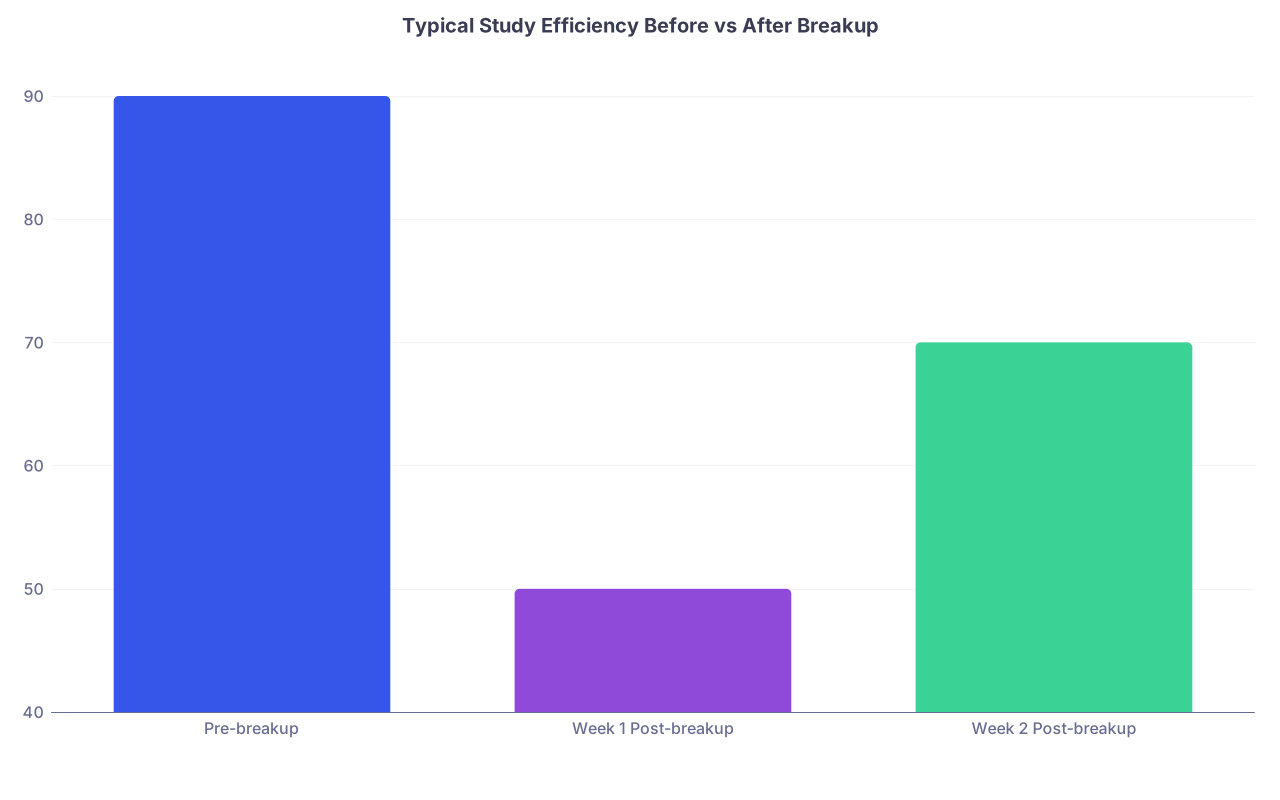
| Category | Value |
|---|---|
| Pre-breakup | 90 |
| Week 1 Post-breakup | 50 |
| Week 2 Post-breakup | 70 |
Four rules for your crisis-mode schedule
Shorter blocks, more breaks
Your concentration is shredded. You’re not doing 6-hour power blocks. Aim for 45–60 minutes on, 10–15 minutes off. Use real timers.Prioritize high-yield, not perfection
This is not the moment to deep-dive obscure glycogen storage diseases for 3 hours. Focus:- UWorld/NBME-style questions
- Missed concepts
- Core systems (cardio, pulm, renal, neuro, micro)
Flexible but mandatory minimums
Each day has a minimum and a stretch goal.For example:
- Minimum: 40 UWorld questions + 200 Anki reviews
- Stretch: 80 UWorld questions + 300 reviews
You hit the minimum no matter how bad the day is, unless you’re in the ER.
Plan emotional “leak time” in advance
You block off time for emotional fallout so it doesn’t drip into every hour.
Example:- 12:00–12:45: walk + allow meltdown
- 9:00–10:00 pm: journal, cry, voice memos, sad music, whatever
Sounds clinical. That’s the point. Containing the damage is part of passing.
Step 3: Decide What to Do About Contact and Social Media
Breakup during dedicated has a specific extra problem: your brain is looking for any excuse not to study.
Your ex’s Instagram becomes a black hole.
You need rules. Written. Today.
The hard line I usually recommend
For at least 14 days:
- No social media stalking: no checking their IG, Snapchat, LinkedIn, Venmo.
- No rereading old messages: you’re not “looking for closure,” you’re self-torturing.
- No long back-and-forth texting with them: one short logistics message if needed (“I’ll grab my stuff after exam week”), then done.
- No relationship autopsy with 6 different friends every day. One or two friends, max. Rotate only if you must.
Yes, it’s harsh. But every 30 minutes of doom-scroll is 15 UWorld questions. Multiply that by 2–3 weeks and now we’re talking a failing score.
If you absolutely cannot cut social cold turkey, set hard constraints:
- Social apps only on your laptop, not your phone
- Website blocker (ColdTurkey, Freedom, or bare minimum Screen Time limits)
- A single 20–30 minute window per day, after you hit your study minimum
Step 4: Adjust Expectations Without Lowering the Bar to “Whatever”
This is where most people mess up. They swing too far one way:
- “I’m heartbroken, so I’ll just accept a low score.”
- “This breakup cannot affect my performance at all. I must power through like nothing happened.”
Both are lies.
You will be less efficient. You do not have to fail or tank your score.
Get real about where you actually stand
If you are within 2–4 weeks of the exam, look at your most recent NBME/COMSAE:
| Last Practice Score | Relative Position | Breakup Strategy |
|---|---|---|
| > +15 above target | Safe buffer | You can absorb some inefficiency |
| Within ±10 of target | Tight range | You must stabilize quickly |
| > 10 below target | Risk zone | Strongly consider rescheduling |
| No recent exam | Unknown | Take a self-assessment ASAP |
If you haven’t taken a self-assessment in the past 2–3 weeks, schedule one 5–7 days from now, not tomorrow. You need a few days of partial stabilization first.
When rescheduling is actually smart
Rescheduling is not weakness. But it shouldn’t be driven by panic.
Strong reasons to strongly consider postponing:
- You’re more than 10–15 points below your target on multiple recent practice tests.
- You can’t study more than 2 hours per day even after the first 72 hours.
- You’re not sleeping at all or are having severe panic attacks / suicidal thoughts.
- You’re failing multiple practice blocks (e.g., <50% repeatedly).
If two or more of these are true, talk to:
- Your school’s dean of students or academic advisor
- A mental health professional through student health
- A trusted faculty mentor
Do this within a week, not a month.
Step 5: Use the Breakup, But Don’t Romanticize the Grind
I’ve heard this thousands of times:
“I’ll show them. I’ll crush this exam.”
Sometimes that works. Sometimes it blows up and you end up associating the exam with them forever.
Use the anger or sadness as fuel, but don’t make revenge your study goal. It’s unstable.
A better mental reframe
Instead of:
- “I’ll prove them wrong.”
Try:
- “My life is bigger than this relationship. Passing this exam protects my future options.”
Your ex is not in the Prometric center with you. Your score will affect you, not them.
You can make a small symbolic link if it helps:
- “I’m not letting them take this exam from me too.”
- “I already lost one thing. I’m not dropping my career on top of it.”
But keep the main motive tethered to you, not them.
Step 6: Mental Health Support That Actually Fits Dedicated
Here’s what usually stops students from reaching out: “I don’t have time for therapy during dedicated.”
You do not need a perfect, fully processed emotional arc right now. You just need not to disintegrate.
Good enough support during dedicated can look like:
- A 30–45 minute telehealth therapy check-in once a week
- Brief daily text to a “study buddy” to say: “I’m alive; did 60 questions”
- One friend who knows the full story and checks in for 10 minutes every other day
If your school has free counseling, use it. If wait times are long, ask for:
- Single-session intervention
- Crisis support
- Short-term bridge therapy
You don’t need a year-long treatment plan today. You need triage-level support.
Step 7: Specific Study Modifications for a Heartbroken Brain
Your emotional CPU is at 70% running background grief. So yes, you modify how you study.
Changes that help most students in this spot
Fewer new resources
Now is not the time to add a brand new 80-hour video series. Stick to what you were already using plus maybe one lightweight supplement if truly necessary.More questions, less passive reading
Your mind will drift fast with pure reading. Questions force you to come back.
If you’re spacing out:- Do 5–10 questions at a time, then review
- Say out loud why each distractor is wrong
Write down wandering thoughts once, then switch back
Keep a scratch page labeled: “Breakup brain.”
Every time your mind spins (“What if they’re already dating someone else?”), write a fragment of that thought quickly, then force 1–2 more questions before allowing another mental detour. You’re externalizing the loop instead of sitting in it.Use physical cues to reset
When you feel the emotional wave coming:- Stand up
- Drink water
- Splash cold water on your face
- Take 10 deep, controlled breaths
Then sit back down and commit to 10–15 more minutes before the next break.
It’s ugly, but it works.
Step 8: Keeping Functioning on Exam Day If the Breakup is Still Fresh
Let’s say your exam is in a week or even a couple days. You’re not “over it.” Of course you’re not.
Your goal is not to be healed. Your goal is to be functional for 8 hours.
Exam-day mental strategy
On test day, you commit to these:
No contact with your ex that day. No checking their socials. No peeking.
Pre-written permission statement you tell yourself:
- “For the next 8 hours, I’m allowed to put this breakup in a box. I can open it again after the exam.”
Literally visualize putting it in a box, closing the lid, walking into Prometric.
- “For the next 8 hours, I’m allowed to put this breakup in a box. I can open it again after the exam.”
A grounding script for when your mind drifts in the middle of a block
Example:- Thought appears: “I can’t believe they left me.”
- You silently respond: “Not now. Question first.”
Then you reread the stem sentence-by-sentence. Use your finger on the screen if you need to.
Protect your breaks
Breaks are not for texting, not for scrolling, not for rereading old texts. You:- Eat something small
- Drink water or coffee
- Walk, stretch, breathe
- Glance at your formula sheet if you use one
The exam is 1 day. Your grieving will continue after. You can survive putting it on partial mute for that one window.
Step 9: After the Exam – Let Yourself Crash, Then Rebuild
Here’s the thing people do not talk about: many students hold it together through the exam, then completely fall apart afterward.
That’s normal. You’ve been white-knuckling.
When the exam is done:
- Expect a crash. Physically, emotionally, all of it.
- Give yourself at least 48–72 hours of off-time. No “I must immediately be productive again.”
Then, when some of the emotional smoke clears, you can reassess:
- Do you need longer-term therapy?
- Do you want to reflect on how the relationship intersected with your training?
- Do you need to adjust your support system for future high-stakes periods?
You’re building a career that will have many more “dedicated” periods: boards, fellowship apps, boards again. Learning now how to handle personal earthquakes during high-stakes seasons is actually… weirdly valuable.
But that’s later. Pass this exam first.
Visual: A Simple “Survival Week” Layout
Here’s what a realistic “post-breakup dedicated week” might look like—not pretty, but survivable:
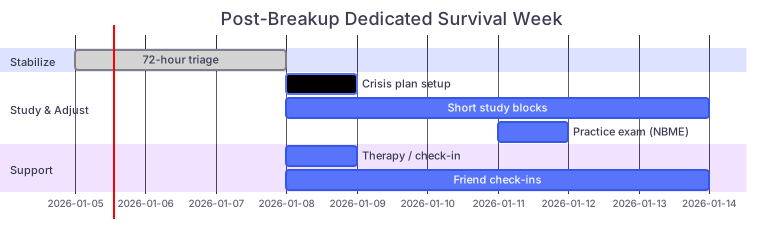
| Task | Details |
|---|---|
| Stabilize: 72-hour triage | done, t1, 2026-01-05, 3d |
| Study & Adjust: Crisis plan setup | active, t2, 2026-01-08, 1d |
| Study & Adjust: Short study blocks | t3, 2026-01-08, 6d |
| Study & Adjust: Practice exam (NBME) | t4, 2026-01-11, 1d |
| Support: Therapy / check-in | t5, 2026-01-08, 1d |
| Support: Friend check-ins | t6, 2026-01-08, 6d |
You’re not aiming for the “perfect dedicated” week. You’re aiming for “good enough to not sabotage months of work.”
FAQ (Exactly 5 Questions)
1. Should I reschedule my exam just because of the breakup?
Not automatically. You look at three things: your recent practice scores, your ability to study at least 3–4 hours per day after the first 72 hours, and your basic functioning (sleep, appetite, safety). If your practice scores are close to your target and you can still hit minimum daily goals, you probably do not need to reschedule. If you’re >10–15 points below target on multiple practice tests and can barely function even after a week, that’s when postponing becomes a smart, not “weak,” choice.
2. What if I keep checking their social media even though I know it’s hurting me?
Then you remove the option instead of relying on willpower. Log out of the apps, delete them from your phone, or use blockers. Tell one friend: “I need you to hold me accountable for two weeks.” If you find your fingers opening the apps by habit, replace the behavior with opening your question bank or Anki. It sounds corny, but pairing “urge to stalk” with “do 5 questions instead” literally rewires your reaction over a couple of weeks.
3. I feel guilty for prioritizing studying when I’m this upset. Is that normal?
Yes. You’re wired to treat breakups as emergencies, because emotionally they are. But your future licensing exam is also a real-life emergency if you blow it. You’re not being selfish by protecting the exam; you are preserving years of work and hundreds of thousands of dollars in future earning capacity. You can respect your grief and still refuse to let it take your career down with it.
4. How do I stop memories of the relationship from popping up while I’m doing questions?
You don’t completely stop them—you get faster at recovering from them. When a memory hits mid-question, notice it (“there’s that thought”), label it (“breakup brain”), and then physically redirect: finger on the screen, reread the stem sentence by sentence, and force yourself to choose an answer within 60–90 seconds. If the same thought comes back every 3 questions, jot a tiny note on your scratch paper (“think about X at 9 pm”), then promise yourself you’ll actually allow it space later. You’re training your brain that “now is not the time.”
5. What if the breakup was my fault and I’m drowning in guilt—how do I focus at all?
Guilt is brutal during dedicated because it feeds rumination. You can deal with the deeper “why” and “how did I screw this up” after the exam; right now you need containment. Two things help: first, a time-boxed “guilt window” daily (10–20 minutes where you let yourself think freely and maybe journal what you’d want to do differently in future relationships), and second, a simple written statement you can repeat whenever the guilt flares during study: “I can’t undo the past today. I can prevent a second disaster by passing this exam.” It’s not about denying responsibility; it’s about not letting one mistake cause a cascade of others.
Open your calendar or study planner right now and carve out a 72-hour triage plan: block off your sleep, minimum daily questions, and one emotional-processing window each day. Give those hours names. Then follow it for just three days. Not forever—just three. Let that be your first act of not letting this breakup take your exam down with it.