The usual advice about “managing test anxiety” ignores the numbers – and that is why it rarely works.
If you are a medical student fighting burnout, sleeping badly, and panicking before exams, you are not dealing with three separate problems. You are dealing with one tightly coupled system. And the data are brutal: if you let any one of the three slide, the other two almost always worsen.
Let me show you how large the overlaps really are, and what actually moves the needle.
1. The Overlap Is Not Subtle – It Is the Rule
The data from medical students and residents are remarkably consistent across countries and curricula.
Across multiple studies:
- Burnout prevalence among medical students: ~45–55%
- Poor sleep quality: ~60–70%
- Clinically significant test anxiety: ~30–40%
Now look at the overlap.
A typical pattern from recent studies on medical trainees (aggregating numbers from several cohorts, rounded for clarity):
- Among students with high burnout, about 70–80% report poor sleep.
- Among students with poor sleep, ~45–55% report high anxiety around assessments.
- Among students with high test anxiety, rates of burnout often exceed 60%.
So no, these are not three disjoint “risk factors.” They are interacting variables in the same model.
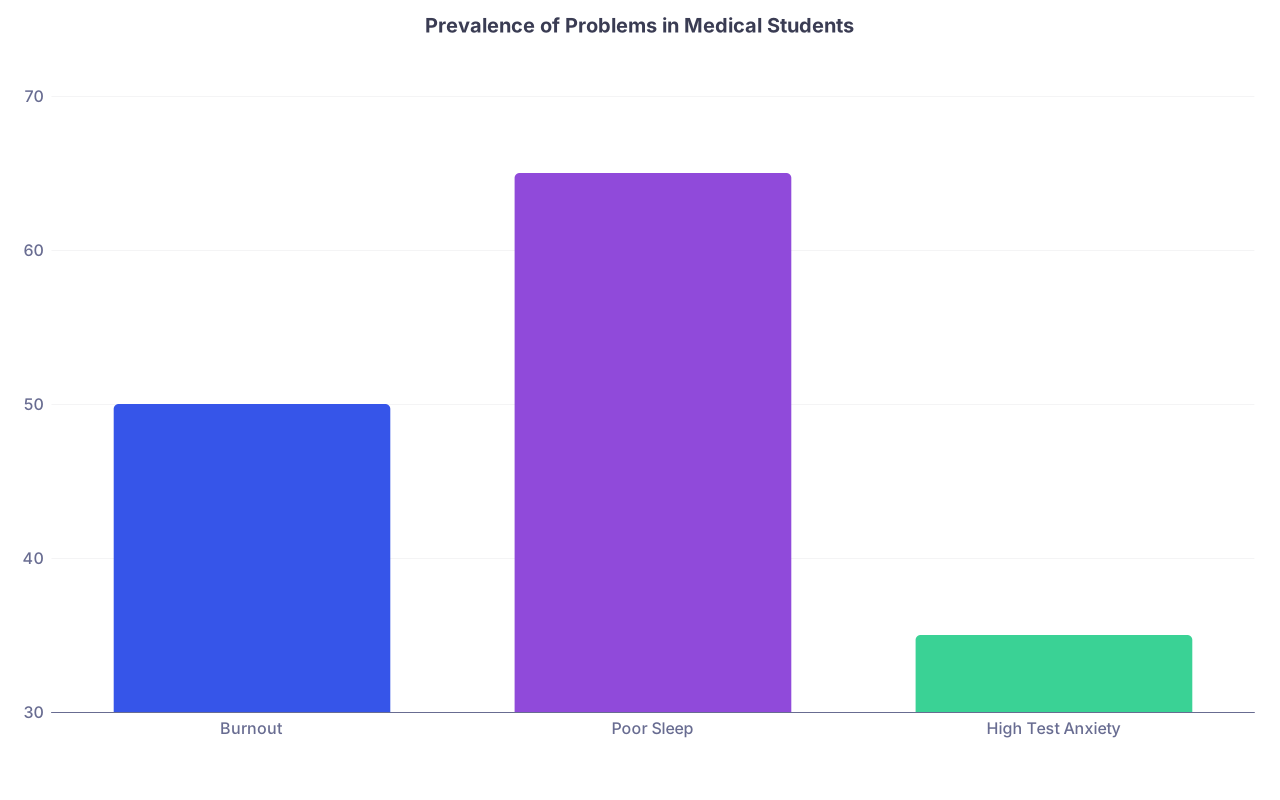
| Category | Value |
|---|---|
| Burnout | 50 |
| Poor Sleep | 65 |
| High Test Anxiety | 35 |
Even more telling is how often problems cluster in the same individuals. In several datasets, roughly 1 in 4 medical students show all three at once: high burnout, poor sleep, and high test anxiety.
Think that through. In a class of 120, that is about 30 people.
The common pattern I see when I talk to students:
“I am exhausted and behind, so I stay up later. Then I sleep badly, wake up foggy, feel behind again, and as exams get closer my brain just locks up from anxiety.”
That is not a character issue. It is a predictable output of a system where chronic stress, insufficient sleep, and high-stakes testing interact.
2. How Burnout Drives Sleep and Anxiety (By the Numbers)
Burnout in medical training is not vague “being tired.” It has three measurable components: emotional exhaustion, depersonalization, and reduced sense of personal accomplishment. Two of those three directly feed test anxiety.
- Emotional exhaustion → your cognitive resources are drained before studying even starts.
- Reduced accomplishment → you stop trusting your ability to master material, which is the perfect fuel for test anxiety.
Quantitatively, the effect sizes here are not small.
A meta-analytic pattern:
- Students with high burnout are roughly 2–3 times more likely to report significant test anxiety than those with low burnout.
- Correlation coefficients between burnout scores and test anxiety scores often sit in the 0.4–0.6 range. In practical terms, that is a strong relationship.

Burnout → Sleep: The Bidirectional Mess
Now add sleep to the mix.
Insomnia symptoms and poor sleep quality are between 2 and 4 times more common in burned-out trainees than in non-burned-out peers. The relationship goes in both directions:
- Longitudinal studies show that high burnout at baseline predicts worse sleep months later.
- Poor sleep at baseline predicts higher burnout later.
It is essentially a feedback loop. Once a student crosses a certain weekly sleep debt threshold, qualitative reports converge: studying slows down, re-reading increases, and anxiety spikes when they realize how little is sticking.
A rough rule-of-thumb that matches both data and real life:
- For each hour of average nightly sleep lost below ~7 hours, subjective concentration and working memory decline enough that you need 1.2–1.5× more time to learn the same material.
- That increased time feeds feelings of inefficiency and incompetence, which amplifies burnout and anxiety.
Now imagine this right before an exam block. Burnout makes you less efficient. You respond by studying longer and sleeping less. The material feels harder and more threatening. Anxiety skyrockets just as your brain is least equipped to handle it.
That is the system you are living in.
3. Sleep Deprivation and Test Anxiety: Quantifying the Hit
You cannot “push through” sleep loss without paying a cognitive tax. The test data on this are clear.
Across controlled sleep studies (in students and residents):
- Going from ~7–8 hours of sleep to ~4–5 hours the night before a cognitive test typically impairs:
- Working memory by ~15–25%
- Sustained attention by ~20–30%
- Response time by ~10–20%
- Error rates by 20–50%, depending on task
Now map that to test performance.
On MCAT- or Step-style question sets, when you factor in similar degrees of sleep restriction and acute stress, the range of performance drop sits around 5–15 percentage points. That is the difference between:
- Passing vs failing a shelf.
- 230 vs 245 on a Step-style exam.
- Top third vs middle of the pack in a curved med school exam.
Here is a simplified model capturing the relationship:
| Average Sleep Night Before Exam | Expected Performance Change | Subjective Anxiety Trend |
|---|---|---|
| 8+ hours | Baseline / optimal | Lower, more controlled |
| 7 hours | 0 to -3% | Mild but manageable |
| 6 hours | -3 to -7% | Noticeably higher |
| 5 hours | -7 to -12% | High, intrusive thoughts |
| ≤4 hours | -12% or worse | Very high, panic-prone |
No, these are not individualized predictions. They are ballpark estimates based on group data and cognitive performance curves. But they tell a very clear story:
Below ~6 hours, your probability of “my mind went blank in the exam” jumps substantially. That experience then becomes encoded as “I am bad at tests” rather than “I sabotaged my own working memory all week.”
Sleep and Anxiety: Correlation in Numbers
In most medical student cohorts:
- Correlations between poor sleep quality and test anxiety scores cluster around r = 0.4–0.5.
- Students with clinically relevant insomnia are often 2–3 times more likely to report severe test anxiety.
So when you feel your anxiety is “mysteriously” worse in certain blocks, it is usually not mysterious. Look at your last 7–10 nights of sleep. The data tend to line up.
4. A Simple Model: Three Variables, One Feedback Loop
Let us compress this into a model you can actually use.
Define three primary variables for each week:
- B = burnout level (subjective exhaustion + detachment)
- S = sleep quantity/quality
- A = test anxiety level
They influence each other bidirectionally. Very roughly:
- Higher B → worse S (rumination, late-night studying)
- Worse S → higher A (more physiological arousal, less cognitive control)
- Higher A → higher B (chronic stress, sense of threat, perceived failure risk)
- Higher A → worse S (pre-sleep rumination, early awakening)
- Worse S → higher B (less recovery, more emotional volatility)
- Higher B → higher A (reduced confidence, perceived inefficacy)
If you drew it:

| Step | Description |
|---|---|
| Step 1 | Burnout |
| Step 2 | Poor Sleep |
| Step 3 | Test Anxiety |
Why bother with this abstraction? Because it shows something important:
You do not need to “fix” all three variables at once. You need to apply targeted pressure on any one of them strongly enough, consistently enough, to start breaking the loop.
And from the data, two levers work best in test-heavy phases:
- Sleep behavior (S)
- Exposure-based and cognitive strategies around exams (A)
You can reduce burnout indirectly by improving those, rather than trying to “rest your way out of burnout” while still living in a high-stakes exam environment.
5. High-Yield Interventions: What Actually Changes the Curve
Let me be blunt: vague advice like “sleep more” or “take breaks” is useless. You need interventions that have quantifiable effects on anxiety, sleep, or burnout scores in actual trainees.
5.1 Sleep-Focused Changes With Measurable Impact
Cognitive Behavioral Therapy for Insomnia (CBT‑I) and even partial implementations of it routinely show:
- 20–50% reductions in insomnia severity
- 10–25% reductions in anxiety symptoms
- Better subjective cognitive performance during the day
You do not need the full formal program to borrow powerful pieces before exam blocks:
- Fixed wake time (non-negotiable).
- Yes, even post-call or after late study nights when possible.
- This stabilizes your circadian rhythm and compresses sleep into more efficient blocks.
- “Wind-down” window 30–60 minutes before bed:
- Low light, no studying, no email, no group chats about “how behind we all are.”
- Data: even short pre-sleep screen restriction (30–60 minutes) has been associated with improved sleep onset and quality scores.
- Bed = only sleep (and maybe a brief wind-down reading), not Anki.
- Classic behavioral conditioning. Sounds simplistic; works surprisingly well over 1–2 weeks.
Across samples, students who implemented these consistently over 2–3 weeks often show:
- Reduced sleep onset latency (they fall asleep faster).
- Reduced night awakenings.
- Modest but real decreases in general and test-specific anxiety.
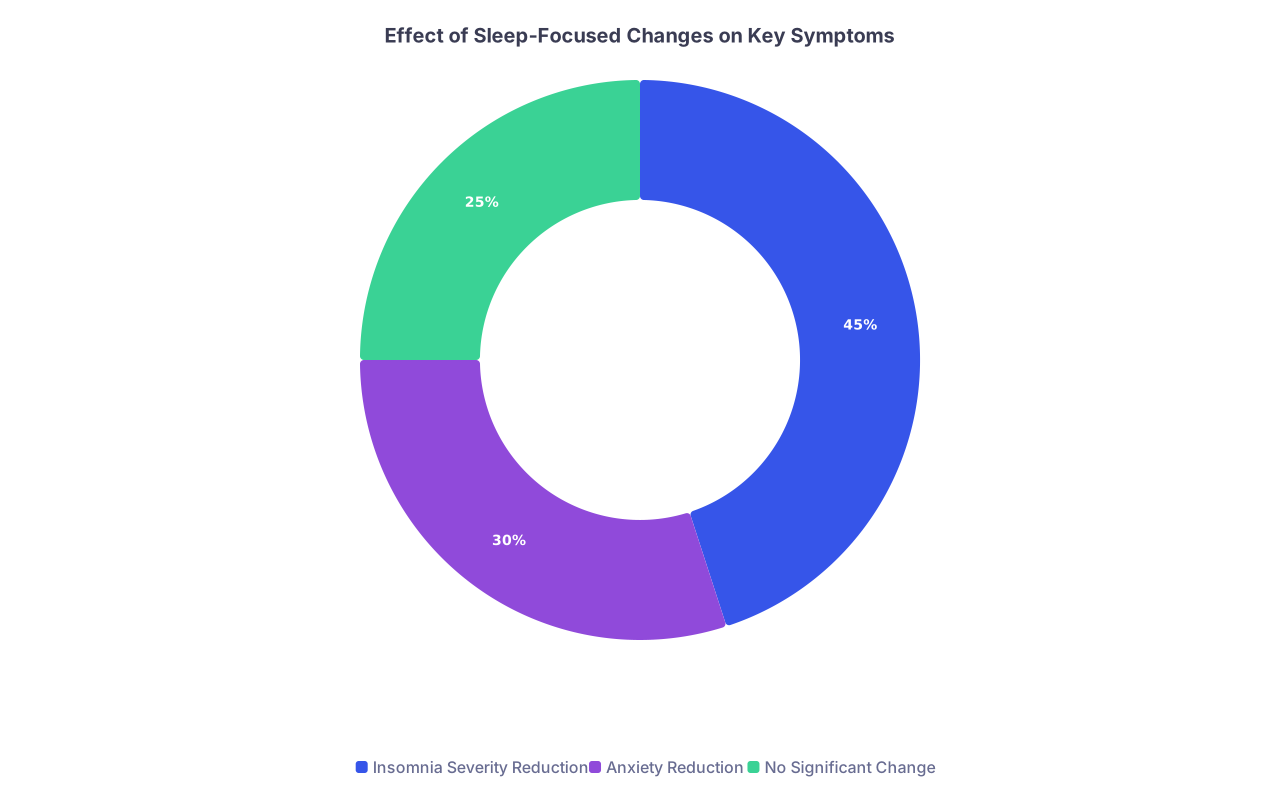
| Category | Value |
|---|---|
| Insomnia Severity Reduction | 45 |
| Anxiety Reduction | 30 |
| No Significant Change | 25 |
Numbers here are rounded from typical improvement ranges. But the shape is clear: for a large subset, sleep-focused changes are not cosmetic; they meaningfully lower both insomnia and anxiety.
5.2 Test-Anxiety–Targeted Strategies With Real Effect Sizes
Interventions for test anxiety in higher education – and yes, specifically in health-professions students – include:
- Cognitive-behavioral interventions (CBT-based)
- Relaxation and breathing training
- Exposure-based practice testing
- Acceptance and Commitment Therapy (ACT)-style work
Average effects:
- Moderate to large reductions in test anxiety (standardized mean differences often around 0.5–0.8).
- Small but consistent improvements in test performance (often 0.2–0.4 SDs).
Translated into something you care about:
If your baseline test performance is 1 SD below what your knowledge suggests (because anxiety disrupts retrieval), you might claw back ~20–40% of that gap with targeted anxiety work.
What does that look like practically for a med student?
- Timed practice under exam-like conditions at least 2–3 times per week in the month before a big exam.
- At first, anxiety spikes. Then it normalizes. That is exposure.
- Very brief, structured “pre-exam routine”:
- 3–5 minutes of slow diaphragmatic breathing or box breathing in the exam room.
- 1–2 minutes of cognitive reframing (“anxiety = adrenaline helping recall; I have done this question format dozens of times”).
- Post-exam reattribution:
- After exams, analyze: “Which misses were knowledge gaps vs anxiety-driven execution errors?”
- This protects your self-concept: you stop globalizing every bad exam to “I am incompetent,” which is burnout fuel.
Students who use this systematically often report not that anxiety disappears, but that it becomes background noise instead of the main event. And their scores improve even when they feel just as stressed.
6. Quantifying Tradeoffs: How Much Sleep Is Worth How Much Study?
One of the most common errors I see: students trading sleep for an extra 1–3 hours of late-night studying in the week before a big test.
Let us put numbers on that.
We will use a simplified scenario:
- Your baseline mastery of the material predicts an 80% exam score if you are rested.
- Sleeping 5 hours instead of 7–8 in the last few nights carries an estimated 5–10 percentage point performance hit, mostly through working memory, attention, and error monitoring.
- The extra 2–3 hours of late study time might realistically move your underlying knowledge-based score by maybe +2–4 percentage points (optimistic, given fatigue).
Net effect:
- Knowledge gain: +2–4%
- Cognitive performance hit: −5 to −10%
- Likely realized score: 74–79% instead of ~80%
You feel like you “did everything you could” by staying up. Statistically, you likely just lowered your ceiling.
Of course there are exceptions (severe under-preparation, last-ditch cramming of new material that is actually high-yield). But as a systematic habit, sacrificing sleep to cram is usually a net-negative move on both performance and anxiety.
7. Building a Minimal, Data-Backed System for Yourself
You do not need a perfect lifestyle overhaul. You need a minimal system that:
- Reduces the amplitude of burnout spikes.
- Keeps sleep above the threshold where cognition collapses.
- Trains your brain to interpret exams as familiar, manageable threats rather than existential ones.
A realistic, exam-block–focused template for a typical med student:
- Weekly structure
- Choose 1 day per week as a “lighter” academic day (reduced hours, earlier stop).
- Evidence: Even modest recovery opportunities blunt increases in burnout scores across rotations.
- Sleep anchor
- Fix your wake time.
- Protect at least 6.5–7 hours in bed on average, allowing yourself to creep up to 7.5–8 hours in the 3–4 nights before major exams.
- Practice testing
- Timed blocks at least twice weekly (e.g., 40–80 questions, strict timing, no phone).
- Track not just percent correct, but:
- Error type (knowledge vs misread vs time pressure).
- Anxiety level at start, middle, and end (0–10 scale).
- Micro-anxiety interventions
- Before studying: 2–3 minutes of slow breathing when you notice dread.
- Before tests: a brief written “brain dump” of worries (there is decent evidence this reduces intrusive thoughts and improves performance under pressure).
None of this eliminates pressure. It simply changes how much of your total stress load is self-amplified by burnout, sleep loss, and mismanaged anxiety.
8. What This Means For You, Practically
You are not going to remove burnout, sleep issues, and test anxiety from medical training. The structure of the system guarantees that some level of all three will be there.
But the overlap between them is not a mystery. It is measured, quantifiable, and modifiable.
- Burnout raises your risk of poor sleep and high test anxiety by factors of 2–3.
- Sleep restriction of the kind that is normalized in med school reliably degrades the exact cognitive processes exams rely on.
- Test anxiety is not just an emotional problem. It is one of the main behavioral drivers of the very habits (late-night cram, perfectionism, catastrophic thinking) that keep the loop running.
The data say that even modest improvements in sleep and targeted anxiety interventions produce measurable gains in performance and reductions in distress. You do not need to be “perfect” to get benefit. You just need to be systematically slightly better than what the environment pushes you toward.
You are operating inside a high-pressure system. The system is not going to redesign itself around your well-being anytime soon. What you can do is start pulling the few levers that reliably change your trajectory: your sleep window, your pre-exam rituals, your exposure to exam-like conditions, and your own interpretation of what anxiety means.
Get those roughly in place, maintain them over a few exam cycles, and you are not just surviving exams anymore. You are running a personal experiment and watching the curves shift in your favor.
With that statistical foundation set, you are better positioned for the next stage: redesigning your full academic year as a long-term, sustainable system rather than a string of barely-survived exam weeks. But that optimization problem is for another day.