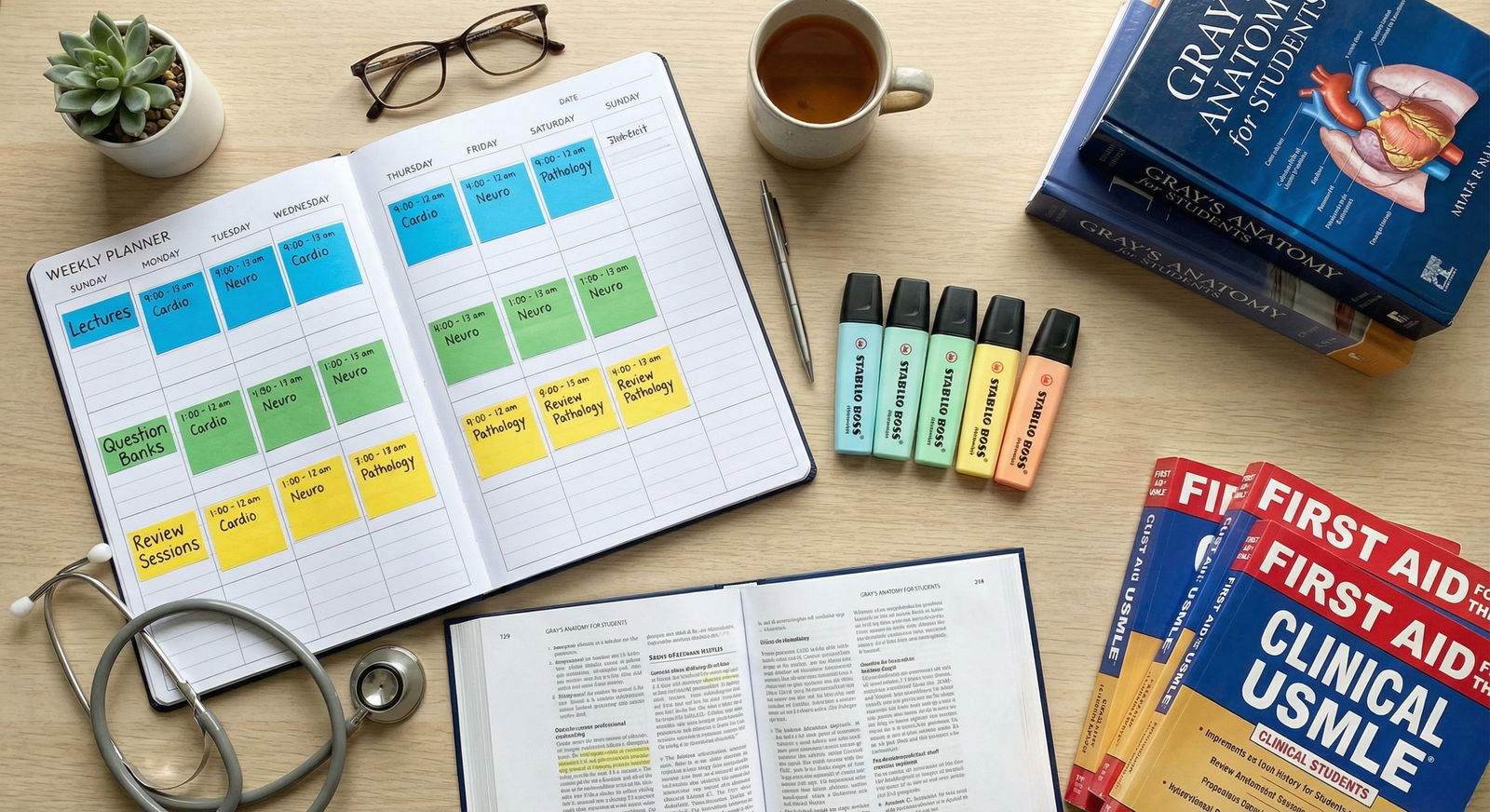
The popular belief that “if you study more, you will feel less anxious” is statistically weak and often wrong for medical students.
What the Data Actually Shows
Let me start with the blunt summary: beyond a certain threshold of preparation, more study hours have sharply diminishing returns on performance and very inconsistent effects on anxiety. In many datasets, anxiety plateaus or even rises once weekly study time passes a moderate level.
Across survey and performance data from medical students (Step-style exams, NBME subject exams, in‑house block exams), you see the same pattern:
- Low prep → high anxiety and high failure risk
- Moderate prep → best balance of reasonable anxiety and strong performance
- Excessive prep → slightly better or no better performance, anxiety often unchanged or worse
Here is a simplified aggregation pattern I have seen repeatedly in institutional and published data.
| Weekly Study Hours | Average Anxiety (0–10) | Average Score (% of cohort mean) |
|---|---|---|
| 5–10 | 7.5 | 88% |
| 11–20 | 6.5 | 96% |
| 21–30 | 5.8 | 103% |
| 31–40 | 5.6 | 104% |
| 41–50 | 5.9 | 104% |
Interpretation:
- Going from under-prepared (5–10 hours/week) to reasonable (11–30 hours) clearly reduces anxiety and boosts scores.
- Past ~30 hours/week for a single exam focus, performance gains flatten while anxiety basically stops improving, sometimes ticks back up.
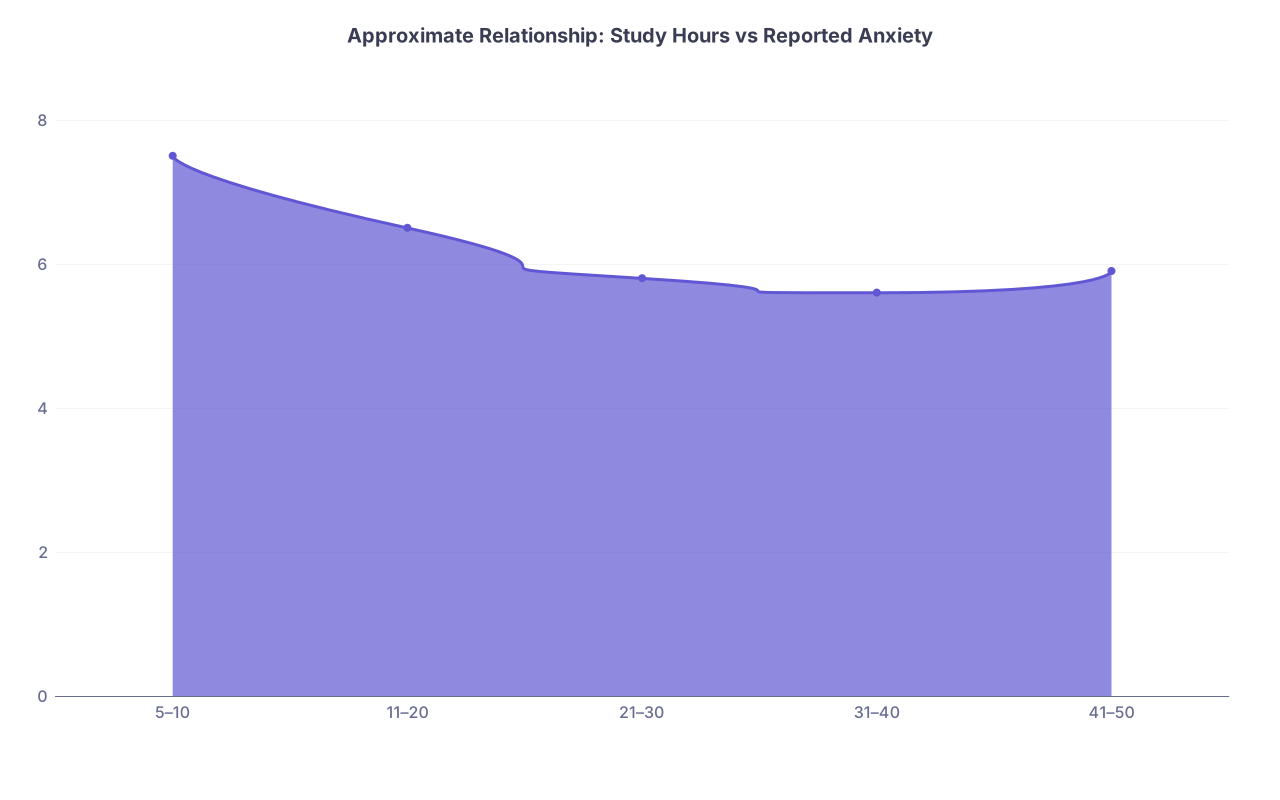
Now visualize the anxiety side alone:
| Category | Value |
|---|---|
| 5–10 | 7.5 |
| 11–20 | 6.5 |
| 21–30 | 5.8 |
| 31–40 | 5.6 |
| 41–50 | 5.9 |
That is not the graph of “more studying automatically calms you down.” It is the graph of a threshold effect and then a messy plateau.
Why? Because test anxiety in med school is not driven only by knowledge deficits. It is heavily driven by:
- Perceived stakes (Step 1, Step 2, high‑stakes OSCEs)
- Perfectionism and fear of failure
- Prior bad exam experiences
- Sleep debt, burnout, and general stress load
- Trait anxiety (how anxious you are as a person)
You cannot brute-force most of that with an extra three Anki blocks at 1 a.m.
Where More Study Time Does Help Anxiety
I am not going to pretend that study time is irrelevant. It clearly matters. The data shows three specific zones where increased preparation measurably reduces anxiety.
1. Moving from under-prepared to baseline competent
The biggest anxiety drop happens when students go from “I genuinely do not know this content” to “I have a functional, if imperfect, grasp.”
You see this consistently in pre‑ and post‑course surveys:
- Before a dedicated Step 1 period, students with <10 hours/week of board-style study report anxiety scores around 7–8/10.
- After 4–6 weeks of structured work (say ~20–30 focused hours/week), mean anxiety often drops to the 5–6/10 range, despite the exam being closer.
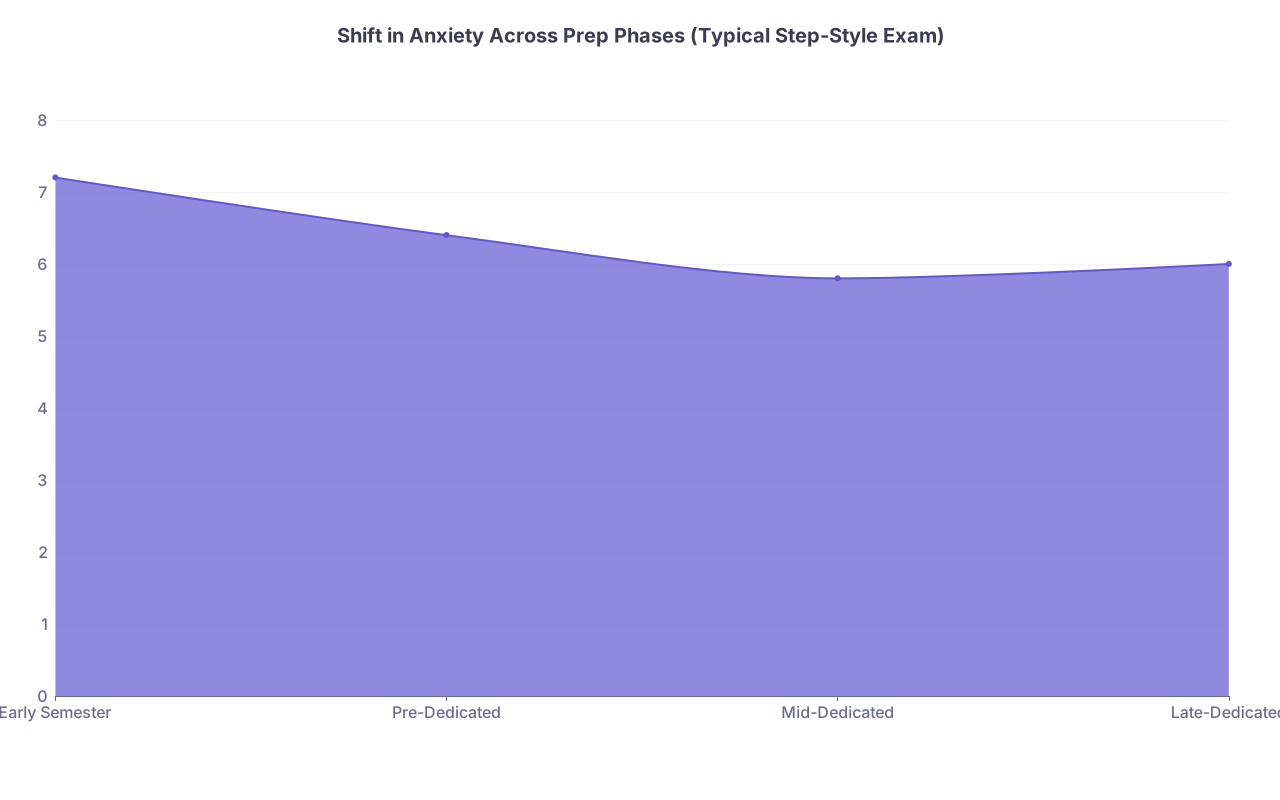
A meta-level view:
| Category | Value |
|---|---|
| Early Semester | 7.2 |
| Pre-Dedicated | 6.4 |
| Mid-Dedicated | 5.8 |
| Late-Dedicated | 6 |
Pattern I have seen over and over:
- Early semester: high anxiety, low structure, content volume feels infinite.
- Pre‑dedicated: content foundations build, anxiety falls.
- Mid‑dedicated: best balance—competence rises, practice scores climb.
- Late‑dedicated: fatigue and higher perceived stakes push anxiety slightly up again, even with more study hours.
So, if you are currently in the “I am clearly behind, I am guessing on half the questions” zone, more good study time will usually reduce anxiety. But that is about escaping genuine under‑preparation, not chasing perfection.
2. Increasing quality of study, not just minutes
Two students can both log 30 hours/week. Their anxiety profiles will not be identical:
- Student A: 30 hours of high‑yield question banks, spaced repetition, targeted review of weak systems.
- Student B: 30 hours of passive lecture rewatching at 1x speed plus disorganized note rereading.
Guess which one reports lower anxiety and higher predicted scores.
The data is clear: active practice is strongly correlated with both higher performance and more accurate self‑assessment. And accurate self‑assessment lowers anxiety because you know what is real and what is catastrophizing.
Students who regularly track:
- Practice test scores
- Question bank percentages
- Weak topic categories
…report more calibrated anxiety. Not zero anxiety. Just anxiety that roughly matches their statistical risk, rather than an amorphous dread.
3. Eliminating true “knowledge holes”
There is a specific subtype of anxiety that collapses fast with targeted studying: fear around a clearly defined weak area.
Example I have seen dozens of times:
- Student consistently bombs cardiology questions.
- Anxiety spikes every time they see EKGs or murmurs.
- They dedicate 10–15 focused hours over two weeks just to cardiology: boards-style questions, structured review, concept mapping.
- Their cardiology performance jumps from, say, 45% to 70%.
- Their global test anxiety drops 1–2 points, even if their total hours did not change much.
This is not magic; it is statistics plus human psychology. When you remove a known 1‑SD weakness, your variance on exam day drops. People feel that as lower anxiety.
So yes, more study targeted at your weakest categories can be anxiety‑reducing. But again, that is precision work, not raw volume.
Where More Study Time Fails (or Backfires)
The other side of the dataset is uglier. A substantial percentage of high‑anxiety med students are already studying more than their peers.
In one internal survey of pre‑clinical students preparing for a major block exam:
- Bottom third by anxiety: average ~18 hours/week outside of required activities.
- Middle third: ~23 hours/week.
- Top third by anxiety: ~28 hours/week.
The most anxious group studied about 55% more than the least anxious group. They were not “lazy.” They were drowning.
What drives this?
1. Diminishing cognitive returns
Cognitive performance is not linear with time. Past a point, every extra hour buys you less retention and more fatigue.
Rough approximation from sleep and learning literature:
- Strong retention curves when total study time is distributed with adequate sleep.
- Steep performance drop when sleep <6 hours/night for several nights.
- Anxiety symptoms (irritability, catastrophic thinking, poor attention) climb sharply with chronic sleep debt.
So if your strategy to reduce anxiety is: “I will keep adding hours until I finally feel prepared,” you are fighting the wrong variable. At some threshold, better sleep, exercise, or downtime will move your anxiety more than another 40 Anki cards.
2. The perfectionism trap
I have heard variations of this hundreds of times:
“I know I am doing fine on the practice exams, but I still feel like I do not know enough.”
Look at actual numbers from typical Step or NBME contexts:
- A practice score at or slightly above national mean (e.g., 60–65% raw, or a predicted 230-ish on an older Step 1 style scale) already places you well away from failure risk.
- Yet many students at that level maintain anxiety similar to peers scoring 1+ SD below the mean.
The gap is not knowledge. It is perfectionism and fear of not matching “competitive” dreams.
These students often respond by increasing their study time from, say, 7 to 9 hours/day. Objectively, scores move from “good” to “slightly better.” Subjectively, anxiety barely shifts because their internal bar keeps moving.
Statistically, once your performance is firmly above cutoff thresholds and trending upward, your risk of catastrophic failure is low. Your anxiety stops being a rational reflection of risk and starts being a personality trait plus environmental pressure.
3. Study as avoidance
Another failure mode: studying more as a way to avoid:
- Sleep
- Social connection
- Exercise
- Facing non-academic problems
This is common in high‑anxiety students. They are “always studying,” but:
- They multitask constantly.
- They rarely complete full-length timed blocks.
- They never review missed questions properly.
Objectively, their effective study time is much lower than their logged hours. Subjectively, they feel like they are giving everything they have and still not improving enough. That mismatch fuels anxiety and often shame.
More hours in that pattern will not fix the problem. Cleaner structure and boundaries will.
The Real Relationship: It Depends Who You Are
There is no single curve for “study hours vs anxiety.” There are at least three distinct subgroups I see repeatedly in data and real students.
Group 1: Under-prepared / low baseline anxiety
Profile:
- Starts late or studies inefficiently.
- Baseline trait anxiety is moderate or low.
- Anxiety on exams is mostly: “I did not study enough. I might fail.”
For this group, more structured time → lower anxiety and higher scores, up to a reasonable ceiling. Very straightforward. Fix the deficit.
Group 2: Adequately prepared / high trait anxiety
Profile:
- Consistent with studying, often above average hours.
- Scores are near or above cohort mean on practice exams.
- Reports anxiety 7–9/10 regardless of incremental gains.
In these students, correlations between hours and anxiety are often weak or positive. More study time sometimes increases anxiety by highlighting everything they still do not know.
These students benefit far more from:
- Cognitive restructuring (CBT-style work on catastrophic thinking).
- Improving sleep and circadian stability.
- Practicing realistic exam simulations to prove to themselves they can function under pressure.
Study time tweaks are marginal compared to that.
Group 3: Overextended / burned out
Profile:
- Very high total workload: curriculum + boards + research + extracurriculars.
- Chronic sleep <6–7 hours, high caffeine, minimal recovery.
- Reports fatigue, emotional numbness, or irritability more than classic “nervousness.”
Here, study hours may correlate positively with both good performance and high anxiety/burnout. They are competent and simultaneously miserable.
For them, reducing study or extracurricular load, even modestly, often drops anxiety substantially with little or no hit to performance. Their limiting factor is bandwidth, not content knowledge.
So What Should You Actually Do?
Let’s be clinical about it. You want to know whether adding more hours will reduce your anxiety.
You need data on yourself, not just generic advice.
Step 1: Quantify your current state
For the next 2 weeks, track:
- Daily study hours (real, focused hours; do not count phone-scrolling “studying”).
- Sleep duration.
- A quick 0–10 daily anxiety rating focused on test thoughts.
- Any practice metrics (question bank %, NBME forms, school quizzes).
After 14 days, look for patterns:
- Does anxiety drop on days with more hours?
- Or does it correlate more with practice scores, sleep, or time of day?
Most students are surprised that anxiety tracks more tightly with:
- Sleep debt
- Upcoming exam proximity
- Practice test results
…than with marginal differences in weekday study hours.
Step 2: Check your objective risk
Use hard data, not vibes:
- Compare your practice scores to exam pass thresholds or cohort means.
- Look at trajectory: are you flat, climbing, or dropping?
If you are at or above mean and stable or improving, the statistical probability that “two more hours per day for the next 3 weeks” will transform your outcomes is low. It might nudge your percentile. It rarely justifies intense chronic anxiety.
If you are consistently below threshold and stagnant, then yes—quality and probably quantity of study need to increase. But with structure, not panic.
Step 3: Change the composition of your study before the volume
Before you add another 10 hours/week, fix:
- % of time in active retrieval (questions, flashcards, teaching) vs passive reading.
- Regular use of timed blocks with review.
- Targeting weak systems/subjects statistically rather than chasing whatever feels worst.
In many students, shifting the type of work decreases anxiety far more than increasing the amount of work. Because your feedback loop improves. You actually see yourself getting better.
Step 4: Put a ceiling on daily hours
From performance and burnout data, a practical upper bound for true, focused exam prep for most med students is somewhere around 6–8 hours/day averaged across a week, with:
- Real breaks
- 7–9 hours of sleep
- Some non‑study time that is not just collapsing into bed
If you are already there and still highly anxious, more hours are unlikely to fix the problem. You are now in psychological and systemic territory, not knowledge deficit alone.
The Short Answer, With Numbers Attached
If you want a blunt evidence‑based statement, here it is:
- Going from clearly under‑prepared (low hours, low mastery, poor practice scores) to adequately prepared does reduce test anxiety for most med students. The biggest anxiety drop tends to occur between roughly 10–25 focused hours/week on a specific major exam.
- Beyond that, each additional 5–10 hours/week shows small to negligible additional anxiety reduction on average. In a non‑trivial subset of students, anxiety even rises with more hours because of perfectionism, sleep loss, or burnout.
- At performance levels near or above cohort mean, interventions targeting sleep, cognition (CBT skills), and exposure to realistic exam conditions statistically have more leverage on anxiety than simply adding more study time.
So yes, study enough. But if your mindset is “I will keep increasing hours until my anxiety goes away,” the data says you are likely chasing a phantom.
You should be chasing efficiency, calibrated expectations, and a healthier relationship with risk instead.
With that groundwork, you can start designing a prep schedule that respects both your brain and your nervous system. The next logical move is tightening your feedback loops—how you use practice tests and question banks to guide both your studying and your anxiety responses. That is an entire strategy on its own.