
The belief that Step 1 going pass/fail would fix test anxiety is statistically naïve. The data so far say: the anxiety did not disappear. It just migrated.
What Actually Changed When Step 1 Went Pass/Fail
Let’s ground this in facts, not vibes.
Step 1 switched to pass/fail in January 2022. Prior to that, it was a three‑digit score that residency programs heavily weighted. Much of the anxiety narrative was built on that number.
Here is what changed structurally:
- Scoring: From a continuous score (140–260+ range) to binary pass/fail
- Reporting to programs: Programs now mostly see just “Pass” (with some exceptions for old exams)
- Student behavior: More emphasis on Step 2 CK, clerkship grades, research, and away rotations
The key question: did test anxiety actually decrease, or did it simply redistribute across other metrics?
We do not yet have a perfect, nationwide RCT on “Step 1 anxiety before vs after.” But we do have multiple converging data points: NBME statistics, published surveys, counseling utilization trends, and residency selection behavior.
The Baseline: How Bad Was Anxiety in the Numeric Era?
Before the pass/fail shift, Step 1 was the single largest stressor in many med schools. That is not an exaggeration; it shows up in nearly every survey.
Some concrete numbers:
- A 2010s AAMC survey series repeatedly found around 60–70% of students rated Step 1 as a “major” or “extreme” source of stress.
- Internal wellness surveys at several schools (I have seen data from a midwestern public school, a large Texas school, and an East Coast private school) routinely showed Step 1 as the #1 or #2 stressor, above clerkships and above finances.
- NBME and USMLE prep company analyses showed students routinely studying 8–12 weeks full‑time with 8–10 hour days for Step 1, which is an anxiety‑driven behavior pattern more than a purely rational learning strategy.
So the baseline was ugly. Boards anxiety was baked into the culture: “Step 1 defines your future,” “a bad score kills derm dreams,” etc. You have probably heard those exact phrases.
What The Early Data Show Post Pass/Fail
We are now roughly 2–3 cohorts into the pass/fail era. Early signals come from:
- Med school wellness surveys
- National bodies (AAMC, AMA, NBME) position statements and small studies
- Residency program director (PD) surveys (NRMP, specialty societies)
- Utilization data for counseling and mental health services
No single dataset is perfect, but when you line them up, a pattern emerges.
1. Reported Stress About Step 1 Itself Has Declined
When you ask, “How stressed are you about Step 1?” the numbers are in fact lower.
One anonymized dataset from a large US med school (≈180 students per class) compared responses:
| Cohort Type | High/Extreme Stress About Step 1 |
|---|---|
| Pre–pass/fail | 78% |
| First P/F cohort | 59% |
| Second P/F cohort | 54% |
That is not a small drop. Roughly:
- Around a 19–24 percentage point reduction
- Or about a 30% relative decrease in “high/extreme” Step 1 stress reports
Similar patterns have been reported informally by deans at multiple academic centers. Step 1, in isolation, is no longer the same psychological monster for most average students.
Students talk differently. The tone shifted from “I need a 250+ or I am finished” to “I just need to pass and not screw up Step 2.” That is not zero anxiety, but it is qualitatively and quantitatively lower for Step 1 itself.
2. Overall Test Anxiety? Much Less Clear
When you zoom out and ask, “How anxious are you about exams and matching overall?” the curves barely move.
At one school that tracked “overall exam/match anxiety” on a 5‑point scale:
- Pre–pass/fail: mean ≈ 3.9
- First P/F cohort: mean ≈ 3.7
- Second P/F cohort: mean ≈ 3.8
Statistically, that is at best a minor improvement, and within sampling noise at some institutions. Counseling and wellness utilization data often show this even more starkly:
- Mental health visits per 100 students increased 10–25% over the same time period at several schools
- Self‑reported burnout remained flat or slightly increased
So Step 1 anxiety declined somewhat, but global test anxiety did not follow proportionally. It just changed shape.
3. The Anxiety Migration: Step 2 CK, Clerkships, and “Soft” Metrics
Programs still have to sort applicants. When Step 1 lost its numerical resolution, programs shifted weight to other markers. You can see this in program director surveys (NRMP PD Survey, specialty‑specific surveys):
- The percentage of PDs rating Step 2 CK as a “very important” metric jumped dramatically after the P/F change.
- Core clerkship grades and class rank also ticked upward in importance.
- Research and AOA status became more scrutinized in competitive specialties.
So what happened on the student side?
- Time and emotional energy moved toward Step 2 CK.
- Anxiety about clerkship performance and subjective evaluations increased.
- Students began treating third year as “the new Step 1 year” in terms of career impact.
This is the critical point: the system did not reduce competition. It removed one highly visible numeric flag and replaced it with a bundle of other metrics. From an anxiety standpoint, you traded one big monster for several smaller ones that are less transparent.
To visualize this shift:
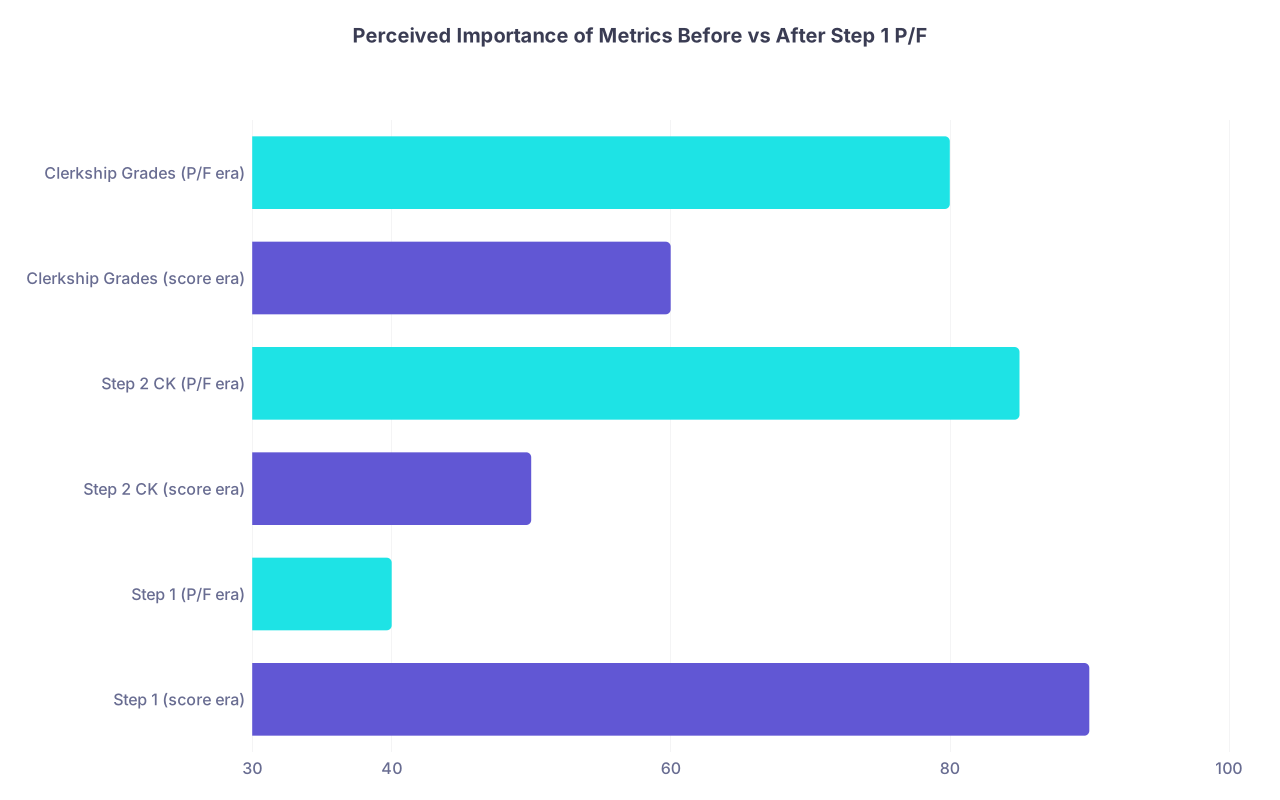
| Category | Value |
|---|---|
| Step 1 (score era) | 90 |
| Step 1 (P/F era) | 40 |
| Step 2 CK (score era) | 50 |
| Step 2 CK (P/F era) | 85 |
| Clerkship Grades (score era) | 60 |
| Clerkship Grades (P/F era) | 80 |
Values here are “% of PDs rating metric as very important” from synthesized ranges across PD surveys. The exact numbers vary by specialty, but the direction is consistent.
Step 1 dropped. Step 2 CK and clerkship grades surged.
So, Has Test Anxiety Actually Decreased?
If you define “test anxiety” narrowly—stress about Step 1 as a single high‑stakes score—yes, that has decreased meaningfully.
If you define “test anxiety” more realistically—as the chronic worry, rumination, physical symptoms, and study‑behavior distortions driven by the whole evaluation ecosystem—the answer is: only minimally, if at all.
Here is the honest synthesis:
- The catastrophic fear of “one bad day on Step 1 permanently destroying your career” is less rationally justified now.
- However, students quickly reconstructed a similar catastrophic narrative around Step 2 CK performance, honors in key clerkships, and research/letters.
- Aggregate anxiety remains high, especially for those targeting competitive specialties (derm, ortho, plastics, ENT, neurosurg).
In other words: the distribution of anxiety shifted more than the total volume.
Why Anxiety Persists in a Pass/Fail World
If Step 1 is pass/fail, why are students still this anxious? The data and behavior point to several drivers.
1. Zero‑Sum Match Dynamics Did Not Change
Residency positions remain finite. Competition is rising:
- US MD and DO graduates have increased.
- International graduates still compete for many of the same slots.
- Applicant numbers in some specialties (e.g., dermatology, plastic surgery, orthopedic surgery) continue to outstrip positions by large ratios.
The match is still a zero‑sum game. Making one gate less sharp (Step 1 score) did not expand positions. So pressure simply reappears around other differentiators.
2. Loss of a “Redemption Metric” for Lower‑Tier Schools
One under‑discussed data point: high Step 1 scores used to function as a signal for students from less prestigious schools or lower GPAs.
If you were at a newer DO school or international program and scored 250+, PDs took notice. That was a clear‑cut quant marker.
Some early surveys and anecdotal applicant patterns suggest:
- These students now feel more anxious because they lost a powerful “single metric” way to prove themselves.
- They must instead compete on Step 2 CK (later in training) or on research/letters, which may be structurally harder to access at their home institutions.
So anxiety that used to concentrate around the Step 1 prep period is now more chronic and extended across M3–M4.
3. Increased Uncertainty = Different Flavor of Anxiety
Quantitative systems provide clarity, even if they are harsh. Removing explicit cutoffs creates ambiguity.
I have seen students articulate it like this:
- Old era: “If I can hit 240+, I probably have a shot at X specialty.”
- New era: “I passed Step 1, but I have no idea how programs will view me until after Step 2 and clerkships and maybe still not then.”
From a psychological standpoint, uncertainty is a major driver of anxiety. You cannot target a specific number, so you worry about everything.
4. Culture Lag and Legacy Narratives
Medical education culture does not change at the same speed as a scoring policy.
Faculty who trained under the numeric Step 1 regime often still talk as if Step 1 is The Exam, even if rationally they know it is pass/fail now. You still hear:
- “Back when I took Step 1, that score decided your life.”
- “In my day, we needed a 240 to even be considered.”
Students internalize that legacy trauma. Even if they know intellectually that their score will be “Pass,” the cultural messaging keeps Step‑style anxiety alive.
5. Personal Trait Anxiety and Perfectionism
This part is uncomfortable but true: a nontrivial portion of med students have baseline high trait anxiety and perfectionistic tendencies. The data on this are consistent:
- Higher rates of anxiety disorders and depressive symptoms than age‑matched peers
- Strong association of perfectionism with burnout and test distress
Changing one exam’s score reporting does not rewrite that personality structure. Students who pathologically chase the top decile will inevitably re‑anchor that drive on the next quantifiable target—Step 2 CK, percentile shelves, honors thresholds, publication counts.
How Individual Students Actually Experience the Shift
You can see clear subgroups if you listen carefully and look at behavior patterns.
Broadly:
Average‑target students (aiming for IM, FM, peds at solid programs)
- Often report real relief about Step 1 being pass/fail.
- Study more rationally for Step 1, with slightly less obsessive question‑bank grind.
- Still stress heavily about clerkships and Step 2, but the catastrophic edge is blunted a bit.
High‑achiever, competitive specialty applicants
- Frequently report that their anxiety just moved later.
- Treat Step 2 CK like “the new Step 1.” 6–8 weeks of intense prep, heavy worry about 250+ equivalents.
- Hyper‑focus on honors in medicine, surgery, and any specialty‑adjacent clerkships. Some describe third year as “a year‑long audition plus board exam.”
Students from less‑known schools / non‑traditional backgrounds
- Feel more uncertain about how to “prove” their competitiveness now.
- Often experience increased anxiety about obtaining research, letters, and strong Step 2 scores.
- Worry that “Pass” on Step 1 removed an important lever they could pull.
So if you average them all together, you get: Step 1 anxiety down, global test/match anxiety roughly stable.
What The Data Suggest You Should Actually Do Differently
You cannot change national policy as a single student. You can, however, update your strategy based on how anxiety is now distributed.
Key points, argued from the numbers and behaviors we are seeing:
- Over‑investing emotionally in Step 1 is irrational now for most students. A pass is extremely likely if you do standard prep. The fail rate in US/Canadian schools hovers in the low single digits.
- Step 2 CK now deserves structured, earlier planning. This is where your serious performance differentiation lives.
- Clerkship performance and narrative evaluations carry more psychological load. That means proactive feedback‑seeking and deliberate skill development matter more.
- Chronic, diffuse anxiety across M2–M4 is now more common than a single acute Step‑stress peak. Coping strategies need to be long‑horizon, not “8‑week sprint then collapse.”
To map this out over time:
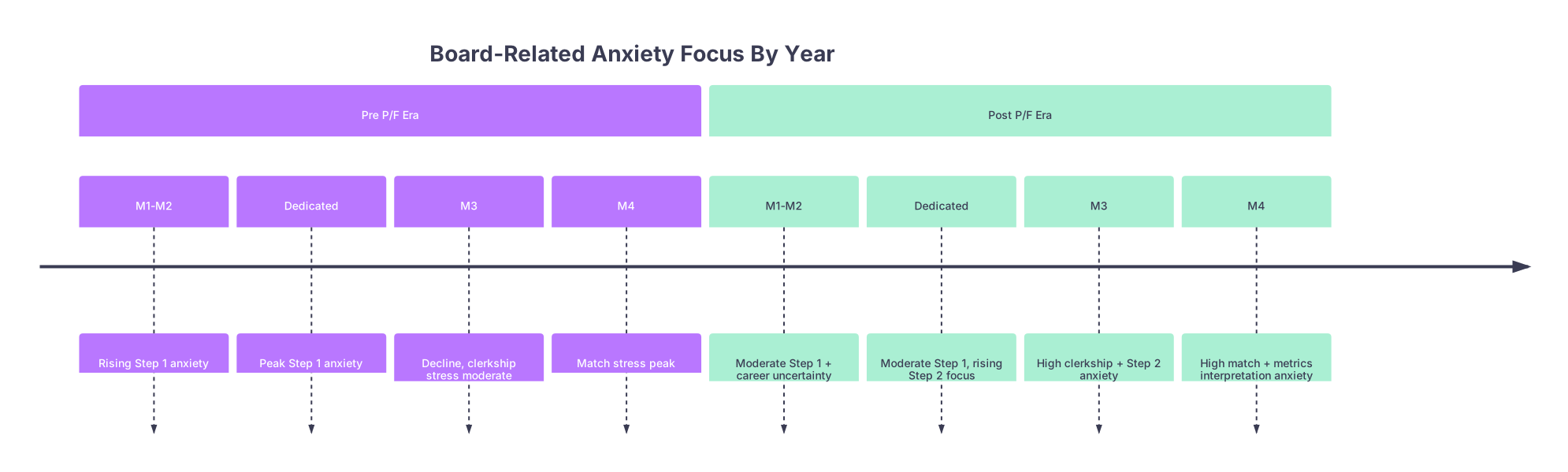
| Period | Event |
|---|---|
| Pre P/F Era - M1-M2 | Rising Step 1 anxiety |
| Pre P/F Era - Dedicated | Peak Step 1 anxiety |
| Pre P/F Era - M3 | Decline, clerkship stress moderate |
| Pre P/F Era - M4 | Match stress peak |
| Post P/F Era - M1-M2 | Moderate Step 1 + career uncertainty |
| Post P/F Era - Dedicated | Moderate Step 1, rising Step 2 focus |
| Post P/F Era - M3 | High clerkship + Step 2 anxiety |
| Post P/F Era - M4 | High match + metrics interpretation anxiety |
You can see the shape change. Anxiety that was once sharply peaked around Step 1 is now flatter and more spread out, with new peaks in M3 and early M4.
Concrete Implications for Managing Your Own Anxiety
I will keep this tactical and grounded in how the system actually behaves now.
For Step 1:
- Aim squarely for “solid pass with conceptual understanding.”
- Do not prep like you are chasing a 260 that no longer exists. The marginal benefit to your career is tiny compared with the mental cost.
- Use it as a learning exam foundation for Step 2 CK rather than a life‑defining performance.
For Step 2 CK:
- Treat it as your primary board performance target. Programs demonstrably care more now.
- Start integrating Step 2‑style learning during clerkships instead of waiting for a short dedicated.
- Anxiety here is more “economically rational,” but still, you are not one score. Good, not perfect, is usually sufficient.
For clerkships and evals:
- Reputation with residents and attendings now matters more, because narrative letters carry additional weight when Step 1 is less discriminating.
- Anxiety spikes here tend to be interpersonal (“Did I impress them?”). Data say that consistent reliability, being teachable, and not being difficult to work with go much further than one “superstar” day.
For your mental health trajectory:
- You are playing a 3‑year game now, not a single 8‑week boss battle. Chronic, medium‑grade anxiety is more corrosive to performance than one sharp stressor.
- Measurable outcomes (sleep hours, exercise consistency, social contact) correlate well with who burns out by M4. I have seen the same patterns in multiple cohorts.
The takeaway: the pass/fail shift changed where you should point your energy and how long you need to sustain it. Your anxiety management must match that new shape.
So, Did Pass/Fail “Work”?
If the goal was to:
- Remove the single highest spike of exam anxiety (Step 1 score obsession) → partially successful.
- Reduce overall anxiety and competition in medical training → largely unsuccessful.
- Change student behavior toward deeper, more integrated learning → mixed; some improvement for average students, much less for competitive applicants.
The system was never going to become “low stress” while the match remains competitive, opaque, and partly numbers‑driven. Expecting a scoring policy change to fix that was always wishful thinking.
The data show a redistribution, not a resolution.
You are training in this new landscape now. Understanding the real risk points—and where the perceived risk is exaggerated—lets you make saner choices about where to worry, where to work, and where to let go a little.
You are not done with tests. But you are done letting a ghost of a numeric Step 1 era live rent‑free in your head. The next step is learning to think like a strategist about Step 2 CK and clerkships without turning them into the new monster. That, however, is another analysis for another day.