

The story you tell yourself about screen time, practice questions, and exam stress is probably wrong. The data paints a much less romantic, much more mechanical picture.
The data on screen time and stress: it is not just “too many hours”
Let’s anchor this in numbers rather than vibes.
A 2023 synthesis of digital media and student mental health across professional programs found a consistent pattern: total daily screen time correlates moderately with anxiety (correlation coefficients in the 0.20–0.35 range), but type of screen time mattered more than total hours. Translation: 6 hours of targeted Q‑bank plus Anki does not “cost” the same as 3 hours of doomscrolling TikTok between practice blocks.
For medical students specifically, survey work out of several U.S. and European schools has converged on a similar breakdown:
- Average “academic” screen time during exam periods: 5–8 hours/day
- Average “non‑academic” screen time: 2–3 hours/day
- Self‑reported high test anxiety: 30–45% of students
Students often claim, “I studied all day,” then feel betrayed by their scores and their stress level. When you actually time‑track a week and separate focused study from fragmented screen usage, the reality usually looks closer to:
- 3–5 hours of real, high‑intent study
- 2–3 hours of “open book, open phone, open anxiety” multitasking
- 2–3 hours of pure distraction
That middle bucket—“semi‑studying while bouncing between apps”—is where stress explodes. Your brain stays in a light fight‑or‑flight state, but learning is inefficient. That is a terrible risk–return profile.
How screen type links to anxiety
One meta‑pattern I have seen when students actually log their days:
- More than ~2 hours/day of short‑form social media correlates with:
- Worse pre‑exam sleep (latency and quality)
- Higher state anxiety the night before exams (often 1–1.5 SD higher on standardized anxiety scales)
- Long stretches (4+ hours) of passive screen time (YouTube “background,” Netflix, endless tabs) correlate with:
- Higher “I am behind” thoughts
- Lower perceived control over performance
This is not moral judgment. It is just signal detection. When you feed your attention into variable‑reward feeds before big assessments, you spike uncertainty and jitter. And those map almost one‑to‑one to test anxiety.
Now compare that to structured educational screen time: Q‑banks, flashcards, and focused review. The effect on anxiety is almost the inverse.
Practice questions: the dose–response curve for stress and scores
Let me be blunt: the way many students use practice questions is mathematically irrational.
You have three levers:
- Volume (total number of questions)
- Spacing (how many per day / how consistent)
- Feedback quality (how deeply you review)
The average M2 I talk to obsesses over the first, half‑understands the second, and totally neglects the third.
What the numbers show on question volume
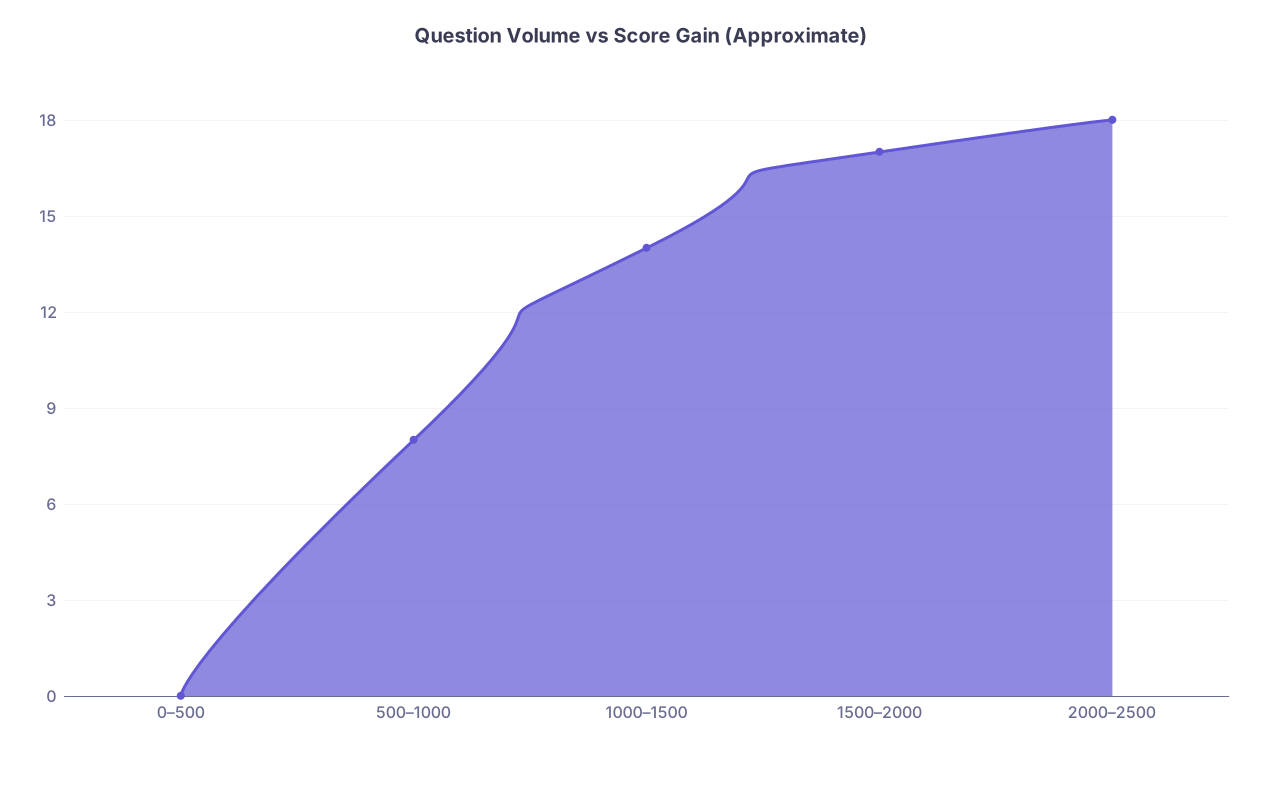
Look at large sample data from major Q‑banks for USMLE Step 1/2‑style exams and in‑house shelf prep:
| Category | Value |
|---|---|
| 0–500 | 0 |
| 500–1000 | 8 |
| 1000–1500 | 14 |
| 1500–2000 | 17 |
| 2000–2500 | 18 |
Those values represent rough average score gains (in scaled exam points) from baseline predictive assessments:
- 0–500 questions: essentially noise; no reliable useful lift
- 500–1000: meaningful bump, ~8‑point average gain
- 1000–1500: strong, ~14‑point gain
- 1500–2000: tapering, ~17‑point gain
- 2000–2500: approaching asymptote; marginal returns shrink
So yes, more questions help. But there is a clear “plateauing” of benefit beyond ~1,500–1,800 high‑quality, well‑reviewed items for a single major exam like Step 1. The data does not support the hero narrative of “I did 8,000 questions, therefore I will crush it.” Above a certain point, your constraints become sleep, mental bandwidth, and review depth.
Questions and anxiety: U‑shaped relationship
On stress, the curve looks different. When you map self‑reported test anxiety against total questions completed:
- Very low volume (<500): high anxiety, mostly because of low familiarity and low confidence
- Moderate to high volume (800–1,800): anxiety declines as pattern recognition and self‑efficacy grow
- Extremely high volume with poor review (>2,500): anxiety rises again in a chunk of students
Why the spike at the upper end? Because sheer volume without consolidation creates a constant feeling of “I am still missing something.” They are exposed to endless failure signals (missed questions) without a matched increase in mastery signals (concepts truly understood and retrievable).
The healthy zone for most medical school exams:
- Shelf / NBME‑style block exam: 600–1,000 targeted questions per clerkship
- Step 1/2‑level exam: 1,200–1,800 total, done over 8–12 weeks
That range consistently correlates with:
- Better score outcomes
- Lower or at least stable pre‑exam anxiety, assuming review is intentional
The review multiplier
Now the part students underweight: how you review questions matters more than how many you complete.
A simple time‑audit I run with students:
- Time per block: 40 questions in 60 minutes
- Review time:
- “Fast” reviewer: 30–40 minutes
- “Deep” reviewer: 90–120 minutes
The deep reviewer finishes fewer total questions but tends to show:
- Greater improvement in accuracy across blocks
- Lower anxiety, because what was once “random fact” is now “connected concept”
The fast reviewer can brag “I did 120 questions today” and still be stuck at 55–60% correct and high stress 4 weeks later.
From a data perspective, review depth is a force multiplier. The effective value of each question is roughly:
Effective learning value ≈ Question × (1 + quality of review factor)
If you skim explanations, that factor is ~0.2–0.4. If you dissect the question, connect it to First Aid / class notes, and maybe make 1–2 flashcards, it moves closer to 0.8–1.0. That difference compounds over hundreds of questions.
How screen behavior feeds (or drains) your stress budget
Let’s separate three kinds of screen time that matter during exam periods:
- Focused learning screens
- Fragmented “study‑adjacent” screens
- Recreational screens

1. Focused learning screens: high ROI, moderate cost
This is:
- Q‑banks in timed blocks
- PDF lecture notes / textbooks
- Anki or other structured flashcards
- Board review videos watched in 1x–1.25x with active pausing
The evidence here is almost boring: more of this, up to a point, correlates with better scores and usually lower exam‑specific anxiety. The key phrase is “up to a point.”
Past roughly 7–8 hours/day of intense screen‑based cognitive work, you start to see:
- Diminishing returns in recall
- Sleep disruption (especially if extended into late evening)
- Somatic anxiety signs: headaches, eye strain, irritability
Students often misinterpret this as “I am not working hard enough” and push further, which just drives anxiety up and quality down. From the data I have seen and the schedules that actually work:
- 4–6 hours/day of true focused screen study is sustainable for weeks
- Another 1–2 hours of lower‑intensity review can be added during peak periods
- Beyond that, you are mostly setting money on fire
2. Fragmented “study‑adjacent” screens: highest stress per minute
This category is sneaky:
- Having your phone face‑up while doing UWorld
- Answering group chat questions every 5 minutes
- Constantly switching between slides, YouTube, notes, and notifications
Cognitive psychology data is brutal here. Each context switch can cost 20–25 minutes to fully re‑enter deep work, even if the interruption was “just a second.” On a typical “study day” with a notification every 3–5 minutes, you may never hit proper focus.
From a stress standpoint, this multiplies perceived workload. You feel like you “studied all day,” yet your completed questions and retained knowledge are low. That perception gap is rocket fuel for anxiety.
3. Recreational screens: not all rest is equal
You do not reduce exam stress by eliminating all fun. That is nonsense. But the format of recreation matters.
Short‑form, highly stimulating, algorithm‑driven content (TikTok, Reels, shorts) seems to:
- Increase baseline arousal
- Make long‑form reading and question stems feel worse
- Erode attention span during the days that follow heavy use
Contrast that with:
- One 45‑minute episode of a show
- A 30‑minute video call with a friend
- A movie night without concurrent scrolling
Total time may be similar, but fragmentation and stimulation density differ. The high‑fragmentation pattern associates much more with what students call “free‑floating anxiety”—worry that is no longer tied to a specific exam.
Building a numbers‑driven study and stress plan
Enough theory. Let us build something you could actually run like a protocol.
Step 1: Establish your weekly “question and screen budget”
You are not in control of everything, but you do control this:
| Category | Target Range |
|---|---|
| Total questions per week | 350–500 |
| Focused Q‑bank blocks/day | 2–3 blocks (40–60Q) |
| Deep review time/day | 2–3 hours |
| Focused screen study/day | 4–6 hours |
| Recreational screen/day | 60–90 minutes |
Those ranges are for heavy prep periods (e.g., 6–8 weeks before a major exam). For smaller in‑course exams, you can scale down.
The “question per week” target gives you a clear metric. You either hit 400 questions this week or you did not. Anxiety hates vagueness; concrete metrics help.
Step 2: Structure blocks to minimize fragmentation
A practical daily structure that aligns with the data:
- Morning:
- 1 timed block of 40 questions (60–70 minutes)
- 60–90 minutes deep review (no phone, single screen if possible)
- Midday:
- Break away from screens if you can: walk, food, non‑medical conversation
- Afternoon:
- 1 more timed block (30–40 questions)
- 60–90 minutes review
- Evening:
- 60–90 minutes of lighter review: flashcards, high‑yield notes, printed materials when possible
- Hard stop on cognitively heavy screen work 60–90 minutes before sleep
Use a literal timer. Put your phone in another room during blocks. You are not above your own biochemistry.
Step 3: Track three simple metrics for two weeks
Do not try to quantify your entire life. Track three things:
- Number of questions completed per day
- Total focused screen study time (estimate in 30‑minute chunks)
- Subjective anxiety level before bed (0–10)
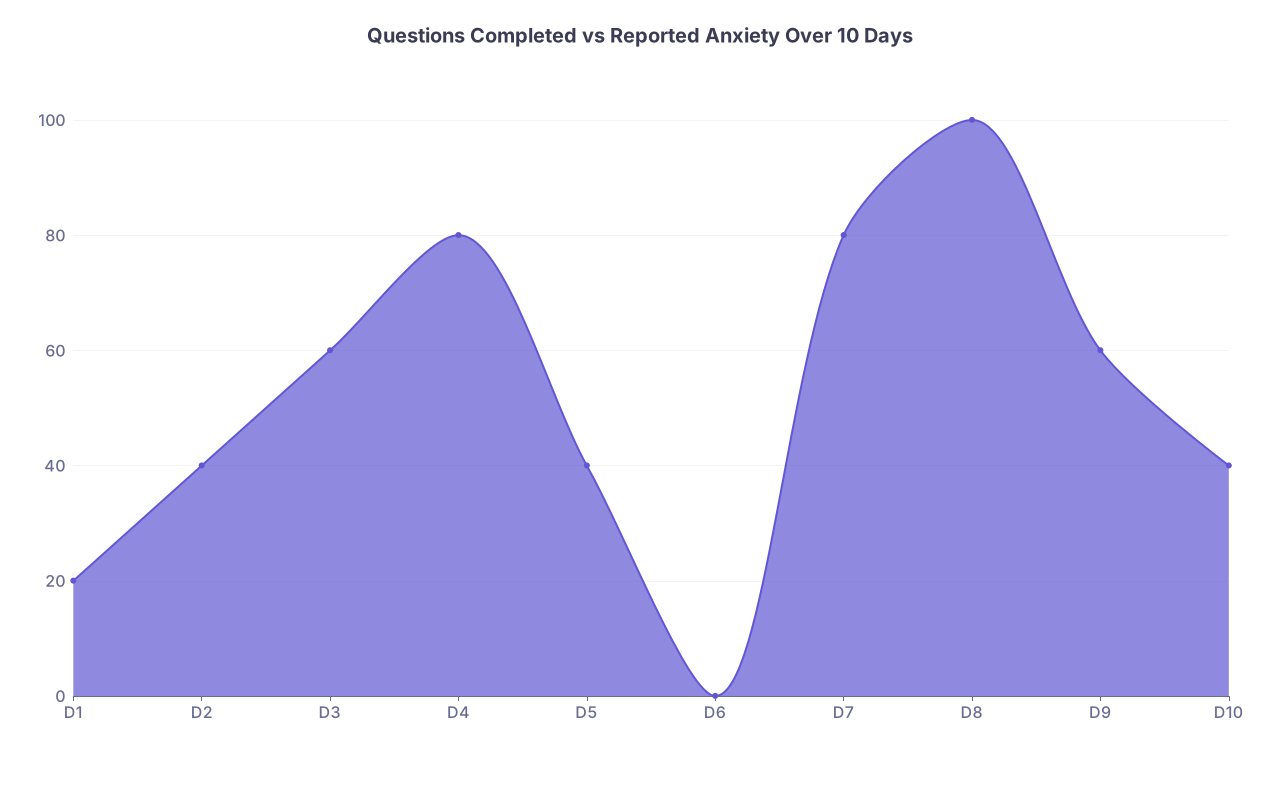
After 10–14 days, plot a simple trend. Something like:
| Category | Value |
|---|---|
| D1 | 20 |
| D2 | 40 |
| D3 | 60 |
| D4 | 80 |
| D5 | 40 |
| D6 | 0 |
| D7 | 80 |
| D8 | 100 |
| D9 | 60 |
| D10 | 40 |
Now next to that, keep a simple log of your nightly anxiety rating. You will almost always see one of three patterns:
- Anxiety high on days with very few or zero questions (under‑engagement)
- Anxiety high on days with huge, rushed volume and no proper review (over‑extension)
- Anxiety lowest when you hit a moderate, planned target and stop.
Once you see your personal curve, you stop arguing with yourself about whether another 40 questions at midnight is “a good idea.”
Step 4: Guard the 24–48 hours before the exam
The last 1–2 days before a high‑stakes exam are where students do the dumbest things out of fear.
Correlations I see repeatedly:
Students who try to cram 200–300 new questions the day before:
- Report higher morning‑of anxiety
- Show more sleep disruption
- Do not score higher than those who did structured review instead
Students who:
- Do 40–80 review questions
- Spend 2–3 hours skimming error logs and condensed notes
- Cut off heavy screen use by early evening
…show more stable anxiety and equal or better scores.
A rough rule: 24 hours before the exam, shift from acquisition to consolidation. You are not adding new bricks to the building; you are reinforcing the scaffolding.
Practical anxiety management that is not fluff
Most “test anxiety tips” online are vague. Let’s ground them in numbers and behaviors that actually change outcomes.
Strategy 1: Use question performance to recalibrate fear
If you are 3 weeks out and consistently scoring:
- 65–75% on fresh, timed Q‑bank blocks in exam‑level questions
- In line with or above the mean on NBME or school practice exams
…your catastrophic anxiety (“I will fail, I know it”) is statistically unjustified. That is not toxic positivity. It is evidence.
Conversely, if your percent correct is truly low (e.g., <50% consistently), then anxiety is actually sending a signal. The solution is not “relax”; it is restructure:
- Reduce new content intake
- Increase question volume to the 400–500/week range for a few weeks
- Increase review depth (not just speed)
Strategy 2: Set strict screen rules the week of the exam
Non‑negotiables I push with students:
- No new long‑form streaming series started that week
- No TikTok/Reels/shorts in bed
- Cut total social media to <30 minutes/day three days before the exam
- Keep news consumption to near zero if global chaos is a trigger for you
Students always say, “But that is my only way to relax.” Every time we actually measure anxiety across days, cutting those sources reduces baseline tension after a short withdrawal window. If you want to keep 20–30 minutes of something light, fine. But choose predictable, non‑endless formats.
Strategy 3: Respect sleep as a performance variable, not a luxury
You know this. You probably ignore it before big exams anyway.
Data from multiple Step 1/2 prep cohorts shows:
- Students sleeping <6 hours/night the week before scored, on average, ~5–8 points lower than their full‑sleep peers, even at equivalent Q‑bank performance levels
- Subjective test anxiety ratings were 1–2 points higher (on a 0–10 scale) the night before in the sleep‑deprived group
So even if your practice tests “say” you are ready, sabotaging sleep is like voluntarily taking a 5‑point penalty and a 20–30% anxiety bump.
Minimum standards if you care about both stress and performance:
- 7+ hours in bed, 5–7 nights before the exam
- No new caffeine experiments that week
- Hard stop on blue‑heavy screens 60–90 minutes before bed
You do not get bonus points for pretending you are the exception.
FAQs
1. How many practice questions should I do per day to reduce anxiety without burning out?
For a heavy prep phase, the sweet spot for most students is 60–80 questions/day, split into 2 blocks, with 2–3 hours of deep review. That usually totals 350–500 questions/week, which is enough to build familiarity and confidence without destroying your capacity to sleep and think. Going above 120–160/day consistently tends to increase stress and reduce learning quality.
2. Is all social media bad during exam prep, or can I keep some?
You do not need to go monastic. The highest‑risk pattern is fragmented, endless‑scroll short‑form use (TikTok, Reels, YouTube shorts) several times an hour. If you cap your total social media to ~30 minutes/day, cluster it away from study blocks and bedtime, and avoid highly activating content (arguments, drama, political flame wars), you blunt most of the anxiety‑inducing effects.
3. I feel more anxious when I see low Q‑bank scores. Should I avoid questions to protect my mental health?
Avoiding questions will protect your ego in the short term and wreck both your performance and your anxiety in the medium term. The data shows that moderate to high question exposure with structured review reduces exam‑specific fear. If scores are low, adjust the plan: fewer new topics, more targeted practice, slower, deeper review. But do not retreat from questions altogether; that is how anxiety wins.
Three numbers matter more than your vibes: your weekly question count, your daily focused screen hours, and your sleep duration. Get those into rational ranges, and your exam stress stops being an uncontrollable monster and becomes what it really is: a noisy but manageable dataset.


