
The gap between how anxious you feel and how anxious you test is measurable—and it is often larger than people think.
Most medical students trust their self-reported anxiety scales far more than their actual performance data. That is backward. When you put self-report surveys next to practice scores, question-level metrics, and timing data, you see a clear pattern: subjective anxiety and objective outcomes correlate, but not strongly, and not consistently. If you rely only on how you feel, you will misjudge your risk.
Let me walk through this like a data problem, not a therapy session.
Objective vs Subjective Test Anxiety: Two Different Datasets
We are talking about two fundamentally different measurement systems.
Subjective test anxiety = what you say about your anxiety:
- “I feel extremely nervous during exams.”
- “I worry a lot about failing.”
- “My mind goes blank under pressure.”
Objective test anxiety = how your anxiety shows up in the numbers:
- Practice exam scores and their variability
- Timing patterns (rushing early, slowing late, unfinished questions)
- Accuracy on easy vs hard items
- Performance drop from practice to real exams
You can think of it as two variables that should correlate, but do not fully overlap.
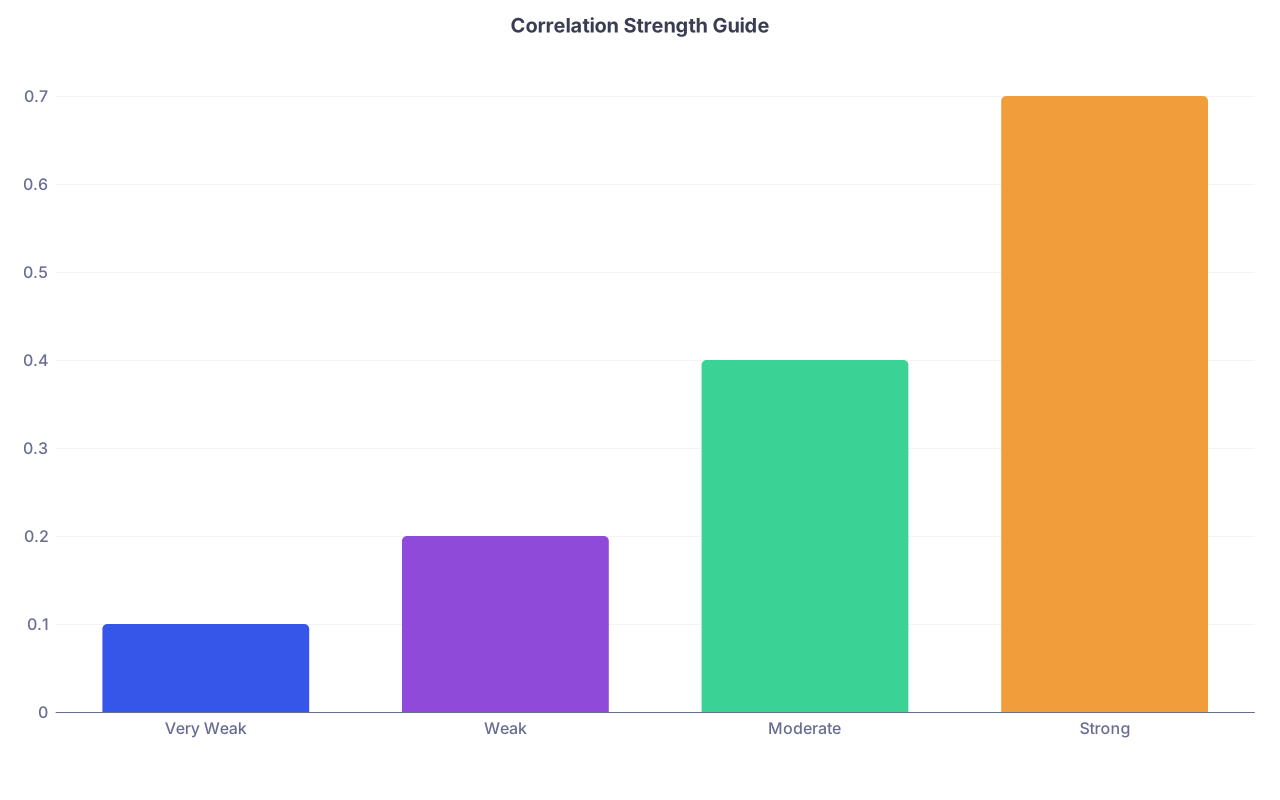
From psychometric studies (Spielberger’s Test Anxiety Inventory, Westside Test Anxiety Scale, and several Step 1/Step 2 performance papers), the typical correlation between test anxiety scales and performance sits around r = –0.20 to –0.35. That is not zero, but it is not destiny either.
| Category | Value |
|---|---|
| Very Weak | 0.1 |
| Weak | 0.2 |
| Moderate | 0.4 |
| Strong | 0.7 |
A –0.25 correlation means: higher anxiety tends to be associated with lower scores, but with huge overlap. Many highly anxious students perform just fine. Many low-anxiety students quietly underperform.
So you cannot treat a high anxiety score as a diagnosis of “you will bomb this exam”. Nor can you treat a low score as a safety guarantee.
What the Data Actually Shows in Medical Learners
The medical education literature is full of small but consistent results. If you strip the jargon, the patterns look like this:
- Self-reported test anxiety explains roughly 4–12% of the variance in exam scores.
- Objective metrics like prior GPA, NBME practice scores, or UWorld percentages usually explain 20–40%.
- Combined models (anxiety + prior performance + demographics) often nudge R² up by only a few percentage points.
In other words: past performance and current practice metrics are far stronger predictors of future scores than any anxiety survey.

A typical med school study I have seen looks like this:
- n ≈ 150–300 students
- Measure: Test Anxiety Inventory (TAI) or Westside scale
- Outcome: written block exams, OSCEs, or board-style tests
- Results: correlation around –0.25, p < 0.01, modest effect size
Translated: yes, anxiety matters. But it is one piece in a much bigger regression model, not the main driver.
If you want a clean hierarchy:
- Objective practice scores (NBME, UWorld, school-written)
- Consistency of those scores over time
- Study behaviors (hours, question volume, review quality)
- Subjective anxiety levels
Anxiety is not irrelevant. It is just not the best primary variable to optimize.
When Surveys and Scores Disagree: Four Profiles
In real students, you see four common patterns when you overlay survey results with performance metrics.
| Profile | Subjective Anxiety | Objective Scores | Risk Pattern |
|---|---|---|---|
| A | High | High | Emotional only |
| B | High | Low | True performance risk |
| C | Low | High | Stable, low risk |
| D | Low | Low | Hidden performance risk |
Profile A: “I feel awful but my scores are fine”
High survey anxiety, consistently solid scores (e.g., NBME 74–80%, school exams >1 SD above mean).
Data pattern:
- Practice exam scores steady or improving
- Small gap between practice and real exams (e.g., 1–3 percentile points)
- No big spike in careless errors or unfinished questions on high-stakes tests
Interpretation: Subjective distress is high, but cognitive performance is largely intact. The main problem is suffering, not failure risk.
Management priority: Emotional regulation and quality of life. You are losing sleep and peace of mind more than points.
Profile B: “I feel awful and my scores drop under pressure”
High survey anxiety, and clear performance hit under exam conditions.
Data pattern:
- Practice exams solid (say mid 60s on UWorld, mid 70s on NBME)
- Actual exam performance drops meaningfully (5–10+ percentile points)
- Timing distortions: long dwell times early, rushed guesses late
- Higher miss rate on easier items than your practice would predict
Interpretation: Anxiety is not just noise. It is actively impairing performance.
Management priority: Hardcore test-taking strategy + targeted anxiety interventions. This is the group where performance-focused anxiety treatment can yield measurable score gains.
Profile C: “I feel fine and my scores reflect it”
Low survey anxiety, stable strong objective performance.
Data pattern:
- Consistent practice metrics in target range
- Minimal variability across blocks or question sets
- No substantial performance drop in real exams vs practice
Interpretation: System is working. You might have transient nerves, but not clinically meaningful test anxiety.
Management priority: Maintain habits. Do not “optimize” what is already statistically excellent.
Profile D: “I do not feel anxious, but my scores are concerning”
Low reported anxiety, but objective underperformance.
Data pattern:
- Practice scores in the danger zone (e.g., <60% on UWorld, repeated NBME scores below passing threshold)
- Little or no score growth over time
- You “feel okay” about exams and do not endorse typical anxiety statements
Interpretation: Lack of anxiety here is not resilience. It is miscalibration. Sometimes it is avoidance, sometimes overconfidence.
Management priority: Reality testing with data. You do not need relaxation techniques; you need accurate feedback and serious remediation.
How Well Do Surveys Match Scores? Let’s Quantify It
To answer the main question directly: “How well do surveys match scores?”
Short answer in numbers: weak to moderate, and not in a clinically clean way.
If we imagine a cohort of 200 medical students taking a high-stakes exam:
- Suppose the correlation between anxiety scale and score is r = –0.28
- R² ≈ 0.08 → anxiety explains about 8% of score variance
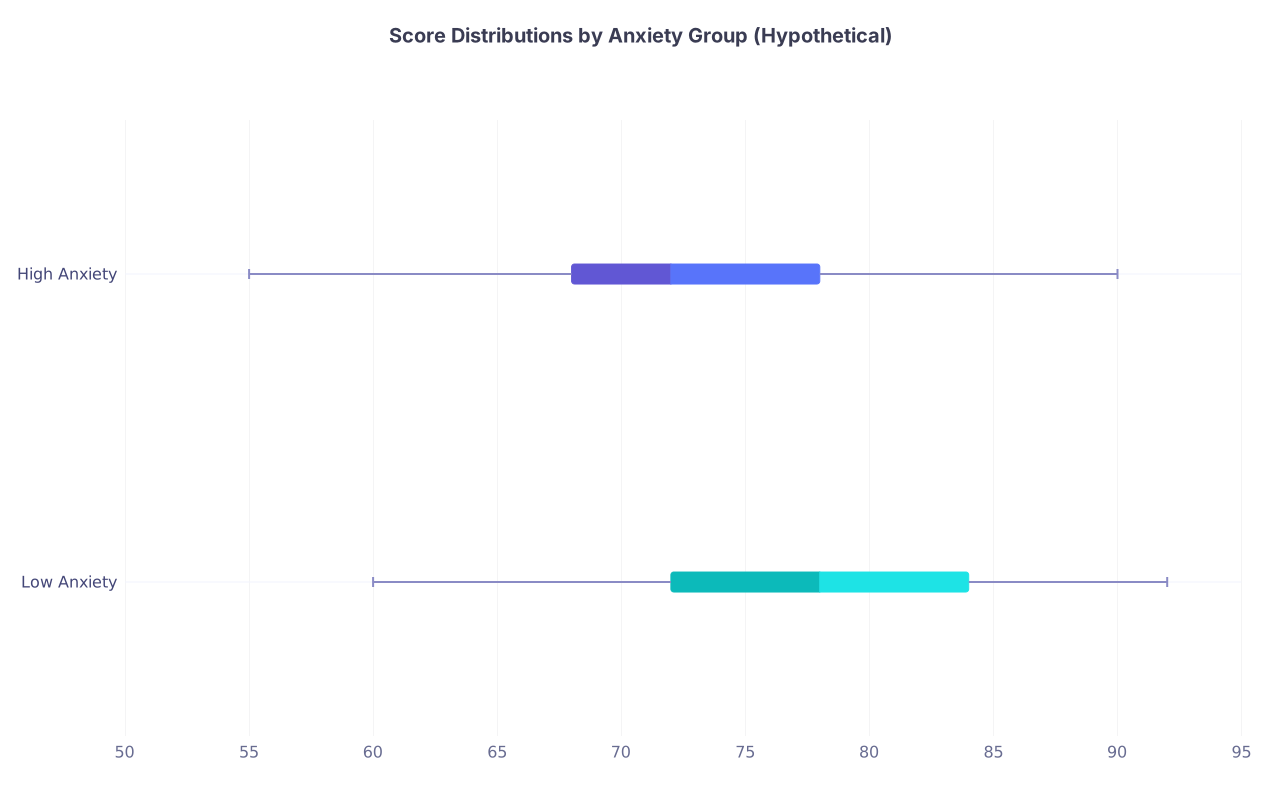
- If we split anxiety into “high” vs “low” by median, you might see:
- High anxiety group mean score: 72
- Low anxiety group mean score: 78
- But with wide overlaps: plenty of high-anxiety students scoring >80, plenty of low-anxiety students in the 60s
| Category | Min | Q1 | Median | Q3 | Max |
|---|---|---|---|---|---|
| Low Anxiety | 60 | 72 | 78 | 84 | 92 |
| High Anxiety | 55 | 68 | 72 | 78 | 90 |
What this shows: if your anxiety score is high, your average risk of a lower score is real but modest. You cannot use the survey as a precise predictor of individual outcome.
Compare that to an objective predictor like repeated NBME practice tests:
- Correlations with real Step 1/2 often run r = 0.70–0.85
- R² ≈ 0.49–0.72 → practice explains 49–72% of variance in final score
The contrast is brutal. If we built a predictive model for your board score and could include only one variable, it would be practice scores. Not anxiety.
The “Performance Gap”: Where Anxiety Actually Shows Up
The most useful way to use subjective anxiety data is not to predict raw score, but to predict the gap between practice and actual performance.
Call this the “exam-day delta”:
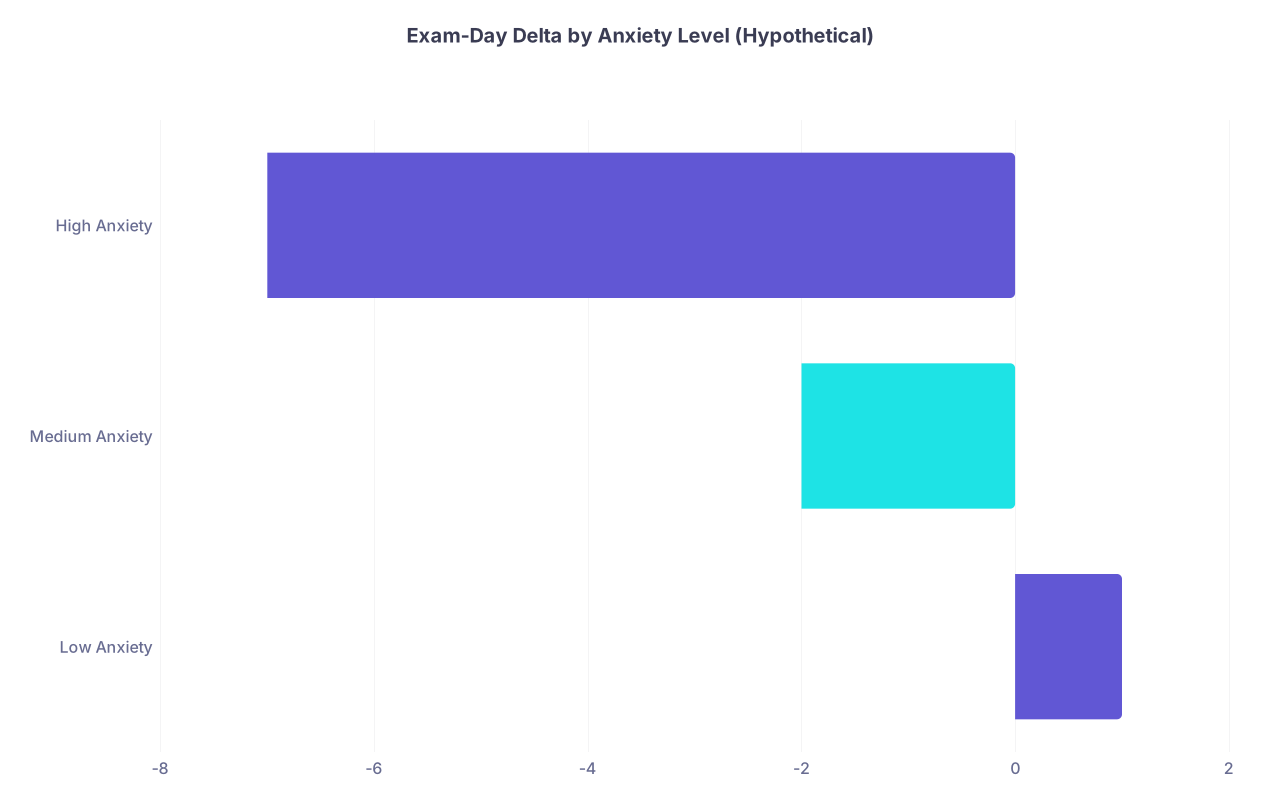
Exam-day delta = Actual test score – Predicted score from recent practice
For a stable, non-anxious performer, this delta clusters near 0. Maybe ±2–3 points or percent.
For a highly anxious, performance-affected student, this delta can swing negative by 5–15 points, even when practice data looks strong.
| Category | Value |
|---|---|
| Low Anxiety | 1 |
| Medium Anxiety | -2 |
| High Anxiety | -7 |
Interpreting those numbers:
- Low anxiety: On average, score 1 point higher than predicted (small positive surprise)
- Medium anxiety: About 2 points below prediction
- High anxiety: Roughly 7 points below prediction (that is the difference between comfortably passing and barely passing—or between middle of the pack and competitive for a tougher specialty)
So subjective anxiety matters most where it interacts with pressure, not in calm, at-home practice.
If you want a practical use:
- Track your last 3–4 full-length practice exams.
- Build a rough predicted range.
- After the real test, compare result vs expected.
Repeated large negative deltas + high anxiety surveys = clear sign your anxiety is functionally impairing performance.
What Data You Should Actually Track as a Med Student
If you want to manage test anxiety strategically rather than emotionally, treat yourself like a one-person dataset.
The high-yield metrics to collect:
Practice score series
- Keep a log: NBME forms, UWorld % correct, school block exams
- Focus less on single numbers, more on trend and variability
Timing and pacing data
- Average seconds per question
- Variability across test sections (early vs late blocks)
- Number of questions guessed or left rushed in last minutes
Error type breakdown
- Misread question / rushed
- Knew content but changed from right to wrong
- Truly did not know
If anxiety is driving mistakes, the first two categories spike.
Practice vs real exam gaps
- As described above: exam-day delta over multiple tests
Subjective ratings, but in context
- Use a 0–10 anxiety rating before, during, and after practice exams
- Add a simple survey (e.g., brief Westside items) monthly, not daily

| Step | Description |
|---|---|
| Step 1 | Take practice exam |
| Step 2 | Record score & timing |
| Step 3 | Classify error types |
| Step 4 | Rate anxiety 0-10 |
| Step 5 | Compare with prior data |
| Step 6 | Targeted anxiety intervention |
| Step 7 | Maintain current strategy |
| Step 8 | Pattern of performance drop? |
Over 6–8 weeks, you will see patterns that no single survey can reveal.
Where Surveys Still Help (And Where They Do Not)
Surveys are not useless. They are just misused.
Good uses of subjective anxiety scales:
- Screening: Do you cross into a level where intervention is justified?
- Self-awareness: Are you trending up or down month to month?
- Communication: Giving your advisor or mental health professional something concrete to work with.
Bad uses:
- Predicting your exact exam score
- Overriding strong objective data (“My anxiety scale is high, so my good NBMEs don’t matter.”)
- Justifying last-minute schedule changes when your practice data is stable
Self-report is noisy. Influenced by mood, sleep, recent feedback, comparison to peers, and your own narrative about “being anxious.” Objective metrics are not perfect either, but they are less mood-dependent.
So, if your survey says “severe anxiety” but your last four NBMEs are solid and stable, I treat the anxiety as primarily a quality-of-life issue.
If your survey says “mild anxiety” but you are chronically <60% on UWorld and shrugging, I treat the performance data as the urgent signal.
Turning Insight into Action: Data-First Anxiety Management
Once you know how poorly surveys alone predict scores, your strategy should flip: measure first, feel second.
Here is how I structure this for medical students in exam-heavy phases (blocks, NBME comps, Step 1/2):
Create a simple tracking sheet
Columns for date, exam type, score, timing notes, anxiety (0–10), hours slept, and one-line reflection (e.g., “rushed last 10 Qs,” “felt panicky in block 3”).Define danger zones using numbers, not vibes
- Practice score below a set threshold (e.g., NBME below 60 or school’s pass mark + 5)
- Exam-day delta worse than –5 on more than one major exam
- Anxiety consistently ≥7/10 plus objective timing or error-pattern distortions
Match intervention to profile (A–D earlier)
- Profile A: Keep your study system. Add targeted coping (breathing drills, simulated test conditions, maybe therapy) to reduce suffering.
- Profile B: Blend performance skills (timing drills, pre-planned passes on brutal items) with clinical-level anxiety treatment if available. Track if the exam-day delta shrinks.
- Profile C: Do not overmedicalize mild nerves. Protect routines that are working.
- Profile D: Aggressively confront the data gap. Use advisor feedback, remediation, far more questions, maybe formal assessment for attention or learning issues.
Reassess every 4–6 weeks with both datasets
- Are practice scores trending up, flat, or down?
- Are your subjective anxiety ratings trending in the same or opposite direction?
- Is the gap between prediction and outcome shrinking?

I have seen plenty of students whose anxiety scores remained high, but whose exam-day delta improved from –8 to –2 after structured simulation and timing practice. They still felt nervous. They just stopped bleeding points. That is success in numeric terms.
The Bottom Line: How Well Do Surveys Match Scores?
Condensed into hard conclusions:
Subjective test anxiety surveys correlate weakly to moderately with exam scores (often around r = –0.20 to –0.35). They explain a small fraction of performance variance, far less than practice exam metrics.
Where surveys do add value is in predicting differential performance under pressure—the exam-day drop from your practice baseline. In high-anxiety students, that delta can be large enough to change clinical outcomes (pass vs fail, competitive vs average).
The rational approach in medical school is to anchor your decisions on objective data—practice scores, timing, error patterns—and use subjective anxiety scales as supplementary context, not the primary driver.
If you treat your mind like a black box, every spike of anxiety feels like a five-alarm fire. If you treat yourself like a dataset, you can separate the noise from the real signal—and manage test anxiety in a way that actually moves your numbers, not just your feelings.