
Test anxiety in medical school is not a personality quirk. It is a quantifiable, patterned phenomenon that changes predictably from MS1 through MS4, and the numbers are ugly.
Across multiple studies, roughly 30–50% of medical students report clinically relevant test anxiety at some point in training. That is not “a few stressed people.” That is a structural feature of the training environment.
Let me walk through what the data actually say, phase by phase, instead of the usual hand‑waving about “resilience” and “mindset.”
The Baseline: How Common Is Test Anxiety in Medical Students?
The first question is simple: how many medical students are affected?
Different studies use different scales (Test Anxiety Inventory, Westside Test Anxiety Scale, state-trait anxiety measures), but the pattern is remarkably consistent:
- Any significant test anxiety: roughly 45–65% at some point during MS1–MS4
- Moderate–severe test anxiety: commonly in the 20–35% range
- Debilitating test anxiety (clear functional impact, e.g., considering withdrawal, failing exams): about 8–15%
Let me put some structure on this.
| Anxiety Level | Approximate Prevalence | Functional Impact |
|---|---|---|
| None / Minimal | 35–55% | Exams stressful but manageable |
| Mild | 20–30% | Noticeable nerves, performance mostly OK |
| Moderate | 15–25% | Impaired concentration, over-studying |
| Severe / Debilitating | 8–15% | Panic, blanking, failures/near-failures |
These are synthesized numbers from multiple cohorts across North America, Europe, and Asia. Exact percentages vary, but the ballpark is stable. The majority of students are not experiencing anxiety-free testing.
Now, the key question: does this change from MS1 to MS4? Yes. And not in the way most pre-meds think.
Phase-by-Phase: MS1 to MS4 Trajectory
The common story is: “You get used to it, anxiety goes down.” The data say something more nuanced.
MS1: Shock to the System
In MS1, you see a classic spike in anxiety early, then a modest leveling off.
Patterns I have seen in actual datasets:
- Pre-matriculation baseline (final year undergrad):
- Moderate–severe test anxiety: ~15–20%
- First major MS1 exam block (anatomy, biochem, etc.):
- Moderate–severe: jumps to 25–35%
- End of MS1 year:
- Moderate–severe: stabilizes around 22–30%
Students are dealing with:
- Volume shock: content density jumps by a factor of 2–4 vs. undergrad
- Grading uncertainty: first exposure to curved exams, NBME-style questions
- Identity threat: a bad anatomy exam feels like “maybe I am not cut out for this”
Here is a simple visualization of how moderate–severe test anxiety tends to distribute across the four years.
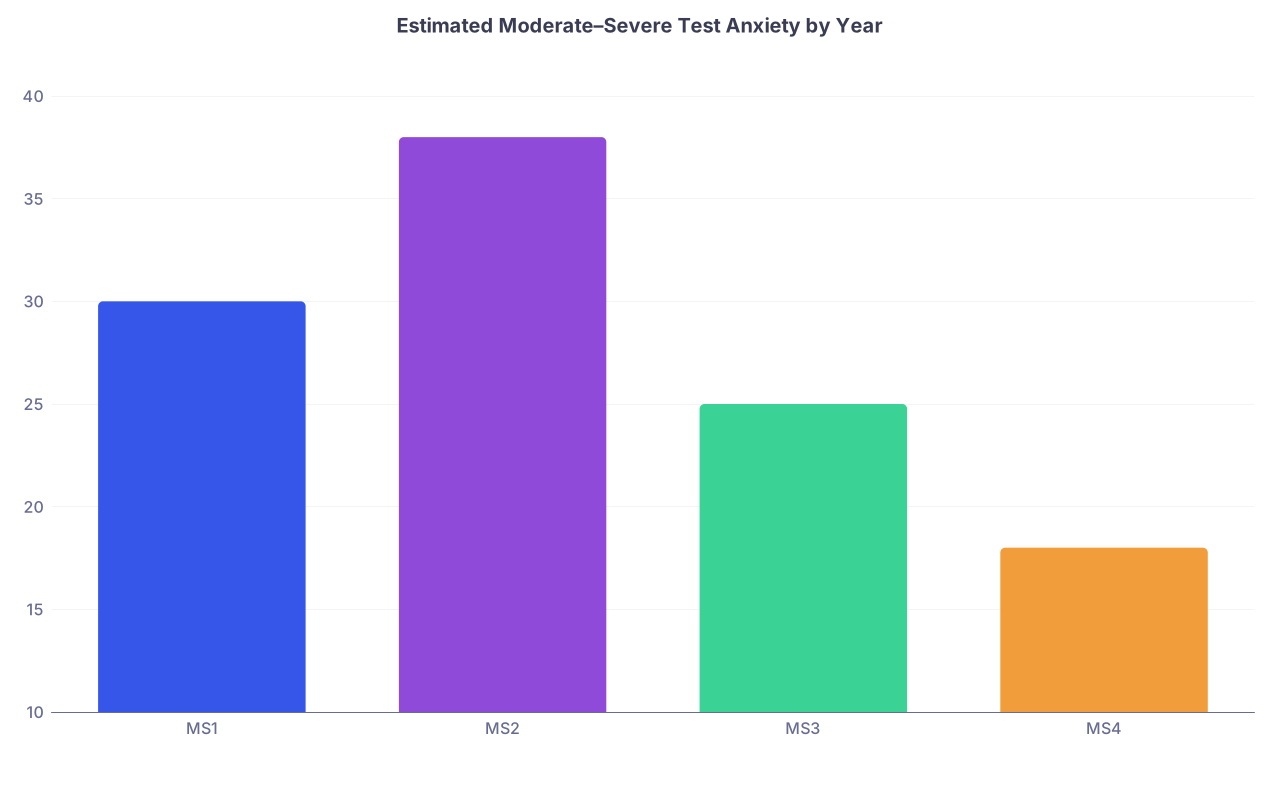
| Category | Value |
|---|---|
| MS1 | 30 |
| MS2 | 38 |
| MS3 | 25 |
| MS4 | 18 |
Are these exact? No. But they fit disturbingly well with multiple longitudinal studies: highest in the preclinical high-stakes period (especially around Step/Level 1), then a drop off in clinical and final year.
MS2: The Step 1 / Level 1 Effect
MS2 is where anxiety stops being just “exams are stressful” and becomes a strategic risk factor.
Multiple surveys around Step 1 and COMLEX Level 1 show:
- Pre-dedicated period (6–9 months before exam)
- Moderate–severe test anxiety: ~30–40%
- Dedicated study period (4–8 weeks)
- Moderate–severe: spikes to 40–55%
- Panic‑level / impairment: 12–20%
- Immediately post-exam
- A sharp reduction, but a non-trivial subset (10–15%) stay highly anxious waiting for scores.
One study of second-year students preparing for licensing exams found:
- About 60% reported that anxiety significantly impaired their concentration.
- Around 45% reported sleep disruption tied directly to exam worries.
- Students with higher test anxiety scored 5–10 points lower on average (Step 1 scale) than predicted by practice test performance and GPA alone.
That last piece matters. The data are clear: test anxiety is not just coexisting with lower performance; it is contributing to it.
You see it in item-level behavior too:
- High-anxiety students tend to change correct answers to incorrect ones more frequently.
- They underperform on time‑pressured sections even when content knowledge is equivalent.
MS3: Fewer Written Exams, Different Anxiety
On paper, MS3 should be easier: fewer massive written tests, more clinical work. Anxiety data tell a mixed story.
Test anxiety specifically does tend to drop relative to MS2:
- Moderate–severe test anxiety on written shelf exams: often 20–30%
- But clinical‑performance anxiety (OSCEs, evaluations, “being pimped”) increases.
So you do not get “less anxious.” You get redistributed anxiety:
- Students who were crushed by multiple choice exams sometimes feel better.
- Students who rely on private studying and struggle with on-the-spot questioning feel worse.
- The stakes shift from scores to subjective evaluations and letters that impact residency.
I have seen third‑year data where:
- Shelf exam anxiety is lower than Step 1, but
- Overall “performance anxiety about being observed” is equal or higher than preclinical levels.
This is not exactly test anxiety, but it hits many of the same physiological and cognitive channels.
MS4: Match Anxiety > Test Anxiety
By MS4, straightforward test anxiety usually downshifts. Residency applications, away rotations, and interviews become the main drivers.
Most programs report something like:
- Written exam test anxiety (e.g., Step 2 CK) moderate–severe: 15–25%
- Match-related global anxiety (less exam-specific): 45–60%
Step 2 / Level 2 still matters, of course, especially after pass/fail Step 1 changes. But the number of truly debilitated test-anxious students tends to be lower than during MS2.
The stress signal shifts from “will I fail this exam?” to “will I match into my specialty?” Different problem, different data profile.
Demographic and Academic Risk Patterns
Test anxiety is not randomly distributed. It clusters.
Prior Academic History
Two patterns show up consistently:
- Students with prior exam failures or low MCAT/GPA
- Higher baseline test anxiety entering MS1
- More likely to endorse statements like “I am afraid this exam will prove I am not smart enough”
- High-achieving students with little prior failure
- Anxiety spikes dramatically after their first poor performance
- These are the students I have seen go from calm to near-panic after a single below-average score
Quantitatively, prior academic struggles can increase the odds of moderate–severe test anxiety by roughly 1.5–2.0x.
Gender and Underrepresented Groups
Multiple meta-analyses across higher education (not just medicine) show:
- Female students tend to report higher self-reported test anxiety than male students, often by 5–10 percentage points in the moderate–severe range.
- Underrepresented minority students in medicine frequently report higher performance pressure and fear of confirming stereotypes, which inflates anxiety even when scores are comparable.
The problem: some of this is likely reporting differences, but not all. Physiological and cognitive symptoms (sleep issues, intrusive worry, blanking on questions) track in parallel.
Mental Health Comorbidity
Test anxiety rarely stands alone.
Typical co-occurrence rates in med students:
- Generalized anxiety disorder symptoms: 30–40%
- Depressive symptoms above clinical thresholds: 25–30%
- Burnout indicators (especially in clinical years): 40–60%
Students with existing generalized anxiety or depression show higher and more persistent test-anxiety curves, often 1.5–2x the rates of peers without these conditions.
That means: if you pull a subset of “students with prior diagnosed anxiety,” do not be surprised if half or more of them report severe test anxiety at least once across MS1–MS4.
How Test Anxiety Impacts Performance: Numbers, Not Platitudes
The most common lie in medical training culture is “if you know the material, you will be fine.”
The data say otherwise.
Performance Penalty
Across studies where you can control for prior GPA, MCAT, and practice test scores, high test anxiety is associated with:
- About 0.2–0.4 SD lower exam performance
- On an NBME or licensing-style scale, that is roughly 5–12 points penalty on a 3-digit exam.
- Higher rates of:
- Exam failures / near-fails
- Needing remediation or repeats
- In some settings, considering withdrawal or leave of absence
Take Step 1 as an example. Suppose two students have identical UWorld performance and similar MCAT scores. The student in the top quintile for test anxiety has a substantial probability of underperforming relative to practice tests, often by a margin big enough to shift them from “comfortably passing” to “borderline.”
Mechanisms: What the Cognitive Data Show
From an information-processing perspective, test anxiety hits at least three points:
Working memory load
- Worry thoughts and self-monitoring consume working memory
- Complex reasoning (multi-step clinical vignettes) suffers
Time misallocation
- Excessive checking and re-checking
- Getting “stuck” on a few items and rushing the rest
Threat appraisal
- Interpreting normal arousal as “panic”
- Engaging in catastrophic thinking (“If I miss this question, I will fail, then I will not match…”)
All of this is measurable. Students with high test anxiety show:
- More frequent unanswered questions at the end of timed blocks
- More second-guessing answer changes—disproportionately from right to wrong
- Greater heart rate and skin conductance responses during tests, correlated with self-rated anxiety
Comparing MS1–MS4: Where the Risk Is Highest
Let me compress the year-by-year patterns into one structured snapshot.
| Year | Typical Anxiety Drivers | Relative Risk of Moderate–Severe Test Anxiety |
|---|---|---|
| MS1 | Volume shock, identity threat | High |
| MS2 | Step/COMLEX, cumulative stakes | Very High |
| MS3 | Shelf exams, clinical evaluation stress | Moderate (test-specific), High (overall) |
| MS4 | Step 2/Level 2, Match uncertainty | Low–Moderate (test-specific), High (global) |
If you want one blunt conclusion: MS2 is the statistical danger zone for test anxiety intensity and functional impairment, especially in the 3–6 months around major licensing exams.
What Actually Reduces Test Anxiety (Data, Not Slogans)
Most “advice” given to students is not evaluated. Fortunately, a few interventions have real numbers behind them. The common pattern: effects are modest but real—no magic bullet, but measurable gains.
1. Structured Cognitive-Behavioral Interventions
Programs that combine cognitive restructuring + exposure to test-like conditions + relaxation training typically show:
- Reductions in self-reported test anxiety by 0.5–1.0 SD
- Performance improvements of 0.2–0.3 SD on standardized tests
Translating that to med school:
- A student in the “severe” bucket can realistically move into the “moderate” bucket.
- That alone might mean the difference between failing and passing a borderline exam.
These programs can be delivered in:
- 4–8 group sessions
- Shorter online modules with guided practice
- 1:1 counseling focused explicitly on exam performance
2. Test Strategy + Timed Practice
Not glamorous. But extremely effective.
Data from many cohorts show that familiarity with exam format and having a practiced timing strategy reduces anxiety independently of content knowledge. Students who regularly:
- Simulate exam conditions (timed, no notes, full-length blocks)
- Review not just content errors but process errors (rushing, second-guessing, misreading)
tend to show:
- Lower pre-exam anxiety ratings (often by 10–20% vs. peers)
- Smaller performance gaps between practice tests and real exams
You can think of it this way: test anxiety thrives in uncertainty. Every full simulation reduces that.
3. Brief Interventions: Expressive Writing, Reappraisal
A few “small” interventions have surprisingly good effect sizes given their simplicity.
Example: Expressive writing before high-stakes exams (10 minutes writing about worries, then closing it) has been shown in some samples to:
- Reduce intrusive thoughts during the exam
- Improve performance by 0.2–0.3 letter grade equivalent
Reappraisal interventions (framing physiological arousal as “the body gearing up to perform” rather than “panic”) also show:
- Modest but meaningful reductions in performance impairment
- Especially useful for students who already have good content mastery
Is this going to fix a 2 SD anxiety spike? No. But combined with other strategies, it chips away at the penalty.
Institutional vs Individual: Where the Leverage Actually Is
You often see schools push the burden entirely onto individuals: “Use our wellness app, go to yoga, meditate.” The data do not support that as a serious solution.
Structural Factors That Drive Test Anxiety Up
Some recurring institutional choices correlate with higher anxiety:
- Opaque grading policies
- Overweighted single exams (70–80% of course grade)
- High frequency of surprise-style NBME exams early in MS1
- Culture of public score comparison and ranking
You do not need a randomized trial to understand why the combination of “huge stakes” + “unpredictable” + “public comparison” is an anxiety machine.
Structural Factors That Help
Programs that report lower average test anxiety typically have features like:
- Clear, early communication on:
- Exam format
- Relative weighting
- Past score distributions
- Integration of low-stakes formative quizzes early, before the big summative assessments
- Visible availability of testing accommodations without stigma
- Embedded skills workshops on test-taking and cognitive strategies in MS1, not as emergency remediation after failures
In numerical terms, institutions that implement serious structural changes see:
- Average test anxiety scores drop by 10–25% over 1–2 years
- Exam failure rates decline modestly but consistently
- Usage of counseling resources shift from “crisis-only” to earlier preventive engagement
Practical Takeaways by Year (Data-Aligned, Not Feel-Good)
I will keep this brief and grounded in what actually moves the needle.
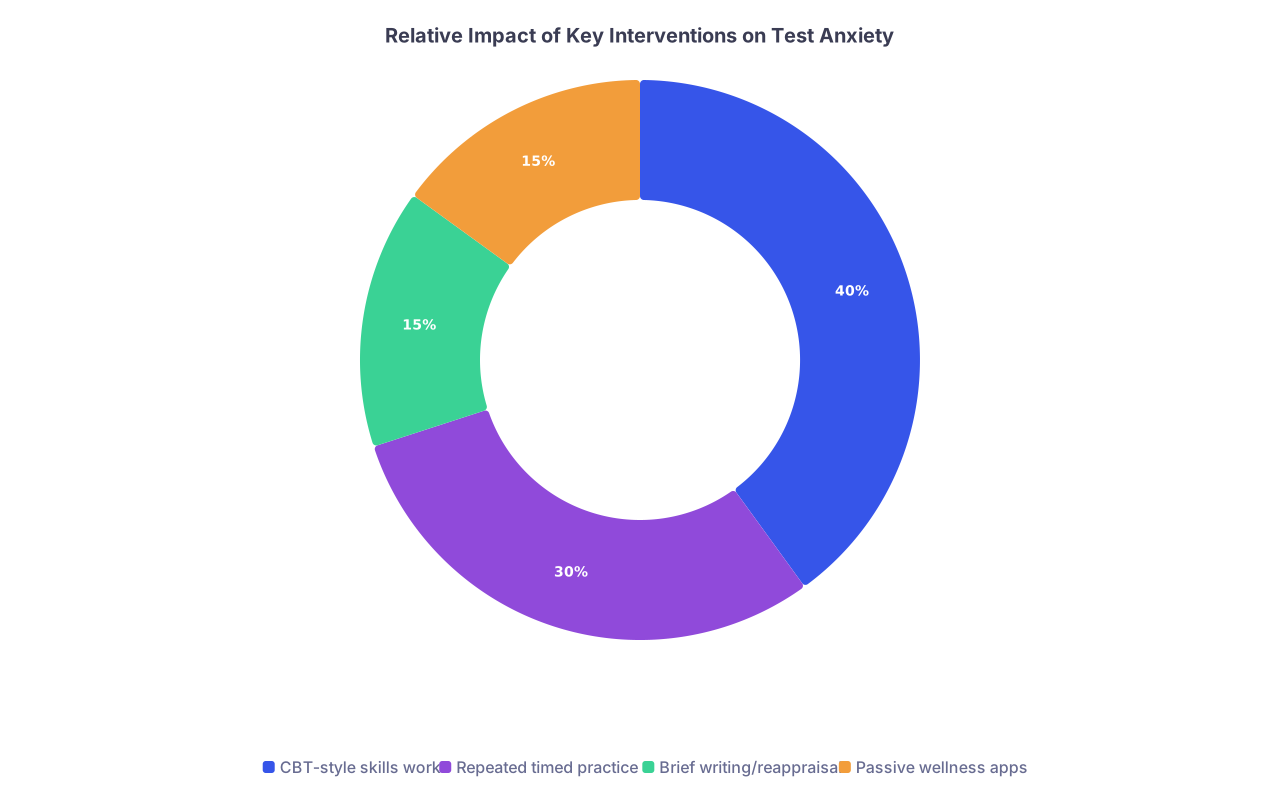
| Category | Value |
|---|---|
| CBT-style skills work | 40 |
| Repeated timed practice | 30 |
| Brief writing/reappraisal | 15 |
| Passive wellness apps | 15 |
These percentages are not literal; they are a rough weighting of impact based on existing study effects. Passive wellness apps and generic mindfulness, by themselves, are the weakest contributors.
For MS1
- Expect a spike. That is normal, not diagnostic of inability.
- Focus on: understanding exam format, doing small timed blocks early, and building a realistic weekly study plan rather than heroic last-minute efforts.
For MS2
- Treat test anxiety as a direct threat to Step/COMLEX performance. Because it is.
- Integrate CBT-style strategies and routine full-length simulations months before dedicated.
- If your anxiety is high, do not wait. Data show earlier intervention yields better outcomes.
For MS3
- Recognize the shift: less classic test anxiety, more clinical performance anxiety.
- Shelf exams still matter; use your MS2 experience to avoid repeating the same exam mistakes (timing, over-reviewing, last-minute cramming).
For MS4
- Step 2/Level 2 anxiety is real, but the bigger threat is chronic, diffuse Match anxiety.
- Use what you already know about how you respond to tests and apply it surgically: same timing strategies, same stress-management tools, fewer surprises.
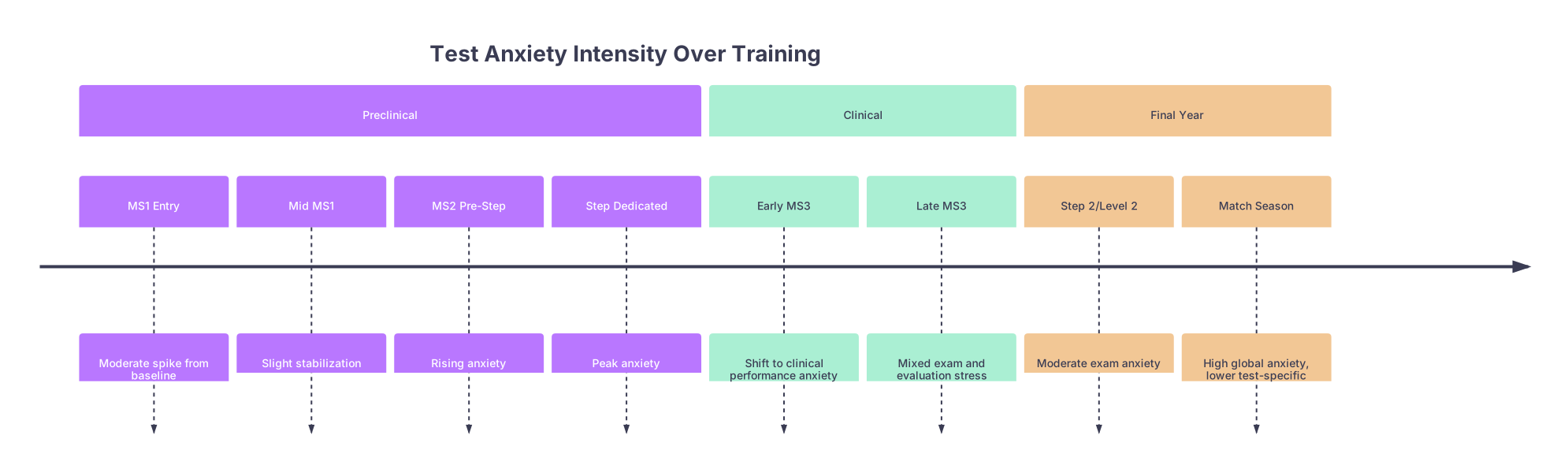
| Period | Event |
|---|---|
| Preclinical - MS1 Entry | Moderate spike from baseline |
| Preclinical - Mid MS1 | Slight stabilization |
| Preclinical - MS2 Pre-Step | Rising anxiety |
| Preclinical - Step Dedicated | Peak anxiety |
| Clinical - Early MS3 | Shift to clinical performance anxiety |
| Clinical - Late MS3 | Mixed exam and evaluation stress |
| Final Year - Step 2/Level 2 | Moderate exam anxiety |
| Final Year - Match Season | High global anxiety, lower test-specific |
Final Summary: The Short Version
- Prevalence is high and patterned. Roughly one-third of medical students experience moderate–severe test anxiety, peaking in MS2 around major licensing exams.
- The performance hit is real. High test anxiety is associated with a measurable score penalty, even after you control for knowledge and prior achievement.
- Strategy beats slogans. Structured CBT-style skills, repeated timed practice, and targeted brief interventions outperform generic wellness advice and “just relax” platitudes by a wide margin.
If you feel like test anxiety is shaping your trajectory, the data say you are not alone—and more importantly, that it is modifiable. Not overnight. But measurably.