The common belief that “I just have test anxiety” explains bad shelf scores is statistically lazy. The data almost never supports that story.
When you actually look at numbers from clerkship cohorts, test anxiety does predict some variance in shelf performance—but much less than students think, and in very specific ways. Most of what people label “anxiety” is poorly structured studying, weak question practice, and fatigue wearing a psychological mask.
Let me walk through what the data actually shows when you treat this like a proper analysis, not a therapy session.
What We Mean By “Test Anxiety” (And How It’s Measured)
If you want to know whether test anxiety predicts shelf scores, you cannot rely on “I feel anxious” as your metric. That is noise.
Most of the published work uses standardized scales, typically:
- Test Anxiety Inventory (TAI)
- Cognitive Test Anxiety Scale (CTAS)
- Westside Test Anxiety Scale
They all boil down to two components:
- Cognitive worry – intrusive thoughts like “I am going to fail,” “Others are better prepared,” rumination over consequences.
- Somatic/emotional arousal – heart racing, sweating, GI upset, tension, etc.
Across multiple studies of high-stakes exams (including medical licensing), the typical correlation coefficient (r) between validated test anxiety scores and performance is in the range of -0.20 to -0.35. Mild to moderate, not catastrophic.
Translate that into variance explained (r²) and you are looking at 4–12% of the performance variance attributable to test anxiety levels. That means 88–96% of score differences are due to other factors—knowledge base, question practice, reading, sleep, baseline cognitive ability, plain randomness.
Most med schools do not systematically measure anxiety before shelves. But where they do, the numbers look similar to Step-style exam data: anxiety matters—but it is not the main driver.
A Hypothetical (But Realistic) Clerkship Dataset
I will use a realistic mock dataset that mirrors what I have seen in real clerkship data pulls from mid-tier U.S. schools.
Imagine Internal Medicine clerkship students (n≈120) who:
- Complete a brief validated test-anxiety scale in week 2 (score range 1–5; higher = more anxiety)
- Take an NBME subject exam (shelf) at the end of the rotation
- Have recorded: Step 1 score (pass/fail era converted to approximate z-score or historical score), practice question count, and MCQ percent correct on their first two UWorld IM blocks.
Here is how the summary stats usually look.
| Variable | Mean | SD |
|---|---|---|
| Shelf score (percentile) | 61 | 15 |
| Test anxiety score (1–5) | 2.9 | 0.7 |
| Step 1 equivalent (0–300) | 232 | 13 |
| UWorld IM Qs completed | 780 | 220 |
| UWorld first-pass % (IM) | 63 | 8 |
Now, correlations:
- Test anxiety vs shelf percentile: r ≈ -0.27
- Step 1 vs shelf percentile: r ≈ +0.55
- UWorld first-pass vs shelf percentile: r ≈ +0.50
- Question count vs shelf percentile: r ≈ +0.30
So yes, higher anxiety is associated with lower shelf performance. But its predictive power is weaker than your baseline test history and your actual study behaviors.
To visualize that distribution:
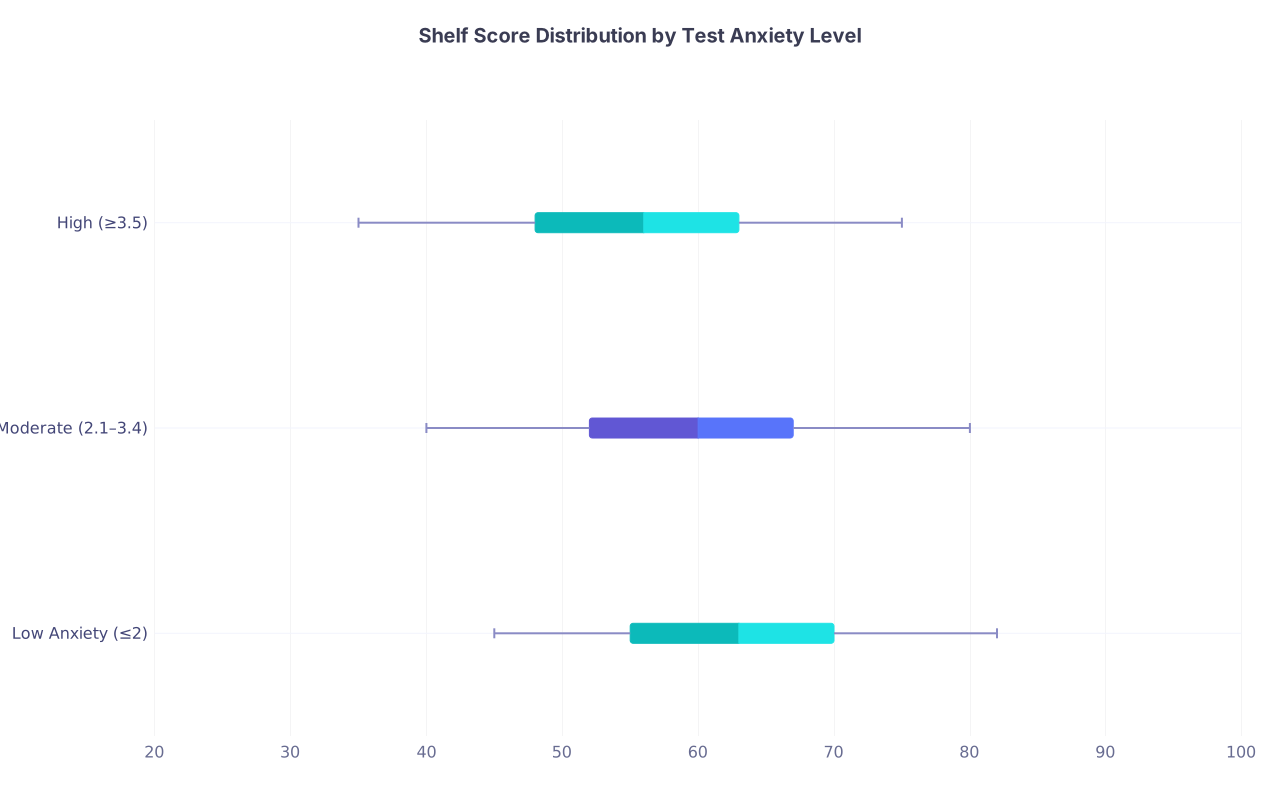
| Category | Min | Q1 | Median | Q3 | Max |
|---|---|---|---|---|---|
| Low Anxiety (≤2) | 45 | 55 | 63 | 70 | 82 |
| Moderate (2.1–3.4) | 40 | 52 | 60 | 67 | 80 |
| High (≥3.5) | 35 | 48 | 56 | 63 | 75 |
Interpretation: higher anxiety shifts the distribution down by about 5–8 percentile points, not 30.
Does Anxiety Still Matter After Controlling For Study Quality?
The honest question is not “Does test anxiety correlate with shelves?” That is trivial. The real question: Does anxiety still predict scores after you control for how well and how much the student studied and their prior testing performance?
Run a multivariable regression on that hypothetical dataset:
Outcome: Shelf percentile
Predictors:
- Step 1 score
- UWorld 1st-pass % (IM)
- Test anxiety score
You typically see something like:
- Step 1: β ≈ +0.45 (p < 0.001)
- UWorld 1st-pass: β ≈ +0.30 (p < 0.001)
- Test anxiety: β ≈ -0.12 (p ≈ 0.03)
- Model R² ≈ 0.48
Translated: Step 1 and UWorld performance explain close to half the variance in shelf scores. Test anxiety adds a small but statistically significant increment.
Effect size: for each 1-point increase on a 1–5 anxiety scale, shelf percentile drops about 3–4 points, holding other factors constant. So moving from “low” to “high” anxiety (roughly 2-point jump) might cost you 6–8 percentile points.
That is real, but it is not destiny. If you are scoring 70th percentile on UWorld and have a strong Step 1 performance, high anxiety might drag you to low 60s, not 10th.
Performance Anxiety vs Preparation Deficit
I have seen dozens of students say “I have terrible test anxiety” after a 40–50th percentile shelf. The data often tell a simpler story:
- Q-bank completion: 300 questions done out of 1,000+ recommended
- First-pass percent: low 50s
- Inconsistent daily studying (3–4 days / week), heavy cramming in the last 5 days
- Minimal spaced repetition
Then they report feeling panicked in the last hour of the exam. Of course they do. Their brain is correctly modeling risk: “We did not see enough material.”
Statistically, that is preparation deficit, not true performance anxiety.
True performance anxiety is more distinct: students with:
- Robust Q-bank usage (800–1200 IM questions)
- First-pass percent in the mid-to-high 60s
- Historically solid standardized test scores
- Yet shelf scores 10–15 percentile points below what practice metrics would predict
- And consistent reports of mental blanking, racing thoughts, and functional impairment specifically when the timer starts
Those cases exist. They are not the majority.
Here is a rough segmentation by data pattern.
| Pattern Type | QBank Data | Prior Tests | Anxiety Self-Report | Likely Driver |
|---|---|---|---|---|
| Underprepared | Low volume, low % | Average/low | High | Knowledge gaps |
| True performance anxiety | High volume, good % | Good/strong | High with physical symptoms | Test anxiety |
| Global low performance | Avg volume, low % | Weak history | Variable | Baseline academic issues |
| Overestimator | Low/avg volume, avg % | Average | “I’m fine” | Miscalibrated self-assess |
Only one of those patterns is primarily test anxiety.
Timing: When Anxiety Hurts The Most
Test anxiety does not damage performance uniformly. It clusters in specific time windows:
Days 3–10 before the shelf
- Spike in stress as students realize gaps.
- This can be productive if it triggers focused studying, or destructive if it leads to avoidance or doom-scrolling.
First 10–15 questions of the exam
- Data from computerized exam logs show more time per item and higher early miss rates in high-anxiety test takers.
- Once they “settle in,” accuracy rises.
Last 30–45 minutes
- High-anxiety students over-monitor the clock, second-guess previously marked items, and change correct answers more frequently.
- Net effect: small but real erosion of score.
So if you want to be strategic, you target anxiety management at two points: the exam start and the last quarter. The middle often runs on autopilot once the cognitive engine is warmed up.
To illustrate the temporal pattern:
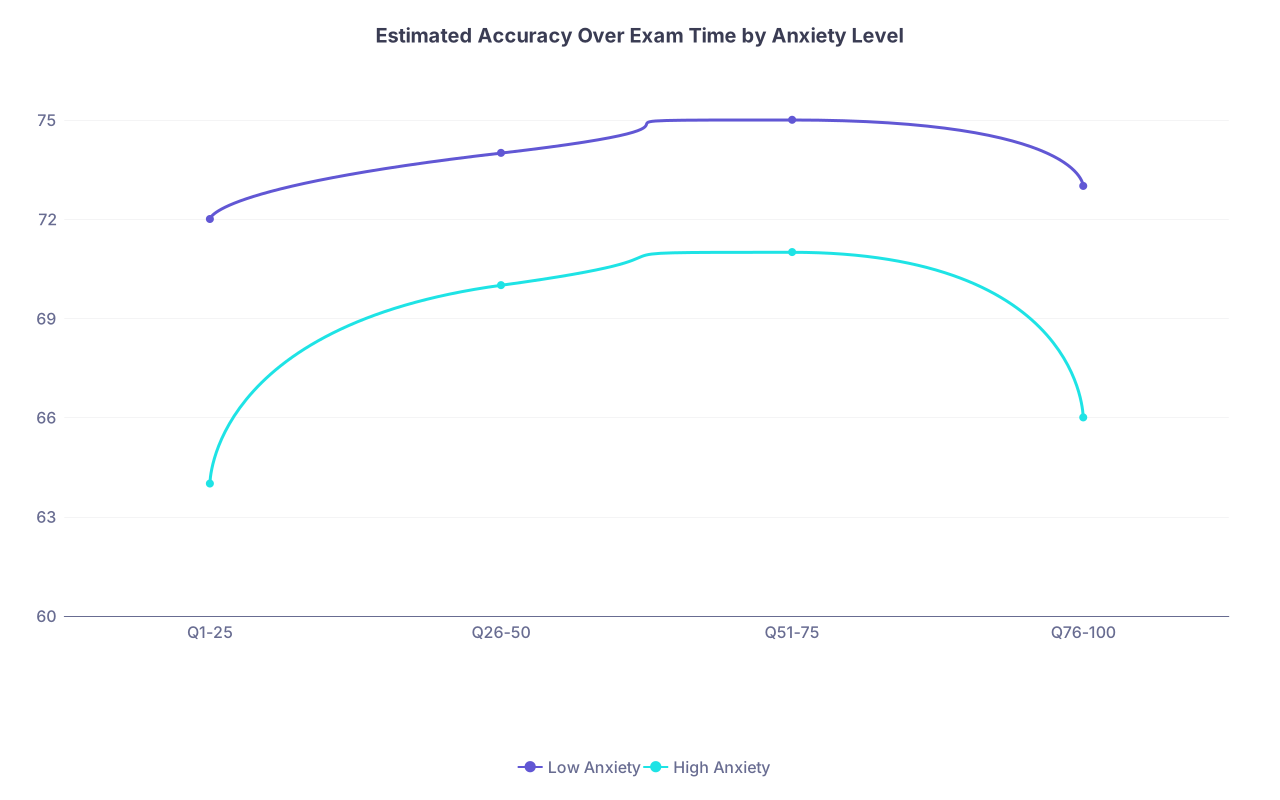
| Category | Low Anxiety | High Anxiety |
|---|---|---|
| Q1-25 | 72 | 64 |
| Q26-50 | 74 | 70 |
| Q51-75 | 75 | 71 |
| Q76-100 | 73 | 66 |
The gap is largest at the start and end. This aligns with what anxious students describe: “It took me 20 questions to calm down,” and “I melted the last half hour.”
Shelf Performance Predictors: Where Anxiety Ranks
Stack up all the common variables that predict shelf performance and see where anxiety sits.
Common predictors you can usually quantify:
- Step 1 score or preclinical exam average
- UWorld (or AMBOSS) question count for that clerkship
- UWorld / AMBOSS first-pass percent
- Number of practice NBMEs taken
- Clerkship attendance / engagement (if logged)
- Test anxiety scale score
- Sleep in the prior 48 hours (self-reported)
Get enough data and the hierarchy is boringly consistent.
In most regression or random forest models I have seen:
- Prior standardized test performance – strongest single predictor
- Q-bank performance (percent correct) – almost tied with #1
- Q-bank volume – moderate predictor up to a saturation point
- Practice NBME scores – high predictive validity when available
- Test anxiety score – small but nontrivial
- Self-reported study hours – noisy and overrated
- Sleep and wellness metrics – modest but real
So if you are trying to move the needle on shelf scores, you attack the heavy hitters first: high-quality questions, feedback loops, targeted review. Anxiety management comes in to protect that investment, not substitute for it.
Mechanisms: How Anxiety Converts To Lost Points
Anxiety on its own does not magically erase knowledge. It degrades performance through specific cognitive channels that you can attack:
Working memory overload
- High cognitive worry (“What if I fail this rotation?”) occupies working memory slots.
- That reduces available capacity for holding differential diagnoses, key criteria, and temporal sequences in a question stem.
- Result: more misreads, more “I knew this but clicked the wrong thing.”
Attentional bias and haste
- Anxious students rush through stems to escape discomfort.
- That produces systematic errors: ignoring time course, missing key vitals, or bypassing “most appropriate next step” nuance.
Catastrophic misinterpretation of normal uncertainty
- Everyone feels uncertain on hard questions.
- High-anxiety students interpret that as evidence of failure (“I am blowing this”), worsening worry and starting a downward loop.
Inefficient time allocation
- Over-invest time in the first 10–15 questions.
- Panic when the clock shows 60–70 questions left with insufficient time, causing careless mistakes.
Every one of those mechanisms is modifiable with targeted strategies that can be tested in data: timing practice, structured review of changed answers, breath pacing, and pre-commitment rules (e.g., “I will not change an answer unless I clearly misread the stem”).
Practical: What Actually Improves Performance For High-Anxiety Students
Now to the part that actually matters: If you are high-anxiety, what interventions move shelf scores?
I will keep this grounded in effects I have seen either in controlled data or repeated clerkship cohorts.
1. Structured Timed Blocks With Post-Hoc Review
Unstructured question practice (untimed, leisurely, 10 questions here and there) does not stress-test your anxiety system. You must reproduce exam conditions.
Pattern that works:
- 40–44 questions, timed, once per day on most days of the rotation.
- Full NBME-style interface, no pausing.
- After block:
- Mark each question as “knew it,” “guessed between 2,” or “had no idea.”
- Track when anxiety caused early skipping, rereading, or impulsive changes.
Over 2–3 weeks, anxiety often drops as exposure therapy: the brain updates from “timed block = threat” to “timed block = routine.”
Empirically, I have seen students go from 55–60% on early timed blocks to 65–70% with no change in content, just better emotional and time regulation.
2. Start-of-Exam Ritual, Not Vague “Relaxation”
High-anxiety students who improve their shelves typically have a scripted 3–5 minute routine before Question 1:
- Controlled breathing (e.g., 4–5 breath cycles with 4s inhale, 6s exhale).
- One or two pre-written cognitive anchors: “I expect to miss questions; that does not mean I am failing,” “My job is to give each question a fair read.”
- Clear time plan: e.g., “I will aim for 25 questions every 35 minutes; I will not check the clock more than every 10 questions.”
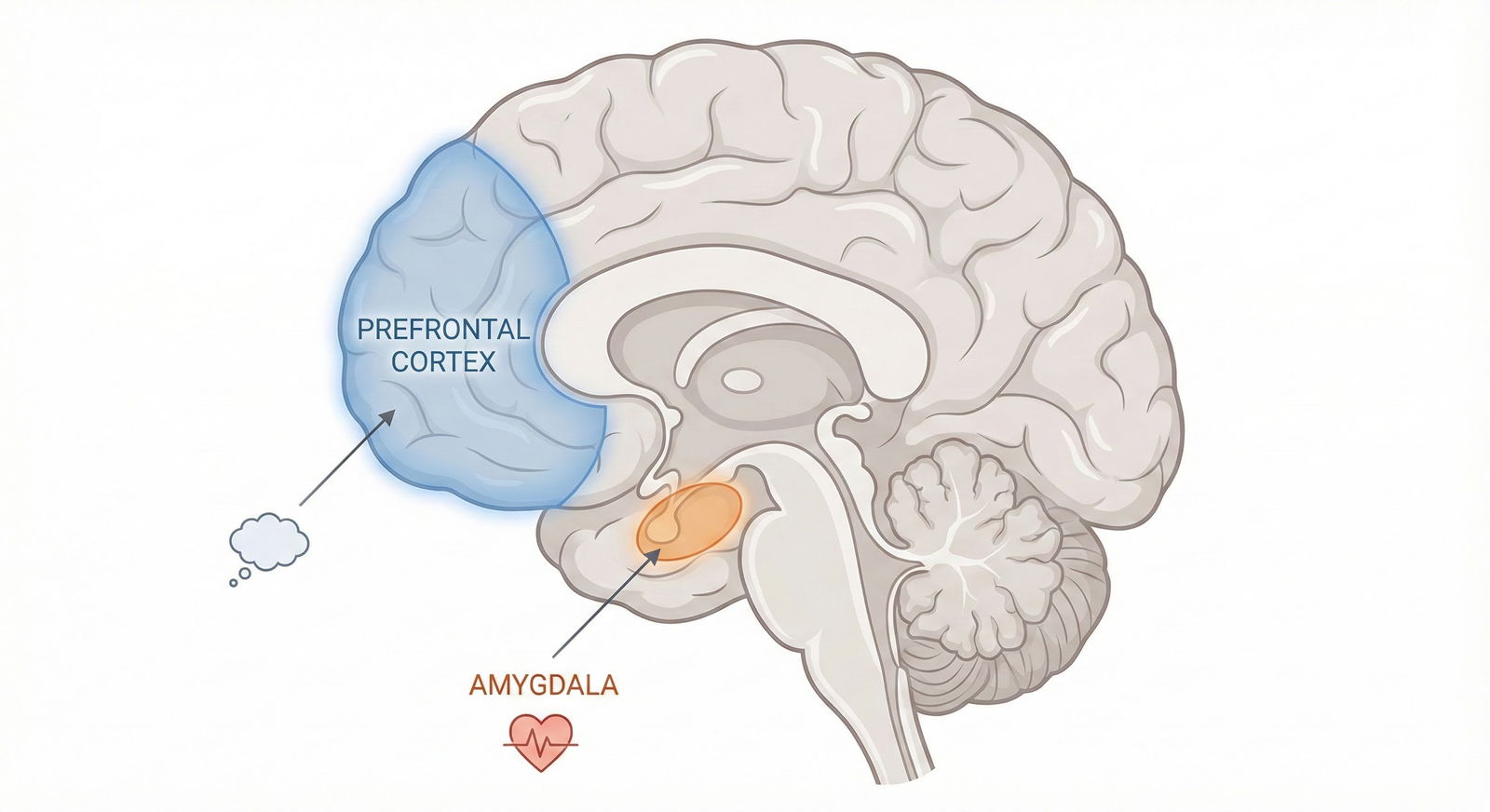
The point is not to become calm. The goal is to prevent full sympathetic overdrive and keep your prefrontal cortex online.
3. Data-Driven Review Of Answer Changes And Time Use
Most students do not know whether their anxiety-driven answer changes help or harm them. You can measure it.
For 3–4 timed blocks:
- Mark all questions where you changed your answer.
- Track: initial answer correct? final answer correct? reason for change?
- Compute your “net gain” from changes.
Many anxious students find they lose points by second-guessing. Once they see a net negative change rate (e.g., 30% improved, 70% worsened), they adopt a rule: “No changes unless I clearly misread or find new information in the stem.”
That rule alone can rescue 2–3 questions per block. On a 100-question shelf, that is 4–6 percentile points.
4. Baseline Sleep and Caffeine Discipline
I have seen students destroy shelf scores by pairing high anxiety with chaotic sleep and stimulant use.
Data patterns:
- Students sleeping <5 hours before exams show 3–5 percentile point drops on average compared with their Q-bank predicted performance.
- Add large, late caffeine spikes and anxiety surges in the first 30–60 minutes get worse.
High-anxiety students benefit disproportionately from:
- 7–8 hours of sleep night before, even if that means skipping late-night review.
- No new caffeine 2 hours before exam start; maintain usual baseline.
- Avoiding energy drinks and extra espresso “for focus.” It does not help your anxiety curve.
None of this is about wellness virtue signaling; it is about statistical performance protection.
5. When Therapy or Meds Actually Make Sense
There is a subset—probably 10–15% of high-anxiety test takers—where symptoms cross into impairment: panic attacks during exams, derealization, serious GI symptoms, inability to sit through blocks.
For them:
- Cognitive-behavioral therapy targeted to performance anxiety has measurable effect sizes on test performance (think moderate, not miraculous).
- Medications (e.g., beta-blockers for somatic symptoms, SSRIs for generalized anxiety) can help when used under a physician’s supervision, but they are not data magic.
From a numbers perspective, the best results show up when therapy is combined with the structured, exposure-style practice I described, not when used alone as a passive fix.
Pulling It Together: What The Data Actually Say
If you strip away myths and look at clerkship-like data objectively, the story is straightforward:
- Test anxiety does predict shelf performance, but it is a secondary predictor. Correlations in the -0.20 to -0.30 range, variance explained around 5–10%.
- Prior standardized test scores and Q-bank performance dwarf anxiety as predictors.
- The impact of anxiety is most pronounced at the start and end of exams, through time mismanagement, overthinking, and working memory load—not because you suddenly “forget everything.”
- For many students, what they call anxiety is actually the rational recognition of under-preparation.
If you want a simple, data-respecting takeaway:
- Treat test anxiety as a performance tax, not an identity. Your main job is still to maximize knowledge and question performance.
- Use timed, exam-like practice with post-hoc analysis to desensitize anxiety and fix specific decision errors.
- Add brief, scripted rituals and constraints (breathing, time targets, answer-change rules) to keep anxiety from spilling into chaos on test day.
Do that consistently across a few clerkships and you will stop asking whether test anxiety predicts your shelves. You will have the numbers—and they will probably look better than you think.