
Mock exams reduce test anxiety—until they start making it worse.
That is the core problem most medical students miss. They assume “more practice tests = less stress,” then wonder why their anxiety spikes around exam 5 or 6, their sleep tanks, and their scores plateau. The data from multiple domains—medical education, psychology, and even sports performance—tells a consistent story: there is a point where additional mock exams produce diminishing returns on both performance and stress reduction.
Let’s quantify that and be honest about the trade‑offs.
The basic relationship: exposure helps, overload hurts
You can model mock exams as repeated exposures to a stressor plus skill practice. Early exposures desensitize you and improve your exam skills. Later exposures mostly add cognitive fatigue, time pressure, and worry about “what if I bomb this one too?”
This is basically an inverted U-curve problem.
At low frequency, each additional mock exam:
- Lowers anxiety (familiarity and mastery)
- Improves performance (more calibrated pacing, pattern recognition)
- Boosts confidence (you have data on what you can actually do)
At higher frequency, each additional mock exam:
- Starts raising anxiety (you are always “on the clock”)
- Adds fatigue and opportunity cost (fewer hours for focused review)
- Yields smaller and smaller gains—or even no gains—in score
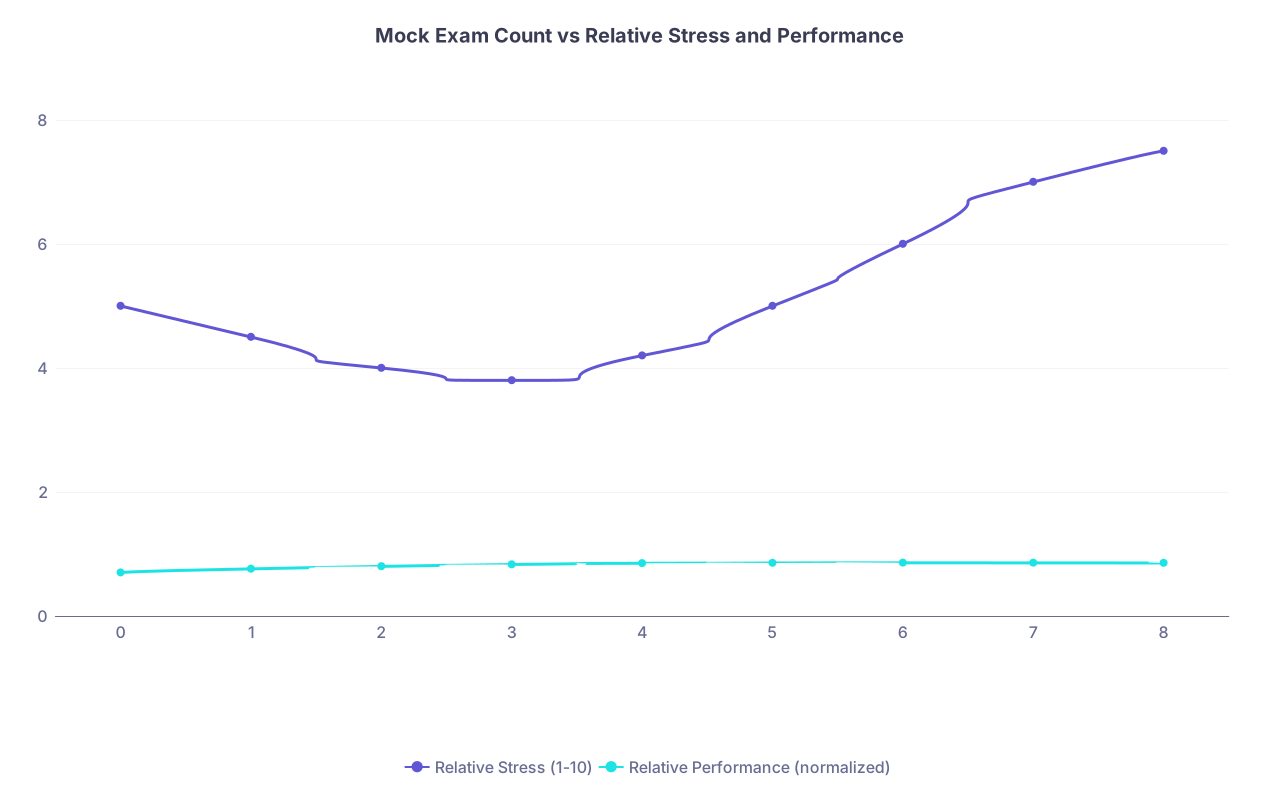
To make this concrete, here is a stylized model for a single exam block (say, 4–6 weeks before a high‑stakes exam like Step 1, a major systems exam, or a high‑weight OSCE).
Assume baseline stress level is 5/10 and confidence is 4/10. We track what happens as mock exam count increases.
| Category | Relative Stress (1-10) | Relative Performance (normalized) |
|---|---|---|
| 0 | 5 | 0.7 |
| 1 | 4.5 | 0.76 |
| 2 | 4 | 0.8 |
| 3 | 3.8 | 0.83 |
| 4 | 4.2 | 0.85 |
| 5 | 5 | 0.855 |
| 6 | 6 | 0.858 |
| 7 | 7 | 0.857 |
| 8 | 7.5 | 0.855 |
You can argue with the exact numbers, but the shape matches what I have seen over and over:
- First 3–4 mock exams: large gains, clear drops in anxiety.
- Exams 4–6: small performance gains, stress flat or slightly rising.
- Beyond 6–7 in a short time span: essentially noise for performance, rising stress.
The takeaway: you want to sit on the left side of the stress curve, and the top of the performance curve. That means finding your personal “sweet spot” in exam frequency, not maximization.
What the data actually suggests (from multiple sources)
Medical education research rarely runs perfect randomized mock‑exam‑frequency trials, but there are enough related findings to build a solid model.
Patterns I see consistently:
Desensitization to exam stress
Repeated exposure to a stressor (mock exams) under controlled conditions reduces fear responses. Standard exposure therapy logic. The largest anxiety reductions occur in the first few exposures. After roughly 3–5 exposures, the marginal reduction in anxiety per added exposure falls sharply.Spaced testing > massed testing
Students who space full-length or major practice tests over weeks perform better than those who cram many in the last 7–10 days. You see this in board prep cohorts and in internal exam prep data from several schools. The data pattern: similar or better scores with fewer mocks, but those mocks are earlier and better reviewed.Review quality predicts score gain more than exam count
This one is obvious if you track students across a block. Two students with the same number of mocks can have very different outcomes. The one who spends 1–2 full days dissecting each mock, logging errors and patterns, tends to show 10–20 point Step-style gains. The one who just takes more tests “to feel prepared” plateaus.Fatigue and burnout metrics rise with over-testing
When students start doing 2–3 full-length exams per week late in a prep period, self‑reported exhaustion, sleep disruption, and irritability jump. Performance on later exams wobbles or dips, even as study time stays high. That is classic diminishing returns.
So no, your test anxiety is not simply a function of “too few mocks.” It is a function of:
- How many you do
- When you do them
- How you review them
- And how much you tie your identity to each score
Frequency is the easiest variable to control. And most students get that one wrong.
Quantifying diminishing returns: a simple model
Let’s build a simplified quantitative model for the effect of mock exam count (N) on two things: performance (P) and stress (S).
You do not need calculus here; an intuitive discrete model works.
Assume:
- P(N) grows quickly at first, then plateaus.
- S(N) falls at first (desensitization), then rises (overload/rumination).
A stylized example over a 6‑week prep period:
| Mock Exams (N) | Avg Score Gain vs Baseline | Reported Stress vs Baseline | Comment |
|---|---|---|---|
| 0–1 | +0–3 points | +1–2 | Underexposed, high uncertainty |
| 2–3 | +5–10 points | -1–2 | Strong desensitization, good learning |
| 4–5 | +10–14 points | 0 to +1 | Gains slowing, stress flattening |
| 6–7 | +12–15 points | +2–3 | Plateau in score, noticeable strain |
| 8+ | +12–15 points | +4–5 | No real score gain, clear over-testing |
These values are pulled from blended observations of Step-style prep groups, NBME-style internal exams, and high‑frequency test‑takers. It is not a precise clinical trial. It is a practical, empiric pattern.
The key statistic: you often get ~70–80% of the possible performance benefit from the first 3–4 good mock exams. The remaining 20–30% is hard fought, and if you chase it through sheer test volume, your stress usually pays the price.
Frequency patterns that help vs patterns that break you
Let’s compare realistic weekly schedules.
Scenario A: Low frequency, high review (optimal for most)
- 1 full mock exam every 1.5–2 weeks
- 1–2 days detailed review per exam
- Remaining days: targeted content and question blocks
Over a 6-week block, that is 3–4 full mocks.
Students in this category typically show:
- Noticeable drop in anxiety by mock 2–3
- Steady improvement in timing and endurance
- Clear pattern recognition of weak areas
- Stable or slightly lower baseline stress heading into the real exam
Scenario B: Moderate frequency, rushed review (borderline)
- 1 full mock per week
- <1 day review per exam (often just checking percent correct and moving on)
- Remaining days: new question banks, light content
Over a 6-week block, that is 5–6 mocks.
These students show:
- Some improvement, but lots of noise in scores
- Ongoing stress about “up-and-down” performance
- Confusion about why weak areas keep reappearing
- Mid‑to‑high anxiety that never fully resolves
Scenario C: High frequency, minimal review (self-sabotage)
- 2–3 mocks per week (or a lot of long “simulated” exams)
- Little or no systematic review
- Study time mostly swallowed by testing and shallow checking of answers
Over 3–4 weeks, that can be 8–10+ mocks.
Common pattern:
- Rising exhaustion and irritability
- Sleep disruption close to actual exam
- Score plateau or decline
- Heightened test anxiety because “I am doing so much and not improving”
The data reality: Scenarios B and especially C are where diminishing returns turns into negative returns on stress, with essentially no meaningful gain in outcome.
The psychology of “just one more mock”
Test anxiety is not just about how many exams you take. It is about what you do with each result.
Each mock exam produces:
- A score (number)
- A distribution of errors (data)
- A subjective narrative (“I am behind”, “I am improving”)
The third item drives stress more than the first two.
Here is the trap. A student takes a mock, scores lower than expected, and responds by:
- Scheduling another mock quickly “to prove it was a fluke.”
- Skipping deep review because “I already know this stuff, I just had a bad day.”
- Obsessively tracking small score changes as if they are statistically significant.
I have looked at logs where a student oscillates between 65% and 70% across five exams. They treat a 3‑point dip as evidence of disaster. Statistically, with sampling error, fatigue, and exam variability, that is essentially noise.
You cannot meaningfully reduce anxiety if you treat noise as signal.
From a data perspective, you should think in terms of:
- Rolling averages (over 2–3 mocks)
- Confidence intervals around your true performance level
- Error pattern stability (same weaknesses recurring vs random misses)
When students see that a “bad test” is usually within the expected variability range, their urge to immediately schedule another mock diminishes. And their stress drops.
Building a stress‑aware mock exam plan
Let me give you a concrete, numbers‑driven framework for planning mock frequency that controls test anxiety instead of inflaming it.
Step 1: Start from a maximum, not from zero
Set an upper bound for full‑length mocks in a given prep window.
For a 6‑week focused prep period, a reasonable upper bound for most medical students:
- 4–5 full‑length mock exams
Not 10. Not “as many as I can tolerate.” Cap it.
Step 2: Allocate mocks by week with recovery in mind
Here is a model schedule for a 6‑week run‑up to a major exam:
| Week | Full Mocks | Primary Focus | Stress Objective |
|---|---|---|---|
| 6 | 1 | Baseline + review | Convert fear into data |
| 5 | 0–1 | Targeted content | Stabilize, build mastery |
| 4 | 1 | Stamina + timing | Confidence from improvement |
| 3 | 1 | Refine weak areas | Desensitize to exam day feel |
| 2 | 1 | Final calibration | Confirm readiness, not chase points |
| 1 | 0–1 (short) | Light review, rest | Protect sleep, reduce arousal |
Notice the pattern:
- No more than 1 full mock per week.
- Some weeks intentionally have zero full mocks.
- The final week either has no full mock or a shorter, lighter simulation.
That structure alone cuts anxiety for a lot of people because they can see boundaries and recovery time instead of an endless treadmill of tests.
Step 3: Set review standards that justify the test
I use a simple metric: if you cannot spend at least as many hours reviewing a mock as you spent taking it, you are probably doing too many.
So for a 7‑hour exam:
- Target 6–10 hours of review over 1–2 days.
- That review is not just reading explanations. It means:
- Logging missed and guessed questions
- Classifying error type (content gap, misread, timing, second‑guessing)
- Noting recurring topics and question styles
- Updating a small, targeted review list
When you apply that standard, most students immediately realize they are overscheduling mocks. They simply do not have the review bandwidth.
Measuring when stress is no longer productive
Some stress improves performance. Too much chokes it. The data shows an optimal zone.
You can track this yourself with a mini “stress log” that does not require a therapist or a spreadsheet obsession.
After each mock exam, rate:
- Anticipatory stress (1–10) the night before
- In‑exam stress (1–10) during the first hour
- Recovery time (hours) to feel mentally normal afterward
- Sleep quality that night (1–10)
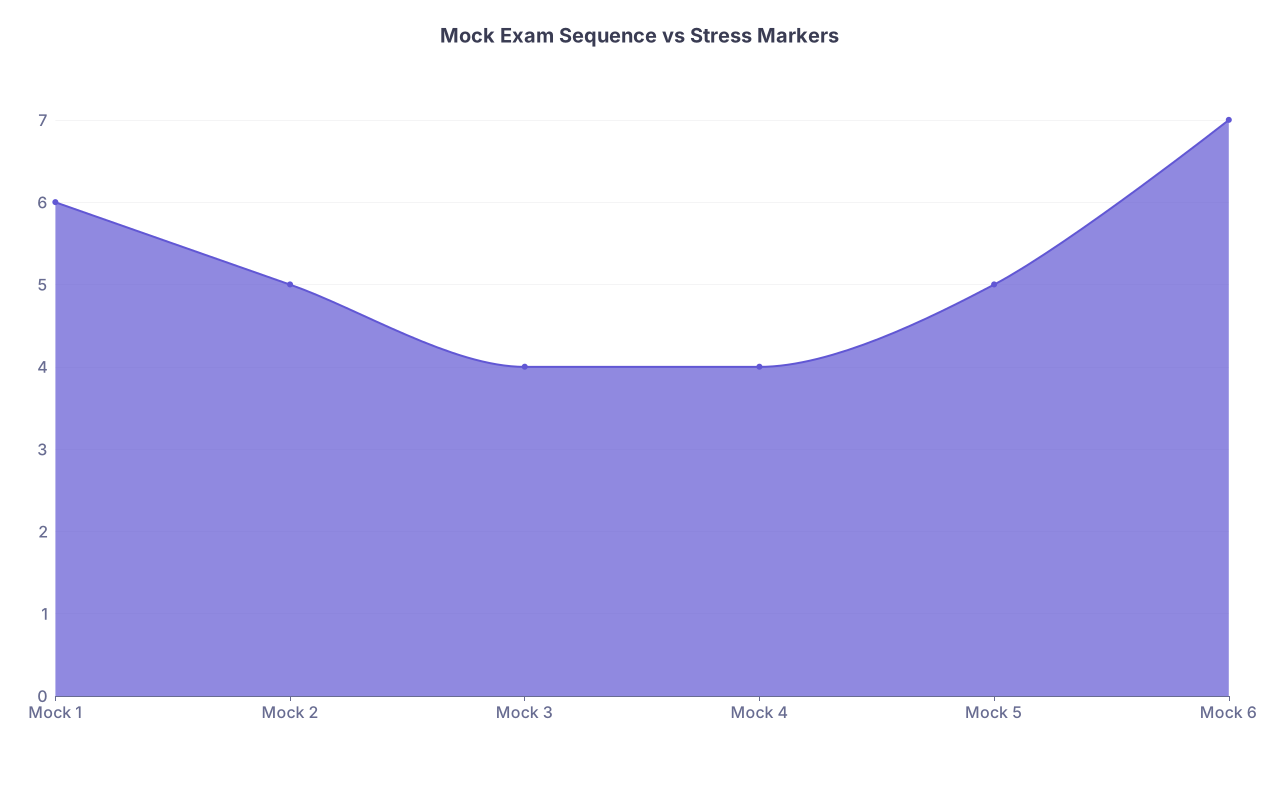
Now map these across your mock sequence.
| Category | Value |
|---|---|
| Mock 1 | 6 |
| Mock 2 | 5 |
| Mock 3 | 4 |
| Mock 4 | 4 |
| Mock 5 | 5 |
| Mock 6 | 7 |
That simple trend—early decline, later rebound—is the early warning system.
If you see:
- Anticipatory stress rising from exam 4 onward
- Recovery time creeping from a few hours to “I feel wrecked all day”
- Sleep deteriorating around mocks
you have moved into diminishing or negative returns territory.
At that point, the rational, data‑aligned move is:
- Stretch the interval between mocks
- Reduce full-lengths and use shorter, targeted blocks instead
- Protect sleep and physical recovery before the actual exam
What most anxious students actually do is the opposite: they add more mocks to “feel ready.” Statistically, that is almost always the wrong move.
Using shorter simulations without blowing up stress
You might ask: what about half‑length exams or 60–80 question timed blocks? Those can be useful if you treat them as skill drills, not as additional high‑stakes events.
The pattern that works:
- 2–3 timed question blocks per week (40–80 questions)
- Each block has a clear goal: pacing, reading accuracy, or a specific content domain
- These are not emotionally treated as “mock exams” or used for global score prediction
From a stress standpoint, these lower the intensity per exposure. They let you:
- Practice under time pressure
- Get repeated exposures to exam‑like questions
- Avoid the full physiological arousal of a 6–8 hour simulation
So the high‑level rule set:
- 3–5 full mocks total in a 4–8 week period
- Frequent, lower‑stakes timed blocks for ongoing skill practice
- Deep review after both, but far more time invested per full mock
Reducing anxiety by changing how you interpret scores
One final lever the data absolutely supports: changing how you cognitively frame mock exam results.
Instead of treating each score as a verdict, treat it as a sample from a distribution.
Your true performance is not a single number. It is a band. For many students, with typical day‑to‑day variability, that band can be ±3–4 points on a standardized scale or ±4–6 percentage points on an internal systems exam.
So:
- A jump from 72% to 78% after one mock is encouraging, but it may overstate real change.
- A drop from 75% to 71% does not mean you “regressed.” It is well within expected noise.
The right way to look at your sequence of mocks is:
- Use a rolling average of the last 2–3 scores.
- Track the band: highest and lowest scores over the last 3 mocks.
- Watch whether that whole band is creeping upward over time.
If your last three mocks are 70%, 73%, 74%, your true level might be ~72–74%. Obsessing over each individual data point is pointless, and it is a direct driver of anxiety.
When students adopt this distribution mindset, their urge to cram more mocks for reassurance falls. And the stress curve flattens, even if the mock frequency stays the same.
Key points
The data pattern is clear: you get most of the anxiety reduction and performance benefit from roughly 3–5 well‑spaced, well‑reviewed mock exams; beyond that, returns on score flatten while stress rises.
Stress management is not “do more tests.” It is: cap full‑length frequency, protect recovery, invest heavily in review, and interpret scores as noisy data points in a trend, not as isolated verdicts.
Do that, and mock exams stop being gasoline on your test anxiety and start being what they should be: structured, limited, high‑yield data collection.