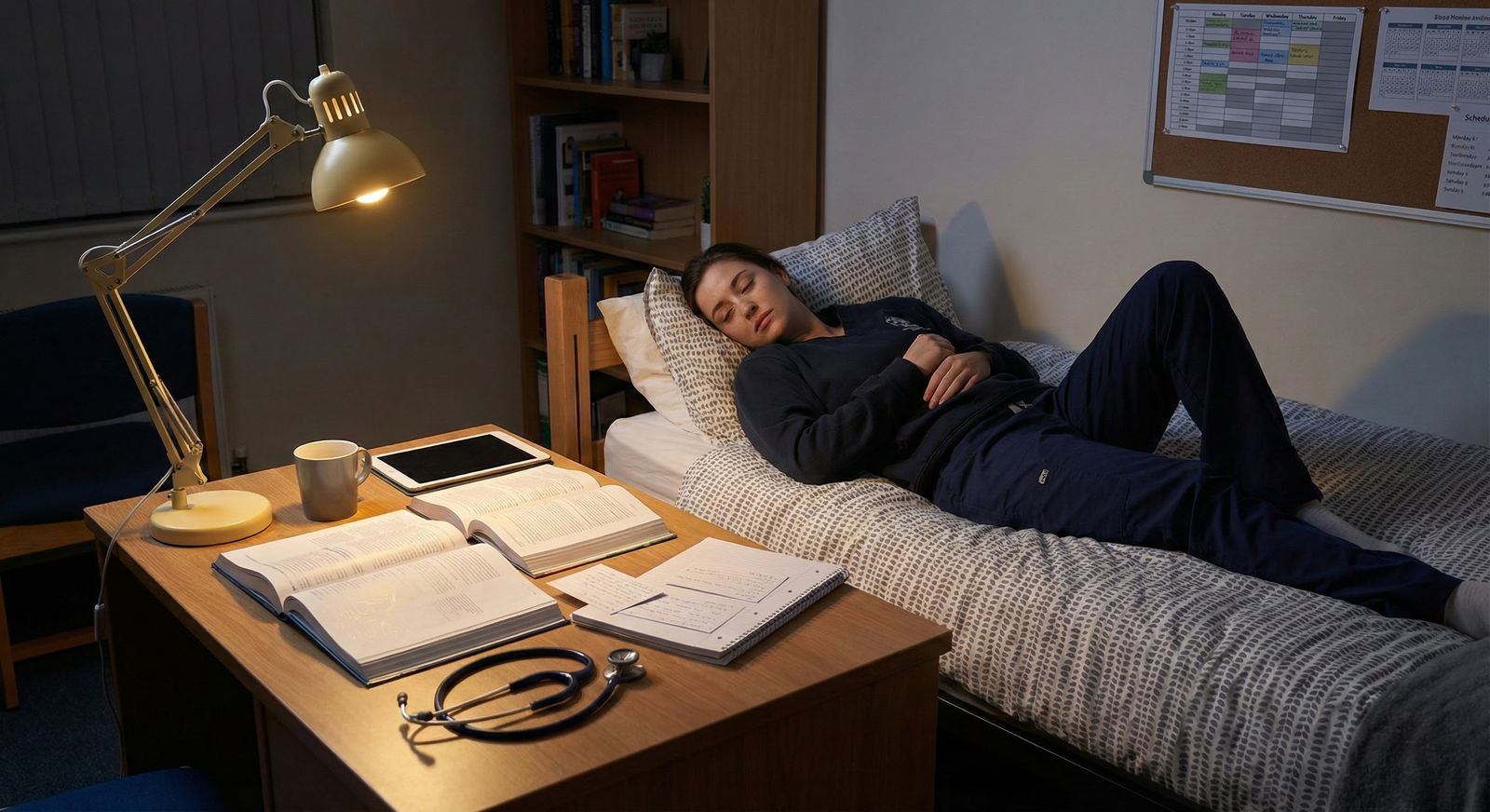
What actually happens to your score if you trade 3 hours of sleep for 3 more hours of last‑minute cramming?
Let me just answer the main question first, then we’ll unpack it.
If you’re a medical student with a major exam tomorrow (NBME, shelf, Step, OSCE, or a brutal block exam), you should be aiming for 7–8 hours of sleep the night before, not less.
Not 4. Not 5 “because adrenaline will carry me.”
You want 7–8.
The Short Answer: The Night Before vs The Week Before
Here’s the key distinction too many students miss:
The week before the exam:
Aim for 7–9 hours per night. Your consolidation window matters more than you think.The night before the exam:
Aim for 7–8 hours. Going to bed a bit earlier is fine, oversleeping into 9–10 hours isn’t helpful and can leave you groggy.
Let me be blunt: if you’re sleeping 4–5 hours or less the night before a major exam, you’re knowingly handicapping:
- Working memory
- Processing speed
- Focus and sustained attention
- Emotional regulation (your “don’t panic” system)
I’ve watched students lose 10–20+ Step or NBME points not because they didn’t know the material, but because they were cognitively dulled from chronic sleep debt and one bad pre‑exam night.
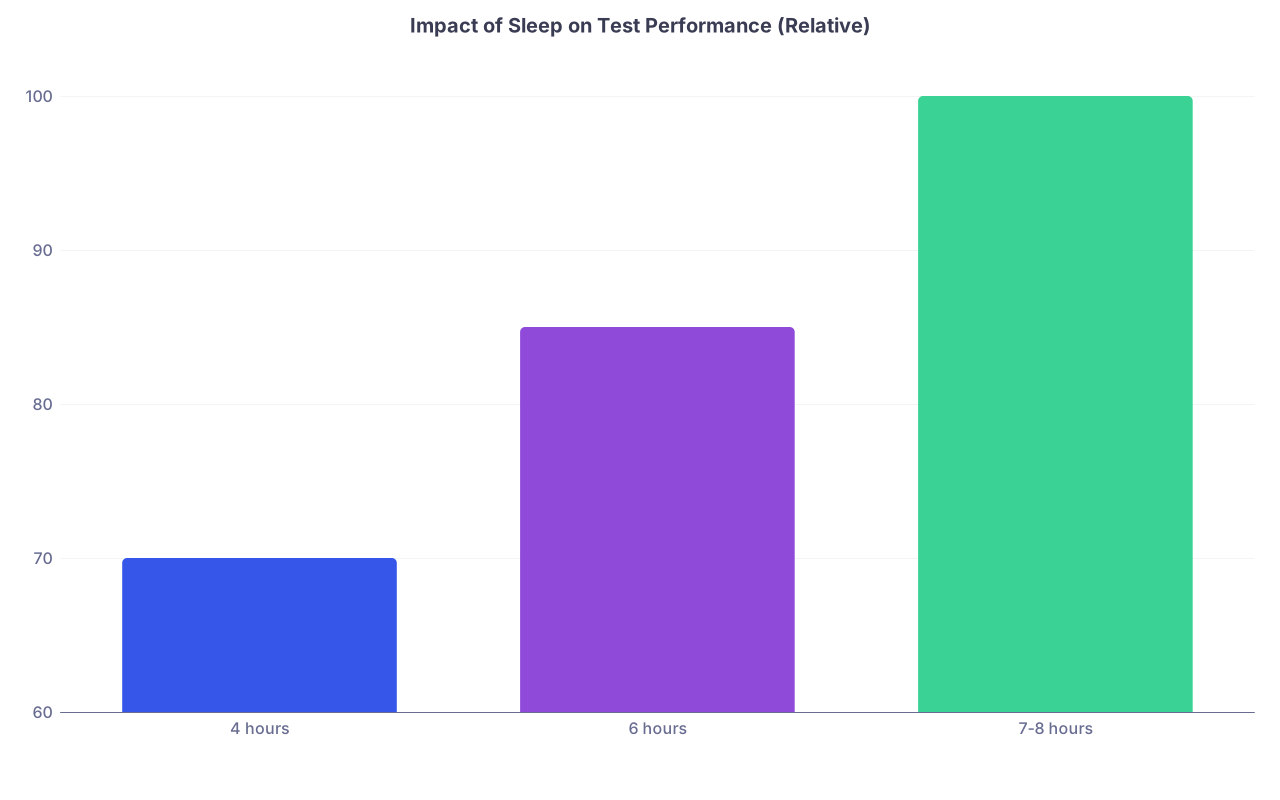
| Category | Value |
|---|---|
| 4 hours | 70 |
| 6 hours | 85 |
| 7-8 hours | 100 |
(Relative scale: 100 = you performing near your actual knowledge potential.)
Why Med Students Keep Cutting Sleep (And Why It Backfires)
I’ve heard every version of this:
- “I’ll sleep after this exam.”
- “I just need one more pass through my Anki cards.”
- “If I don’t review heme-onc one more time I’ll fail.”
Here’s what actually happens when you cut sleep severely before a big exam:
Your recall gets fuzzy.
You’ve seen the question stem before in a UWorld block, but you cannot pull the fact out quickly enough.You misread and rush.
Sleep-deprived brains skim. You miss the key word “EXCEPT,” you ignore an age clue, or you mix up lab values.Your decision-making gets impulsive.
You bail on a correct answer for a distractor because your confidence is shot.Anxiety spikes. Performance drops further.
By question 40, you’re mentally swearing you “forgot everything.”
You didn’t forget everything.
You just degraded the hardware (your brain) right before you needed it to run at max power.
The Sweet Spot: 7–8 Hours, Not Perfection
No, you do not need “the best sleep of your life” before a big exam. One slightly sub‑par night is fine if the week leading up has been decent.
What you do want:
- 7–8 hours in bed with at least 6.5+ hours of true sleep
- A sleep time that’s roughly consistent with your normal schedule
- A wake-up time that gives you 2–3 hours before the exam to fully “boot up”
What you do not need:
- A perfect pre-sleep routine like a wellness influencer
- Total silence and blackout perfection
- To panic if you wake up in the middle of the night once or twice
You’re aiming for good enough sleep, not a flawless performance.
The Week Before: Where the Real Damage Happens
Here’s the part people ignore. The night before matters, but the 5–7 days before the exam may matter more.
A pattern I’ve seen repeatedly:
- Monday–Wednesday: 6 hours
- Thursday: 5 hours
- Friday (night before exam): 4–5 hours
By exam morning you’re effectively operating like someone legally drunk in terms of reaction time and attention, even though you’re sober.
If you’re within 1–2 weeks of a major exam, your plan should explicitly include protected sleep as a performance strategy, not as a luxury.
Target for the week before high‑stakes exams
- Nightly goal: 7–9 hours in bed
- Minimum non-negotiable floor: 6.5–7 actual hours of sleep
- Consistency: Keep sleep and wake times within about 1 hour of your normal routine
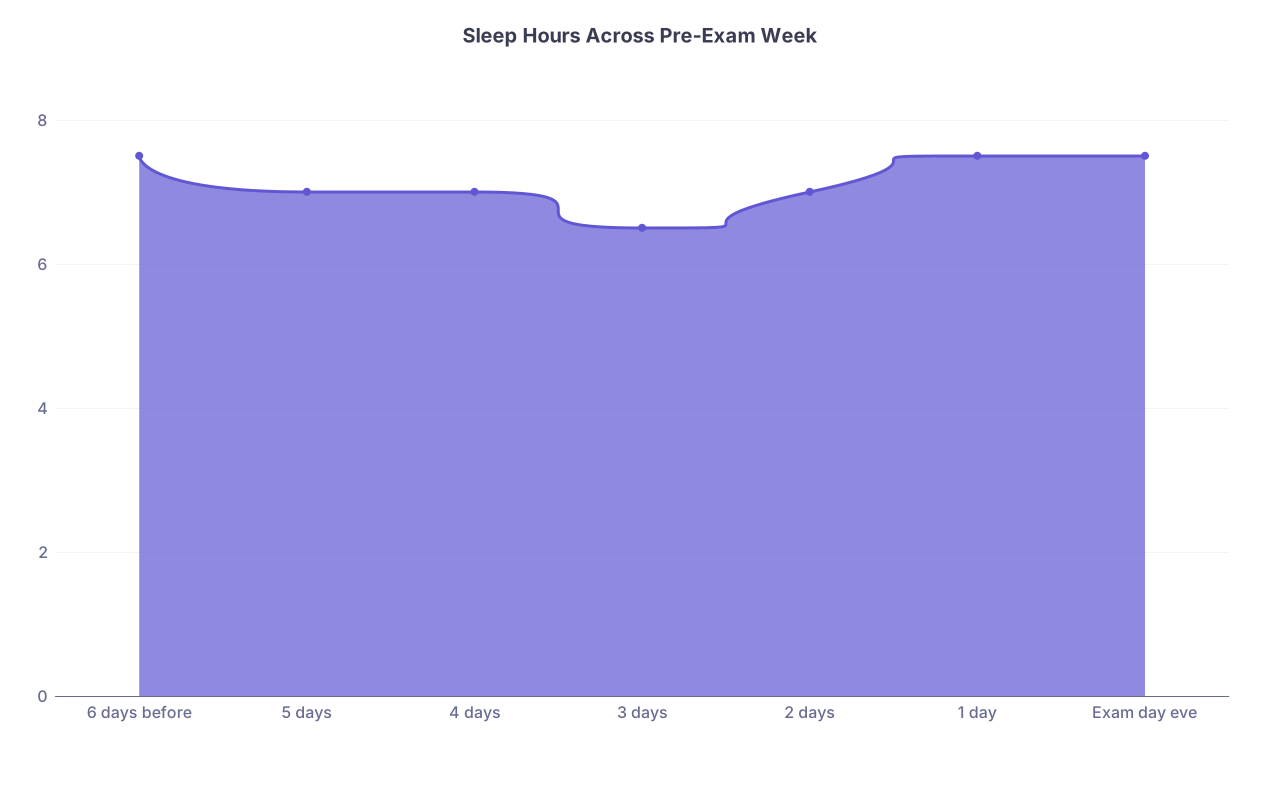
| Category | Value |
|---|---|
| 6 days before | 7.5 |
| 5 days | 7 |
| 4 days | 7 |
| 3 days | 6.5 |
| 2 days | 7 |
| 1 day | 7.5 |
| Exam day eve | 7.5 |
The point: keep your brain stable. Don’t treat sleep like an expendable resource.
How Sleep Actually Boosts Exam Performance
Let me spell this out in exam-relevant terms, not vague “sleep is good for you” fluff.
Sleep, especially deep sleep and REM, helps with:
Consolidation of facts and patterns
You’re doing those UWorld blocks and Anki cards for a reason. Sleep is when your brain actually integrates them. Less sleep = shallower encoding.Connecting concepts across systems
Those exam questions that blend pharm, path, and phys? That’s higher-order thinking. Sleep loss pushes you toward superficial recall and away from integration.Error checking and impulse control
Sleep helps your prefrontal cortex regulate your “I’m freaking out” limbic system. Without it, you’re more likely to change correct answers or second‑guess everything.Stamina for long exams
Step exams, NBMEs, and some finals are marathons. Without decent sleep, your brain hits a wall halfway through and you start hemorrhaging points late in the test.
“But I’ll Lose Content Time if I Sleep More”
Yes. And that’s actually the point.
Here’s the tradeoff you’re really making the night before a big exam:
- 2–3 extra hours of low-quality, panic-driven, half‑awake review
vs. - 2–3 hours of sleep that preserves your recall of the hundreds of hours you already studied
You do not win that trade by sacrificing sleep.
The last 24 hours are about:
- Light review
- Solidifying high-yield concepts
- Keeping anxiety from boiling over
- Protecting brain function
They’re not about rebuilding knowledge you should’ve accumulated weeks ago.
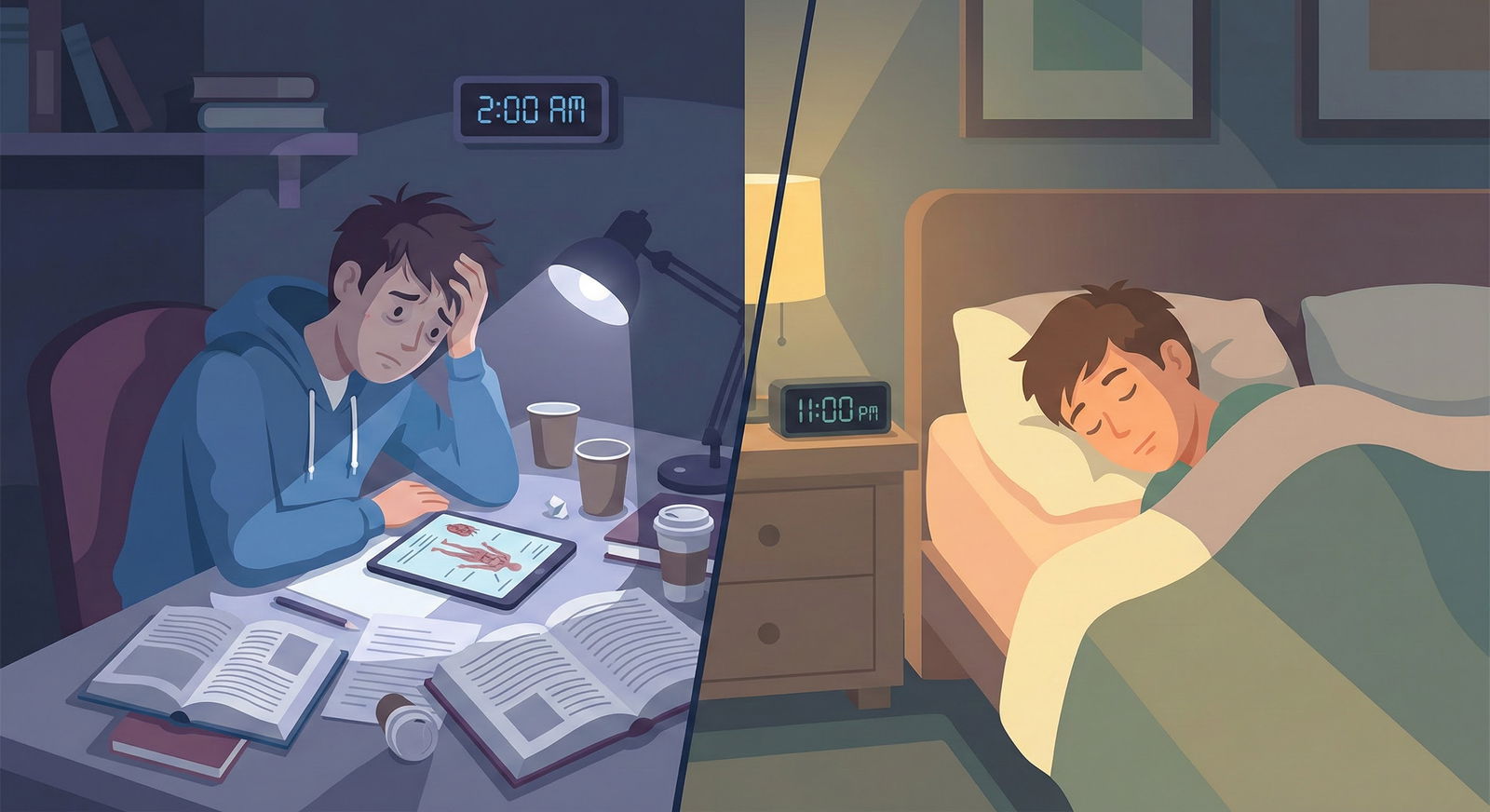
Practical Strategy: What To Do the Day and Night Before
This is what I recommend to real students, and it works.
The day before the exam
Keep it medium-intensity, not all-out.
- Do 1–2 modest blocks of questions or cases
- Review high-yield summaries (pharm charts, formulas, weak areas)
- Stop anything truly demanding 3–4 hours before bedtime
Your goal is to arrive at bedtime mentally tired but not fried.
The evening and night before
Your rules:
- Pick a hard cutoff time. Example: “I stop all real studying by 8:30 PM.”
- After that, only do:
- Light flashcards
- A quick formula/pharm skim
- Organizing test-day logistics (ID, snacks, route, etc.)
Then:
- Screen downshift 1 hour before bed (night filter at minimum)
- Moderate, familiar food—don’t experiment with heavy new meals
- No big caffeine hits after mid-afternoon (for most people, after 2–3 PM is risky)
Try to be in bed such that you can get 7–8 hours before your alarm. If your exam starts at 8 AM and you need to leave at 7 AM, then:
- Wake: 5:30–6 AM
- Bedtime: ~9:30–10:30 PM
If your mind will not shut up
This is where people spiral.
If you’re lying there thinking:
- “I should be reviewing cardio one more time.”
- “What if this ruins my future?”
Use this script:
“I have done the work I can do. Sleep protects the work I’ve done. This is studying now.”
Tools that actually help:
- A very short, boring audio (sleep story / non-medical podcast at low volume)
- 5–10 minutes of slow breathing: inhale 4 sec, exhale 6 sec
- Writing down intrusive worries on a notepad so your brain stops trying to “hold” them
And here’s the truth: even if your sleep is a bit fractured, as long as you stay in bed and stay off high‑stim screens, you’ll still get more rest and partial sleep cycles than you think.

| Step | Description |
|---|---|
| Step 1 | End intense studying |
| Step 2 | Light review only |
| Step 3 | Prepare exam logistics |
| Step 4 | Screen downshift |
| Step 5 | Wind-down routine |
| Step 6 | In bed for 7-8 hours |
What About All-Nighters?
You’re a med student. So you know this objectively:
- All-nighters blow up working memory
- Mood goes sideways
- Attention and reaction time nosedive
But subjectively, under stress, you will still be tempted.
Here’s my position:
All-nighters before a major exam are almost always a net negative.
The only exception: you literally have not opened the material at all and need bare minimum exposure to pass a low-stakes quiz. That’s not what we’re talking about here.
For anything that matters for clerkships, Step, or your transcript, your priority the night before is:
- Sleep
- Stable mood
- Preserving prior learning
If you’re considering an all-nighter, it usually means a systems problem happened weeks earlier. Don’t try to solve a semester’s worth of under-prep by lighting your brain on fire the final night.
Naps, Caffeine, and Other “Performance Hacks”
Let’s be precise.
Naps
Day before exam:
If you’re exhausted, a 20–30 minute early afternoon nap can help. Set an alarm. Don’t oversleep into 90 minutes.Morning of the exam:
Skip the nap. You should be awake and ramping up, not cycling in and out of sleep inertia.
Caffeine
- Stick to your usual pattern. If you normally drink one coffee, do that. Don’t suddenly triple it.
- Last meaningful caffeine dose no later than 6–8 hours before your intended bedtime.
You want alertness, not jitters plus insomnia.
Sleep aids
Non-prescription and prescription sleep meds are overused. The night before a huge exam is not the time to try a new sedative you’ve never taken. If you already use something under supervision and know how you respond, fine. But “I’ll just knock myself out with X” can backfire badly with morning grogginess.

Mental Health Angle: Sleep as Your First-Line Protection
Category is medical school mental health, so let’s not pretend this is only about scores.
Chronic exam-period sleep loss:
- Worsens baseline anxiety and rumination
- Exaggerates feelings of hopelessness and failure
- Makes normal pre-exam jitters feel like the end of the world
Many students think they’re “burned out” when in reality they’re brutally sleep deprived, under-eating, and over-caffeinated. Once sleep stabilizes to even 7 hours on most nights, their mood and confidence improve fast.
You are not weak for prioritizing sleep before an exam. You’re doing what high-performance professionals do:
- Pilots
- Surgeons
- Elite athletes
None of them are advised to cut their sleep the night before peak performance. They’re told the opposite.
If You’re Already Behind and Panicking
You might be reading this a few days before a big exam thinking, “I don’t have the luxury of sleeping 8 hours. I’m behind.”
Here’s the harsh truth:
If you’re truly behind in the final week, you won’t fully fix it with sleep deprivation. You’ll just ensure you underperform on what you do know.
So you choose:
- Slightly less content reviewed with a functional brain
- Or more content superficially crammed with a foggy, anxious brain
Every time I’ve watched students gamble on the second option for Step or shelves, they regret it.
If you absolutely must extend hours, steal them from low-yield activities (phone scrolling, redundant review passes), not from the sleep that keeps your cognition online.
| Timeframe | Recommended Sleep | Absolute Minimum | Goal Focus |
|---|---|---|---|
| 7–5 days before exam | 7–9 hrs/night | 6.5–7 hrs | Consolidation, stamina |
| 4–2 days before exam | 7–8.5 hrs/night | 6.5–7 hrs | Stabilizing routine |
| Night before exam | 7–8 hrs | 6–6.5 hrs | Peak mental function |
| Daytime before exam | 0–30 min nap max | None | Avoid sleep inertia |
FAQ: Exactly 7 Questions
1. What if I can only get 5–6 hours the night before despite trying?
You’ll probably be okay if the previous few nights were solid. Don’t spiral. Focus on calm routines in the morning, light caffeine if you use it, and trust the prep you’ve done. The damage is much worse when it’s 5–6 hours every night for a week, not just once.
2. Is it better to wake up early to cram or stay up late to cram?
If you must choose (and I’d rather you didn’t), it’s usually better to go to bed earlier and wake a bit earlier than to push deep into the night. Late-night studying tends to be lower quality, more anxiety-ridden, and more disruptive to sleep cycles. Early-morning review after 7 hours of sleep is far more effective than midnight-to-2 AM panic passes.
3. Should I use melatonin or other sleep aids before a big exam?
If you have never used them before, do not experiment the night before a high-stakes test. If you already regularly use a low-dose melatonin or a prescribed med without morning grogginess, continuing your normal routine can be fine. Anything new carries a non-trivial risk of side effects or oversedation.
4. How much worse is 4 hours of sleep compared to 7–8 for test day?
It’s significantly worse. You’ll see drops in reaction time, attention, working memory, and emotional regulation. The subjective “I feel wired from adrenaline” hides how impaired you actually are. In practice, I’ve seen students with 4 hours of sleep underperform their practice NBMEs by 10–20+ points.
5. Is oversleeping (like 10–11 hours) bad before an exam?
If it’s a one-off after a long period of deprivation, you might just be catching up. But intentionally sleeping 10–11 hours right before a test can leave you groggy and off your normal rhythm. Aim for your typical healthy range—about 7–9 hours. “More” isn’t always “better” if it disrupts your internal clock.
6. Do short naps help if I’m exhausted the day before?
Yes, if they’re controlled. A 20–30 minute nap early afternoon can restore alertness without wrecking nighttime sleep. Avoid 60–90 minute daytime naps; those often dump you into deep sleep and leave you more groggy, plus make it harder to fall asleep that night.
7. Bottom line: what’s the non-negotiable rule for med school exams and sleep?
For any exam that actually matters—shelves, Step, big blocks—do not willingly go below about 6–6.5 hours of sleep the night before, and aim for 7–8. Protect sleep the same way you protect your exam ticket and your ID. It’s not “self-care fluff”; it’s one of the highest-yield performance moves you have.
Key points to remember:
- For big exams, your target is 7–8 hours of sleep the night before, with solid sleep the entire week leading in.
- Trading sleep for last-minute cramming almost always costs you performance on what you already know. Protect your brain, not just your outline.