
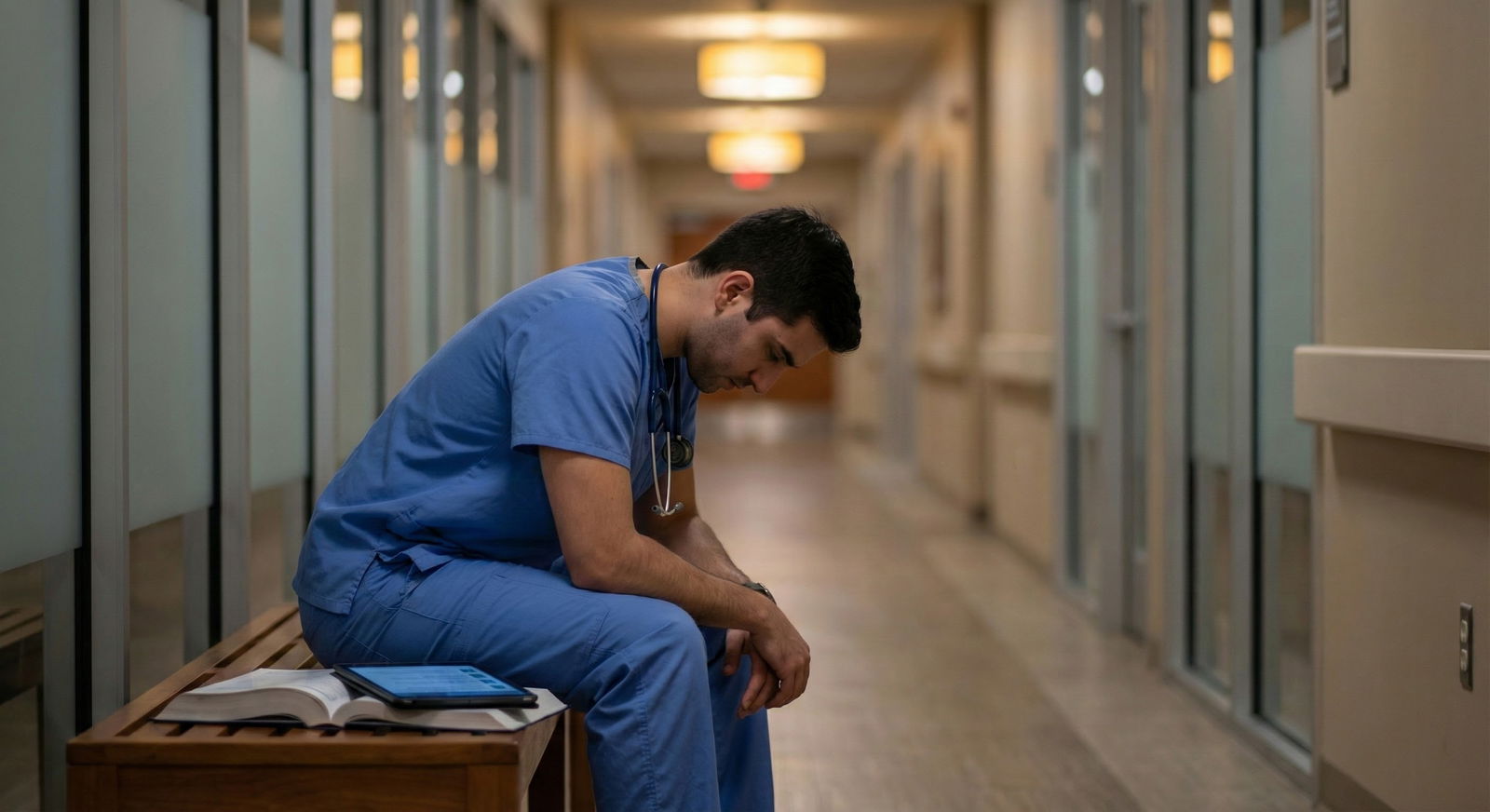
It's 8:00 AM on a Tuesday. You're sitting in a cramped call room or sitting in your car before pre-rounds, refreshing the NBME portal. The page loads. There it is: red text, a score below the passing cutoff, and an abrupt drop in your stomach that feels like falling off a cliff.
You failed a clinical shelf exam.
I've seen this exact moment break exceptional students. Your immediate instinct is to panic, spiral into catastrophizing about your residency match, or fire off erratic, emotional emails to faculty. Stop. Take your hands off the keyboard.
Failing a shelf isn't the end of your career; it's a tactical setback that requires an immediate, disciplined response. At this point, you don't need platitudes or toxic positivity. You need a operational plan.
Over the next 72 hours, you will systematically move from emotional shock to structured remediation. Here is your exact hour-by-hour timeline.
Hours 0 to 12: The Immediate Aftermath and Decompression
Hour 0 to 2: Complete Shutdown
Step away from the screen. Close the portal. Do not open UWorld. Do not launch Anki. And whatever you do, do not start retaking diagnostic practice exams out of sheer desperation.
Your brain is in acute fight-or-flight. Cortisol is surging. Any analysis you try to do right now will be distorted by panic. If you're currently on service, finish your clinical duties for the morning without making a scene. If you need to step into a bathroom stall for five minutes to breathe or shed a tear, do it. But keep your composure on the floor.
Hour 2 to 6: Strategic Disclosure Only
Loose lips sink ships. Do not announce your score on your class GroupMe. Do not complain about the test fairness in the student lounge. Word travels fast in clinical departments, and public spiraling projects unprofessionalism.
At this point, you should notify exactly two people maximum:
- A personal anchor: A partner, spouse, or non-medical friend who offers emotional safety without giving unsolicited study advice.
- A designated trusted advisor: A student affairs dean or a trusted faculty mentor.
That's it. Classmates who passed will give you useless platitudes or subtle condescension. Avoid them today.
Hour 6 to 12: Physical Reset
Your main objective for the evening is physiological stabilization. You cannot build a bulletproof study plan on zero sleep and high stress.
- Food: Eat a real meal with actual protein. Skip the junk food binge; a sugar crash at midnight makes panic worse.
- Hydration: Drink water. High stress dehydrates you faster than you realize.
- Sleep: Go to bed early. Take melatonin or magnesium if your mind is racing. Zero study materials touched today. That is a non-negotiable command.
Hours 12 to 36: Assessment and Clerkship Director Outreach
Day two is about data gathering and institutional communication. The shock has faded into a dull ache. Good. Channel that energy into cold, ruthless objectivity.
Hour 12 to 18: The Diagnostic Audit

Most students who fail don't lack general knowledge; they have lethal blind spots.
- Did you bomb Obstetrics content while passing Gynecology?
- Was it fluids and electrolytes on General Surgery that dragged you down?
- Did you run out of time and guess randomly on the last 15 questions?
Write down your bottom three content areas on a piece of paper. This is your targeted hit list for the retake.
Hour 18 to 24: Crafting the Professional Outreach
By this afternoon, you must email your Clerkship Director and Coordinator. Taking accountability immediately sets you apart from students who make excuses or blame the NBME curve.
Keep it brief, professional, and ownership-driven:
Subject: [Your Name] - Remediation Planning - [Clerkship Name]
Dear Dr. [Last Name],
I received my score report for the [Clerkship Name] shelf exam today and fell short of the passing standard. I take full responsibility for this result.
I have analyzed my diagnostic score report and identified key content gaps. I would appreciate the opportunity to schedule a brief 15-minute meeting with you this week to discuss institutional remediation requirements, retake timelines, and my strategy for passing the upcoming retake.
Respectfully, [Your Name] MS3
Hour 24 to 36: The Advising Meeting Execution
When you meet with the Clerkship Director, do not cry, complain about bad questions, or claim you're "bad at standardized tests." Present yourself as a clinician managing a complication.
Ask these exact four questions:
- What is the institutional window for my retake (e.g., within 30 days, or during dedicated retake blocks)?
- How does this impact my current rotation schedule?
- What is the transcript notation policy once I pass the retake?
- Are there institutional tutoring resources or approved remediation Q-banks provided by the school?
Leave that meeting with clear administrative parameters.
Hours 36 to 60: Resource Pivot and Schedule Reconstruction
Now you build the tactical machine that will guarantee a pass on your second attempt. Repeating the exact same study routine expecting a different outcome is pure insanity.
Hour 36 to 42: The Resource Audit
If you failed, your previous preparation strategy failed first. It's time to audit what went wrong:
- Did you read passively? Reading First Aid or Step Up to Medicine cover-to-cover without active testing is a waste of time. Cut passive reading by 80%.
- Was your Q-bank usage flawed? If your UWorld or AMBOSS average was below 60%, or if you were doing questions tutor-mode in random blocks without reviewing explanations, your system is broken.
- Did you ignore time management? If you left questions blank, you need timed 40-question blocks, strictly enforced.
Dump the resources that didn't work. Pick one primary question bank (UWorld or AMBOSS) and one high-yield supplementary tool (Anki or Divine Intervention Podcasts). That is all you need.
Hour 42 to 48: Resource Integration and Anki Setup
Set up your new toolkit immediately:
- Reset your Q-bank questions for that specific specialty, or create custom blocks of incorrects plus unused.
- Download a targeted deck (e.g., AnKing specialty sub-decks) or create a personal "Incorrects Deck." Limit yourself to max 150 reviews a day so it doesn't swallow your rotation time.
- Bookmark specific, high-yield audio/video reviews (like Divine Intervention shelf shelf-reviews or OnlineMedEd high-yield modules) strictly for weak topics identified in Hour 12.
Hour 48 to 60: Building the Retake Calendar
You are likely on a brand-new clinical rotation right now. That means you have to balance 50+ hours of ward duty with aggressive shelf remediation.
You must map out every single hour of your week.
Here is how you carve out 5 hours of study time on a heavy clinical day:
- 05:00 - 06:00: 1 block of 20 targeted questions (Timed).
- 12:30 - 13:00 (Lunch): 30 minutes of Anki cards on mobile.
- 18:00 - 19:30: Review the morning's 20 questions deeply. Write down 1-line key learnings for every missed question.
- 19:30 - 20:30: Targeted content review or Divine Intervention podcast on weak areas.
- 20:30 - 22:30: Decompress, eat, sleep.
Hours 60 to 72: Psychological Re-centering and Action Execution
The final hours of the recovery timeline are about psychological reframing and initiating momentum.
Hour 60 to 66: Identity Shift
Medical school admissions didn't make a mistake when they accepted you. Standardized exams test a specific, artificial game of pattern recognition, not your empathy, your bedside manner, or your ultimate skill as a physician. Strip the ego out of the equation. This is just a mechanical problem to solve.
Hour 66 to 72: Execution and Lockdown
Lock in your official retake date with Prometric or your school's testing center.
Sit down and execute Block 1 of your new calendar. Do the first 20 questions. Review them. Complete your Anki cards.
The moment you complete that first structured study session, the initial crisis phase is officially over. You are no longer reacting to a bad score report; you are actively grinding toward a passing grade.
Key Takeaways
- Treat Hours 0-12 as a absolute lockdown: Zero studying, zero broad announcements, total physical reset to clear cortisol.
- Take ownership early: Email your Clerkship Director within 24 hours with a professional, non-defensive tone.
- Overhaul your strategy: If your methodology resulted in a fail, drop passive reading and switch to aggressive, timed active recall.
- Structure beats anxiety: Map out an exact 24-hour daily template that balances current ward responsibilities with targeted retake prep.
Take the Next Step
Don't build your remediation plan from scratch. [Download our free 72-Hour Shelf Exam Recovery Checklist PDF] featuring exact email templates for Clerkship Directors, diagnostic score breakdown worksheets, and ready-to-use study calendar layouts.
Need peer accountability? [Join our Clinical Remediation Cohort] to get paired with senior residents who navigated shelf retakes and matched into top-tier programs.