
You’re walking out of the shelf exam room. Your brain feels like scrambled eggs. You remember at least three questions you definitely got wrong. Your friends are already in the group chat typing, “Lol that was rough,” but somehow they’re still joking, and you’re thinking:
“I just failed that. What happens if I actually failed? Am I going to have to repeat the rotation? Is my dean going to silently blacklist my residency dreams? Is this how my career ends?”
Yeah. This is the headspace. Let’s sit in it and then actually unpack what happens if you fail a shelf exam, not the fantasy horror novel version your anxiety is writing at 2 a.m.
First: How Bad Is Failing a Shelf Really?
Let me say the scary part out loud: failing a shelf is not great. It’s not neutral. It’s a problem you’ll have to deal with.
But it’s also not:
- Automatic dismissal
- Automatic “no residency for you”
- The end of your ability to become a competent physician
I’ve seen people fail a shelf and still:
- Match into solid IM programs
- Match EM with backup issues
- Even end up in competitive specialties after some clean-up and explanation
The part nobody tells you when you’re spiraling: a single failed shelf usually becomes a story, not a death sentence. Admissions committees and program directors are annoying, but they’re not stupid. They know students have off rotations, family issues, mental health crashes, weird grading systems, nonsense preceptors.
What they care about is: What did you do after that failure?
We’ll get there. But first you probably want specifics: what actually happens at your school when that score drops under the cut line.
What Usually Happens If You Fail a Shelf Exam
Every school has its own policies, but they’re all some variation of the same playbook. Roughly, this is what you’re looking at.
| Outcome Type | How Often It Happens (Anecdotally) |
|---|---|
| Simple retake, same rotation grade possible | Common |
| Retake + automatic grade cap (Pass) | Very common |
| Required remediation course/assignment | Occasional |
| Repeat entire rotation | Less common but real |
| Academic review/probation | Depends on pattern, not one-time |
Let’s break it down more honestly.
1. You fail the shelf, but pass the rotation overall
This is surprisingly common.
Many schools weight the shelf as a component of the clerkship grade, not the entire thing. You might have:
- Shelf = 30–40%
- Clinical evals = 40–50%
- Other stuff (OSCEs, quizzes, presentations) = the rest
So if you bomb the shelf but absolutely crushed the clinical side, some schools let you still technically pass the rotation. But. There’s usually a catch.
Common versions:
- You pass the rotation, but you must retake the shelf for promotion or for Step 2 readiness
- Your final grade gets capped (so your “Honors-level” clinical eval becomes “Pass” overall)
- A note gets logged internally (not necessarily on transcript) that you needed remediation
The internal note sounds terrifying, but often it’s just bureaucratic housekeeping unless there’s a pattern.
2. You fail the shelf and that means you fail the rotation
Some schools are harsher: “You must pass the NBME exam to pass the clerkship.”
If that’s your school, failing the shelf usually triggers something like:
- You get an “Incomplete” or “Fail” initially
- You’re offered a remediation exam after some time to study
- If you pass the remediation, your rotation grade might convert to “Pass” (often capped, no Honors)
The truly painful part is if you:
- Fail the initial shelf
- Fail the remediation
That’s usually when repeating the rotation comes into play, and you’ll probably hit some academic review committee radar.
Concrete Scenarios: What Actually Plays Out
Because it’s easier to think in stories.
Scenario A: The One-Time Disaster
You’re on Surgery. It’s 80 hours a week. You’re sleeping 4–5 hours a night, crying in your car, and studying on fumes. You take the shelf. You fail.
What usually happens:
- Clerkship director emails: “We need to talk.”
- You get the “this is concerning, but you’re not the only one” speech.
- You’re offered a retake of the shelf after a defined study period.
- Grade is often capped at “Pass,” even if your evals were glowing.
If you pass the retake and the rest of your record is clean, this often ends up being:
- A single line in your dean’s letter stating you had to remediate one shelf
- Something you may or may not briefly explain in ERAS, depending on school culture
Residency impact: mildly annoying, not catastrophic. Especially if everything after that is strong.
Scenario B: The Pattern (What PDs Actually Worry About)
You fail one shelf. Then barely pass another. Then get middle-of-the-pack or weak clinical comments.
This is where red flags start to stack:
- Academic concern meetings
- Possible formal remediation plan
- Some form of academic probation if multiple failures
Residency side: this becomes “Is this person going to struggle with Step 2, in-service exams, and board certification?” That’s what they really care about.
So they’ll look for:
- Improvement over time (did your later shelves go better?)
- Step 2 CK score (this becomes huge if your shelves were rough)
- Any narrative in your dean’s letter explaining what happened
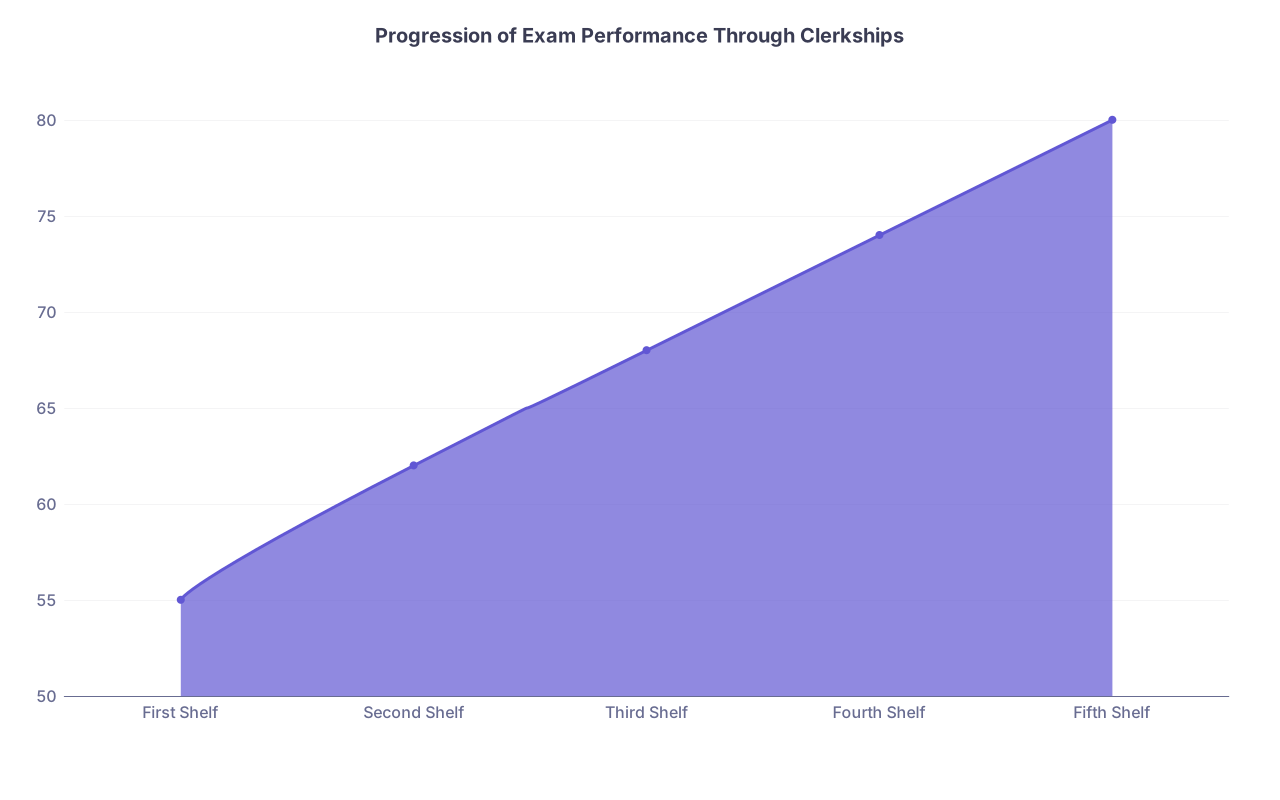
| Category | Value |
|---|---|
| First Shelf | 55 |
| Second Shelf | 62 |
| Third Shelf | 68 |
| Fourth Shelf | 74 |
| Fifth Shelf | 80 |
How Failing a Shelf Hits Your Transcript and MSPE
You’re probably fixated on this: “Will everyone know I failed?”
Reality:
Transcript:
Usually only shows the final clerkship grade: Pass / High Pass / Honors / Fail.
If you remediate and convert a fail to a pass, many schools only show the final pass.
Some will tag it as “Pass (Remediated)” or have a note. Depends on policy.MSPE (Dean’s letter):
This is where stuff can show up, because they’re supposed to be “transparent.”
The MSPE may:
- List that you had to remediate a shelf or rotation
- Mention academic concerns if there was a formal committee involved
- Or barely mention it if it was a one-off with successful remediation
Here’s the thing though: program directors don’t sit there circling every less-than-perfect line with a red pen. They skim. They look for patterns. If the rest of your story is: “Improved steadily, strong clinical comments, good Step 2,” one bad shelf doesn’t dominate the narrative.
It feels like your whole identity right now. It won’t be later.
What It Does to Your Mental State (The Part No One Talks About)
Failing a shelf hurts way more mentally than it does structurally in most cases.
It hits all the greatest hits:
- “I don’t belong here.”
- “Everyone else is smarter.”
- “My evals were lies; I’m actually incompetent.”
- “If I can’t pass a shelf, I’m going to hurt patients someday.”
This is the point where a lot of people start doing self-sabotage stuff: pulling back from asking for help, pretending they’re fine, hiding the failure like a dirty secret. Bad move.
I’ve watched people who failed early shelves do one of two things:
- Turn inward, isolate, feel more ashamed, and then struggle again later.
- Get a little pissed off, get help, adjust how they study, and quietly come back stronger.
You want group #2, obviously. That’s where you protect both your mental health and your residency chances.

The Boring But Critical Part: What You Actually Do After Failing
You can’t control that score now. You can control the response, which frankly is what your school and future programs care about.
1. Get clarity on the policy, not rumors
Stop listening to hallway gossip. Email / meet with:
- Clerkship director
- Student affairs / academic support
Ask very specifically:
- What is the exact cutoff at our school for passing this shelf?
- What are the exact consequences of my score? (Retake? Grade cap? Remediation?)
- How will this appear on my transcript and in the MSPE?
- What’s my timeline for retaking and what happens if I don’t pass the retake?
Get it in writing if you can. Anxiety grows in vagueness. Specifics usually feel less apocalyptic than the story in your head.
2. Do an autopsy on what actually went wrong
I don’t mean “I’m just stupid.” That’s not an answer. That’s lazy self-hate.
Be concrete:
- Did you literally not have enough study time because of hours / commute / life stuff?
- Did you rely on watching videos and never really did questions?
- Did you start studying in Week 4 of a 6-week rotation?
- Did test anxiety completely nuke your performance?
Different problems need different fixes. If you studied 2 weeks total, the fix is not “maybe I should try a new Anki deck.” It’s “I need a structured study schedule from Week 1, with question blocks baked in.”
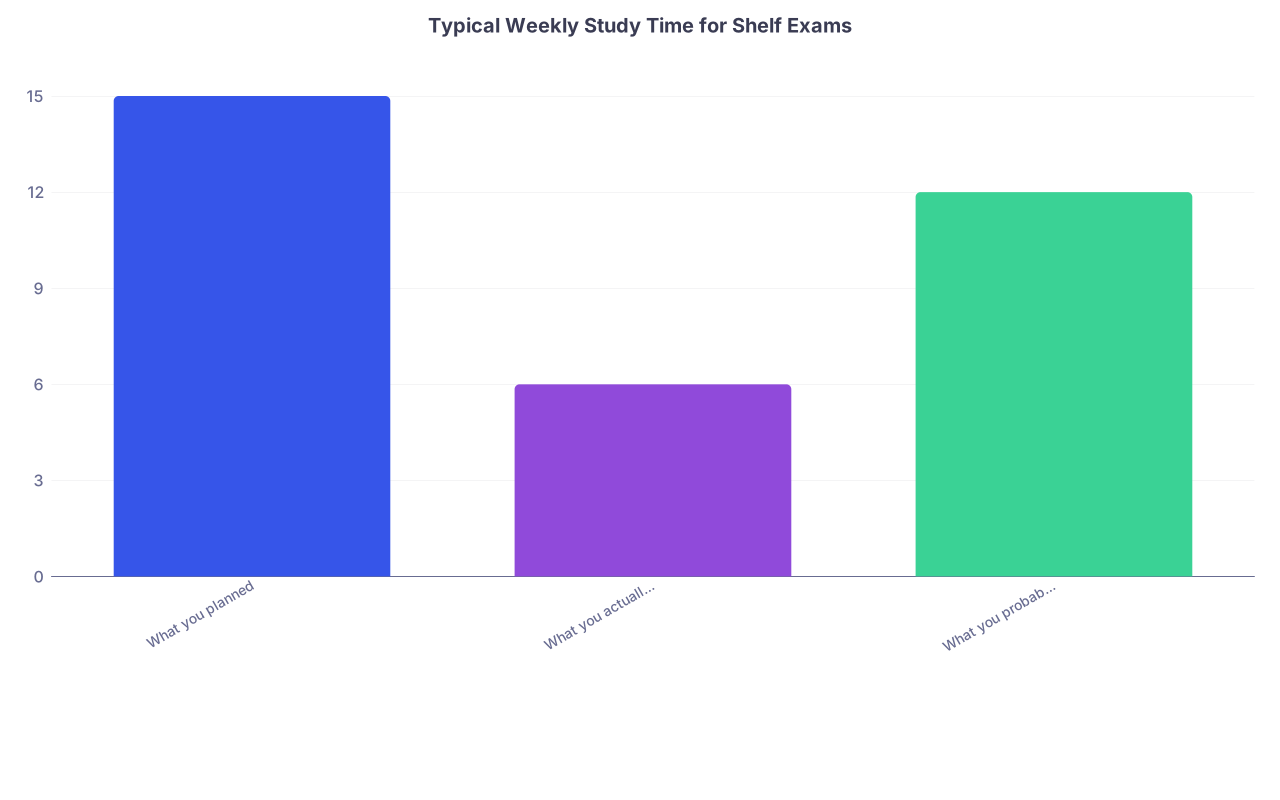
| Category | Value |
|---|---|
| What you planned | 15 |
| What you actually did | 6 |
| What you probably needed | 12 |
3. Change your study approach like you actually mean it
I’ve seen this pattern so many times: someone fails, says they’ll “do better next time,” then repeats the same half-baked strategy with slightly more panic layered on top.
If you failed, your shelf strategy wasn’t working. Period.
Concrete changes that actually move the needle:
- Commit to a primary Qbank (UWorld / AMBOSS) and track blocks daily
- Use one main resource per shelf (e.g., OnlineMedEd, Emma Holliday, or a single text), not five
- Start from week 1, even if day 1 you feel like a lost puppy on the ward
- Block dedicated time every day, non-negotiable (even if it’s just 60–90 focused minutes post-call cycle)
And yes, talk to people who did well on that shelf at your own school. Ask exactly what they did: “How many questions per day? Which resources? When did you start? How did you review wrong answers?”
4. Bring in support early
This is where swallowing pride matters.
Real options:
- Academic support / learning specialist (yes, they exist for med students too)
- Counseling / therapy if the failure cracked something bigger in you
- Peer tutors for specific shelves
- Upperclass students who can walk you through what worked for them
I’ve watched people go from failing one or two shelves to scoring mid-230s+ on Step 2 once they actually got structured support. It’s not a cute story. It’s just what happens when you stop trying to white-knuckle everything alone.

| Step | Description |
|---|---|
| Step 1 | Receive Failing Shelf Score |
| Step 2 | Meet with Clerkship Director |
| Step 3 | Clarify Policy & Consequences |
| Step 4 | Schedule Retake Timeline |
| Step 5 | Analyze Why You Failed |
| Step 6 | Adjust Study Strategy |
| Step 7 | Use Academic & Mental Health Support |
| Step 8 | Retake Shelf |
| Step 9 | Document Improvement & Move On |
| Step 10 | Remediation / Repeat Rotation |
| Step 11 | Pass Retake? |
How This Plays with Residency Applications
Let’s talk about the nightmare in your head: “I failed a shelf; now I’ll never match.”
Reality is more boring and more forgiving.
Program directors mostly care about:
- Step 2 CK score
- Clinical evaluations / comments (are you safe, teachable, normal to work with)
- Patterns of failure vs single events
- Whether you recovered
A single failed shelf, remediated, with:
- Decent Step 2
- Solid letters
- No repeated disasters
…is annoying, but not lethal. Especially in less cutthroat specialties or at mid-tier programs.
Where it hurts most:
- Hyper-competitive specialties (Derm, Ortho, Plastics, ENT, etc.)
- Combined with low Step scores or multiple failures
- Combined with meh clinical comments
In those cases, you may need:
- A backup specialty that’s less score-obsessed
- Strong research or mentorship to vouch for you
- A very clear, concise, non-dramatic explanation: “Had X happen during this rotation, underperformed, remediated successfully, no issues since, see my improved performance in Y and Z.”
If you’re early in third year and just failed your first shelf, you still have so much runway to change how your story looks by the time ERAS goes in.

What If You Fail the Retake Too?
This is the big monster under the bed.
If you fail the original shelf and the retake, here’s what usually happens:
- You’re almost certainly required to repeat the rotation or do some form of intensive remediation
- You’ll be referred to an academic progress or promotions committee
- There’s a decent chance of formal academic probation
That sounds terrifying. It is serious. But it’s still not necessarily game over.
I’ve watched:
- Students repeat a rotation, pass on second try, and still graduate on time or with a minor delay
- People on academic probation dig out, clear it, and match (often into less competitive specialties, but still into residency)
This is the point where pretending you’re fine is no longer an option. You need:
- Full workup for test anxiety, ADHD, depression, burnout – all of it
- Very explicit test-taking support (NBME-style practice, timing, tactics)
- Someone in administration who actually knows you and can advocate for you later
Hard truth: failing both the original shelf and the retake will follow you in your dean’s letter. You won’t be able to hide it. The question is: will it be framed as “repeated, unresolved struggle” or “serious setback with real recovery and sustained improvement”?
You still have some say in that.
If You Haven’t Failed Yet but Are Terrified You Will
You might be reading this preemptively, from the “I think I failed but results aren’t out yet” zone. Or from “I keep borderline passing shelves and I’m terrified the next one will be the one I fail.”
A few protective moves:
- Treat every shelf like it actually matters, because unfortunately, it does.
- Front-load studying in the first 2–3 weeks instead of telling yourself you’ll magically do a sprint at the end.
- Use at least one full NBME practice exam before the real thing if your school lets you.
- If you keep scoring low but technically passing, act now like you’ve already failed one – meaning, change strategy, get help, don’t wait for the official red flag.
Fear is sometimes a warning. The trick is not to let it just paralyze you.
The Short Version: Where You Actually Stand
Let me cut through all of it for you.
If you fail a shelf:
- It’s a problem, not a death sentence. One shelf failure by itself doesn’t end a career.
- Someone will make you retake it or remediate. How you handle that matters more than the initial failure.
- Program directors notice patterns and recovery, not isolated disasters in an otherwise solid record.
You’re allowed to freak out for a night. Then you sit down with real information, change your approach, and get some people in your corner. That “I’m doomed” voice in your head is loud, but it’s not accurate.
You’re not the first person to fail a shelf. You absolutely will not be the last. What matters now is what you do next.