
The night before a new rotation, your brain starts running scenarios you didn't authorize. You rehearse an introduction you'll probably never deliver word-for-word. You check the hospital's website for the third time. You tell yourself it's "just normal nerves," but your chest has other opinions.
Here's what most medical students don't realize: that pre-rotation anxiety isn't a personal failing. It's not a sign you picked the wrong specialty, or that you're weaker than the classmate who seems eerily calm. It's your nervous system doing exactly what it's designed to do when expectations are unknowable. And the attendings running your pre-brief? They already know.
Let me tell you what really happens behind that orientation table.
Fresh Start: What "Pre-Brief Anxiety" Really Is (and why attendings quietly see it as normal)
Pre-brief anxiety is the specific flavor of dread that hits in the 24-72 hours before a new rotation begins. It's not the same as exam anxiety, where at least the content is finite. It's the dread of unknown expectations, a different beast entirely.
Your brain is running safety checks without information. It wants to predict: Will I embarrass myself? Will I be laughed at? Will I look incompetent in front of people whose opinions will follow me into my career? Without data, it fills the void with worst-case scripts.
Program directors and chief residents know this. They've watched dozens of students walk into orientations visibly nervous. Here's the part they don't say out loud: they're not watching your nervous system. They're watching how quickly you recover. A student who stumbles through an introduction, then asks a clean, polite follow-up question? That student looks trainable. A student who performs a flawless cold introduction but freezes when asked an unexpected question? That student looks brittle.
The mismatch fueling most of your anxiety is between your self-narrative ("I must already be ready") and the rotation's actual learning curve ("we're training you to be ready over four to eight weeks"). You've been conditioned by years of academic performance to believe that preparation equals mastery. Clinical rotations don't work that way. Readiness is built through reps, not pre-loading.
And the "first day illusion"? Half the people around you look composed because they have better scripts, not better brains. Many of them are managing the exact same fear with rehearsed small talk and a confident handshake. The difference is packaging, not panic.
The Behind-the-Scenes Truth: What faculty notice in the first 15 minutes (and what they don't)
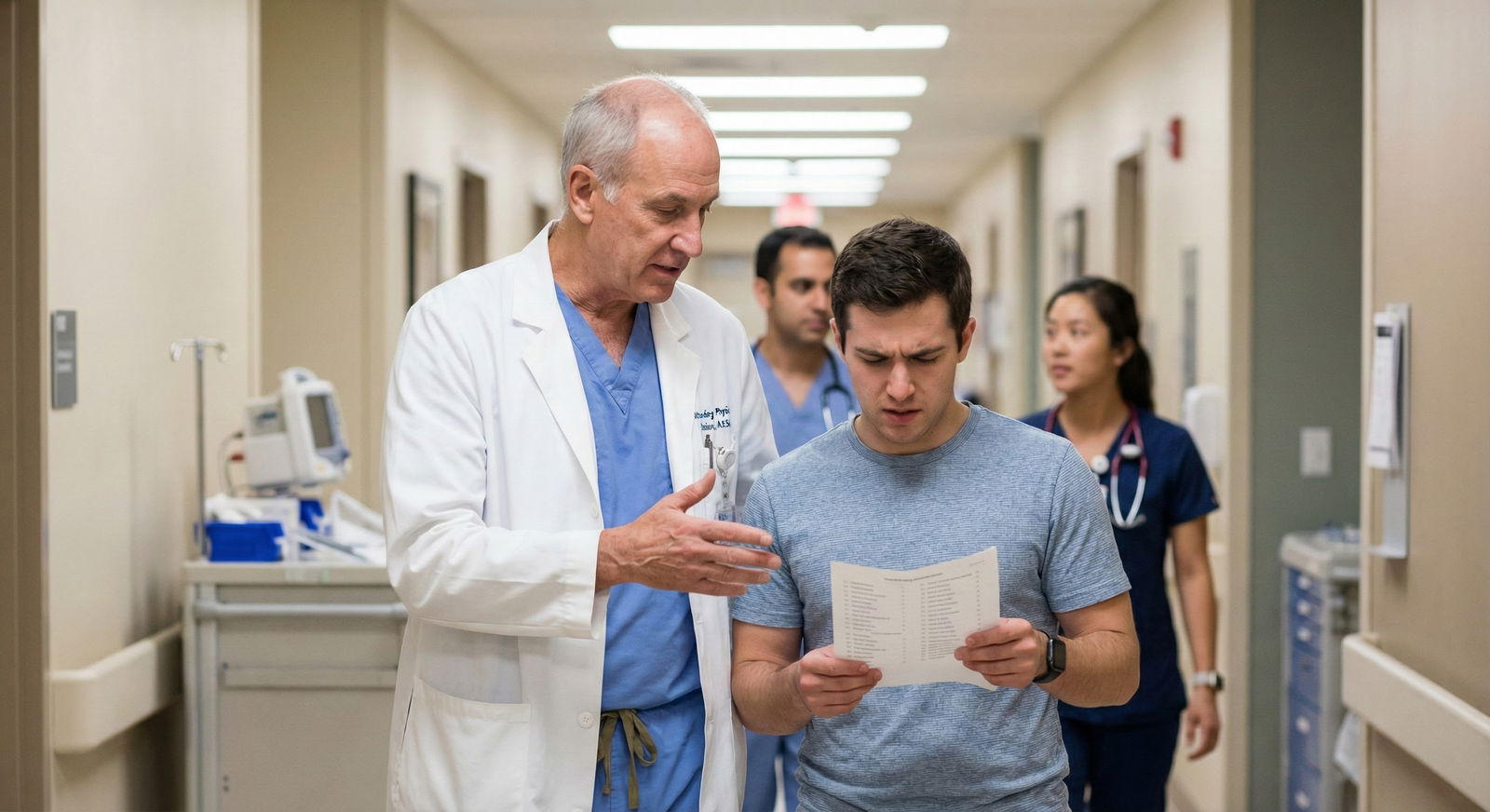
Most attendings spend the first fifteen minutes of any rotation scanning for one thing above all: baseline professionalism. Not brilliance. Not encyclopedic knowledge. Just the core indicators of someone who will be safe to work with.
Here's the actual informal checklist they run, the one never written down anywhere:
- Reliability. Will this student show up, be on time, and follow through on small tasks?
- Communication clarity. Can they speak in coherent sentences when handed a question?
- Ability to ask for help. Will they swallow confusion silently for six hours, or will they surface it early?
- Respect for time and teams. Do they listen when someone is mid-sentence, or interrupt to perform?
That's the list. Everything else is noise.
What they almost never conclude from your visible anxiety: that you're incompetent. Anxious students get labeled as "green but coachable" all the time. Quiet students get labeled as "watching closely" or, occasionally, "hard to read." Cold, dismissive students get labeled as "concerning." But a visibly nervous medical student with intact manners? Faculty have seen hundreds. You're not the anomaly.
When you go silent after an introduction, experienced clinicians read that as processing time, not judgment. Especially if you break the silence with a short, polite ask. "Is there anything I should review before rounds tomorrow?" lands beautifully. It's a question that signals respect for their workflow without bleeding your fear into the room.
The secret expectation nobody verbalizes: you will make at least one procedural or social mistake in the first three days. You'll show up to the wrong floor, forget to introduce yourself to the charge nurse, page someone using the wrong service code, ask a question you should have known the answer to. The attending isn't evaluating whether the mistake happens. They're evaluating whether you recover cleanly, acknowledge it, adjust, move on. Perfection isn't the bar. Recovery is.
Why the pre-brief moment spikes your anxiety: prediction error, uncertainty, and the competence trap
Here's the psychology in clinical terms. Your brain operates on prediction: it takes incoming information, compares it to expected outcomes, and either stays calm (prediction matches) or fires alarm signals (prediction fails). When you walk into a new rotation, you're flooded with input, names, locations, expectations, hierarchies, and you have no internal model to compare it against. That mismatch is called prediction error, and your amygdala treats it as a threat.
The competence trap makes it worse. You've been trained to believe that feeling ready equals being safe. In med school, you can usually reach readiness through study. Clinical rotations break that equation. Readiness there is built through repeated exposure to workflow, communication patterns, and team dynamics, none of which you can pre-load in a textbook. The feeling of "I'm not ready" is therefore a correct signal. You aren't ready yet. You're supposed to build readiness in the rotation itself.
Then there's the hidden comparison effect. You're comparing your internal rehearsal to everyone else's external composure. Their composure is often a practiced script, the same introduction they've given five times before. You're watching polished output and comparing it to your unrehearsed internal experience. That's not a fair comparison, but your brain doesn't care about fairness.
Cognitive distortions show up predictably:
- Catastrophizing: "If I stumble once, they'll remember me as the worst student this service has seen."
- Mind-reading: "They'll all know I'm nervous, and they'll think I don't belong."
- All-or-nothing thinking: "If I don't ace orientation, I'm doomed for the whole rotation."
The action principle that ties this together: your goal isn't to eliminate nerves. It's to reduce uncertainty. Nerves without information spiral. Nerves with a plan get channeled into preparation.
That loop is the entire mechanism. Notice where it breaks: at the moment you take a small action in the actual rotation environment. Even one question answered by a real person on the team starts closing the prediction gap.
The rotation "Pre-Brief Script" that calms you without faking confidence

Insider method: treat the pre-brief as data collection, not an audition. You're there to extract information, not perform competence. That reframe alone calms more students than any breathing exercise.
Here's a three-part script you can adapt in five minutes:
Part 1, Your intention. A short statement of why you're there and what you're hoping to learn. Keep it to one sentence. "I'm on this rotation to develop my approach to [X], and I'm especially interested in [Y]." That's it. No disclaimers, no apologies.
Part 2, Your constraints. A bounded, factual mention of anything relevant. "This is my first rotation on this service," or "I'm coming off [prior rotation] where I focused on [Z]." This primes the team to calibrate expectations without you having to manage their impressions in real time.
Part 3, Your request for feedback. The closer. "I'd appreciate any guidance on how to be most helpful in the first few days." This signals coachability and gives the attending something concrete to respond to.
Examples that work across roles:
- To the attending: "Hi, I'm [name], MS3 starting this rotation. I'm especially hoping to work on my [specific skill]. What's the best way to round with you in the morning?"
- To the resident: "I'm [name], excited to be on the team. If I can take notes, call consults, or do discharge summaries, just point me at them."
- To the nurse or charge: "Hi, I'm the new medical student on [service]. I'll be around this week, please let me know if I'm ever in the way or if there's anything I should know about how the floor runs."
Notice what's missing: excessive apology, nervous laughter, and over-explanation. The script doesn't perform confidence. It performs clarity.
For Day 1, set yourself a micro-behavior plan: one question you'll ask, one task you'll volunteer for, and one clarification about workflow you'll request by lunchtime. That's three small actions. Each one breaks a slice of the uncertainty loop. The question is the signal, not your emotional state when you ask it.
The phrase that converts nervous energy into competence: "I can do X; can you show me Y?" You name a thing you can already handle, then ask for the missing piece. It's structurally humble and operationally useful. Attendings love it because it makes their coaching job easier.
Practical toolkit: reduce uncertainty fast (48-hour plan + in-the-moment regulation)
Program directors consistently praise students who do small, targeted preparation over students who disappear into long anxious spirals. Targeted prep looks like this:
48 hours before pre-brief:
- Identify the rotation's three most common chief complaints or case types. Skim one reference, not five.
- Map the who to ask structure: who's the chief resident, who runs the team, who's the go-to person for logistical questions.
- Confirm logistics: where to park, where to show up, what to wear, when orientation starts.
- Draft your one-page pre-brief script. Write it. Read it twice. Stop.
What to stop doing 12 hours before pre-brief: doom-scrolling old student forums, reading horror stories from three years ago, and over-rehearsing your introduction until it sounds robotic. None of that reduces uncertainty. It just inflates it.
In-the-moment regulation, the 90-second protocol:
- Exhale longer than you inhale for four breaths (in through nose for 4 counts, out through mouth for 6-7 counts).
- Ground with one sensory input, the floor under your feet, the temperature of the air, the weight of your badge.
- Take one concrete action: walk into the room, make eye contact, deliver your opening line.
That's it. The protocol isn't about becoming calm. It's about preventing your nervous system from hijacking your motor skills before you've had a chance to perform.
Asking for feedback in a way that makes attendings' jobs easier: don't ask "how am I doing?" That's open-ended and forces them to construct an evaluation on the spot. Instead ask: "What's one thing I could do differently tomorrow that would make your morning smoother?" Specific, actionable, and respectful of their time.
Support systems: your peers, resident mentors, and course coordinators exist for exactly this. Use them. But don't make your fear their problem. Share what's useful, ask for what you need, and resist the temptation to spiral-vomit anxiety into a group chat at 2 AM. That doesn't help you, and it recruits other people into your prediction error.
The chart is illustrative, not clinical data, but the directional point holds. Targeted prep reduces uncertainty, which reduces anxiety. Rumination generates noise without information, which keeps the prediction error loop running.
Here's the truth to carry forward: your job in the pre-brief is not to be impressive. It's to collect information, signal coachability, and take one concrete action early. That's what breaks the loop. The calm comes after, not before, the first real interaction with the team.
You will still be nervous before your next rotation. That's fine. The question is whether you'll let the nervous system drive, or whether you'll hand the wheel to a one-page script and a single, well-aimed question. The attendings you're about to meet are rooting for you. They just don't say it out loud.