
This article is for educational purposes only. It is not financial advice, not legal advice, and not tax advice. Figures vary by individual circumstances, so consult a qualified professional before acting.
Introduction: The M2 at the Crossroads of Inquiry
It's 9:47 PM. You're an M2. Your renal block final is in 72 hours and you have two browser tabs open that have nothing to do with nephrotic syndrome.
Tab one: Dr. Chen's cancer biology lab wants you to learn Western blots this summer. Tab two: Dr. Patel needs someone to pull 300 charts for his heart failure readmission trial.
Both say they can "get you published." Both are lying a little.
This is the choice that derails more medical students than any exam. Basic science versus clinical trial research. Not which is better science. Which is better strategy for you given the clock you are on.
Here's the framework I use with every student. M2 is for laying pipe. M3 is for surviving. M4 is for packaging. The type of research that wins in each phase is completely different. Get this wrong and you'll spend a year troubleshooting a PCR that never had time to work.
Let's walk it.
M2 Year Phase 1: Autumn Foundations and Lab Selection
At this point in the fall of your M2 year, you should focus entirely on conquering your organ-based block exams while simultaneously vetting potential basic science mentors. Not joining a lab. Vetting.
That distinction matters. I have seen students formally join a lab in October of M2, then fail Cardio. Now they have a bad grade and a PI who thinks they're flaky. Don't do that.
Your job September through November is 90% academic survival. The other 10% is intelligence gathering.
Basic science is slow. Painfully slow. If you think you can walk in May and have a first-author paper by August, you have never waited for IACUC approval. Or for your transgenic mice to breed. Or for that antibody that worked in the postdoc's hands to mysteriously stop working in yours.
It demands runway.
So at this point you should be doing this quiet background work:
Your Fall M2 Basic Science Vetting Checklist:
- Find the money. Search NIH RePORTER for your institution. Filter for R01s in departments you like. Faculty with active R01s have technician support, reagents, and projects that won't die if you leave for rotations. Avoid the brilliant new PI with no funding and one tech who is about to quit.
- Audit the lab culture. Ask current students: How often do you meet with the PI? Is there a lab manager who can actually teach you? How many medical students got their name on a paper in the last two years? Vague answers = red flag.
- Draft a literature review, not a protocol. At this point you should be able to explain your PI's last three papers in plain English. Offer to write a 2-page review of a new sub-topic for them. It shows initiative without committing you to 20 hours of bench work during pulm block.
- Lock down summer funding now. December is too late. Applications for Dean's Summer Research Fellowships, specialty society stipends (AHA, ASCO), and institutional T35s close January-March. If you wait until you "have time to think about it," you will be unfunded.
If you secure this by January, you're ahead of 80% of your class. That gives you February to April to get badged, complete safety training, and watch someone else do your assay once before you touch it.
This timeline is non-negotiable if you want basic science to work for you. No shortcuts.
M2 Year Phase 2: The Summer Pivot to Clinical Trials
At this point (the summer between M2 and M3), you must evaluate whether your basic science project can realistically yield an abstract before ERAS opens. Brutal honesty required.
Here's the math I make every student do on June 15th.
Can you honestly see yourself getting a figure that tells a clean story by early September? If the answer is no, and for 70% of first-time bench students, the answer is no because your Western blot looks like modern art, you need to pivot or supplement. Immediately.
This is where clinical trials research saves your CV.
Clinical work, especially retrospective chart reviews, investigator-initiated database studies, and secondary analyses of existing trial data, is fast. No mating mice. No waiting for cells to double. You get IRB exemption, you get RedCap access, you start pulling data day one.
One of my students spent 6 weeks in a neuro lab trying to optimize a tau staining protocol. Zero usable data. She switched to the stroke service's thrombectomy registry. In the next four weeks she abstracted 180 patients and got a poster accepted at AAN. That's not luck. That's the speed differential.
At this point you should make a deliberate strategic decision:
- If you love bench science and your project is working: Stay. Double down. But add ONE clinical project on the side. You need that rapid win.
- If your bench project is stalled or your specialty is competitive (derm, ortho, ENT, neurosurgery, plastics): Pivot hard to clinical. You need lines on your ERAS, not a noble struggle in a basement lab.
- If you never started basic science: Do not start it now. It is too late. The summer after M2 is a clinical research summer. Period.
Weigh long-term high-impact against short-term reality. A Cell paper in three years does nothing for your match if it doesn't exist in September of your M4 year. Program directors can't read your potential. They read your PubMed.
Which brings us to the data:
Those numbers aren't made up. 18 months average for a bench medical student to first author or co-author. 6 months for a retrospective clinical study. When your application deadline is 15 months away, that difference decides whether you have three publications or zero.
M3 Transition: Maintaining Momentum During Core Rotations
At this point during your core clinical rotations, bench research must take a back seat unless you have dedicated technician support. I will say it louder: Get out of the lab during M3.
Your surgery rotation will eat you alive. You are not pipetting after a 14-hour day in the OR. You are sleeping. If your project depends on you personally feeding cells every two days, it will die. And your PI will be annoyed.
Clinical trial work, however, fits perfectly into M3. You are already in the hospital. You are already seeing the exact patients you need for enrollment or chart review.
At this point you should reframe your rotations as data collection opportunities:
- On Internal Medicine: Ask your attending if you can pull data on that weird hyponatremia cohort you both noticed. That's a case series.
- On Pediatrics: Log that QI project on asthma readmissions into a pre/post intervention abstract.
- On your protected afternoons: Do your data entry. Not at 11 PM.
Set a boundary that actually works. Here is the rule that protects your shelf scores:
The 3-Hour M3 Research Rule: You get one 3-hour block per week. Sunday morning, Wednesday evening, whatever. Outside of that block, you do not open RedCap. You do not email your PI. You study for shelf. If you can't progress on 3 hours a week, your project scope is too big. Slice it in half.
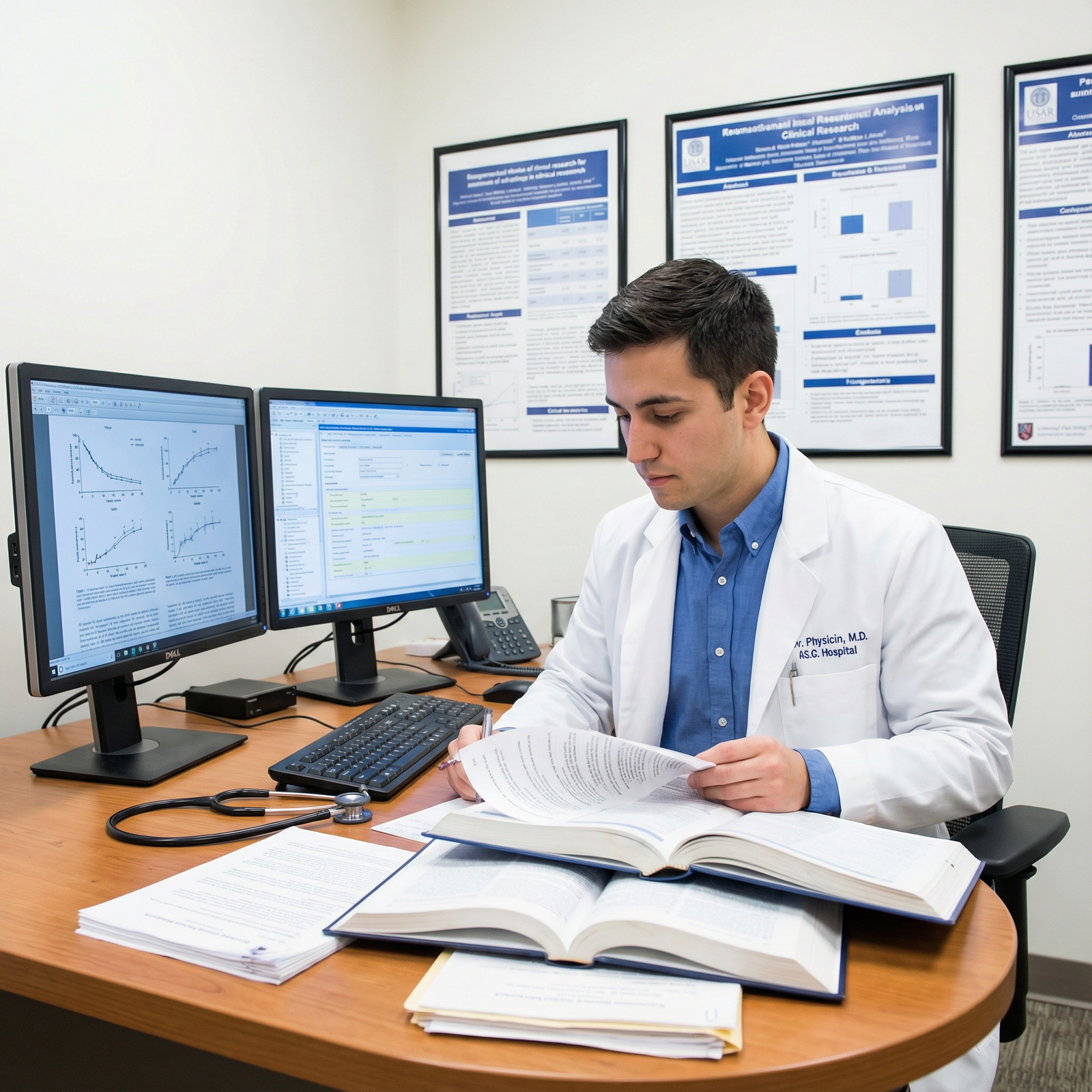
This phase is also when I tell students to learn meta-analysis. Unsexy. Incredibly high yield. You can do a full systematic review from your apartment, no IRB, no lab, and crank out a solid second-author paper while on OB-GYN. Exactly what you need.
M4 Year: Finalizing the Portfolio for Match Day
At this point at the start of your M4 year (May/June), your research portfolio is locked in for ERAS submission, no new bench experiments will save you.
Stop starting things. Seriously. Every year I watch an anxious M4 in June join a brand new basic science project thinking it will impress programs. It won't. It will be listed on ERAS as "ongoing research" which is code for "I have nothing to show."
What residency programs want on September 15th is finished product. Abstracts presented. Papers published or accepted. That means your summer before M4 is for polishing, not discovering.
At this point you should shift your entire focus to these high-yield conversion tasks:
- Turn every poster into a manuscript. You have three posters? At this point you should have three manuscripts in submission. Even a short letter to the editor counts more than "poster presented."
- Write case reports from your M4 electives. Your sub-I in cardiology has a patient with a bizarre complication? That's a 2-week turnaround case report in Cureus or BMJ Case Reports. Programs love it because it shows clinical curiosity.
- Update old clinical trial data. If you helped on a prospective trial as an M2, email the fellow now: "Can I update the dataset and help write the one-year follow-up abstract?" Instant second pub, minimal work.
When you get to interviews, framing matters. If you're applying ortho and you did 2 years of cartilage biology basic science plus 3 clinical database studies, lead with the basic science story for research-heavy programs, lead with clinical volume for community programs. Know your audience. The bench work shows commitment, the clinical work shows productivity. You want both lines in your story.

You can't rewrite the last two years. You can absolutely make the last two years look coherent.
Summary: Play the Clock, Not Just the Science
This isn't about basic science being better than clinical trials. It's about timing.
Start basic science inquiries no later than the fall of M2 to account for institutional delays and slow assay optimization.
Pivot or supplement with clinical trial research by M2 summer if your residency match strategy requires rapid, high-volume publication counts.
By M4, focus exclusively on polishing existing abstracts and manuscripts rather than starting new investigative pipelines.
The students who match best aren't always the smartest in lab. They're the ones who understood which game to play when. Don't bring a pipette to a CV line fight two months before ERAS is due.