
You are three months from submitting ERAS. Your CV has that lonely “Research” header with…one line. A poster from M2 summer that you barely remember. People around you are talking about “getting on a clinical trial,” “needing QI to show systems thinking,” or “real research means bench work.”
And you’re stuck on the real question:
Not “what can I get,” but “what does each kind of research actually signal to PDs?”
That is the right question. Because at this point in the game, you are not building a Nobel career. You are sending signals. And different research types send very different messages.
Let me break this down specifically.
What Program Directors Actually Read From Your Research Section
Before comparing clinical trials vs QI vs basic science, you need the decoder ring PDs are using.
When I sit in rank meetings or review application packets, research is rarely about the raw count of pubs. It is about what the work implies about how you will function as a resident.
Here is what most PDs and faculty are subconsciously indexing when they see your research:
- Can you work on hard, long-term projects without hand-holding?
- Do you understand data, evidence, and uncertainty—or do you just memorize UpToDate?
- Do you fit the culture of this specialty? (Academic? QI-heavy? Outcomes-focused?)
- Are you likely to produce scholarship during residency? (For programs that care.)
- Can you see a project through to completion—poster, abstract, manuscript?
And under pressure, they compress all of that into a few quick heuristics:
- Type of research
- Setting (bench, clinical department, QI office, etc.)
- Role (first author vs middle of 17 names)
- Timeline (spans more than a few weeks?)
- Output (pub, abstract, oral, or just “project in progress”)
So let’s map each research type to the signals it sends.
Clinical Trials: “I Can Operate in the Real Clinical Research Machine”
By “clinical trials,” I mean prospective clinical research: interventional or observational, human subjects, IRB-approved, often industry-sponsored or part of a large academic group. That includes drug/device studies, large registries, multicenter trials, and robust retrospective chart review with actual protocol and data structure.
This is the most “visible” research to residency programs because it happens in their world: patients, clinics, hospital workflows.
What Clinical Trial Work Signals
When a PD sees several clinical projects or trial-related work, they tend to assume:
You understand how clinical questions become structured studies
You have at least a minimal grasp of:- Inclusion/exclusion criteria
- Data collection and endpoints
- Outcomes and confounders
- IRB and regulatory oversight
They do not think you are an expert. But they see that you are not starting from zero.
You can manage tedious, longitudinal tasks with real patients
Screening logs. Data entry. Follow-up calls. Querying REDCap.
None of this is glamorous. But it maps almost perfectly onto residency habits:- Follow-through
- Documentation
- Working in teams
- Respecting protocol
You understand how evidence is generated, not just consumed
When residents argue about “this trial is flawed because…,” clinical research experience lets you participate intelligently. Programs in IM, cards, heme/onc, pulm/crit absolutely care about this.You are safer with patient-level data
Trials require HIPAA awareness, good judgment, and respect for protocol. If your letter writer or PI comments on your attention to detail with patient data, that is worth quite a lot.
What Strong Clinical Research Looks Like on Paper
Let’s be concrete. These look strong:
- “Sub-investigator on multicenter RCT in HFrEF, assisted with patient screening, consent, and data entry; co-author on abstract presented at ACC.”
- “First author on retrospective cohort study of 500 stroke patients evaluating door-to-needle times; oral presentation at regional neurology meeting.”
These are weaker signals:
- “Volunteer: collected survey responses for clinic-based study” with no outcome
- “Research assistant” with no listed output and no clear project ownership
The type of clinical research matters less than whether you can show:
- A clear role
- A finished product (poster, abstract, paper)
- A sustained timeline (months, not weekends)
Specialties Where Clinical Research Carries Extra Weight
Clinical research is especially “on brand” for:
- Internal medicine (and all its subspecialties)
- Neurology
- Emergency medicine
- Anesthesiology
- OB/GYN
- Radiation oncology
- Many surgical fields, if outcome-based
For these, clinical research says: I am already thinking like a clinician who uses and generates data.
Quality Improvement (QI): “I See the System, Not Just the Patient”
Here is the biggest misunderstanding I see: students think QI is the “easier” or “lesser” form of research. Some PDs would disagree. Strongly.
Good QI is not “we made a new poster for handwashing.” It is structured, iterative, data-driven work aimed at changing processes and outcomes in a real system. Think Plan-Do-Study-Act (PDSA) cycles, run charts, pre-post intervention analysis, sustainability planning.
What QI Work Signals
When done properly, QI projects send a very specific and valuable message:
You think in terms of systems, not just individual patients
That is pure gold to:- IM programs with strong hospitalist groups
- Surgery programs focusing on ERAS pathways, LOS reduction
- EM programs obsessed with door-to-doc times and throughput
- Pediatrics programs running vaccination or readmission initiatives
QI means you can identify bottlenecks, design interventions, and measure impact.
You understand how change actually happens in hospitals
Protocols. Nursing workflows. IT limitations. Human behavior.
A PD sees QI and thinks: This person will be useful on committees, M&M conferences, and institutional initiatives.You care about safety, efficiency, and patient experience
That aligns perfectly with ACGME core competencies and CLER (Clinical Learning Environment Review) priorities. PDs are graded, in part, on exactly this.You can complete a project from idea → intervention → measurement
QI requires a start, a change, and a follow-up measurement. If you show that full arc, you are already structurally ahead of the many “research in progress” lines that never produced anything.
What Strong QI Looks Like on a CV
Strong examples look like:
- “Led QI project to reduce unnecessary daily labs on general medicine ward; PDSA cycles over 6 months; reduced CBC/BMP ordering by 28% without increased adverse events; presented at institutional QI day.”
- “Team member on ED door-to-antibiotic time project for sepsis; conducted root cause analysis, redesigned triage prompts; abstract accepted to SAEM.”
Weak QI is what I would call “overhead work”:
- Rewriting a guideline without measuring anything
- Educational posters with no data before/after
- “Participated in patient satisfaction initiative” with no concrete role or outcome
When QI Matters More Than Classic Research
QI gets special weight in:
- Community and hybrid community-academic programs
- Hospitalist-heavy IM programs
- EM, anesthesia, and surgical specialties focused on throughput, safety, OR efficiency
- Programs that explicitly advertise “resident QI tracks” or “patient safety focus”
If you are applying to a high-academic, R01-heavy specialty (radiation oncology, some dermatology, top-tier neurosurgery), QI alone will not substitute for rigorous clinical or basic science output. But it will still be viewed positively as “extra” rather than irrelevant.
Basic Science: “I Can Handle Deep, Abstract, Methodologically Tough Work”
Bench research—cell culture, animal models, molecular pathways, bioinformatics pipelines—signals something very different. It is farther from day-to-day clinical life, but it screams certain traits that PDs, especially at academic centers, recognize immediately.
What Basic Science Work Signals
You can tolerate delayed gratification and frustration
Western blots that fail for weeks. Mice that die unexpectedly. Pipettes that betray you.
Doing bench work for 1–2 years signals: I can grind on complex problems without immediate payoff. That maps surprisingly well onto exam-heavy, cognitively dense specialties like neurology, radiology, radiation oncology, pathology, some IM subspecialties.You understand rigorous experimental design
Controls. Power calculations. Replicates. Blinding.
A PD will assume that if you handled this, you will understand why p-values are not sacred and how bias creeps into any study. Especially valued for programs where residents are expected to write manuscripts frequently.You can engage with high-level literature
Bench-heavy fields (heme/onc, rheumatology, some GI, cards) like residents who can read JCI or Nature papers without drowning. Your bench background hints at that.You can function in high-intensity academic environments
Long hours, demanding mentors, grant pressures. If you produced first- or second-author papers from a strong basic lab, faculty see that as a direct predictor that you can handle clinical research or serious academic productivity later.
When Basic Science Backfires or Misfires
There are two common mismatches.
First, when the research is very strong but completely disconnected from the specialty narrative.
Example: Multiple first-author CRISPR immunology papers, but you are applying to community-focused family medicine with no story tying that past to your future. Programs may think:
- “Are we just a backup?”
- “Is this person going to be happy doing bread-and-butter outpatient medicine?”
Second, when students oversell shallow or short-lived basic work:
- One summer of pipetting that resulted in nothing, framed like a major discovery
- “Co-author” on a paper where your role was essentially washing glassware
Faculty who have done real bench work can smell inflated claims quickly. That hurts more than having less research.
Where Basic Science Shines the Brightest
It plays extremely well in:
- Radiation oncology
- Dermatology (especially for top academic places)
- Neurology (particularly neuroimmunology, neuro-oncology, movement disorders)
- Internal medicine with academic focus (cards, GI, heme/onc, pulmonary, rheum)
- Neurosurgery and some orthopedics programs with research infrastructure
- Pathology, medical genetics, physician-scientist tracks (PSTP)
In these arenas, strong basic science is not “nice to have.” It is a direct signal: this person may be future faculty.
Side-by-Side: What Each Research Type Says About You
Let’s make this explicit.
| Research Type | Primary Signal | Best Fit Programs | Risk If Misaligned |
|---|---|---|---|
| Clinical Trials | Data-driven clinician | Academic IM, neuro, EM, OB, surg | Looks superficial if no output |
| QI | Systems and safety thinker | Community, hospitalist, EM, surg | Dismissed if no real data |
| Basic Science | Future academic / deep work | R1-heavy, subspecialty-focused | Feels off-brand for some fields |
This is not absolute. But it is a realistic approximation of how faculty talk in actual selection committees.
How Research Type Interacts With Specialty Choice
Now the useful part: what you should prioritize or emphasize depending on your target field. I will not sugarcoat this.
Internal Medicine (Categorical, Academic-Leaning)
What signals best:
- Clinical research with meaningful outcomes
- QI with strong metrics (readmissions, LOS, sepsis care, anticoagulation, etc.)
- Basic science if clearly tied to IM-adjacent topics (immunology, metabolism, CV, cancer)
Red flags:
- Only basic science in something far removed (e.g., plant biology) with no narrative about how that trained your thinking and why you switched
- Zero QI or clinical exposure in a program that flaunts “systems-based practice” everywhere on its website
If you have:
- Clinical trials + QI → you look like a future chief/hospitalist leader
- Clinical + basic → you look like future academic subspecialist
- Only QI → you still look good for many solid IM programs, especially community and hybrid
General Surgery
What lands:
- Clinical outcomes research: complications, ERAS protocols, surgical techniques, trauma registries
- QI on peri-op care, OR throughput, infection reduction, VTE prophylaxis
- Basic science in wound healing, oncology, biomechanics for high-academic programs
Weak combinations:
- Only basic science in something very non-surgical, with no surgical exposure
- Only QI that is obviously lightweight (“we made new signs”) with no metrics
Strong narrative:
“I care about processes, complication reduction, and perioperative outcomes” → QI + clinical outcomes is ideal.
Emergency Medicine
EM PDs love:
- Clinical projects related to throughput, sepsis, pain management, ultrasound use, disposition decisions
- QI on door-to-doc, LA/antibiotic times, ED boarding, etc.
They view this as directly translatable to ED life.
Basic science? Rarely a selling point unless:
- You are applying to a research-heavy EM program (e.g., major academic centers)
- You can clearly tie it to why you now care about population-level or acute care questions
If you are short on research, one solid ED QI project with pre/post metrics and a poster at a regional SAEM chapter can be enough to send a strong “I get EM systems” signal.
Neurology
Here, basic science and clinical research both play well.
- Clinical: stroke outcomes, epilepsy, neuroimaging, neuro-COVID, movement disorders
- Basic: neurodegeneration, neuroimmunology, ion channels, synaptic physiology
- QI: stroke codes, TPA door-to-needle, EEG utilization
If you have solid basic science in neuroscience and can express a coherent story about wanting to apply those concepts to patient care, you fit the “academic neurology” archetype very well.
Family Medicine, Pediatrics, Psychiatry
These fields are more heterogeneous.
Family med:
- Primary signals: commitment to population health, continuity, underserved care
- Research that reflects that: QI in primary care clinics, chronic disease management, preventive care, behavioral health integration
- Bench research with no link to primary care? Harder sell unless you frame it very well.
Pediatrics:
- QI on vaccination, asthma pathways, NICU protocols, antibiotic stewardship
- Clinical research on chronic pediatric diseases, neonatology, behavior/development
Basic science in immunology or genetics can be a plus at academic places, but you must connect the dots.
Psychiatry:
- Clinical work on psychopharmacology, substance use, health services research
- QI on safety, restraint use, outpatient follow-up, ED psych boarding
- Basic neuroscience and imaging are big pluses at research heavy programs.
How Depth and Output Modify the Signal
Type of research is only half the story. Depth and product matter more than students think.
Hierarchy of Signal Strength
Roughly, for most programs:
- 2–3+ projects with at least one peer-reviewed paper, especially first- or second-author
→ “Serious about scholarship” - 1–2 projects with posters/orals at national meetings
→ “Capable of completing real work” - Single project with local poster only
→ “Exposed, but unclear if independent” - “Research experience” with no described output
→ “Probably unproductive / low responsibility role”
Now overlay type:
- Serious QI with outcomes + presentation > superficial clinical work with no endpoint
- One well-executed clinical project > six half-finished “in progress” entries
- High-impact basic science paper > any amount of token clinical data entry
Programs do not say this explicitly in brochures, but in ranking rooms, people absolutely talk like this.
Time Investment vs Signal
This is roughly how much “time burn” you are trading for signal:
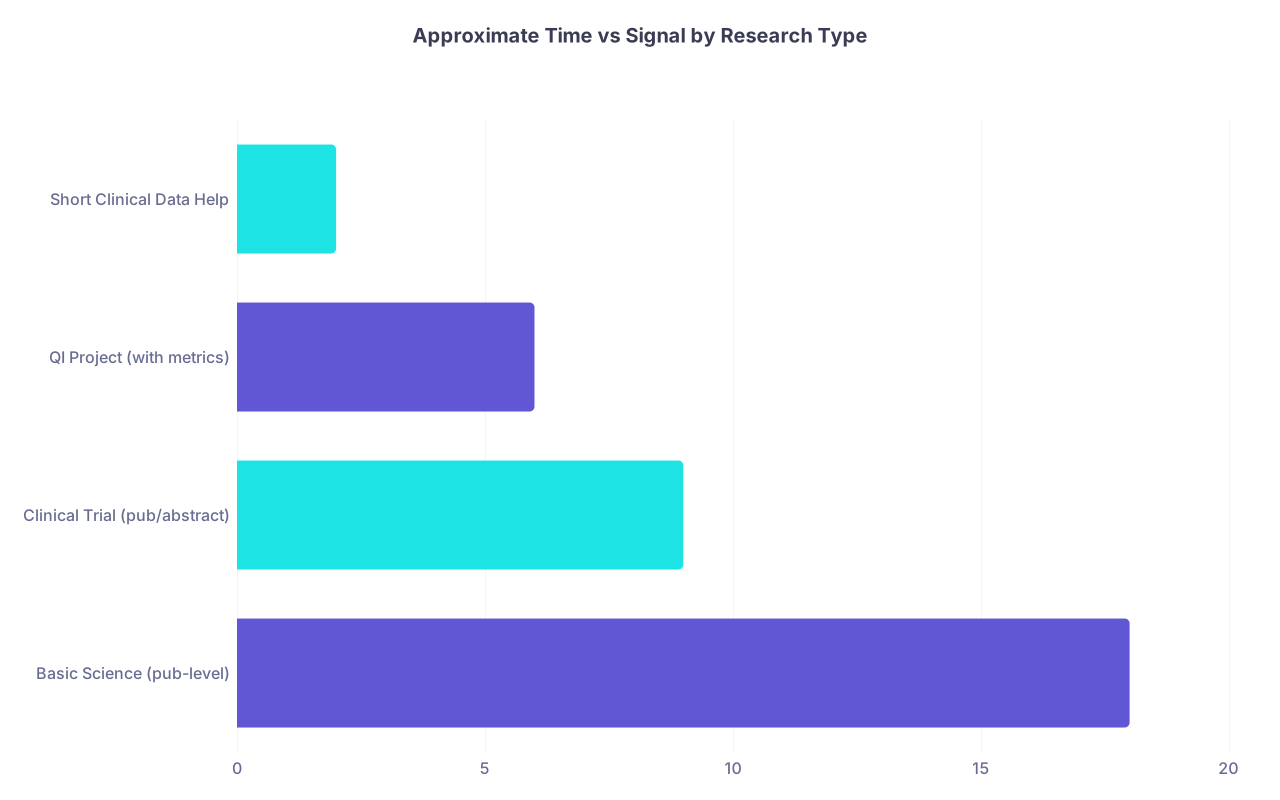
| Category | Value |
|---|---|
| Basic Science (pub-level) | 18 |
| Clinical Trial (pub/abstract) | 9 |
| QI Project (with metrics) | 6 |
| Short Clinical Data Help | 2 |
Values ~ months of sustained involvement equivalent. Interpret:
- Bench work with papers often requires a dedicated research year or long-term involvement.
- Clinical and QI can, with focused mentorship, produce posters or abstracts in 6–12 months part-time.
- Short “helping” experiences deliver low signal unless clearly linked to an output.
Matching Your Research Type to Your Story
You do not need all three. You need coherence.
If You Are Heavy on Basic Science
You should:
- Explicitly connect skills: experimental design, statistics, perseverance, literature fluency
- Show at least some clinical engagement: shadowing, clinical electives, maybe one clinical or QI project
- Tie it to your chosen specialty’s academic side: “I want to ask translational questions in X.”
You should not:
- Ignore the gap between your bench-heavy past and a very clinical, community-focused future
- Overstate QI or clinical roles to “balance” your profile; faculty will notice
If You Are Heavy on QI
You should:
- Lean into systems language: safety, reliability, high-value care, outcomes
- Emphasize metrics and sustainability: “We reduced X by Y% over Z months”
- Align explicitly with specialty values: “In EM, efficient systems literally determine survival.”
You should not:
- Present weak, unmeasured QI as equivalent to large RCTs; be honest about scope but clear on impact
- Hide QI under vague “research experience” headings—call it QI and own it
If You Are Heavy on Clinical Trials/Clinical Research
You should:
- Emphasize patient-centered questions, guideline-relevant outcomes, and how this shaped your thinking
- Highlight your role in design, data interpretation, manuscript drafting, not just “I consented patients.”
- Tie specific projects to sub-interests within the specialty (e.g., cardiology pathways, stroke protocols).
You should not:
- List 8 “ongoing” clinical projects with zero completed outputs and expect them to carry your app
- Pretend data entry alone equals independent scholarship; frame it properly as exposure and teamwork
Where Students Commonly Miscalculate
I see the same three errors repeatedly.
Chasing “prestige” over fit
Doing a year of hardcore bench cancer immunology, then trying to sell yourself as primarily a lifestyle-driven rural FM applicant. That disconnect raises questions about judgment and authenticity.Overvaluing “busy work” research
You do small tasks on five projects, list them all, but have no posters, no abstracts, no narrative ownership. Faculty assume: this person says yes to things but does not finish them.Ignoring the power of a single, well-executed QI project
I have seen applicants with one solid, data-driven QI project get more respect in EM and IM committee rooms than another with five flimsy “chart reviews in progress.” Because one shows closure and measurable impact; the other shows chaos.
How to Decide What to Do Next (Even Late in the Game)
Let’s say you are 4–8 months from ERAS and trying to maximize signal.
Step 1: Be Honest About Your Target Programs
Academic-heavy, NIH-funded, big-name?
You want:
- Clinical research with real outputs
- Or basic science with substantial depth
QI can be secondary.
Community or hybrid, strong clinical training, less research branding?
You want:
- A solid QI project with metrics
- Or practical clinical research tied to patient flow, safety, or common conditions
Basic science helps less unless you sell it well.
Step 2: Pick One Lane to Do Well, Not Three to Do Badly
You have finite time.
- If you already have one bench paper:
Add one clinical or QI project to show clinical/system relevance. - If you have zero research:
A focused QI or small clinical outcomes project with a reasonable chance of a poster by ERAS is more valuable than attempting to “start bench from scratch.”
Step 3: Aim for a Concrete Output, Not Just “Experience”
Posters at national or regional meetings are extremely underrated. They:
- Are easy for PDs to “count”
- Show completion
- Let your letter writers highlight your role

| Step | Description |
|---|---|
| Step 1 | Assess Current Research |
| Step 2 | Push Toward Poster/Abstract |
| Step 3 | Find QI or Clinical Mentor |
| Step 4 | Define 1 Focused Question |
| Step 5 | Collect Limited, Clean Data |
| Step 6 | Prepare Local/Regional Poster |
| Step 7 | Reframe as Longitudinal Effort, Emphasize Role |
| Step 8 | Any Existing Project? |
| Step 9 | Output Before ERAS? |
Do not underestimate the value of a clear story: “I joined this project, took ownership of this piece, and here is the product.”
Putting It All Together
Each research path has a voice.
Clinical trials say: I think like a data-using clinician, and I know how evidence is built.
QI says: I see systems, I care about safety and efficiency, and I can move needles in real workflows.
Basic science says: I tolerate complexity and delayed payoff, and I am comfortable in deep academic spaces.
Your job is to make those signals align with the specialty you claim to want and the type of program you are targeting.
If you are early, you can still choose your lane strategically. If you are late, you can sharpen what you already have—clarifying roles, finishing outputs, and tightening the story instead of chasing new, shallow lines on a CV.
You are not just filling a “Research” section. You are telling programs, in code, what kind of resident—and future physician—you are likely to be.
Get that right, and you are not just padding an application. You are setting the stage for the kind of training environment that will actually fit you.
With that alignment in place, the next real task is how you talk about this work—in your personal statement, in interviews, and in letters. That is where the signal either comes through clean or gets lost in noise. And that conversation comes next.