
Research and Residency: Can a Strong Publication Really Boost Your Chances?
The residency application process has become increasingly competitive across nearly all specialties. Strong board scores and solid clinical evaluations are no longer enough on their own—programs now look closely at what else you bring to the table, especially your research experience and publications.
For many medical students, the critical question is: Can one strong publication meaningfully improve my chances of matching into a good residency program? The answer is nuanced. Research and publications can absolutely strengthen your residency application and open doors—especially in academic and competitive fields—but how you engage in research and how you present it often matters more than simply checking the “publication” box.
This guide breaks down the role of research in residency applications, the true impact of strong publications, what residency programs actually expect, and how to leverage your research experience for maximum effect in interviews and beyond.
Why Research Experience Matters in Residency Applications
Research as Evidence of Academic Curiosity and Critical Thinking
Residency programs seek trainees who will not only provide excellent patient care but will also think critically, evaluate evidence, and adapt to evolving medical knowledge. Research experience is one of the clearest signals of these qualities.
Engaging in research helps you:
Develop rigorous critical thinking skills
- You learn to formulate clinical questions, design studies or QI projects, analyze data, and interpret results.
- This mirrors everyday residency tasks: assessing incomplete data, weighing competing diagnoses, and making evidence-based decisions under uncertainty.
Practice evidence-based medicine in real time
- When you’ve helped generate data, you better understand the strengths and limitations of evidence you rely on.
- You become more discerning about guidelines, study designs, and how to apply research findings to individual patients.
Strengthen your problem-solving abilities
- Every research project involves obstacles—IRB delays, recruitment issues, statistical challenges.
- Demonstrating that you stuck with a project and helped troubleshoot problems shows resilience and initiative—traits residency program directors value highly.
Research as a Marker of Professionalism and Follow-Through
Residency programs are flooded with applicants who claim to be “hard-working” and “dedicated.” Research provides concrete evidence that you follow through on complex, long-term tasks.
On your CV and in ERAS, research experience can show that you:
- Commit to projects over months to years
- Work within a team and meet deadlines
- Take ownership of a specific component (data collection, analysis, drafting manuscripts)
- See work through to completion (abstracts, posters, presentations, publications)
This is why even in-progress or unpublished projects can still be valuable—if you can clearly explain your role and what you learned.
Networking, Mentorship, and Strong Letters of Recommendation
One of the most overlooked benefits of research experience is the access it gives you to:
- Faculty mentors who are often well-known in their specialties
- Collaborators across disciplines and institutions
- Opportunities for presentations at local, regional, national, or international conferences
These relationships can lead to:
- Powerful letters of recommendation from respected academicians
- Advocacy behind the scenes when selection committees discuss applicants
- Long-term career development opportunities such as fellowships, specialty exposure, or multi-year research collaborations
In competitive fields (e.g., dermatology, orthopedic surgery, radiation oncology, plastic surgery), strong letters from research mentors can be a deciding factor when programs choose between otherwise similar applicants.
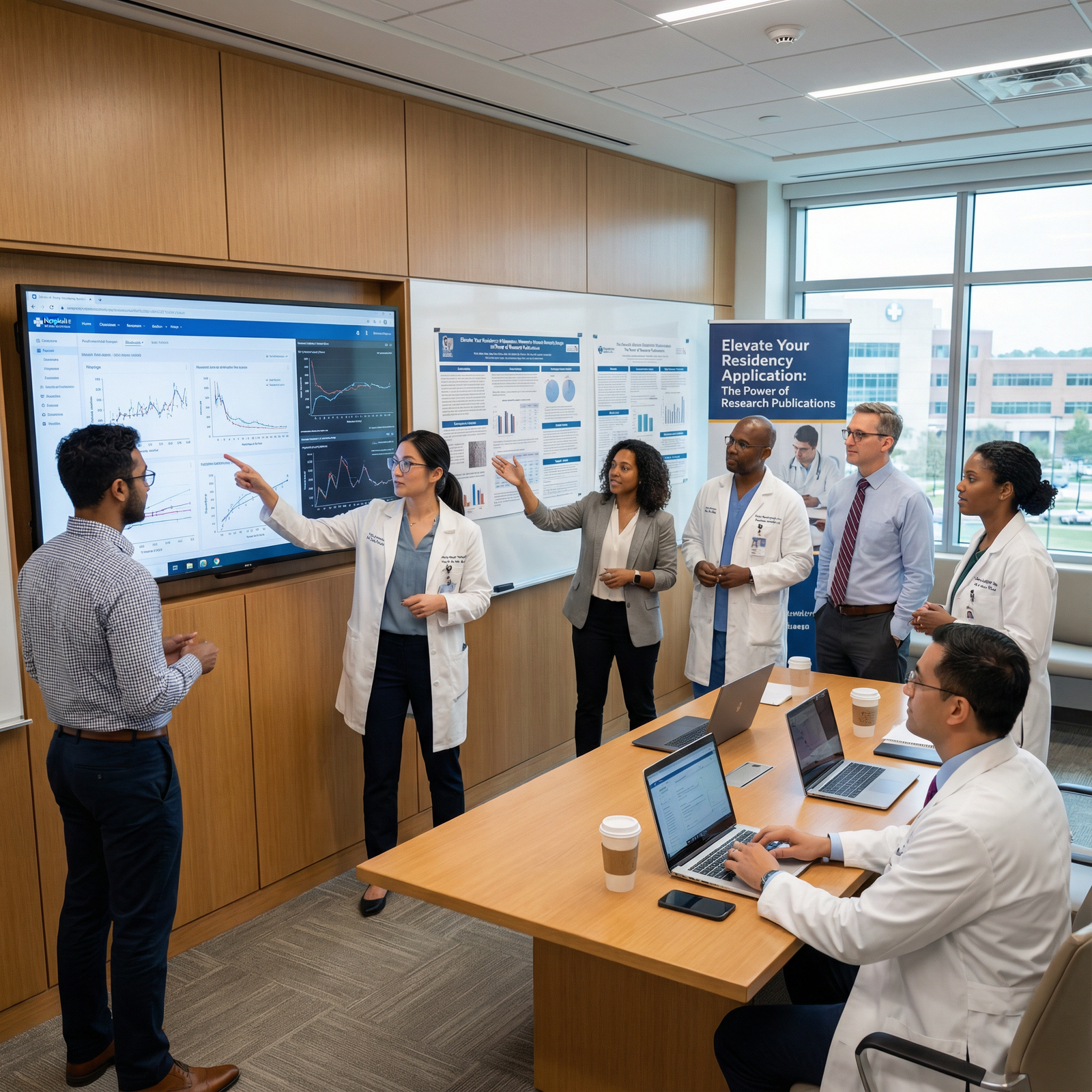
The Impact of Publications on Your Residency Application
Quality Over Quantity: How Programs Actually View Publications
When program directors evaluate the Research Experience and Publications sections of your Residency Application, they are not just counting citations. They are asking:
- Is there evidence of meaningful involvement?
- Does this work show depth, not just breadth?
- Does the research align with our program’s mission or specialty?
- Has the applicant shown the ability to produce scholarly output?
A single high-quality publication—especially in a reputable, peer-reviewed journal—can be more impressive than multiple low-impact or predatory journal publications. What matters most:
Journal Quality and Relevance
- Peer-reviewed, indexed journals (e.g., PubMed) carry more weight.
- Specialty-aligned journals (cardiology for IM applicants, neurology/neurosurgery journals for neuro applicants, etc.) are especially valuable.
Your Authorship Position and Contribution
- First-author or second-author roles suggest substantial involvement in study design, data analysis, and manuscript writing.
- For middle-author roles, be ready to explain your specific contribution clearly in interviews.
Type and Scope of Work
- Original research, systematic reviews, and meta-analyses often carry more academic weight than simple case reports or brief letters.
- That said, case reports can still be very useful, especially if they:
- Are related to your intended specialty
- Sparked meaningful learning or changes in your clinical thinking
- Allowed you to present at national meetings
Beyond Journals: Posters, Oral Presentations, and Abstracts
While full-length publications are ideal, other forms of scholarly output can also strengthen your profile:
- Poster presentations at national or international conferences
- Oral presentations or podium talks
- Published abstracts in conference supplements
- Quality improvement (QI) projects implemented on your clinical service
- Educational research, such as curriculum development or simulation studies
Residency programs often look positively on applicants who have:
- Taken a project from conception to presentation
- Gained feedback from peers and experts
- Reflected on how the research influenced their clinical practice or understanding
Diversity of Research Experience: Clinical, Basic Science, and QI
A diverse research portfolio can show intellectual flexibility, but it does not have to be extensive to be effective. Valuable forms of research include:
- Clinical research: Retrospective chart reviews, prospective cohorts, clinical trials
- Basic science research: Bench work, animal models, molecular studies
- Translational research: Projects that bridge lab findings with clinical application
- Quality improvement (QI): Projects focused on patient safety, workflow efficiency, or guideline adherence
- Medical education research: Studies on teaching methods, learner outcomes, or curriculum change
For many residency programs (especially in community or clinically focused settings), QI and outcomes projects may be particularly compelling because they show direct relevance to patient care and systems-based practice—core ACGME competencies.
What Residency Programs Expect from Research Experience
Different Specialties, Different Expectations
The weight placed on research varies substantially by specialty and program type.
Highly research-driven specialties typically expect more robust research portfolios:
- Dermatology
- Radiation oncology
- Plastic surgery
- Neurosurgery
- Orthopedic surgery
- Otolaryngology (ENT)
- Certain Internal Medicine subspecialty pathways (e.g., physician-scientist tracks)
More clinically focused specialties may place moderate but meaningful value on research:
- Internal Medicine
- Pediatrics
- Emergency Medicine
- Anesthesiology
- Family Medicine
Even in these fields, involvement in research—especially QI or outcomes research—can help you stand out, especially at academic centers.
Program-Specific Research Culture and Fit
Residency programs vary widely in their research environment:
Research-heavy academic programs may:
- Expect multiple publications or significant research involvement
- Offer protected research time for residents
- Seek applicants with clear academic and career development goals (e.g., interest in fellowship or physician-scientist careers)
Hybrid academic-community programs often:
- Value research but do not require extensive portfolios
- Appreciate applicants who can contribute to occasional projects, QI, or resident-led studies
Primarily community-based programs may:
- Emphasize clinical productivity more than publications
- Still appreciate research, especially if it involves QI, cost-effectiveness, or patient safety
Before applying, review each program’s website, recent resident publications, and faculty interests. Having research that aligns with a program’s focus (oncology, health disparities, global health, informatics, etc.) can make you a particularly attractive candidate.
Research in the Interview: What Programs Want to Hear
If you include research on your application, you must be prepared to discuss it in depth. Common interview angles include:
- “Tell me about your research.”
- Be ready with a 60–90 second summary: question, methods, findings, and impact.
- Your specific role:
- Did you design the study, recruit patients, analyze data, write the manuscript?
- What you learned:
- New skills (statistics, chart review, IRB navigation)
- Lessons about evidence-based medicine, patient care, or systems improvement
- How it shaped your career goals:
- Did it confirm your specialty choice?
- Did it spark interest in a subspecialty or academic career path?
Interviewers are less concerned with whether your study changed guidelines worldwide and more interested in whether you understood the project and grew from the experience.
How to Strategically Leverage Your Research in the Residency Application
Presenting Research Experience Effectively in ERAS and Your CV
To maximize impact, go beyond listing titles. When describing each research experience:
Be specific about your role
- Example: “Conducted data extraction and statistical analysis for a retrospective cohort study of 350 patients with heart failure; co-wrote results and discussion sections of manuscript.”
Highlight skills relevant to residency
- Critical appraisal of literature
- Use of statistical software (R, SPSS, Stata)
- Working in multidisciplinary teams
- Presenting to diverse audiences (students, physicians, researchers)
Distinguish between types of scholarly work
- Separate categories for Peer-reviewed publications, Abstracts, Posters/Presentations, Book chapters, and Ongoing projects.
- This helps reviewers quickly assess your level of productivity and engagement.
Connecting Research to Clinical Practice and Patient Care
Residency committees want to see that your research experience is not isolated from patient care. In your personal statement, supplemental essays, and interviews:
- Explain how your research:
- Changed how you approach certain diagnoses or therapies
- Improved your understanding of risk vs. benefit in clinical decisions
- Led you to appreciate guideline limitations and individualized care
Example:
“In studying adherence to anticoagulation guidelines in atrial fibrillation, I gained appreciation for the barriers many patients face: cost, health literacy, and fear of side effects. This experience has already changed how I counsel patients on these medications during my internal medicine clerkships.”
Using Research to Strengthen Letters of Recommendation
If your research mentor knows you well, they can often write some of the strongest letters in your application:
Ask mentors who can comment on:
- Your intellectual curiosity
- Independence and reliability
- Ability to respond to feedback
- Trajectory as a future clinician or academic physician
Help your mentor by providing:
- An updated CV and personal statement draft
- A brief summary of your contributions to the project
- Your target specialty and ideal program type (academic vs community)
A detailed letter from a respected PI, describing your specific contributions and growth, can be far more impactful than a generic letter from a well-known but less involved faculty member.
Common Pitfalls to Avoid
Overstating Your Role
- Program directors may know your mentors personally and can easily verify details.
- Be honest and precise: “assisted with data collection” is better than implying you led the entire project.
Listing Predatory or Questionable Journals
- Publications in non-peer-reviewed or “pay-to-publish” outlets can raise red flags.
- If you’re unsure, ask a mentor whether a journal is recognized and reputable.
Being Unprepared to Discuss Your Work
- If you cannot explain the core question, methodology, or implications of your own research, it can significantly hurt your credibility.
- Practice concise explanations beforehand.
Chasing Quantity at the Expense of Substance
- Do not start multiple projects you cannot finish. One or two well-completed projects are far better than five incomplete ones.
Case Illustrations: How Research Can Influence Match Outcomes
Example 1: A Strong, Well-Utilized Publication
“Dr. Sarah” completed a clinical research project on a novel hypertension management strategy. She served as first author on a paper published in a reputable cardiology journal and presented at a national conference.
How this helped her:
- She gained national exposure and connected with cardiologists at various programs.
- Her research mentor, a recognized cardiologist, wrote a detailed letter highlighting her leadership and analytic skills.
- In interviews, she spoke passionately about how the study changed her approach to risk stratification and patient counseling.
Outcome: She received multiple interviews at top internal medicine programs with strong cardiology divisions and matched into her first-choice academic program, setting her up well for a future cardiology fellowship.
Example 2: Underutilized Research Experience
“Dr. Mike” did basic science work early in medical school, leading to a poster at a local research day but no publication. During interviews, when asked about his project, he struggled to articulate:
- The central research question
- Its relevance to clinical care
- What skills or insights he had gained
His research involvement was real but poorly communicated. Programs could not see the value of his work because he could not clearly connect it to his development as a future resident.
Outcome: While he still matched into residency, his research experience did not significantly boost his application and was largely a missed opportunity.
Key lesson: The impact of research on your residency prospects depends not only on what you did, but on how you describe it and how clearly you link it to your professional growth.

Frequently Asked Questions About Research and Residency Applications
1. Does every residency program require research experience?
No. Many community-focused programs do not require research, and some excellent clinicians match every year with minimal or no research background. However:
- Research can significantly strengthen your application, especially for academic programs or competitive specialties.
- Even a single well-executed QI project, case report, or small clinical study can help demonstrate initiative and academic engagement.
If you are targeting research-heavy or academic programs, it is strongly advisable to have at least some research or scholarly activity on your application.
2. Is it better to have multiple small projects or one strong publication?
When it comes to residency applications, quality and depth are usually more important than raw quantity. A few high-quality projects that you can discuss in detail are better than many superficial ones.
Ideal scenarios include:
- One strong first- or second-author publication plus a few posters or abstracts
- A robust QI project that led to measurable improvements in patient care, even if not yet published
- One longitudinal project that clearly shaped your clinical interests and career development
If forced to choose, prioritize meaningful involvement and completion over accumulating numerous low-impact projects.
3. How can I get started in research during medical school if I have no experience?
You do not need prior experience to begin. Steps to start:
Identify your interests (specialty or topic areas like global health, health disparities, cardiology, oncology).
Review your institution’s website to find faculty engaged in those areas.
Email potential mentors with:
- A brief introduction
- Your interests and goals (including residency plans)
- Your availability and time frame
- A copy of your CV
Start with manageable tasks: literature reviews, chart reviews, data cleaning, or helping draft sections of a paper.
Consider joining existing ongoing projects rather than starting from scratch—these are more likely to lead to concrete outputs before you apply.
If your school has limited opportunities, consider:
- Remote collaborations
- Multi-institution projects
- National medical student research collaboratives
- Online databases to assist with systematic reviews
4. Should I include research on my ERAS application even if I have no publications yet?
Yes. You should list all substantial research experiences, even if they have not yet resulted in publications, as long as:
- You had a real, sustained role in the project
- You can clearly describe your responsibilities and what you learned
- You do not misrepresent ongoing or planned outputs as completed
Use the description fields to highlight:
- Skills you gained
- Progress of the project (e.g., “Manuscript in preparation,” “Data collection completed,” “Abstract submitted to national conference”)
- Any concrete outcomes (implemented practice changes, preliminary findings)
5. What if my research is not directly related to the specialty I’m applying for?
That is rarely a problem. Residency programs understand that:
- Your interests may evolve during medical school.
- Opportunities are sometimes driven by availability more than by specialty.
You can still make your research highly relevant by emphasizing:
- Transferable skills: critical appraisal, statistics, project management, teamwork.
- Conceptual overlap: e.g., studying health disparities in one field can inform your approach in another.
- Personal growth: how the experience influenced your approach to patient care, communication, or professionalism.
If you later develop research more closely aligned with your chosen specialty (e.g., through a sub-internship project or a senior-year elective), include that as well—but do not discount the value of earlier, “off-specialty” work.
A strong, well-presented research portfolio—whether it includes a single impactful publication, multiple smaller projects, or thoughtful QI work—can significantly enhance your Residency Application, demonstrate your commitment to medical education and career development, and help you stand out in a crowded match cycle. The key is not just doing research, but understanding it, owning it, and clearly articulating its impact on your growth as a future physician.