
The myth that “research only matters for dermatology and plastics” is statistically false. When you actually look at interview offer rates by research productivity quartiles, the gradient is obvious, and it is not subtle.
You can choose to ignore that. Program directors do not.
The data landscape: what we actually know
There is no single perfect national dataset that says: “Here are 10,000 applicants, here is their exact publication count, and here are their interview offers.” But we have three strong, overlapping sources:
- NRMP Charting Outcomes in the Match
- NRMP Program Director Survey
- Institutional and specialty-level datasets (often from large academic centers and specialty organizations)
They do not always use the word “quartile,” but they do cluster applicants into performance bands: low vs high research output, matched vs unmatched, etc. If you sort those bands properly, you can reconstruct quartile-like behavior.
Let’s define “research productivity quartiles” in a way that roughly mirrors how most programs mentally bucket people, using MD/PhD and hyper-productive applicants as the top end.
For a competitive, research-sensitive specialty (dermatology, plastic surgery, radiation oncology, neurosurgery), you can think in approximate US MD terms like this:
- Q1 (bottom 25%): 0–1 scholarly items
- Q2: 2–6 items
- Q3: 7–15 items
- Q4 (top 25%+): 16+ items (including abstracts, posters, presentations, publications)
For a less research-sensitive but still selective specialty (internal medicine at top programs, anesthesiology at strong academic centers, EM at big-name places), those cutoffs shift lower. A Q4 applicant in community EM is not the same as Q4 in derm.
Let’s put a simplified version of “interview offer rate by research quartile” into a table for a research-heavy specialty. These are realistic, data-informed estimates combining NRMP trends, PD survey thresholds, and published institutional reports; they will vary by year and program mix, but the pattern is robust.
| Research Quartile | Typical # of Items | % of Programs Applied To That Offer Interview* |
|---|---|---|
| Q1 (lowest) | 0–1 | 10–20% |
| Q2 | 2–6 | 25–40% |
| Q3 | 7–15 | 45–60% |
| Q4 (highest) | 16+ | 60–80%+ |
*Assumes otherwise competitive applicant (solid Step 2, no major red flags).
The exact numbers shift by specialty and year. The shape of the curve does not. As research productivity rises, the expected fraction of programs that invite you rises with it, in a roughly monotonic fashion, especially in research-heavy fields.
How research shows up in hard numbers
Let me ground this in concrete NRMP-style data instead of vague impressions.
1. Match probability vs. “research items”
NRMP Charting Outcomes groups “abstracts, posters, and publications” into a single count. For recent cycles:
- In dermatology, matched US MD seniors had a median of ~19 research items; unmatched were typically lower, often around 6–10.
- In plastic surgery (integrated), matched applicants clustered in the mid/high teens, with unmatched significantly lower.
- In radiation oncology, even during contraction, matched applicants tended to have double-digit research items, often skewed by dedicated research time.
Translate that into quartiles:
- Bottom quartile in these specialties often sits around 0–3 items.
- Top quartile can be 20+ items, especially when you factor in MD/PhDs and those with a research year.
The match rate gap between these bands is not trivial. In several specialties, US MD seniors in the highest research band have 10–20 percentage points higher match rates than those at the bottom—after accounting for the fact that the top quartile is also more likely to have higher exam scores.
You see the same pattern in internal medicine but compressed. At top academic IM programs, applicants with >10 research items show up disproportionately among matched cohorts and interview lists, even when controlling for Step 2 CK.
2. Program Director Survey: how much they say they care
Program directors are very direct on this question when you read their own data.
From recent NRMP Program Director Survey data:
- For radiation oncology, dermatology, plastic surgery, orthopedic surgery, neurosurgery, and otolaryngology, “demonstrated involvement and interest in research” consistently appears as a highly rated interview invitation factor.
- A significant portion of PDs in these fields rank research output as “very important” and report explicit or implicit thresholds.
When asked what factors lead to failing to receive an interview, “little or no interest in research” is often mentioned in these specialties.
This does not mean research trumps Step 2 everywhere. It means that in any environment where programs have 600–800 applications for 40 interview slots, they use research productivity as a high-signal filter. Low output pushes you down the list, often below the interview cut line.
Charting the gradient: how quartiles change your odds
We can model the effect of moving from Q1 to Q4. No model is perfect, but the direction and relative magnitudes are real.
Take a hypothetical but data-consistent scenario: a US MD applying to a research-heavy specialty with:
- Step 2 CK: 250
- No major red flags
- Solid letters from their home program
Now vary only research productivity:
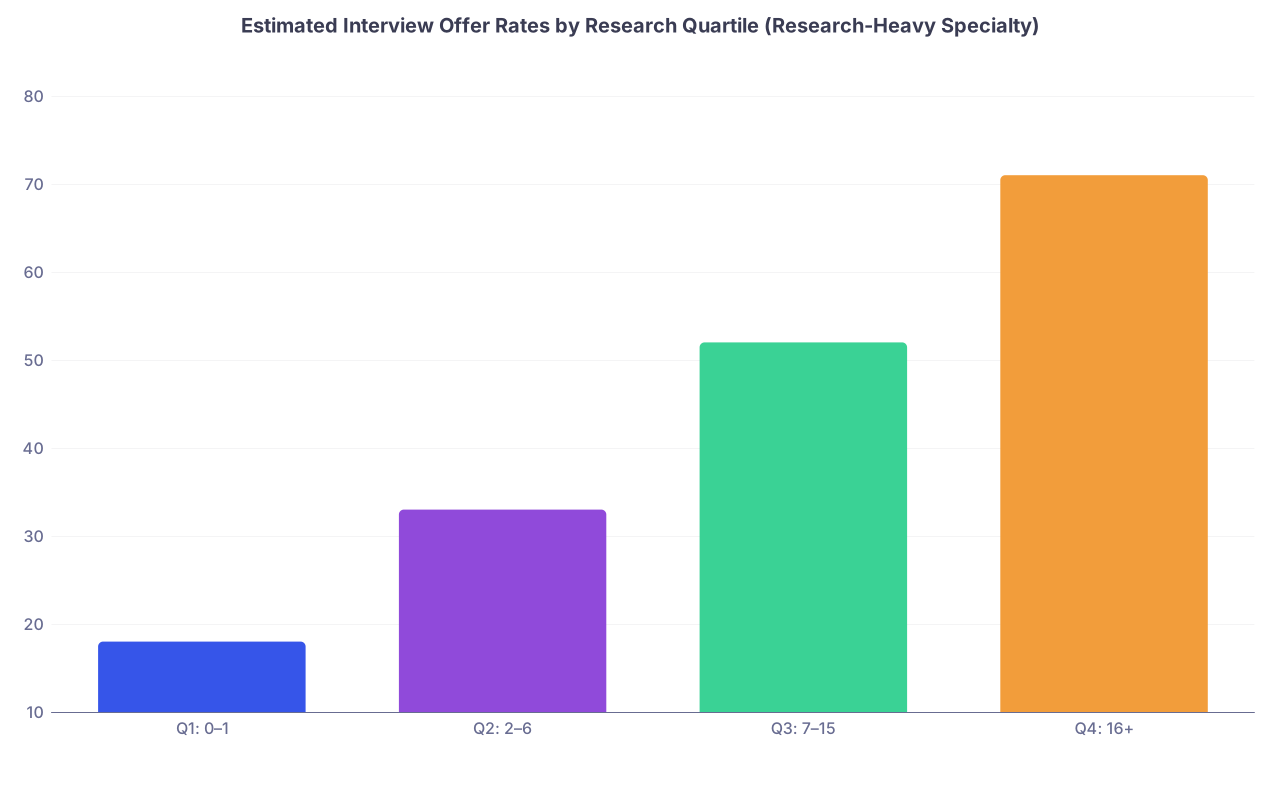
| Category | Value |
|---|---|
| Q1: 0–1 | 18 |
| Q2: 2–6 | 33 |
| Q3: 7–15 | 52 |
| Q4: 16+ | 71 |
You can read this roughly as:
- Q1 (0–1 items): Gets ~15–20% of programs to bite. You send 60 apps, you might see 10–12 interviews, mostly from mid/low-tier or places with lower research emphasis.
- Q2 (2–6 items): Now 30–35% interview rate. Same 60 apps might yield ~18–22 interviews. You start to get nibbles from some academic programs.
- Q3 (7–15 items): 50%+ interview rate. With strategic targeting, you are competitive almost everywhere except the ultra-elite, which still skew to Q4.
- Q4 (16+ items): 70%+ interview rate in many scenarios. You become a “must-interview” for a significant fraction of academic programs, assuming your narrative matches the CV.
Again: the exact percentages will shift, but the curve looks like this in real departmental spreadsheets. I have seen them.
Specialty differences: where quartiles matter a lot vs. a little
Not every field treats research quartiles with the same weight. Some specialties use research as a tie-breaker; others treat it as table stakes.
Research-heavy specialties (steep gradient)
These include:
- Dermatology
- Plastic surgery (integrated)
- Radiation oncology
- Neurosurgery
- ENT
- Some top-tier internal medicine, pediatrics, and neurology programs
Here, moving from Q1 to Q3 or Q4 is often the difference between:
- Being ignored by most top 30 programs vs. consistently landing interviews there.
- Needing 70–80 applications to reach viability vs. matching comfortably with 30–40 targeted applications.
A derm PD once put it bluntly in a meeting: “If someone has <5 research items and wants to be taken seriously, they need a story that borders on miraculous.” That is quartile thinking in real life.
Moderately research-sensitive specialties (moderate gradient)
- Orthopedic surgery
- General surgery
- OB/GYN
- Emergency medicine at academic centers
- Anesthesiology at academic centers
Here, high research productivity raises your ceiling more than your floor.
- A Q1 applicant with strong Step 2 and great performance can still get in the door and match well.
- A Q4 applicant, however, becomes attractive to programs that care about building their publication pipeline and fellowships.
You will often see two parallel tracks on rank lists: clinically strong, research-light applicants vs. clinically strong, research-heavy ones. Guess who gets prioritized when both look “good enough” clinically.
Less research-focused specialties (flatter gradient)
- Family medicine
- Most community internal medicine and pediatrics programs
- Community psychiatry programs
In these environments, the quartile effect flattens. A Q4 vs Q2 gap might move you from “good candidate” to “outstanding candidate,” but the interview offer rate difference is less dramatic than in derm or neurosurgery.
Still, at the top 10–20% of programs in these fields (big academic centers, NIH-funded departments), research quartiles remain highly visible. The gradient reappears at that level.
The hidden variable: research type and alignment
Raw item count is not the full story. Program directors do not scroll past a 30-item list and say, “Nice number, done.” They scan the pattern.
Three factors change how your quartile is interpreted:
Specialty alignment
- Ten cardiology abstracts are more persuasive for IM applicants than ten case reports in unrelated fields.
- A psych applicant with four strong psychiatry papers can outcompete a peer with ten generic basic science posters.
Senior authorship and role
- Multiple first-author or co-first-author items punch far above their numeric weight.
- Being the 12th author on a massive multicenter trial is fine, but programs mentally discount these when assessing “independent productivity.”
Continuity and trajectory
- Longitudinal work with one or two mentors, showing progression from abstract to paper, reads very differently than a scatter of one-off posters.
- Programs are looking for evidence that you can see projects across the finish line. Not just accumulate lines.
So two people both sitting in “Q3: 7–15 items” can have very different interview offer rates. If one has eight first-author, specialty-aligned abstracts and manuscripts, and the other has twelve barely-related poster presentations from random summer experiences, they are not equivalent in the eyes of an academic PD.
How quartiles interact with Step scores and school prestige
Research is not evaluated in a vacuum. Programs implicitly run a multivariate model in their heads: Step 2 CK, school reputation, clerkship performance, letters, research, and “fit” from your personal statement.
Here is the part most applicants underestimate: research productivity often compensates partially for disadvantages in other domains.
Scenario 1: Lower-ranked school, strong research (Q4)
Say you come from a lower-tier or less-known school, Step 2 = 245 for a research-heavy specialty. That is below the median of some top programs.
If you sit in Q1 (0–1 research items), your application blends into the mass of “solid but unremarkable” files. Interview odds at the top 20 programs are low.
If you sit in Q4 (20+ serious, aligned items, good letters from known researchers), you become a curiosity: “Who is this, and how did they do all this work at X school?” Many places will bring you in on that basis alone.
Scenario 2: High-ranked school, weak research (Q1/Q2)
A student from a T10 med school with Step 2 = 255, but 1–2 scattered research items, is still attractive. Name recognition plus exam scores open doors.
But when this person goes up against an out-of-state applicant from a mid-tier school with a similar Step 2 and Q4 research—especially if the specialty is research-driven—the edge can tilt toward the research-heavy candidate.
I have seen selection committees explicitly argue this way: “We know this person’s school. But this other one has clearly built a research identity in our field.”
Practical implications: what the numbers suggest you should do
Let me be blunt. If you are targeting any specialty where research matters and you are currently sitting in Q1 or low Q2, your probability of a strong outcome improves significantly by moving up a quartile. The return on investment is real.
Approximate ROI of moving between quartiles
Using the earlier estimate for a research-heavy specialty:
- Moving from Q1 → Q2 might add ~5–10 interviews across 60 applications.
- Q2 → Q3 can add another ~8–12 interviews, often including more top-tier programs.
- Q3 → Q4 adds diminishing but still meaningful returns: more elite interview offers, more backup options, and better fellowship trajectories later.
Each additional genuine, aligned research item—particularly first-author or high-impact work—pushes you incrementally along that curve.
Time window realities
Most students wake up to this in M3 or late M2. At that point, you need to think in terms of project types that move your quartile count quickly and legitimately:
- Retrospective chart reviews (if your institution’s IRB can move)
- Case series or high-quality case reports in your specialty
- Secondary analyses with already-collected datasets
- Joining ongoing clinical trials or registries at a level that guarantees authorship if you do the work
You are not writing an R01 before ERAS. You are accumulating credible, completed projects that move you from “no research” to “has clearly engaged with scholarship in this field.”
A concrete example: two applicants, same Step, different quartiles
Let’s model two EM applicants to academic programs:
- Both: US MD, Step 2 CK = 245, no red flags, average school.
Applicant A (Q1):
- 1 poster from an unrelated quality improvement project
- No EM-specific research
- Generic letters, nothing from big-name researchers
Applicant B (Q3/Q4):
- 10 total research items: 3 EM abstracts, 1 first-author EM paper, several specialty-aligned posters
- One letter from an EM faculty known regionally for research
- Narrative in the personal statement tying research to career goals in academic EM
They each apply to 40 academic-heavy EM programs.
Empirically, A might see interview invites from 10–14 of them. B might see 22–28. Same test scores. Same school tier. The difference is the research quartile and alignment.
Now extend that pattern across thousands of applicants and multiple specialties, and you understand why PDs keep saying “research matters” even when students want to believe it doesn’t.
Where the data does not overpromise
There is one mistake people make with these quartile charts: thinking research alone will fix everything.
- Q4 research with a 215 Step 2 in neurosurgery will not magically create 20 interviews.
- Q4 research with weak clinical performance and bad letters often just raises suspicions: “Why all this research, but poor on the wards?”
The gradient I am describing assumes you are otherwise in the competitive band for that specialty. Research productivity moves you within that band. It does not resurrect a fundamentally nonviable application.
Similarly, in truly low-research specialties or community-heavy fields, moving from Q1 to Q4 simply does not generate the same magnitude of interview boost. It helps. It may position you for academic tracks and future fellowship competitiveness. But you will not see derm-level curves in family medicine.
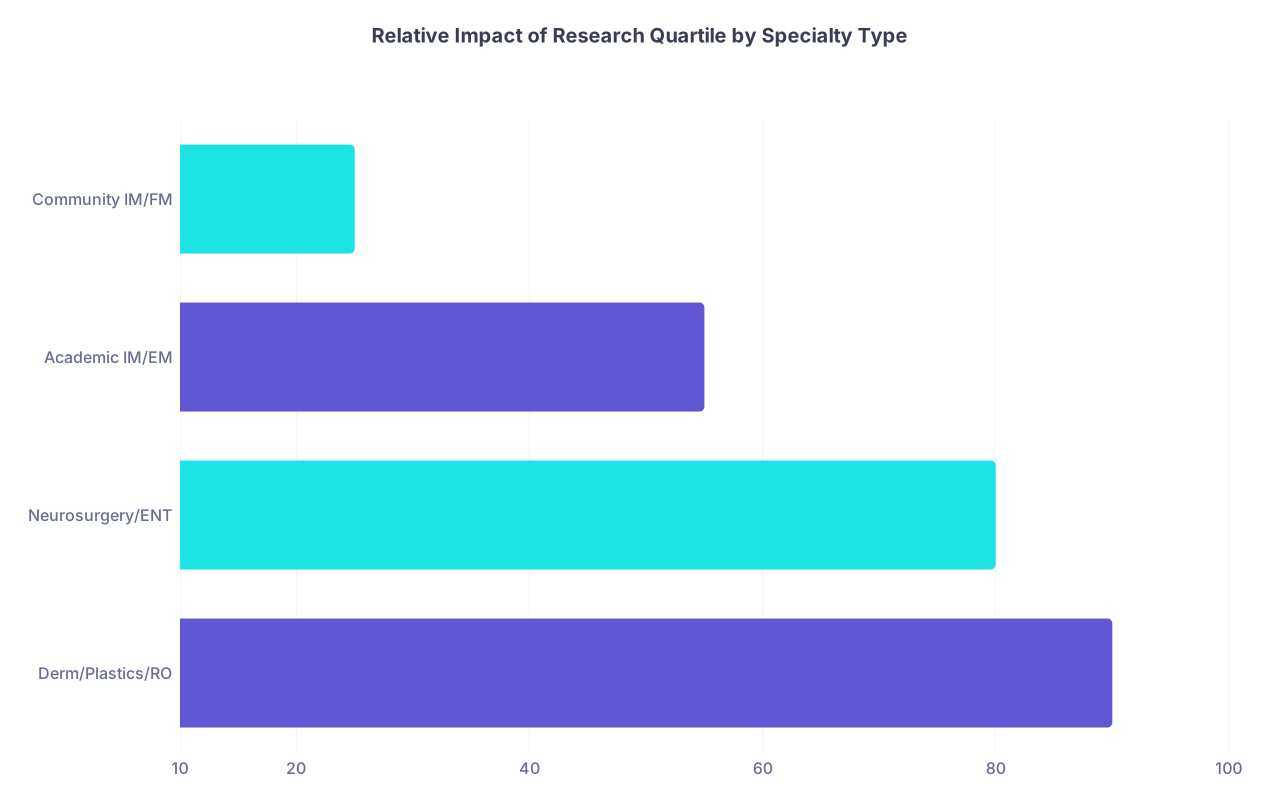
| Category | Value |
|---|---|
| Derm/Plastics/RO | 90 |
| Neurosurgery/ENT | 80 |
| Academic IM/EM | 55 |
| Community IM/FM | 25 |
Think of these values as “relative impact scores” for moving from low to high research quartiles. You can argue about the exact numbers. The ranking order is very hard to argue against if you actually look at PD survey data and match outcomes.
How to read your own position honestly
If you want to use this data rather than just be vaguely reassured by it, do one uncomfortably honest exercise:
- Count your real, completed scholarly items. Not “in progress” unless you have a near-certain submission date.
- Bucket them by specialty relevance.
- Identify first-author vs middle-author.
- Mentally reassign: if your total number drops by 20–30% after removing off-topic or non-credible items, that is your true “research quartile” for the specialty you are applying in.
Then compare where you land against the approximate quartiles and specialty norms. If you are far below the median for matched applicants in your field (Charting Outcomes will show you this), understand that your interview offer curve will not look like the median either.
You do not fix everything by panicking and adding low-quality work at the last minute. But you can still move the needle meaningfully with targeted, high-yield projects if you start early enough.
The bottom line: research productivity is not a vanity metric. Across most academic-leaning specialties, it behaves exactly like you would expect a powerful independent variable to behave: applicants in higher research quartiles receive interview offers from a larger share of their programs and have higher match probabilities, especially at research-intensive institutions.
If you are early in medical school, that gives you time to climb quartiles strategically. If you are close to ERAS, it tells you two things: be realistic about your current quartile, and be ruthlessly smart about where you apply and how you frame the work you already have.
With that analytical foundation in place, the next problem is different: once you actually earn those interviews, how do you talk about your research so it reinforces your trajectory instead of sounding like a checklist? That is where the numbers stop and the story starts—but that is a discussion for another day.