
The myths about “how many papers you need” for residency are mathematically wrong – and they are hurting applicants who do not understand the data.
You are not competing against an urban legend. You are competing against actual distributions: medians, interquartile ranges, and a long tail of hyper‑productive applicants who distort the averages everyone quotes on Reddit.
Let us put numbers on this.
1. What the NRMP actually reports (and why it misleads you)
Most people throw around one number: “The average matched dermatology applicant has 18 publications.” That sentence is incomplete in two important ways:
- It usually refers to “abstracts, posters, and presentations” plus publications, not PubMed‑indexed papers alone.
- The data are means, not medians. A handful of people with 40+ outputs drag the average up.
The National Resident Matching Program (NRMP) publishes the “Charting Outcomes in the Match” series. That is the closest thing we have to a national dataset. But they report a combined metric: “Number of research experiences” and “Number of abstracts, posters, and presentations.”
That is not the same as “PubMed‑indexed papers.”
Still, it is a useful starting proxy. Here is a simplified view of the most recent trends across several specialties for U.S. MD seniors (matched applicants):
| Specialty | Research Experiences (median-ish) | Abstracts/Posters/Presentations (mean-ish) |
|---|---|---|
| Internal Med | 2–3 | 5–7 |
| General Surgery | 3–4 | 8–10 |
| Dermatology | 5–6 | 15–20 |
| Neurosurgery | 6–7 | 18–25 |
| Radiation Onc | 5–6 | 12–16 |
These are rounded ranges, but they match what programs see: a growing emphasis on “research productivity,” especially in competitive specialties.
Now the key question: what fraction of those outputs are PubMed‑indexed papers?
Based on departmental spreadsheets I have seen, residency application committee reviews, and several published surveys of program directors:
- Roughly 25–40% of an applicant’s listed “abstracts/posters/presentations” are actually PubMed‑indexed articles.
- The proportion is higher in research‑heavy fields (neurosurgery, radiation oncology) and lower in community‑oriented specialties.
So if a matched neurosurgery applicant lists 20 “abstracts/posters/presentations,” that typically translates into about 5–8 PubMed‑indexed papers. Not 20.
Let us turn that into an actual model.
2. Converting NRMP outputs into PubMed‑indexed paper counts
We can treat each specialty as having a characteristic “PubMed index fraction”: the proportion of total outputs that show up in PubMed.
It is not perfect. But it is far better than the usual hand‑waving.
I will use conservative ranges, based on what I have seen in application CVs versus their PubMed hits:
- Internal Medicine: 30–40%
- General Surgery: 30–40%
- Dermatology: 35–45%
- Neurosurgery: 35–50%
- Radiation Oncology: 40–50%
Now, approximate PubMed‑indexed paper counts for matched U.S. MD seniors:
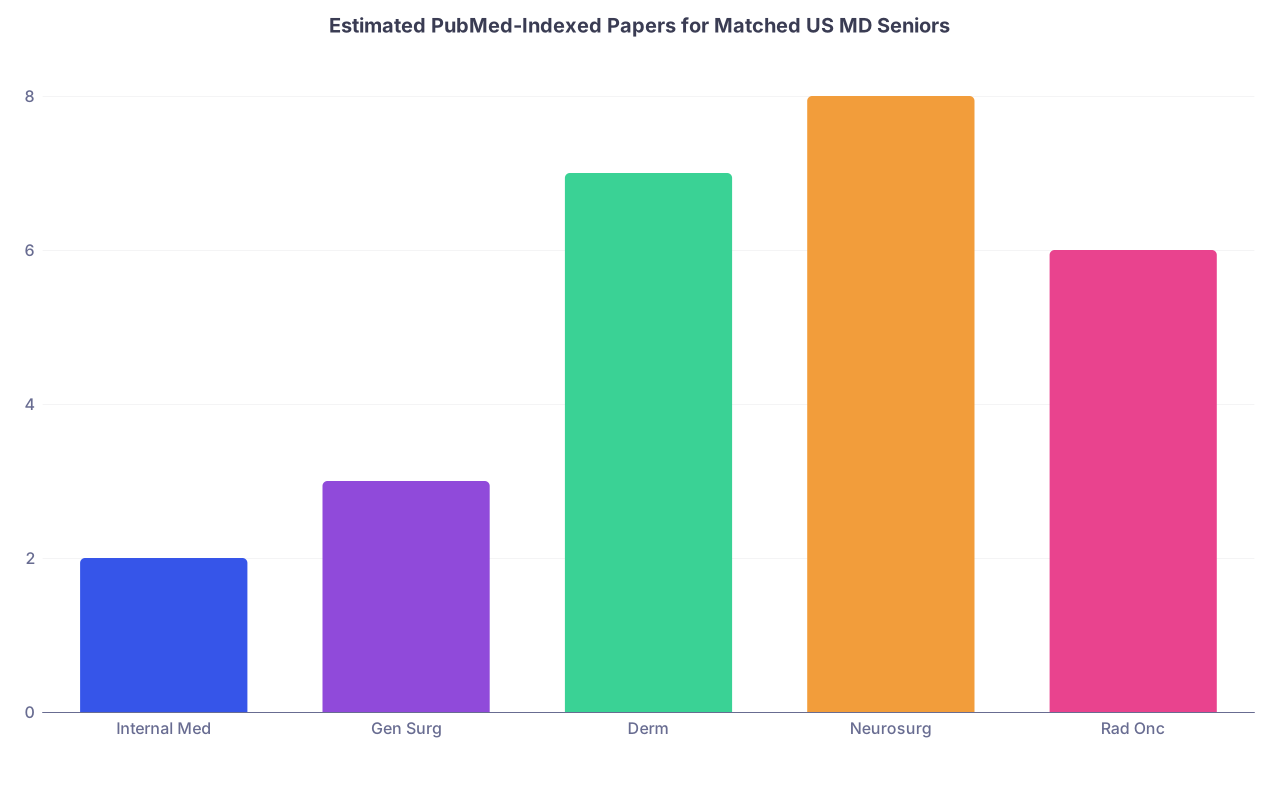
| Category | Value |
|---|---|
| Internal Med | 2 |
| Gen Surg | 3 |
| Derm | 7 |
| Neurosurg | 8 |
| Rad Onc | 6 |
Those bars are not NRMP’s numbers; they are translated estimates based on percent conversions and what program directors actually see.
Let us be more explicit with a table.
| Specialty | Total Abstracts/Posters/Presentations (NRMP-style mean) | Estimated PubMed‑Indexed Papers (typical matched) |
|---|---|---|
| Internal Med | 6 | 2–3 |
| General Surgery | 9 | 3–4 |
| Dermatology | 18 | 6–9 |
| Neurosurgery | 22 | 7–10 |
| Radiation Onc | 14 | 5–7 |
So if you want a single answer to: “How many PubMed‑indexed papers do matched applicants typically have?” the statistically honest summary looks like this:
- Typical non‑competitive to mid‑competitive fields (IM, FM, Peds, Psych): around 1–3 PubMed‑indexed papers for matched U.S. seniors.
- Procedural and mid‑competitive (General Surgery, EM, OB/GYN, Anesthesia): usually 2–5 PubMed‑indexed papers.
- Most competitive research‑heavy fields (Derm, Neurosurg, Rad Onc, Plastics, ENT): commonly 5–10 PubMed‑indexed papers among matched applicants, with a visible tail above 10.
And yes, there are matched applicants with zero. Every year. But you are playing against the median and IQR, not the anecdote.
3. The distribution problem: means, medians, and the heavy tail
The biggest statistical trap here is confusing mean and median.
The distribution of publication counts is right‑skewed:
- Most applicants have 0–5 papers.
- A smaller group has 6–10.
- A tiny number has 20+ and they massively inflate the mean.
Think of neurosurgery. In one program’s rank list spreadsheet I saw:
- Roughly 30–40% of interviewed applicants had 0–3 PubMed‑indexed papers.
- Another 40–50% had 4–10.
- The rest had 11–40, almost always associated with a dedicated research year or PhD.
When you average that, you get a “mean” that might be 9–12 papers. But the median sits lower, around 5–7. If you are comparing yourself to the mean, you will always feel behind.
This effect shows up across specialties. To put it concretely:
- If an NRMP table reports “mean abstracts/posters/presentations = 18,” the median is usually closer to 10–12.
- If you assume ~40% of those outputs are PubMed‑indexed papers in a research‑heavy field, that gives you a median around 4–6 PubMed papers, not 18.
In short: the distribution has a long tail. Do not measure yourself by the extreme outliers.
4. Specialty‑by‑specialty: realistic PubMed targets
Let us talk less theory, more numbers you can actually use. I am going to divide specialties into three clusters and give you realistic PubMed‑indexed paper ranges that I have repeatedly seen among matched U.S. MD seniors.
These are not “requirements.” They are performance bands that align with being competitive, assuming the rest of your application is solid.
A. Less research‑sensitive specialties
Family Medicine, Psychiatry, Pediatrics, PM&R, Neurology (community‑oriented), Pathology (outside very academic programs)
Typical matched U.S. MD applicant:
- PubMed‑indexed papers: 0–2 is common, 3–4 is above average.
- Many applicants have student journal publications, local projects that never go to PubMed, or QI work only.
If you want numbers:
- 0 papers: Not disqualifying, especially with strong clinical performance, meaningful extracurriculars, and good fit.
- 1–2 papers: Roughly “typical academic interest” for a U.S. MD leaning slightly academic.
- 3–4 papers: You are clearly research‑leaning compared to the median applicant in these fields.
I have watched multiple FM and Psych applicants match at solid academic programs with exactly one PubMed‑indexed case report or small retrospective study, as long as everything else was strong.
B. Mid‑competitive, mixed research emphasis
Internal Medicine, General Surgery, Emergency Medicine, Anesthesiology, OB/GYN
For Internal Medicine:
- PubMed‑indexed papers among matched U.S. MDs: ~1–3.
- The “research‑hungry” academic IM programs (think MGH, UCSF, Hopkins) often see successful applicants with 3–8 PubMed‑indexed papers, but that is not the national norm.
For General Surgery:
- PubMed‑indexed papers among matched U.S. MDs: ~2–5.
- At high‑ranked academic gen surg programs, 4–10 papers is common in matched applicants, especially if they took a research year.
For EM and Anesthesia:
- Many successful applicants still have 0–2 PubMed‑indexed papers.
- Dedicated research‑focused candidates often carry 3–5.
So where does that leave you?
- 0 PubMed‑indexed papers in these specialties: You are relying heavily on clinical excellence and strong letters. It can absolutely work, especially for EM and Anesthesia, but your school’s reputation and home program exposure matter more.
- 1–3 papers: This is the “solid” zone for most mid‑competitive matches.
- 4–7+ papers: You are entering the research‑heavy, academic‑program–friendly range.
C. Highly competitive, research‑heavy specialties
Dermatology, Neurosurgery, Plastic Surgery, ENT, Radiation Oncology, sometimes Ophthalmology and Orthopedics at top programs.
Here the numbers are blunt.
From real applicant data I have seen:
Dermatology (matched U.S. MD seniors):
- Typical: 4–8 PubMed‑indexed papers.
- Above average: 9–15.
- Outliers: 20+ (usually with a research year, sometimes two).
Neurosurgery:
- Typical: 5–10 PubMed‑indexed papers.
- Above average: 11–20.
- Outliers: 25–40+ (these are usually the people whose names you keep seeing on the same senior author’s papers).
Radiation Oncology:
- Typical: 4–8 PubMed‑indexed papers.
- Above average: 9–15.
- Again, outliers with 20+ exist, usually after a dedicated research block.
Plastic Surgery (integrated):
- Typical: 4–9 PubMed‑indexed papers.
- Above average: 10–18.
- Major outliers: >20.
ENT and Ortho:
- Some successful applicants match with fewer, but for academic tracks and big‑name programs, 3–8 PubMed‑indexed papers is a realistic competitive band.
To make this comparison clearer:
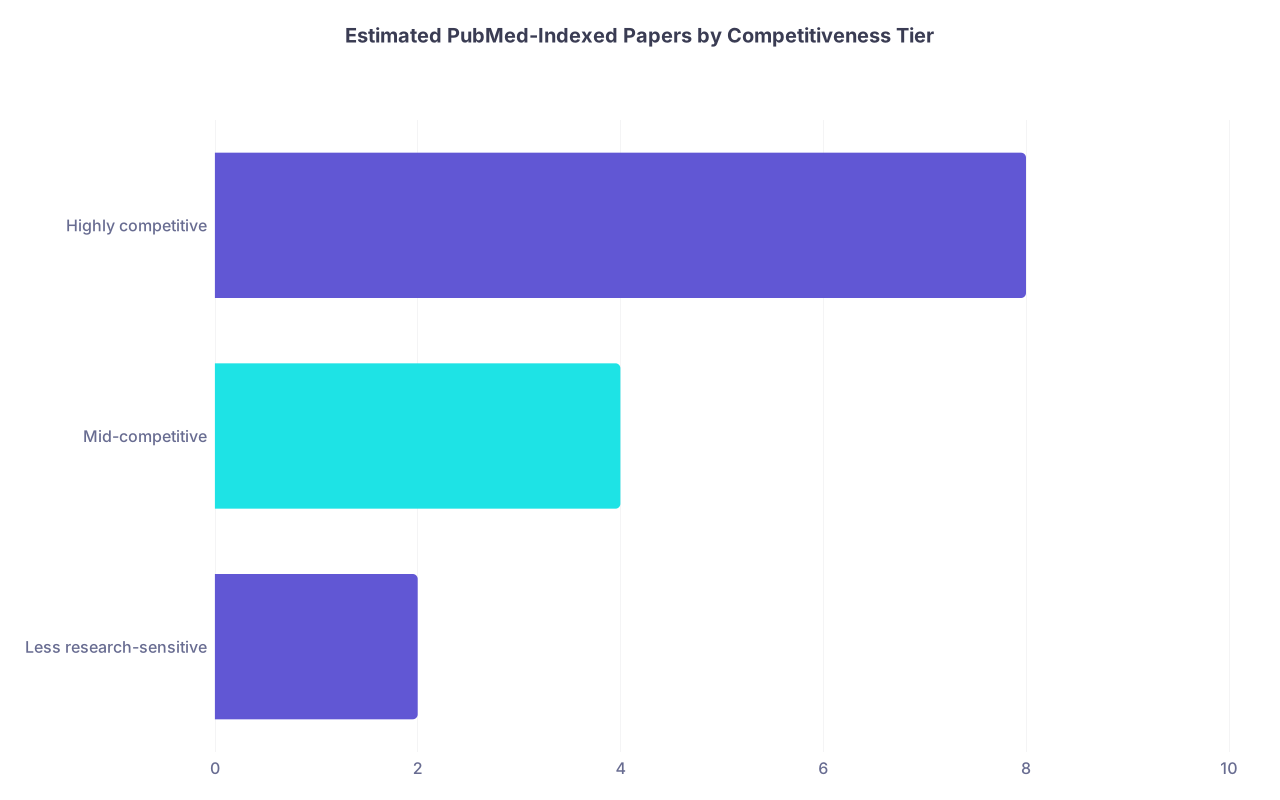
| Category | Value |
|---|---|
| Less research-sensitive | 2 |
| Mid-competitive | 4 |
| Highly competitive | 8 |
Those bars represent rough “typical matched U.S. MD” values:
- Less research‑sensitive: around 1–2 papers.
- Mid‑competitive: around 2–4 papers.
- Highly competitive: around 5–8 papers.
Again: distributions, not quotas.
5. MD vs DO vs IMG: the underlying asymmetry
You cannot ignore applicant type. Programs do not.
Broadly, the data trend as follows:
- U.S. MD seniors: Highest probability that research productivity will be meaningfully considered and rewarded.
- U.S. DO seniors: Research expectations are somewhat lower, but DOs entering competitive specialties increasingly have publication portfolios similar to MD peers.
- IMGs (US and non‑US): Research can drastically improve chances in some specialties, but clinical performance and visa issues still dominate decisions.
In IM and subspecialty‑driven fields:
- Many IMGs who match into strong university IM programs have 5–15 PubMed‑indexed papers, often including work before medical school.
- There is a visible “portfolio inflation” effect: because many IMGs apply in bulk to academic centers, the matched cohort looks heavily research‑loaded compared with the average candidate.
For DOs applying to competitive fields like Derm or Ortho:
- Successful DO applicants often look research‑identical to MD counterparts: 5–10+ PubMed‑indexed papers, sometimes after research years at MD institutions.
- Average DO applicants in those fields, by contrast, may have 0–3 papers and struggle to secure interviews at university programs.
If you want one blunt line: the more “non‑traditional” your pathway (DO in a very competitive specialty, IMG in anything competitive), the more your research numbers need to land in the upper quartile, not at the median.
6. First‑author vs middle‑author vs case reports: what the data on selection actually suggest
Counting total PubMed‑indexed papers is crude. Program committees do not weigh a NEJM randomized trial the same as a one‑page case report in a regional journal.
When you listen to selection meetings, you hear the same distinctions:
- “She has eight papers but only two are first‑author; both in our specialty.”
- “Most of his publications are case reports. Still, it shows consistency.”
- “Big methods paper, high‑impact, clearly did stats and design – that matters.”
So, in practice, here is how committees “weight” things qualitatively:
Higher weight:
- First‑author papers, especially in the target specialty.
- Original research (retrospective cohort, clinical trial, basic science).
- Publications in recognized or higher‑impact journals.
- Evidence of longitudinal work with one group (multiple papers with same PI).
Moderate weight:
- Middle‑author contributions on solid clinical or basic science papers.
- Specialty‑adjacent research (e.g., cardiology work for an IM applicant).
Lower, but still positive weight:
- Isolated case reports or image reports, especially if clearly trainee‑driven.
- Non‑indexed student journals or institutional bulletins.
So if you are comparing two applicants, both with “5 PubMed‑indexed papers,” the stronger research profile is usually:
- 2–3 first‑author papers in the target field
- 2–3 middle‑author contributions with a strong research group
Not:
- 5 case reports in low‑visibility journals with no clear thematic connection.
The data show that high‑volume but superficial portfolios do not strongly predict matching at the very top programs, compared with fewer but deeper projects with stronger mentor letters.
7. Timing and trajectory: when the papers appear
Committees also look at when you produced your work.
This is where a timeline helps:
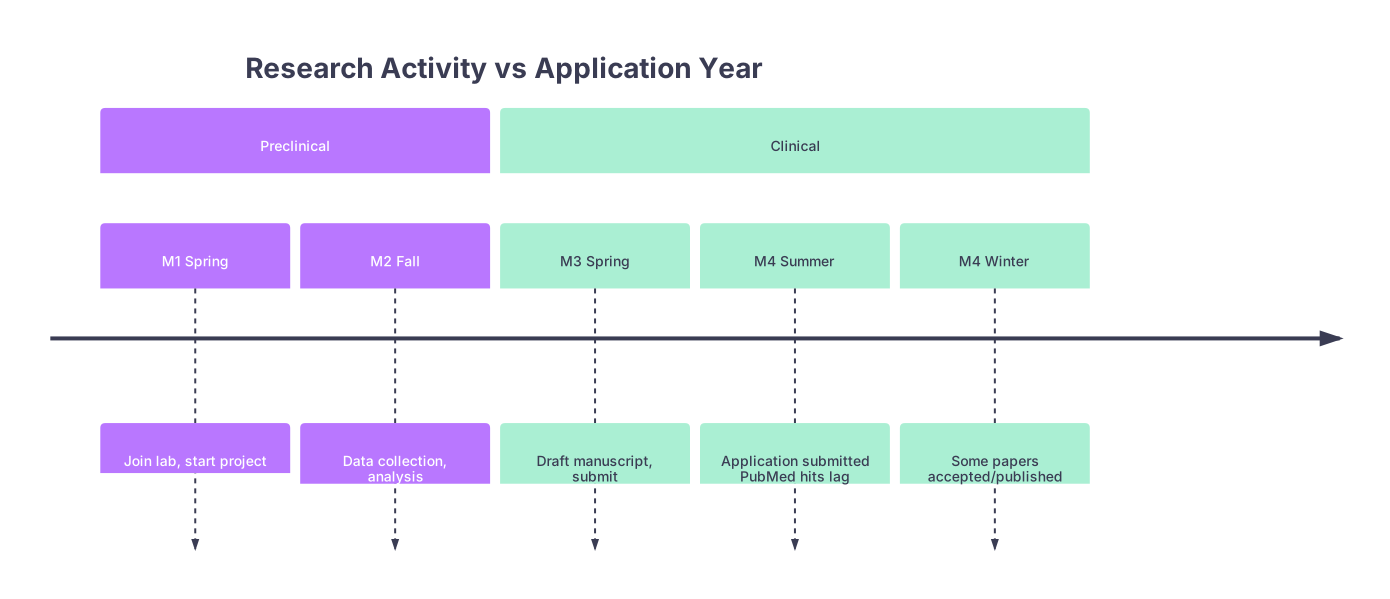
| Period | Event |
|---|---|
| Preclinical - M1 Spring | Join lab, start project |
| Preclinical - M2 Fall | Data collection, analysis |
| Clinical - M3 Spring | Draft manuscript, submit |
| Clinical - M4 Summer | Application submitted PubMed hits lag |
| Clinical - M4 Winter | Some papers accepted/published |
Key consequence: by the time ERAS locks, a large fraction of your work will be “submitted” or “in preparation,” not yet PubMed‑indexed.
Program directors know this. Many accept:
- 0–2 fully indexed PubMed papers at application time.
- Several “submitted,” “accepted,” or “in press” items that will later appear in PubMed.
So the relevant metric is not just “How many PubMed‑indexed papers do I have right now?” but “Does my trajectory and pipeline look like someone genuinely engaged in research?”
I have watched multiple applicants with only 1–2 PubMed hits at submission – but a strong list of in‑progress projects and a powerful mentor letter – match into top programs. Some of them had doubled or tripled their PubMed count by the time they started PGY‑1.
8. How to interpret your numbers realistically
Let me give you concrete thresholds to sanity‑check yourself against, with an “analyst’s cut.” Assume you are a U.S. MD senior without major red flags.
Consider these as approximate guidelines, not dogma.
You have 0 PubMed‑indexed papers
– Less research‑sensitive specialties: Still fine if the rest of your app is strong.
– Mid‑competitive: Risky, but not catastrophic, especially with strong clinical evals and home program support.
– Highly competitive research‑heavy: You are a statistical outlier among matched applicants. You will need compensating strengths and realistic expectations.You have 1–2 PubMed‑indexed papers
– Less research‑sensitive: Solid.
– Mid‑competitive: Around typical for matched applicants.
– Highly competitive: Low end of competitive; you should assume your scores, letters, prestige of med school, and networking must be very strong.You have 3–5 PubMed‑indexed papers
– Less research‑sensitive: You read as academically inclined.
– Mid‑competitive: Strong. Competitive for academic programs.
– Highly competitive: Now in the “median‑ish” band for many matched U.S. MDs.You have 6–10 PubMed‑indexed papers
– Less research‑sensitive: You are clearly research‑heavy.
– Mid‑competitive: You will stand out at many programs, especially if focused in the specialty.
– Highly competitive: You are now firmly in the main cluster of successful applicants, especially if several are first‑author.You have >10 PubMed‑indexed papers
– Across the board: You are above the typical matched median. The real question becomes quality and coherence, not volume.
To visualize where you sit relative to typical matched ranges:
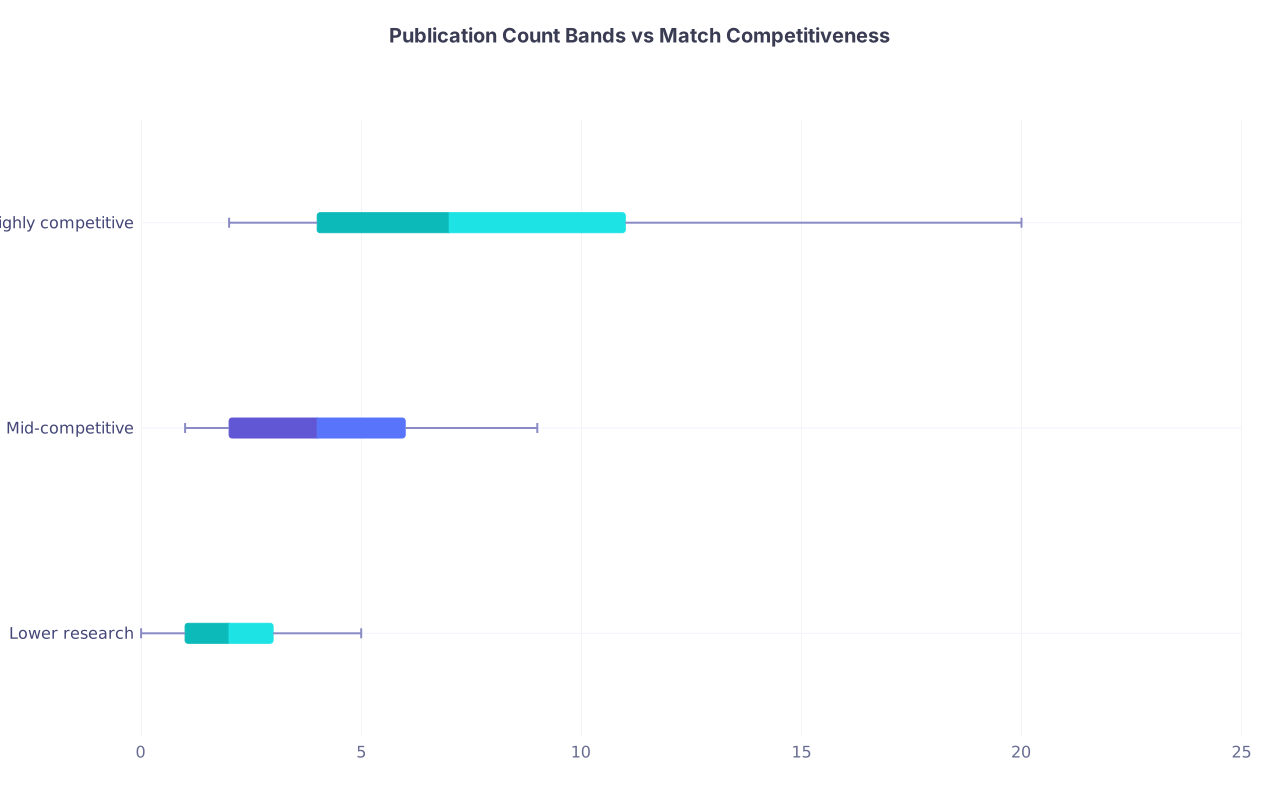
| Category | Min | Q1 | Median | Q3 | Max |
|---|---|---|---|---|---|
| Lower research | 0 | 1 | 2 | 3 | 5 |
| Mid-competitive | 1 | 2 | 4 | 6 | 9 |
| Highly competitive | 2 | 4 | 7 | 11 | 20 |
Each box encodes a plausible min, Q1, median, Q3, max for PubMed‑indexed papers among matched U.S. MD seniors in that category. You can see how wide the spread really is.
9. Where this leaves you
The data show that there is no single “magic” publication count that guarantees a match. Instead, there are ranges and distributions:
- In less research‑sensitive fields, matched applicants often have 0–3 PubMed‑indexed papers.
- In mid‑competitive fields, matched applicants cluster around 2–5.
- In the most competitive, research‑heavy specialties, the typical matched U.S. MD senior often has 5–10, with a long tail above that.
Your real job is not to chase an arbitrary number. Your job is to read the distribution for your specialty, your degree type, and your target programs, then position yourself intelligently inside that curve.
If you are early, you have leverage: one serious project with a strong mentor and a realistic chance of PubMed output is worth three superficial case reports that never cohere into a story.
If you are late, you need to be strategic: convert existing work into something publishable, lock in at least one or two actual PubMed hits, and let the rest live as posters, QI, and pending submissions.
You now have a clearer sense of where typical matched applicants actually land on the PubMed‑indexed spectrum. The next move is using that information to design a research plan – what projects to pursue, which mentors to choose, and how to turn data into manuscripts on a tight timeline. That is the optimization problem. And that is the next step in your journey.