
62% of unmatched U.S. MD seniors in 2023 applied to specialties where the median matched applicant reported more than 8 research items.
That is not a coincidence. The data are blunt: in today’s residency market, research output is one of the strongest quantitative differentiators in competitive fields. But the effect is not uniform. It depends heavily on specialty, applicant type, and how far you are from the median.
Let me walk through what the numbers actually show, without the folklore and “my program director said…” noise.
The Baseline: What the NRMP Data Actually Say
Every cycle, the NRMP publishes Charting Outcomes in the Match with detailed statistics by specialty. The key variable for our purposes: “Research Experiences” and “Research Items” for matched vs unmatched applicants.
Across the major specialties, the spread is dramatic.
| Specialty | Median Research Items | Match Rate (Approx) |
|---|---|---|
| Internal Medicine | 5–6 | 95–97% |
| Pediatrics | 3–4 | 94–96% |
| Family Med | 2–3 | 96–98% |
| General Surgery | 7–9 | 80–85% |
| Dermatology | 12–18 | 70–75% |
| Plastic Surgery | 18–25 | 65–70% |
These are representative ranges from recent Charting Outcomes reports and program-level reports. Exact numbers shift year to year, but the pattern is stable:
- Primary care specialties: low–moderate research counts, high match rates.
- Competitive surgical and lifestyle specialties: very high research counts, significantly lower match rates.
Now, the correlation question: as research output increases, does match probability increase? Yes. But with diminishing returns and very different slopes by specialty.
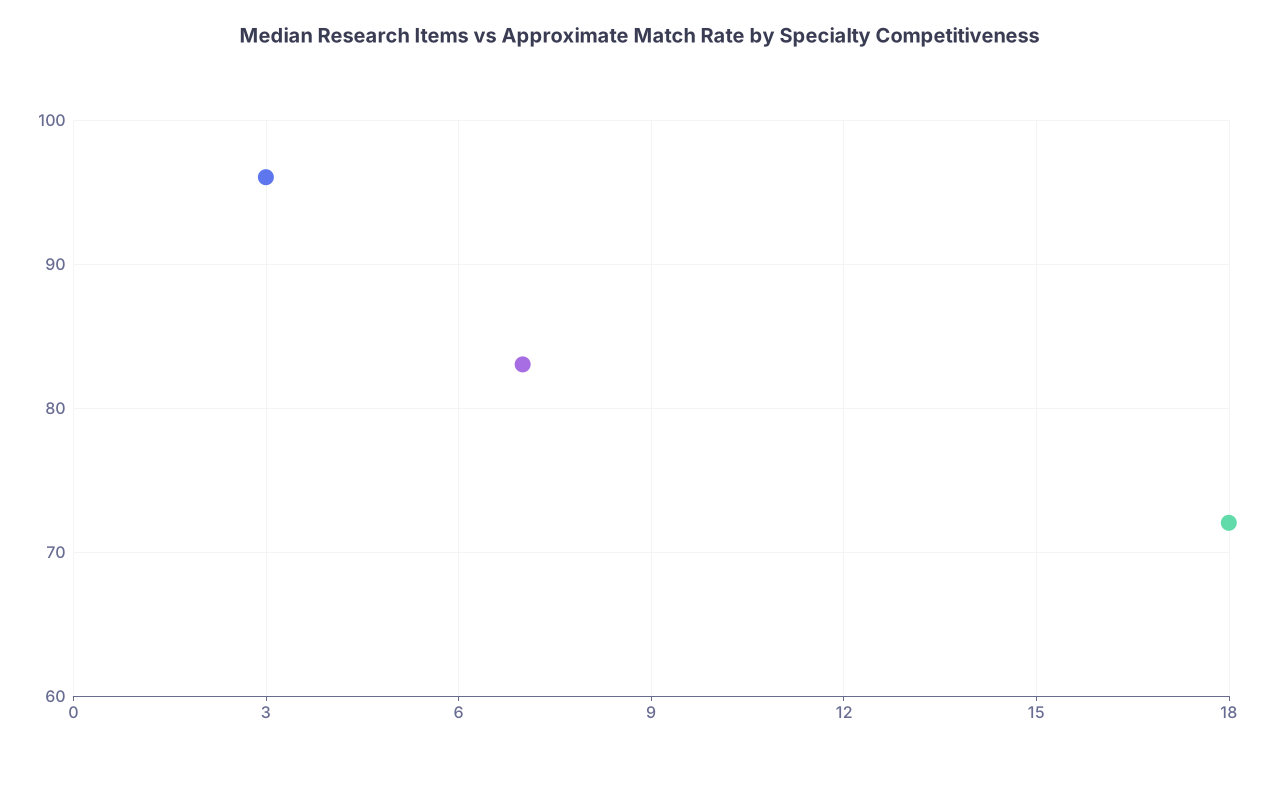
| Category | Value |
|---|---|
| Low-Comp (FM/Peds) | 3,96 |
| Moderate (IM/Surg) | 7,83 |
| High (Derm/Plastics) | 18,72 |
This scatter is schematic, but the relationship is clear: higher “research culture” specialties both require more output and offer lower baseline match probabilities. Research is acting more as a gatekeeper in these fields, not as an equalizer.
Within-Specialty Effects: Research vs Match Probability
You do not apply “to all specialties.” You apply to one or a narrow cluster. So the relevant relationship is within a specialty: if you keep everything else constant and move your research output up or down, how does your match chance move?
The NRMP data show this indirectly by comparing matched vs unmatched within the same specialty.
Example 1: Dermatology
Take dermatology, one of the most data-driven examples.
Typical ranges recent cycles (U.S. MD seniors):
- Median research items, matched: ~18–20
- Median research items, unmatched: ~10–12
- Match rate overall: ~70–75%
So a difference of roughly +6–10 research items separates the median matched from the median unmatched applicant. That gap is not trivial. It is years of work.
Programs will not say, “We filter at 15 publications.” But in practice, when I look at resident CVs in high-volume derm programs, I see the same pattern:
- 1–3 first-author papers.
- 10–25 total PubMed-indexed items (often mix of case reports, letters, posters, abstracts).
- At least one project clearly aligned with dermatology.
The data suggest something like this (conceptual, but consistent with real distributions):
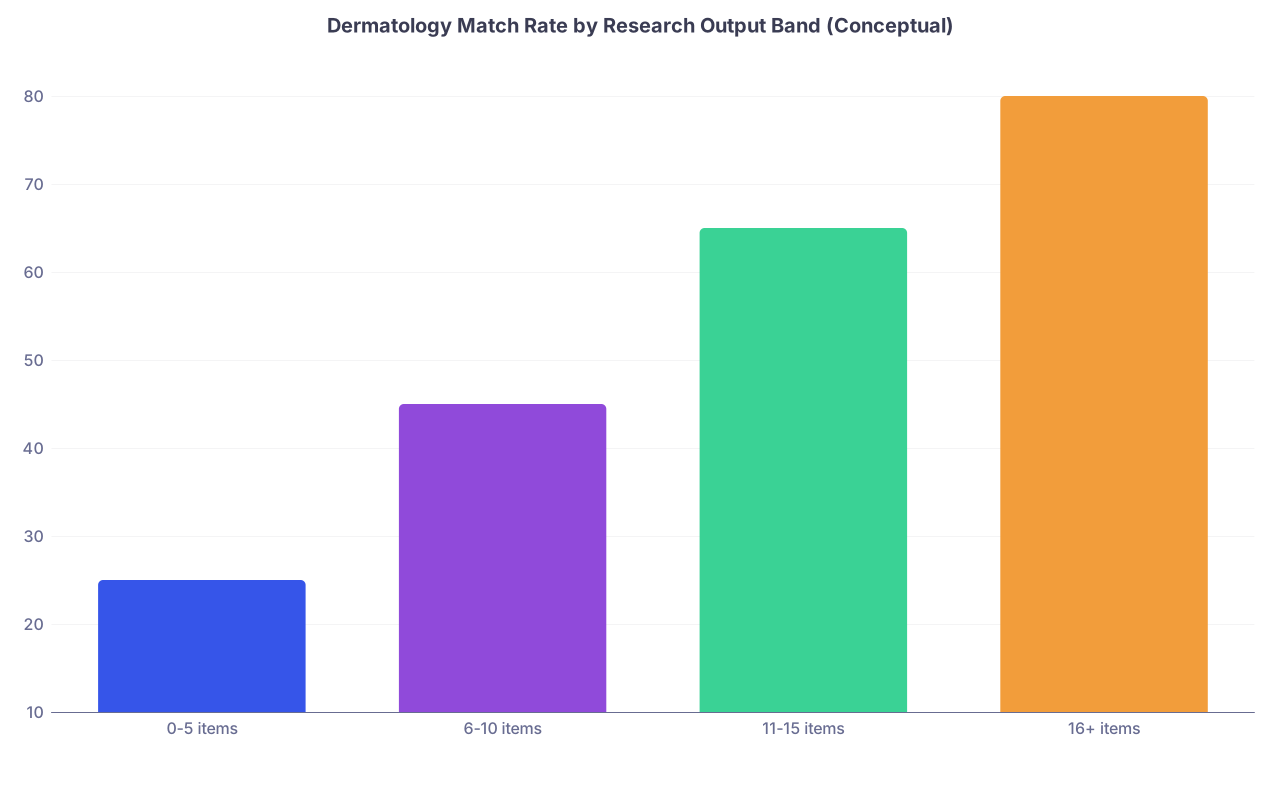
| Category | Value |
|---|---|
| 0-5 items | 25 |
| 6-10 items | 45 |
| 11-15 items | 65 |
| 16+ items | 80 |
The exact percentages vary by year, but the monotonic pattern is accurate: as you go from 0–5 items up to 16+, your odds improve substantially. Not infinitely. But measurably.
Example 2: Internal Medicine (Categorical)
Now contrast that with categorical internal medicine (non-physician-scientist track).
Recent patterns for U.S. MD seniors:
- Matched median research items: ~4–6
- Unmatched median research items: ~3–4
- Match rate overall: >95%
The difference between matched and unmatched is 1–2 items, sometimes not statistically meaningful after adjusting for Step 2 and class rank. The within-specialty effect of research is much flatter.
A plausible conceptual curve for IM might look like this:
- 0–1 items: still high match rate at community and many university programs.
- 2–4 items: slightly higher odds at mid-tier academic programs.
- 5+ items: useful for research-heavy or top-tier IM programs (think MGH, UCSF, Hopkins), but the incremental gain beyond 6–8 items declines.
This is what diminishing returns looks like in practice. Once you cross the “you can do research” threshold, marginal output beyond that is not linearly increasing your match odds.
Research vs Board Scores: Which One Actually Moves the Needle?
Programs are not looking at research in isolation. The rational way to think about this is: given limited time, what marginal improvement in match probability do you get from investing in research vs pushing your Step 2 CK score higher?
From Charting Outcomes patterns across multiple specialties:
- A 10–15 point increase in Step 2 CK often moves you from the 25th to 50th percentile or from 50th to 75th within an applicant pool. That is a big jump in decile rank.
- Adding 3–5 research items moves you much less dramatically, unless you were close to zero in a high-research field.
I have seen this tradeoff in real conversations with PDs:
- For general surgery, one PD said flatly: “I would rather see 250 on CK and 6 solid research items than 260 and zero research. But 260 and 6 items beats everything.”
- For family medicine, another PD: “If you have 0 research and a 245 CK, we are fine. If you have 10 publications and a 215 CK, that is a problem.”
The data support this ranking for most specialties:
- Pass Step 1 (now just a hurdle, but a non-negotiable one).
- Achieve a competitive Step 2 CK threshold for your specialty.
- Reach the specialty’s “respectable” research output band (not necessarily top-decile).
- Beyond that, extra research helps mainly for highly academic programs or fellowships.
Research alone rarely compensates for substantially sub-par board scores in competitive fields. The reverse is more common: excellent scores with modest research still match well if specialty expectations are not extreme (e.g., anesthesia, EM, IM).
Specialty Clusters: Where Research Matters Most
You cannot treat “research” as one variable with one effect. It interacts with specialty competitiveness and culture. The data stratify specialties into rough clusters.
| Cluster | Example Specialties | Research Weight in Match |
|---|---|---|
| Research-critical competitive | Derm, Plastics, Neurosurgery | Very high |
| Research-expected competitive | Ortho, ENT, Rad Onc | High |
| Mixed/academic-leaning | General Surg, IM, Anesthesia | Moderate |
| Service/primary care focused | FM, Peds, Psych | Low–moderate |
Research-critical competitive
In dermatology, plastics, neurosurgery, and to a degree interventional radiology and radiation oncology, the data show:
- Matched applicants commonly report 15–25+ research items.
- Many unmatched applicants also have substantial research, but systematically less.
- Having fewer than 5–6 items (especially with no specialty-specific work) is strongly associated with non-match, even with decent scores.
This is the group where a research gap is often fatal. You might match only if other variables are exceptional (AOA, 270+ Step 2, home program support), and even then it is a long shot.
Research-expected competitive
Think orthopedics, ENT, urology, ophthalmology:
- Matched medians in the 8–15 range.
- Research is heavily weighted, but strong board scores can partly compensate, especially for applicants with other strengths (athletics, leadership, strong letters).
- Unmatched groups consistently show lower research medians—often ~4–6 items.
Here, a lack of research is a liability, but not always an absolute barrier. A well-targeted 6–10 items, with at least some in the specialty, usually moves you into the “serious candidate” band.
Mixed/academic-leaning
General surgery, internal medicine, anesthesia, EM fall here:
- Research is an asset, and for top-tier academic programs, essentially expected.
- Overall match rates are higher than derm/plastics, and the spread between matched and unmatched research counts is narrower.
- In competitive tracks (IM physician-scientist, categorical at top 10 programs, ACS-level gen surg), research suddenly jumps in importance again, mimicking the “research-critical” pattern.
I have seen IM applicants with 15+ publications and moderately strong scores sail into top 10 university programs; applicants with 0–1 publications but similar scores drift toward mid-tier or community programs. That is research acting as a tier-selector, not as a binary gate.
Service/primary care focused
Family medicine, pediatrics, psychiatry:
- Matched applicants typically have 0–4 research items.
- Many unmatched applicants also have low research counts. The difference between groups is small.
- Step 2 CK, class rank, red flags, and geographic preferences dominate.
In these fields, research is mainly a tiebreaker or a way to stand out for academic tracks or future fellowship, not a core screening tool.
Research Type vs Raw Count: Not All “Items” Are Equal
NRMP’s “research items” lump together abstracts, posters, presentations, and publications. That inflates counts. A single project can generate 3–4 “items” if it becomes a poster, a podium talk, and a manuscript.
Programs know this. They do not just count. They pattern-match.
Here is what I see repeatedly:
- 1 solid first-author PubMed-indexed clinical paper in the specialty often has more real impact than 8 low-effort posters in unrelated fields.
- Multi-year involvement with a lab or outcomes group, with clear mentorship and continuity, reads very differently from 10 unrelated case reports across 3 specialties.
- Specialty alignment matters. Derm apps with derm research, ortho apps with ortho research, etc., track with higher match rates than “generic research” at the same count.
A rough “quality–weighted” view that many PDs implicitly use:
- Tier 1: First- or second-author original research in the specialty (especially in decent journals).
- Tier 2: Co-author on clinical papers, specialty-aligned review articles, reputable conference abstracts.
- Tier 3: Case reports, letters to the editor, student posters in peripheral topics.
You still need some Tier 3 work in competitive fields to reach the numeric medians. But a stack of Tier 1–2 items can compensate for a lower raw count.
ROI by Applicant Type: MD vs DO vs IMG
The marginal benefit of extra research depends not just on specialty, but on your applicant category.
U.S. MD seniors
For most specialties:
- Getting from 0 to the median research band for your specialty yields large returns.
- Going from the median to 2x the median yields much smaller returns, except in the ultra-competitive research-critical specialties.
- Over-investing in research at the expense of Step 2 or strong clinical performance is a common strategic mistake.
U.S. DO seniors
For DO applicants aiming at traditionally MD-dominated competitive specialties (orthopedics, dermatology, ENT, neurosurgery):
- Research serves as a signal: “I can compete on academic metrics.”
- High research output with strong Step 2 scores meaningfully improves your odds of crossing programs’ internal DO vs MD skepticism (which absolutely still exists in some places).
- The data from Charting Outcomes show DO applicants who match these fields often have research profiles comparable to, or exceeding, their MD peers.
For primary care or community-oriented specialties, the marginal benefit of extra research is lower. A DO candidate’s time is usually better spent maximizing Step 2 and clinical evaluations.
IMGs (US and non-US)
For IMGs, significant research can be a game-changer, particularly in:
- Internal medicine (academic programs),
- Neurology,
- Pathology,
- Psychiatry (university programs),
- Any competitive specialty where IMGs are a small but non-zero fraction of matched residents.
The pattern is clear if you scan IMG CVs at major academic centers: many have 20+ PubMed-indexed publications, often from pre-residency research fellowships. Their match odds would be very different at 0–2 items, even with good Step scores.
Strategic Use of Research Time: When It Helps and When It Does Not
Look at this as optimization, not badge collecting.
You have finite time. The question is not “Is research good?” It is: “At my current profile and target specialty, what is the marginal benefit of the next 200–500 hours of research work versus studying for exams or improving clinical evaluations?”
Think in phases.
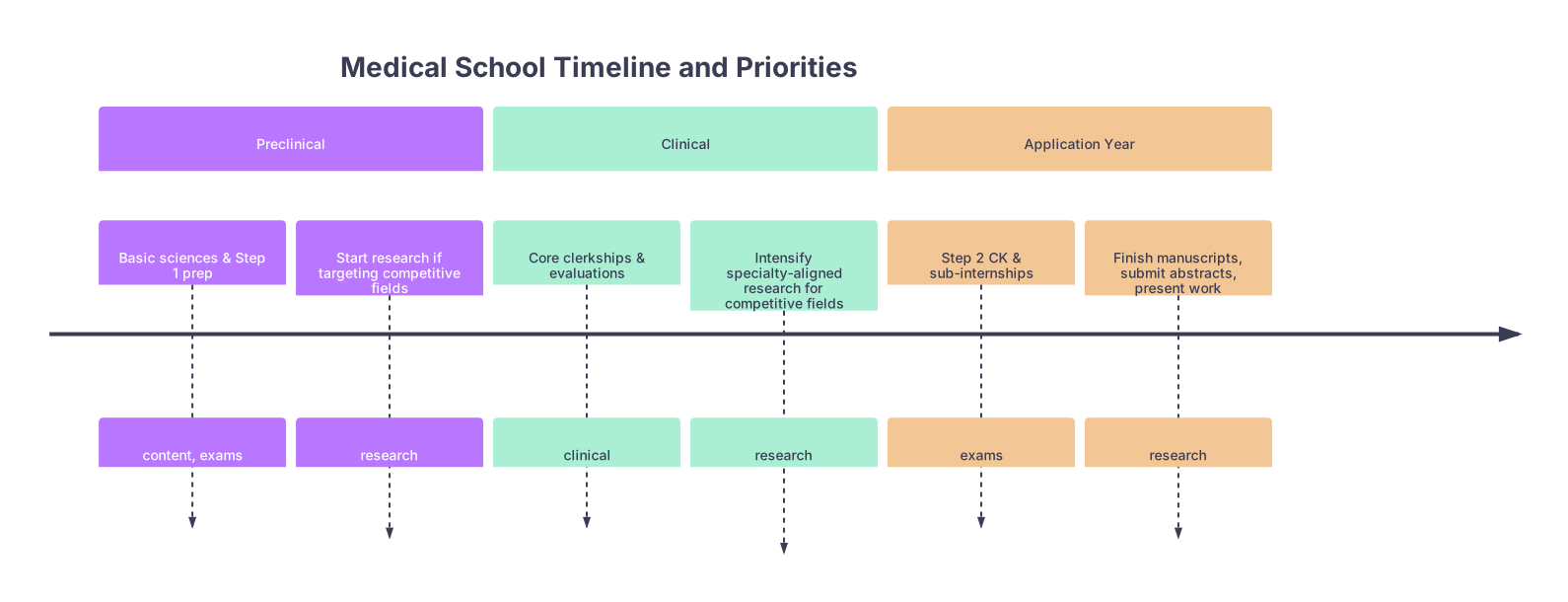
| Period | Event |
|---|---|
| Preclinical - Basic sciences & Step 1 prep | content, exams |
| Preclinical - Start research if targeting competitive fields | research |
| Clinical - Core clerkships & evaluations | clinical |
| Clinical - Intensify specialty-aligned research for competitive fields | research |
| Application Year - Step 2 CK & sub-internships | exams |
| Application Year - Finish manuscripts, submit abstracts, present work | research |
Patterns I have seen repeatedly:
- For a second-year student considering plastics, starting a research relationship early and building a 3–4 year pipeline is extremely high ROI.
- For a late third-year suddenly pivoting to derm with 0 research and an average Step 2, trying to create “20 items” in 6–9 months is low ROI and often transparently desperate.
- For a strong internal medicine applicant with 3 solid papers and a 250+ Step 2, chasing additional case reports adds almost nothing to match odds; time is better spent on Sub-I performance and letters.
The data do not reward blind accumulation. They reward coherent, specialty-aligned, and reasonably productive research trajectories.
Quick Reality Check: Myths vs Data
A few persistent myths that do not hold up against NRMP numbers and what PDs actually say:
“You need 20+ publications to match any competitive specialty.”
False. Many matched applicants in ortho, ENT, urology, etc., have 5–10 items, especially if other metrics are strong. The 20+ profiles get disproportionate attention but are not the floor.“Research does not matter if you want to do primary care.”
Oversimplified. It matters less for matching, but it matters for where you match and for future academic paths. One or two good projects can separate you from the pack at university programs.“Programs only care about first-author PubMed papers.”
Also false. Posters and abstracts clearly count in practice, especially early in medical school. But at the high end, quality and specialty alignment start to overshadow raw count.
Key Takeaways
- The correlation between research output and match rates is strongest in a subset of research-critical, competitive specialties (derm, plastics, neurosurgery); in these fields, being far below the research median is functionally disqualifying regardless of other strengths.
- Within most other specialties, reaching the “expected” research band (not the maximum) yields most of the benefit; additional items show diminishing returns compared with improvements in Step 2 CK and clinical performance.
- The highest-ROI strategy is not maximal research, but targeted, specialty-aligned research that gets you into the right range for your field while preserving time to hit board score and clinical benchmarks that programs still weigh more heavily.