It’s August 1st. ERAS opens in six weeks. Your spreadsheet says you’ve got “3 abstracts submitted, 1 in progress.” Your CV says… nothing. No accepted abstracts, no posters, no presentations. Just “Research experience” and a hope that things get accepted in time.
You’re asking the right question: When do I actually need to submit abstracts so they show up on my residency application, not in some hypothetical future life?
Let’s walk that backward. Month by month. Specialty by specialty. What you can still do now, and what was realistically supposed to happen six months ago.
First: How Programs See Abstracts on ERAS
Before timeline, you need the rule.
On ERAS, you can list:
- Accepted abstracts/posters/presentations (with conference name, date)
- Submitted but not yet accepted (yes, that’s allowed, but it’s weaker)
- Published conference proceedings (if applicable)
Programs care most about:
- Accepted abstracts with a named conference
- Posters/oral presentations actually delivered
- Manuscripts in press/accepted
“Submitted” is better than nothing, but it's soft. Everyone knows conferences reject. A list of ten “submitted” abstracts with zero acceptances looks exactly like what it is.
So the game is this:
- Time your abstract submissions so that:
- They’re accepted by the time you finalize ERAS (Sept–Oct),
- Or at least by the time you send significant update emails (Oct–Dec).
That means you work backward from:
- ERAS submission: mid-September
- Programs downloading apps: late September
- Interview invites peak: Oct–Nov
- Rank list due: late Feb / early March
Big Picture Timeline: When Abstracts Need to Be Accepted
Here’s the reality I’ve seen year after year:
| Timing of Acceptance | How You Can Use It | Impact on Match Application |
|---|---|---|
| By Aug 15 (Before ERAS opens) | Fully listed as accepted, definite conference date | Strongest – looks real, programs see it on first read |
| Aug 16–Sept 30 | Add to ERAS before certifying (or shortly after) | Still solid – many programs will notice |
| Oct–Dec | Update emails to programs, mention on interview days | Moderate impact – helps at margins, especially academic places |
| Jan–Feb | Can mention in rank update emails (if you send any) | Minor, but good for borderline cases or PDs who care about productivity |
| After Match week | Helps only for future (fellowship, academic jobs) | No effect on current Match |
Key point: Anything accepted after mid-October is more of a nice extra than a game-changer. You still list it, but it won't drive interview offers the same way.
Month-by-Month: Ideal Timeline (If You’re 6–12 Months Out)
Let’s assume you’re a third-year planning ahead or an early M4 who isn’t behind yet.
12–9 Months Before ERAS (Oct–Dec, MS3 year)
At this point you should:
- Know your likely specialty lane (or top 2)
- Get slotted into at least one project with:
- A realistic timeline (dataset exists or nearly done)
- A mentor who actually submits things and doesn’t just “talk about abstracts”
- A history of getting posters accepted at real meetings
You’re targeting:
- Spring conferences that will occur before or around ERAS opening in September.
How:
- Collect data, do the analysis, build at least one story that’s “abstract-ready” by January.
9–6 Months Before ERAS (Jan–Mar, MS3)
At this point you should:
- Write and submit your first round of abstracts.
Typical patterns:
- Big national meetings (e.g., ATS, ACP, ACG, RSNA, IDWeek) have abstract deadlines 6–9 months before the meeting.
- Regional/smaller specialty meetings may have deadlines 3–6 months before.
So for a June national conference, you probably submitted in December or January. For a September meeting, submissions might be March–April.
Your target now:
- Submit to at least one conference with notification by June–July.
- That way, acceptance is in hand before ERAS.
6–4 Months Before ERAS (Apr–May, late MS3 / early MS4)
At this point you should:
- Be in second-wave submissions.
You’re doing two things:
- Submitting new abstracts if you have new data.
- Using leftovers (projects that weren’t ready earlier or were rejected) and finding:
- Regional meetings
- State ACP/AMA meetings
- Institutional research days
These often have later deadlines and faster turnarounds.
Your goal:
- Pile up a few likely acceptances that will hit your inbox by July–August.
4–2 Months Before ERAS (Jun–Jul, early MS4)
This is acceptance season from your earlier work.
At this point you should:
- Track your notifications carefully; as soon as something is accepted:
- Lock down exact conference name and date
- Get clear on whether it’s:
- Poster only
- Oral presentation
- Rapid-fire, breakout, whatever
You enter it into your CV and draft ERAS section as:
- “Accepted poster presentation,”
- “Scheduled oral presentation,” etc.
If you still have NOTHING accepted by mid-July?
Time for the backup plan:
- Ask your mentor about:
- Departmental research day
- School-wide research symposia
- State-level societies with late-breaking calls
These can have July/Aug deadlines for Sept–Nov meetings and can save your CV from looking empty.
2–0 Months Before ERAS (Aug–Sept, early MS4)
This is final push.
At this point you should:
- Have most things in one of three buckets:
- Accepted (best)
- Submitted/pending
- “We missed the deadline” (salvage via local opportunities)
Any abstract submitted in August?
- Almost certainly will not be accepted and notified before you submit ERAS mid-September.
- You can still list it as “submitted,” but do not count on updating it to “accepted” before most interview offers go out.
Specialty-Specific Reality: How Early You Actually Need to Move
Some specialties are ruthless about research timelines. Others are more forgiving.
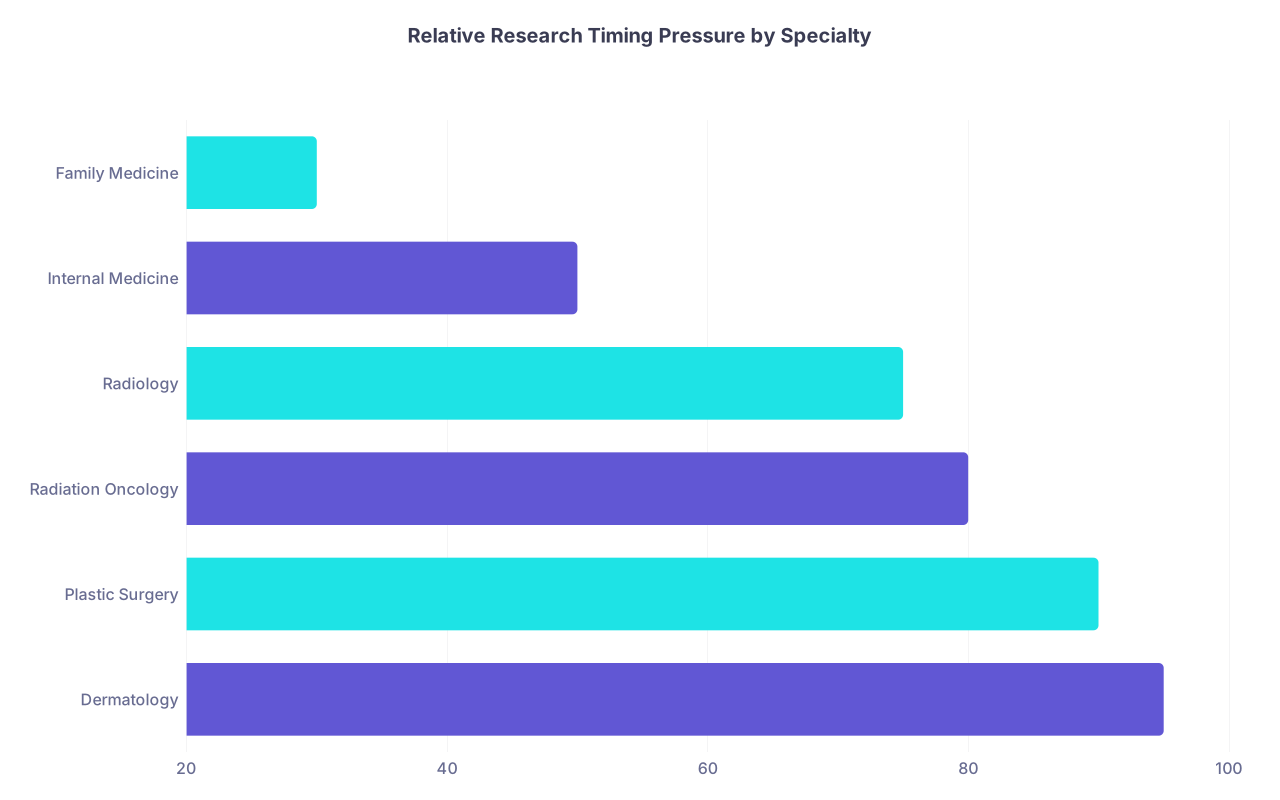
| Category | Value |
|---|---|
| Dermatology | 95 |
| Plastic Surgery | 90 |
| Radiation Oncology | 80 |
| Radiology | 75 |
| Internal Medicine | 50 |
| Family Medicine | 30 |
Highly Competitive (Derm, Plastics, Ortho, Neurosurg, ENT)
For these, at this point you should be a year ahead.
- National meetings: Often have deadlines 6–12 months prior.
- Many derm applicants are submitting abstracts during early MS3 that will present in MS4.
If you’re in this group and it’s already May–June before ERAS:
- Your chance to get new national-level acceptances before ERAS is low.
- You pivot to:
- Local/regional meetings with quick turnaround
- Institutional research day
- Making sure manuscripts move forward (in press > abstract)
Mid-Competitive (EM, Anesthesia, Rads, Rad Onc)
You can get away with:
- Submitting abstracts Jan–May for meetings in June–Oct.
- Even acceptances that land Aug–Sept still look reasonable.
The key is to have things clearly organized on ERAS before most interview invites go out (October).
Less Research-Heavy (FM, Psych, Peds, IM community-focused)
You have more flexibility.
- Late-breaking abstracts to regional meetings can still be accepted in Aug–Sept and then updated on ERAS in early fall.
- These specialties are less obsessed with research, so 1–2 solid accepted posters is usually sufficient.
Typical Conference Timeline Patterns (So You Can Back-Plan)
Conferences cluster their timelines. Once you understand the pattern, you stop getting surprised.
| Meeting Type | Abstract Deadline | Notification | Meeting Dates |
|---|---|---|---|
| Big national (e.g., ATS, RSNA) | 6–9 months before | 3–4 months before | May–Dec |
| Mid-size specialty meeting | 4–6 months before | 2–3 months before | Spring–Fall |
| Regional/state society | 2–4 months before | 1–2 months before | All year |
| Hospital/School research day | 1–3 months before | 2–6 weeks before | Usually Spring |
So if you want:
- Accepted abstract on ERAS by Sept
→ You need notification by Aug
→ You need to have submitted by Mar–May (for most external meetings)
If you’re thinking:
“I’ll do a project in July, submit in August, and have an acceptance by September, no problem.”
No. That works only for:
- In-house symposia
- Some state/regional meetings with very fast review
Concrete Scenarios: Where You Are Right Now & What To Do
Scenario 1: It’s January (MS3), You Want Things on ERAS This Fall
At this point you should:
- Identify 1–2 projects that can be abstract-ready in 6–8 weeks.
- Ask your mentor about specific meetings they actually use:
- “Which conference do you usually send this type of work to?”
- “When are their abstract deadlines?”
Then use this schedule:
- Jan–Feb: Finish data, draft abstract.
- Feb–Mar: Submit to at least one national or big regional meeting with notification by June–July.
- Mar–Apr: Second-wave submissions to smaller/regional meetings for fall.
Your ERAS in September will likely include:
- 1–3 accepted abstracts
- Maybe 1–2 submitted/pending
That’s fine. That’s actually strong if your specialty isn’t hypercompetitive.
Scenario 2: It’s June (Rising M4), ERAS in ~3 Months, Nothing Accepted
Okay. This is the “panic but not hopeless” phase.
At this point you should:
- Make a project inventory:
- What data is done?
- What can be turned into a basic descriptive abstract in 1 week?
- Target:
- Institutional research day (if fall event with summer deadline)
- State/regional societies (ACP chapter, AAFP state meetings, etc.)
- Any sub-specialty meetings your department knows have late or rolling abstracts
Your realistic expectations:
- Some acceptances may come in Sept–Oct, after your initial ERAS submission.
- You:
- List abstracts as submitted on ERAS in September.
- Once accepted, send polite update emails to your top programs:
- “I wanted to share that my abstract titled 'X' was accepted as a poster at [Meeting] in [Month, Year].”
Not ideal. But I’ve watched this still move the needle sometimes, especially at academic IM or EM programs.
Scenario 3: It’s August, ERAS Opens Next Month, You’re Just Now Asking
Clock is basically red at this point.
Here’s what you can still do:
- Convert any near-complete project into:
- A submitted abstract to a local or regional meeting with fast review.
- A well-described research experience that you emphasize in your personal statement and ERAS experience entries.
- Accept that:
- Abstracts submitted now will probably be:
- Listed as “submitted” on your initial ERAS.
- Possibly converted to “accepted” in updates after some invites have already gone out.
- Abstracts submitted now will probably be:
So the priority in August:
- Finish and submit anything that can realistically be reviewed in the next 1–2 months.
- Make your research experience sections on ERAS airtight:
- Your role clearly described.
- Methods and impact obvious.
- Don’t hide behind buzzwords.
Future you (for fellowship) will be glad you did this, even if it’s late for residency.
Week-by-Week: From Abstract Idea to Accepted in Time
Let’s take a 10-week window as a realistic abstract sprint.
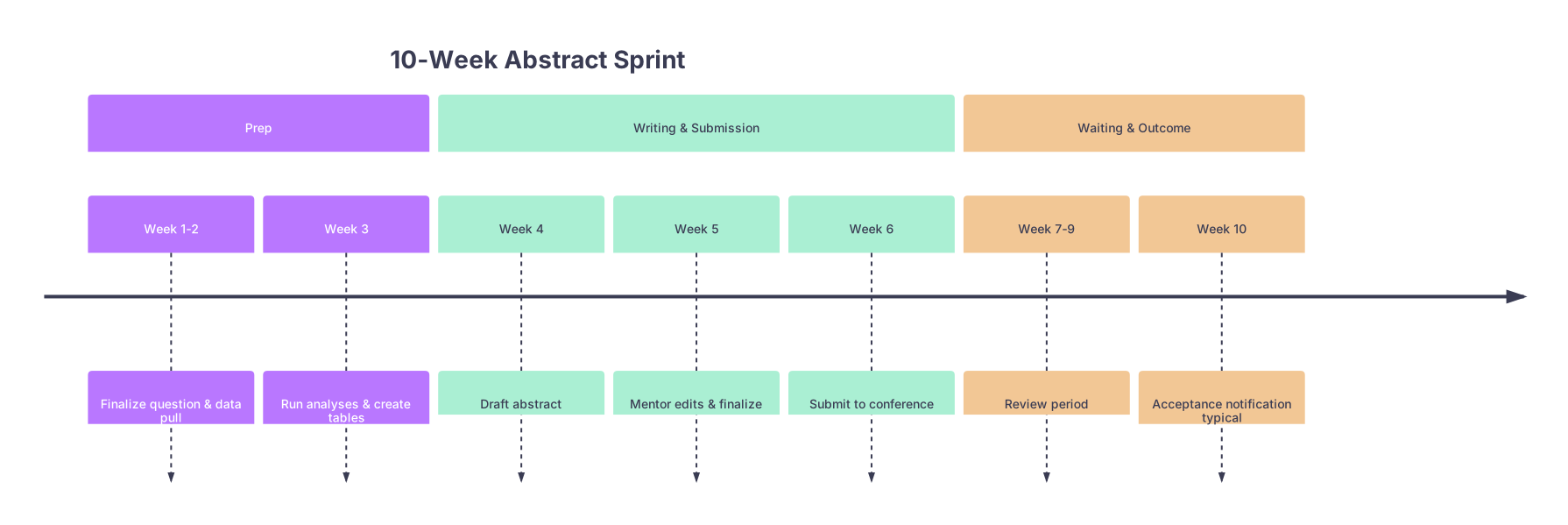
| Period | Event |
|---|---|
| Prep - Week 1-2 | Finalize question & data pull |
| Prep - Week 3 | Run analyses & create tables |
| Writing & Submission - Week 4 | Draft abstract |
| Writing & Submission - Week 5 | Mentor edits & finalize |
| Writing & Submission - Week 6 | Submit to conference |
| Waiting & Outcome - Week 7-9 | Review period |
| Waiting & Outcome - Week 10 | Acceptance notification typical |
If you must have acceptance on ERAS by mid-August, you want:
- Abstract submitted no later than early June (Week 6 of that sprint)
- Notification expected in late July–early August
Working backward is the only way this doesn’t blow up in your face.
Strategic Choices: Where to Submit If You Care About Timing
You’re not just picking the fanciest meeting. You’re picking the meeting that:
- Matches your work,
- Has deadlines that line up with your cycle,
- And doesn’t take half a year to send decisions.
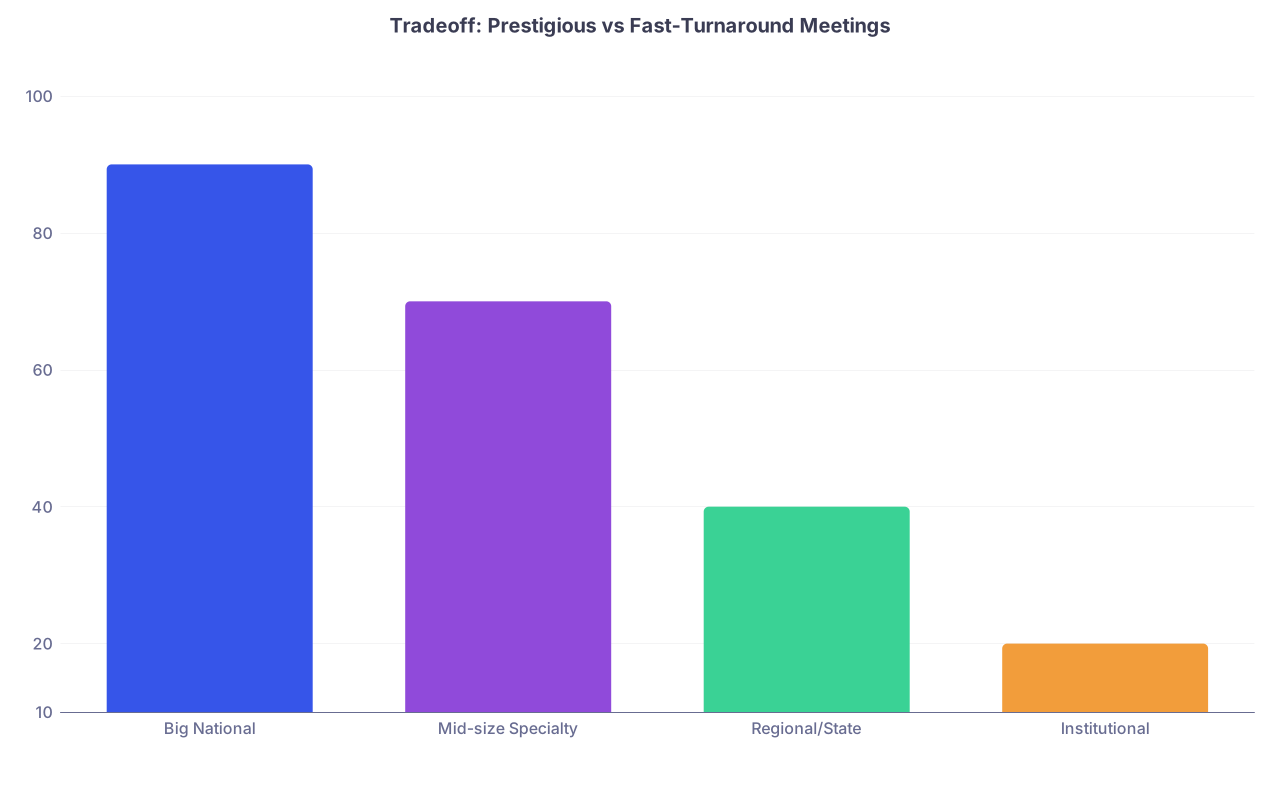
| Category | Value |
|---|---|
| Big National | 90 |
| Mid-size Specialty | 70 |
| Regional/State | 40 |
| Institutional | 20 |
(Rough “notification delay” score – higher = slower)
Big national meetings
Pros: Looks great, high visibility.
Cons: Early deadlines, slow notification. If you miss their winter/spring deadline, you’re done for this cycle.
Mid-size specialty meetings
Often the sweet spot. Deadlines in spring, notifications by summer, meetings in fall.
Regional/state meetings
Deadlines in spring/summer, fast decisions, meetings in fall. For timing, these are your best friends.
Institutional research days
Very fast, usually spring or early fall. Not as impressive, but “poster presentation at [Your Institution] Research Day” is still better than an empty section.
How to List “Submitted” vs “Accepted” on ERAS Without Looking Shady
Programs can smell CV inflation. I’ve seen applicants list “10 abstracts” that were all “submitted” to the same massive national meeting that rejects most of them.
Guidelines:
- If it’s accepted:
- Put “Accepted poster presentation” or “Scheduled oral presentation.”
- If it’s submitted but pending:
- Clearly label it as “Abstract submitted to [Meeting], under review.”
- Once you get a decision:
- Update ERAS if still possible.
- Or mention changes in:
- Update emails
- Interviews (“Since submitting my ERAS, two of my abstracts were accepted…”)
Don’t play games by implying something is accepted when it’s just submitted. PDs talk. Faculty sit on conference committees. They will know.
One More Layer: Manuscripts vs Abstracts for Timing
Sometimes you’re choosing: focus this month on an abstract or push a paper closer to submission.
If we’re talking purely about residency timing:
- By August before ERAS:
- An accepted or in-press manuscript is more powerful than an accepted abstract.
- But an accepted abstract is more visible than a “manuscript in progress.”
So:
- 6–12 months before ERAS: push both.
- 3–6 months before ERAS:
- If you’re close to a manuscript submission, finish it.
- If the paper is months away, but you can carve an abstract out now, do the abstract.
Visual Shortcut: When to Work on What (Jan–Sept Before ERAS)
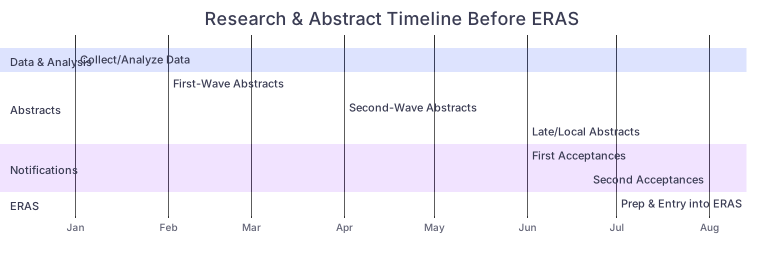
| Task | Details |
|---|---|
| Data & Analysis: Collect/Analyze Data | a1, 2025-01, 4m |
| Abstracts: First-Wave Abstracts | a2, 2025-02, 3m |
| Abstracts: Second-Wave Abstracts | a3, 2025-04, 3m |
| Abstracts: Late/Local Abstracts | a4, 2025-06, 3m |
| Notifications: First Acceptances | a5, 2025-06, 2m |
| Notifications: Second Acceptances | a6, 2025-08, 2m |
| ERAS: Prep & Entry into ERAS | a7, 2025-07, 3m |
If you line up your work to match something like this, your ERAS will not be empty.
Bottom Line: What You Do Now Depends on Where You Are in Time
To wrap this quickly:
- Abstracts need to be submitted 3–6 months before ERAS if you want them accepted and clearly visible on your initial application.
- Late abstracts (Aug–Oct) can still help, but mostly through updates and interviews, not initial invite decisions.
- If it’s late in the cycle, prioritize fast-turnaround meetings (regional, institutional) and make your research experience descriptions airtight, instead of fantasizing about a last-minute national podium talk.
You can’t control review timelines. You can control when you start.