
Your rotation project will not “eventually become a paper” unless you treat it like a deadline-driven job. Hope is not a strategy. A ruthless, time‑boxed plan is.
Below is exactly that plan: month‑by‑month, then week‑by‑week, then day‑by‑day when it matters. The goal is simple: by the time you hit interview season, you have a submitted (or accepted) manuscript on your ERAS, and you can talk about it like someone who actually did the work.
I will assume you are:
- A 3rd or 4th year med student, or early prelim/TY,
- Sitting on a rotation project (QI, case series, retrospective chart review, small clinical study),
- Planning to apply in the upcoming or following Match.
If your timing is different, shift the months, not the sequence.
Big Picture: 6‑Month Conversion Timeline
First, you need to see the whole arc.
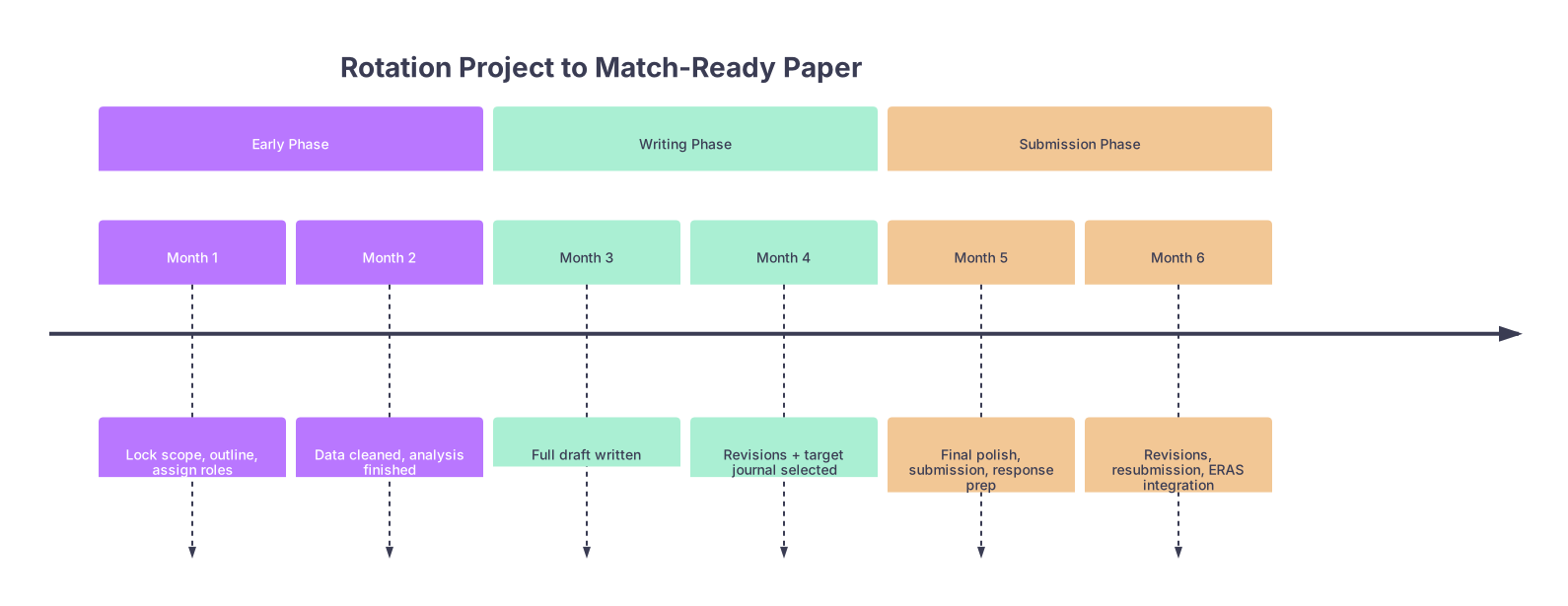
| Period | Event |
|---|---|
| Early Phase - Month 1 | Lock scope, outline, assign roles |
| Early Phase - Month 2 | Data cleaned, analysis finished |
| Writing Phase - Month 3 | Full draft written |
| Writing Phase - Month 4 | Revisions + target journal selected |
| Submission Phase - Month 5 | Final polish, submission, response prep |
| Submission Phase - Month 6 | Revisions, resubmission, ERAS integration |
At this point you should accept one thing: if you do not assign concrete deliverables to each month, your project will die in the land of “working on the paper.”
Month 1 – Lock the Project and Build the Skeleton
This is the month where most people fail by being vague. You will not.
Week 1: Clarify the Project and Ownership
At this point you should:
- Identify exactly which project is getting turned into a paper. Not “maybe one of the QI projects.” One.
- Clarify authorship expectations with your attending / PI:
- Are you first author? (Push for it if you did most of the work.)
- Who is last author?
- Who else needs to be on the list for political reasons?
Have a 15‑minute conversation that sounds like:
“I would like to turn this rotation project into a manuscript with the goal of submission before [Month 5]. I am happy to take ownership of drafting. Would you be comfortable with me as first author and you as senior author?”
If they waffle endlessly, that is a red flag. Better to know early and pick a project with a committed mentor.
Week 2: Define the Story and Target Journal Tier
At this point you should define what this paper is and roughly where it belongs.
Decide:
- Type: case report, case series, retrospective cohort, QI paper, brief report.
- Main message: literally one sentence. (“Implementation of a standardized handoff tool reduced transfer‑related errors by 40% in a community hospital ICU.”)
- Target journal tier: high, mid, or local.
| Tier | Typical Project Fit | Example Journals |
|---|---|---|
| High | Large data, novel findings | JAMA, NEJM, Circulation |
| Mid | Solid single-center data | Journal of Hospital Med |
| Local/Case | QI, small series, case report | State med journal |
Be honest. A 32‑patient, single‑center QI project is not going to JAMA. And that is fine. For residency applications, having a published mid‑tier or local paper beats a fantasy high‑impact submission that never gets accepted.
Week 3: Build the Outline and Data Plan
At this point you should have:
- A working title and abstract skeleton (background, objective, methods, results, conclusion – 2‑3 lines each).
- Section headings for Introduction, Methods, Results, Discussion.
- A list of:
- Tables you need (e.g., Table 1: baseline characteristics, Table 2: outcomes).
- Figures you might want (flowchart, run chart, Kaplan–Meier, etc.).
Also, nail down the data status:
- Is all data fully collected?
- Do you need IRB clarification for publication? (QI vs research debates derail projects all the time.)
Send a short email to your mentor:
“Attached is a one‑page outline of the manuscript, including proposed tables and figures. If you agree, I will proceed with data cleaning and analysis over the next 3 weeks.”
Week 4: Data Cleaning Starts (Not Analysis Yet)
At this point you should:
- Pull the full data set into a single, clean spreadsheet or database.
- Standardize variable names, units, and codes.
- Create a data dictionary (even if crude): what each variable means.
People underestimate Month 1. If you do this right, the rest moves quickly. If you skip it, you will “write” for months and never finish.
Month 2 – Finish Data and Analysis
Month 2 is about turning chaos into tables and figures that can be dropped into the manuscript.
Week 1: Finish Data Cleaning
By now:
- Missing data should be identified and (if possible) fixed.
- Obvious entry errors corrected.
- Inclusion / exclusion criteria applied.
Document every decision. Future‑you, and your reviewers, will ask “Why did we drop 8 patients here?”
Week 2: Basic Descriptive Statistics
At this point you should:
- Generate baseline characteristics:
- Means/SD or medians/IQR for continuous variables.
- Counts/percentages for categorical variables.
- Create Table 1. Even if rough.
Use this as an anchor:
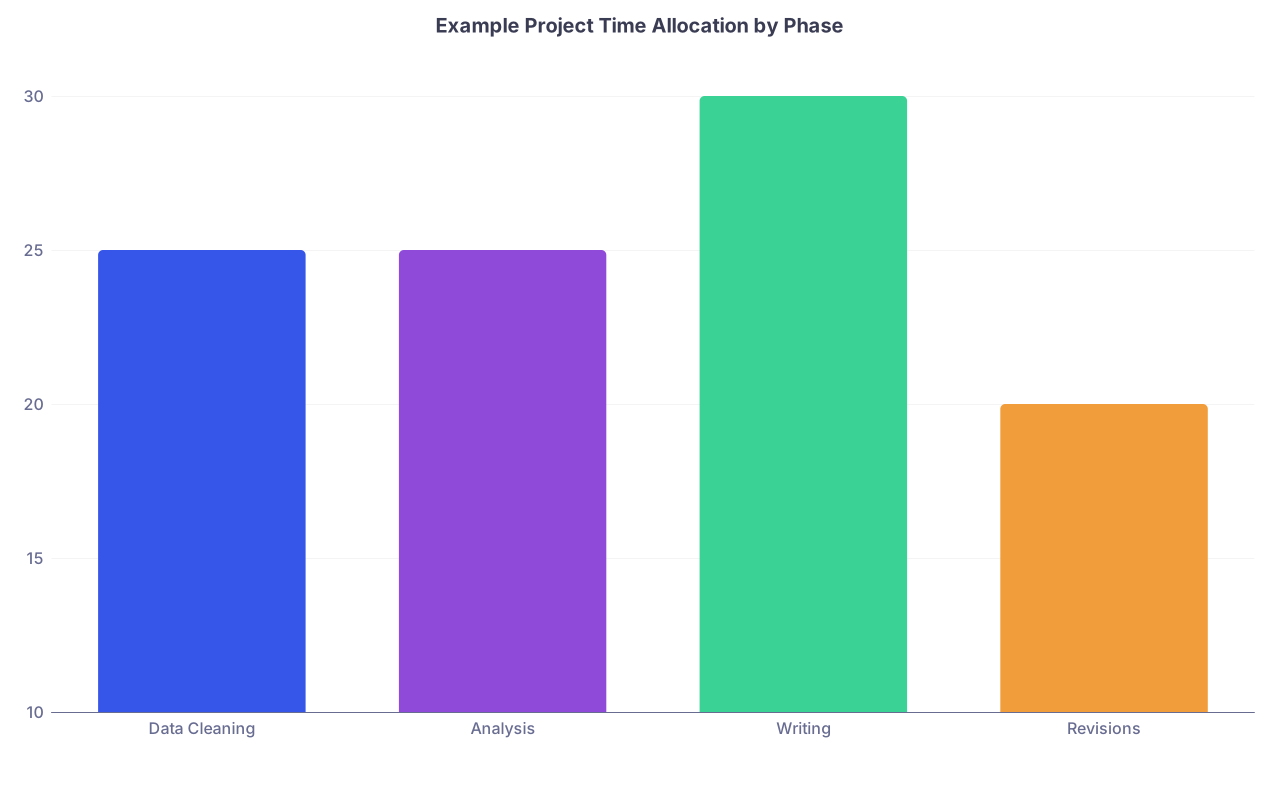
| Category | Value |
|---|---|
| Data Cleaning | 25 |
| Analysis | 25 |
| Writing | 30 |
| Revisions | 20 |
If you are not comfortable with stats, grab a resident or biostats person now. Not later when the journal asks for a methods revision.
Week 3: Core Analyses
At this point you should:
- Run the primary outcome analysis you defined in Month 1.
- Run 1–2 key secondary analyses, max. Scope creep kills timelines.
- Export clean, publication‑quality tables and figures.
Confirm with your mentor:
- “Is this the primary result you want as the headline?”
- If they now want five more exploratory analyses, push back:
“We can plan a separate follow‑up analysis. For this paper, I want to keep the focus tight so we can submit before [Month 5].”
Week 4: Freeze the Data and Lock the Results
At this point you should:
- Freeze the data set. No more additions unless there is a major error.
- Finalize:
- N numbers,
- Main effect sizes,
- P‑values / CIs,
- Final list of tables/figures.
If you keep altering the data, the text will never match the numbers and the paper will drift for months.
Month 3 – Write the Full Draft
This is where you move from “we have data” to “we have a paper.”
Week 1: Write Methods and Results First
At this point you should:
- Draft Methods in detail:
- Setting, period, inclusion/exclusion.
- Data collection.
- Outcomes.
- Statistical analysis.
- Draft Results following your table order:
- Start with participant flow (N approached/included/analyzed).
- Then baseline table.
- Then primary and key secondary outcomes.
Do not polish. Just get complete sentences into a shared document (Google Docs, Word with tracked changes). Aim for ugly but complete.
Week 2: Write the Introduction
At this point you should write:
- 3–5 paragraphs, max:
- What the general problem is.
- What is already known (2–3 key references).
- The gap your study addresses.
- The specific, one‑sentence objective.
Bad intro: “X is important.”
Good intro: “Despite prior work showing X, no studies have examined Y in Z population. Therefore, our objective was…”
Week 3: Draft the Discussion
At this point you should:
- Follow a standard structure:
- Paragraph 1: Answer the research question directly.
- Paragraph 2–3: Compare with prior work.
- Paragraph 4: Strengths and limitations.
- Final paragraph: Implications and future work.
Avoid the common med student mistake: 3 pages of literature review that repeats the Introduction. Editors hate that.
Week 4: Consolidate, Check Coherence, Shorten
At this point you should:
- Make sure:
- Every result mentioned in the text exists in a figure or table.
- The numbers match across abstract, text, and tables.
- Start trimming:
- Remove repeated sentences.
- Tighten rambling paragraphs.
Send a full draft to your mentor with a clear ask:
“Here is a complete draft (4,200 words) with all tables/figures. Could you provide comments on overall structure, missing content, and journal choice within 10 days?”
Month 4 – Revise Aggressively and Pick the Exact Journal
This month is about targeted revision and aligning with a specific journal.
Week 1: Incorporate Mentor Feedback
At this point you should:
- Go through comments line by line.
- Accept or respectfully push back where needed.
- Fix structural issues: unclear objectives, missing limitations, etc.
Do not start reanalyzing the data unless there is a major conceptual error.
Week 2: Choose the Exact Journal and Format the Manuscript
You now stop saying “we’ll figure out the journal later.”
Pick:
- 1 primary target,
- 1 backup (slightly lower tier) in case of rejection.
Then:
- Download the author guidelines and sample articles from that journal.
- Conform to:
- Word count,
- Section headings,
- Reference style,
- Figure/table limits.
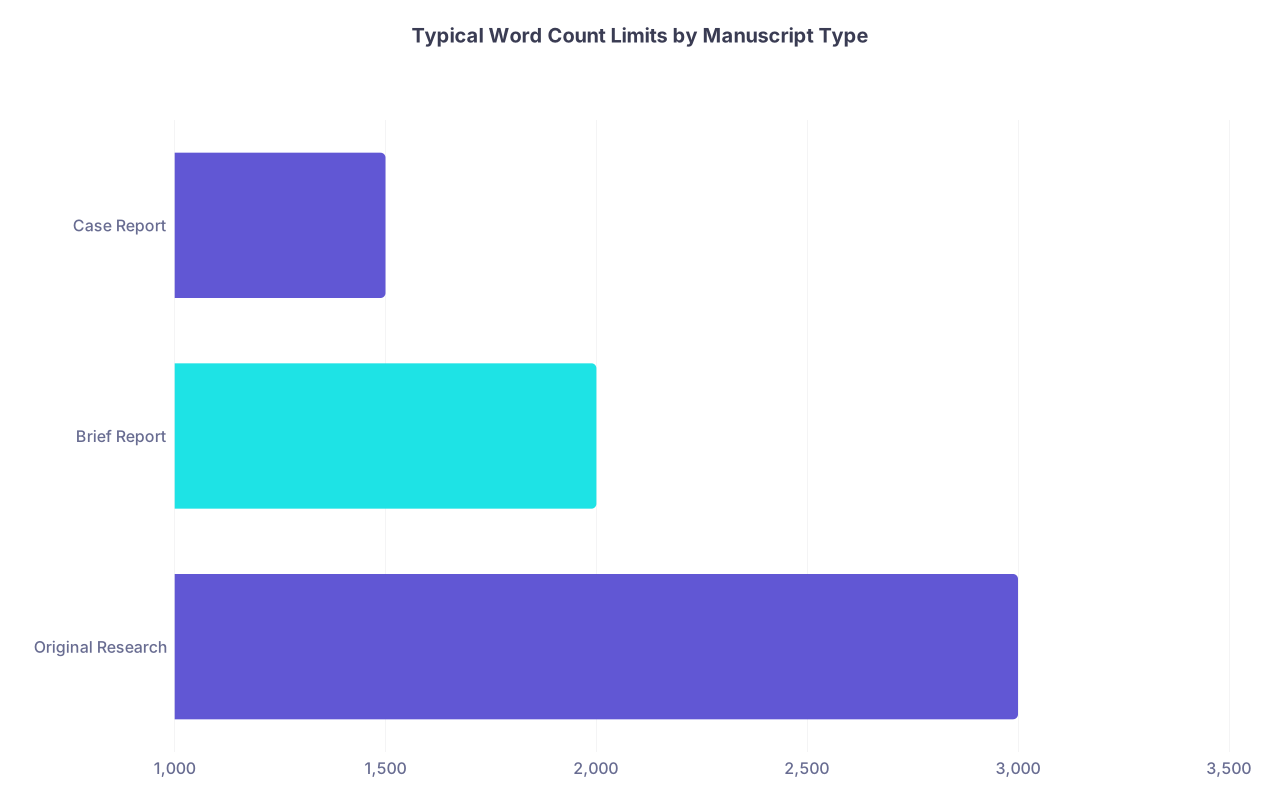
| Category | Value |
|---|---|
| Original Research | 3000 |
| Brief Report | 2000 |
| Case Report | 1500 |
This is where sloppiness shows. Reviewers are biased against manuscripts that scream “generic template” instead of fitting their journal.
Week 3: Polish Language and Tighten the Abstract
At this point you should:
- Rewrite the abstract to exactly match:
- Final numbers,
- Final wording of objectives,
- Final conclusions.
- Remove filler language:
- “Very,” “quite,” “extremely,” “interestingly,” etc.
- Run a spellcheck and basic grammar pass. Get a co‑author to read for clarity, not just content.
Week 4: Final Internal Review
At this point you should:
- Send the near‑final draft to all authors with:
- Authorship order,
- Author contributions if the journal uses CRediT taxonomy,
- Deadline for final comments (7 days).
Be explicit: “If no major concerns by [date], I plan to submit to [Journal] on [date].”
Month 5 – Submit and Prepare for Reviewer Feedback
Month 5 is submission month. No more “almost ready.”
Week 1: Prepare Submission Materials
At this point you should assemble:
- Main manuscript (correctly formatted).
- Title page with:
- Full author list, degrees, affiliations.
- Corresponding author contact info (usually your mentor, not you).
- Figures and tables as per journal specs.
- Cover letter:
- 2–3 short paragraphs:
- Why this is important.
- Why it fits this journal.
- Statement that it is not under consideration elsewhere.
- 2–3 short paragraphs:
Week 2: Get PI Approval and Press Submit
At this point you should:
- Get explicit “OK to submit” from your mentor / senior author.
- Create or log into the journal’s submission system.
- Enter:
- All author details,
- Disclosures,
- Funding info (even if “none”),
- Suggested reviewers if requested.
Then submit. Do not sit on a “ready” paper for 3 weeks because you are nervous.
Week 3: Log, Track, and Move On
At this point you should:
- Record:
- Journal name,
- Submission date,
- Manuscript ID.
- Add it to your CV and ERAS as “Manuscript submitted” (if close enough to application season; label status honestly).
Then, crucial: start the next small project or prepare a conference abstract from the same data. Momentum matters.
Week 4: Anticipate Common Decisions
Most likely outcomes within 4–8 weeks:
- Desk reject (no review),
- Minor/major revision,
- Rare early acceptance.
Talk with your mentor now about Plan B journal in case of a quick reject. That way you can resubmit within 1–2 weeks, not 2 months.
Month 6 – Revise, Resubmit, and Make It Match‑Ready
This month is about handling reviews quickly and aligning everything with your application timeline.
Week 1: If Rejected – Rapid Resubmission
If you get a desk reject at this point you should:
- Skim the letter. Do not take it personally.
- Adjust:
- Word count,
- Scope,
- References (if needed) for the Plan B journal.
- Submit to the next journal within 7–10 days.
Do not rewrite the whole paper. Targeted tweaks only.
Week 2–3: If Revise and Resubmit – Precision Response
If you receive reviewer comments:
- Create a response to reviewers document.
- For each comment:
- Quote it,
- Respond in plain language,
- Indicate where in the manuscript you made changes (page/line numbers).
Example:
Comment: “The authors should clarify how missing data were handled.”
Response: “We thank the reviewer for this comment. We have added a sentence in the Methods (page 5, lines 12–15) clarifying that missing data for secondary outcomes were not imputed and analyses were performed with available cases only.”
At this point you should aim to resubmit within 2–3 weeks. Faster responses look good and prevent the project from going cold.
Week 4: Integrate with Your Residency Application
Now tie it directly to the Match.
At this point you should:
- Update your CV and ERAS:
- Status: “Submitted,” “Under review,” “Accepted,” or “In press” (be honest).
- Final author order, journal name if known.
- Prepare a 2–3 minute spoken summary of the project for interviews:
- Your role,
- The question,
- Key results,
- What you learned.
Residency interviewers care less about impact factor and more about whether you can own a project from start to finish. This 6‑month arc proves that.
Micro‑Timeline: Last 30 Days Before ERAS Submission
Most people panic here. Do not.
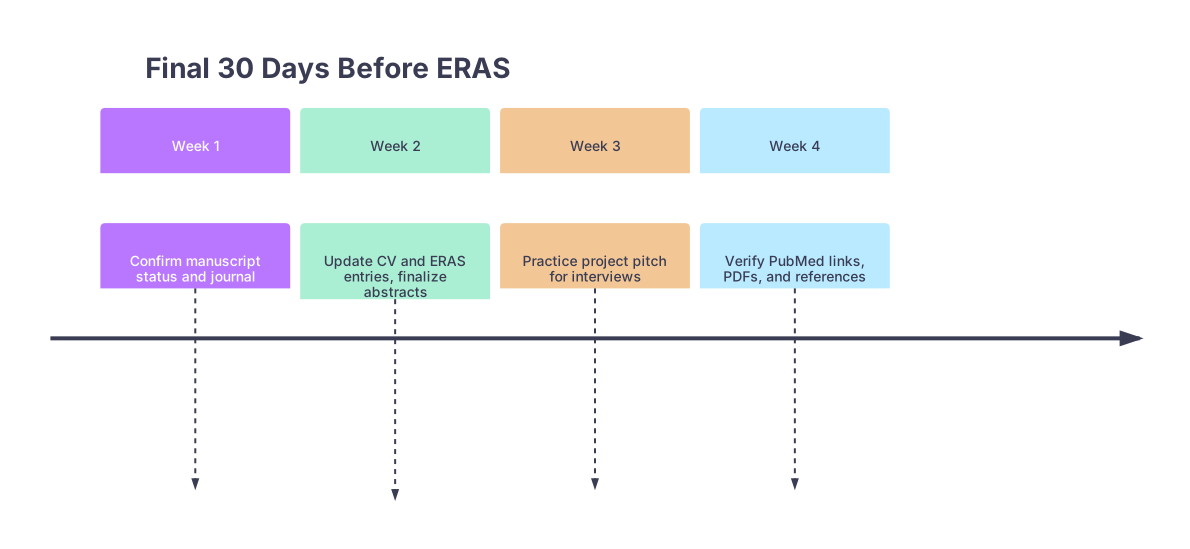
Week 1
At this point you should:
- Confirm with your mentor:
- Latest status of the manuscript.
- Any upcoming revisions or decisions expected.
Week 2
At this point you should:
- Enter the project into ERAS properly:
- Correct title,
- Complete author list,
- Honest status.
Do not inflate “draft in progress” to “submitted.” Programs notice.
Week 3
At this point you should be able to answer, without rambling:
- “Tell me about your research on [topic].”
- “What was the most challenging part of this project?”
- “If you repeated this study, what would you change?”
Week 4
At this point you should:
- Double‑check:
- Spelling of journal names,
- Year/volume if accepted,
- Consistency between CV, ERAS, and what your letter writers may mention.
- Keep a PDF of the latest manuscript version accessible. Interviewers occasionally ask for it.
Quick Reality Check: What Actually Impresses Programs
Programs see a lot of fluff. Here is what stands out:

They care when:
- You have any first‑author paper, even in a modest journal, that is clearly real.
- You can explain the project at a level deeper than “I helped with data collection.”
- The timeline shows discipline: rotation → project → manuscript → submission.
They do not care about:
- Inflated “abstract submitted” entries with no follow‑through.
- Grandiose promises of “planning to publish” with nothing in motion.
- Name‑on‑paper projects where you do not understand the methods.
FAQs
1. How early before the Match should I start this 6‑month plan?
Ideally, you finish the 6‑month cycle before ERAS opens so you can list the manuscript as at least “submitted.” That means backing up:
- If ERAS opens in September and you want a submitted manuscript by then,
- You should start this plan no later than March.
If you are later than that, still do it. A serious “in progress” project that is clearly on track can still help, especially if you can talk about it well in interviews.
2. What if my mentor is slow or non‑responsive?
Then you run a parallel path:
- Send clear, time‑boxed emails (“If I do not hear back by [date], I will proceed with X assumption.”).
- Keep all drafts and decisions documented.
- If there is no movement for 4–6 weeks at multiple points, strongly consider:
- Scaling the paper to a lower tier journal that tolerates more student‑driven work,
- Or prioritizing a different project with a more engaged mentor.
Waiting passively for months because “my attending is busy” is how rotation projects die. Better an honest, modest paper with a responsive mentor than a forever‑draft with an academic celebrity.
Key points:
- Treat your rotation project like a 6‑month job with hard monthly deliverables, not a wish.
- Lock data and story early; then write, revise, and submit on a schedule, not when you “have time.”
- Align the final 1–2 months with ERAS so the paper is not just written, but strategically visible and discussable in your residency application.