The biggest mistake students make about research and the Match is starting the conversation two years too late.
If you care about matching well—especially in competitive specialties—your research timeline starts in MS1, not in the panic of late MS3. The students who look “effortlessly” strong on ERAS didn’t get lucky. They worked the timeline.
Here’s how to do the same, step by step, year by year, and then month by month when it matters.
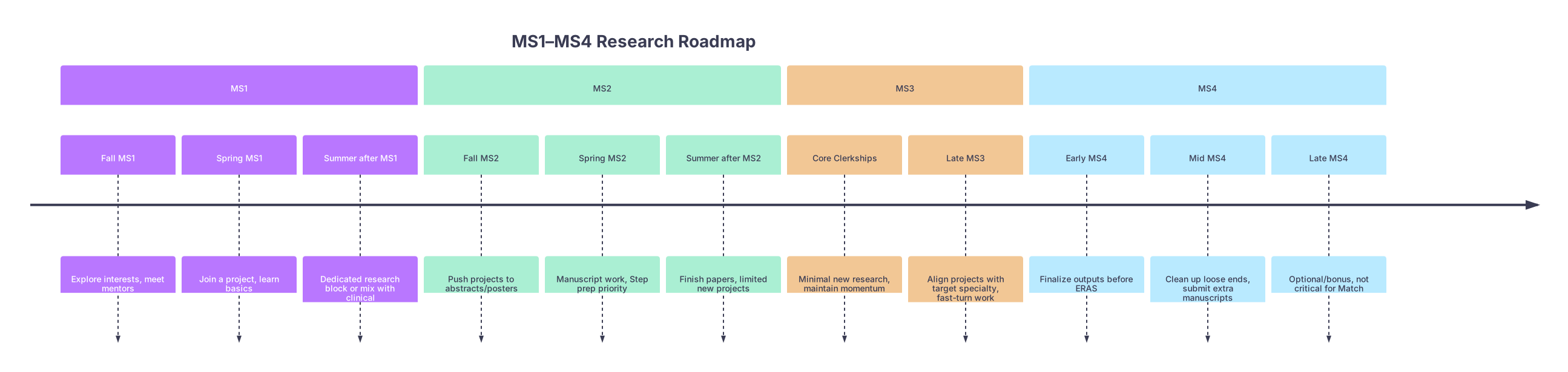
Big-Picture Research Timeline From MS1–MS4
Let’s orient you first. Then we’ll drill down.
| Period | Event |
|---|---|
| MS1 - Fall MS1 | Explore interests, meet mentors |
| MS1 - Spring MS1 | Join a project, learn basics |
| MS1 - Summer after MS1 | Dedicated research block or mix with clinical |
| MS2 - Fall MS2 | Push projects to abstracts/posters |
| MS2 - Spring MS2 | Manuscript work, Step prep priority |
| MS2 - Summer after MS2 | Finish papers, limited new projects |
| MS3 - Core Clerkships | Minimal new research, maintain momentum |
| MS3 - Late MS3 | Align projects with target specialty, fast-turn work |
| MS4 - Early MS4 | Finalize outputs before ERAS |
| MS4 - Mid MS4 | Clean up loose ends, submit extra manuscripts |
| MS4 - Late MS4 | Optional/bonus, not critical for Match |
Here’s the core rule:
Outputs (abstracts, posters, manuscripts) lag inputs (joining a project) by 6–18 months. If you want something on ERAS by September of MS4, you cannot start in MS3 and expect miracles.
MS1: Positioning Yourself (Not Drowning Yourself)
At this point you should not be asking, “How do I publish 5 papers this year?”
You should be asking, “How do I become the kind of student people actually want on their research team?”
MS1 Fall (August–December): Recon and Relationship-Building
Main goals:
- Figure out who actually does research you care about.
- Become visible and reliable, not overeager and annoying.
At this point you should:
Map your school’s research ecosystem (first 4–6 weeks)
- Skim your department websites for:
- Division chiefs in competitive areas (cards, heme/onc, ortho, plastics, derm, ENT, neurosurg, ophtho, rad onc, rads, anesthesia).
- Mid-career attendings with recent publications (not just emeritus big names).
- Check PubMed for their last 5–10 papers. You’re looking for patterns of output, not titles that sound fancy.
- Skim your department websites for:
Talk to near-peers
- Ask MS3s/MS4s who matched well: “Who actually gets things done with students?”
They’ll tell you which “big name” never finishes anything and which low-profile hospitalist churns out QI papers.
- Ask MS3s/MS4s who matched well: “Who actually gets things done with students?”
Protect your bandwidth
- Avoid big, unfocused commitments early:
- Multicenter projects where you’re “one of 30 sites collecting data” → slow.
- Basic science with no clear subproject for you → even slower.
- One small, well-defined project is better than three vague “maybe” collaborations.
- Avoid big, unfocused commitments early:
By the end of MS1 fall, you should:
- Have 3–5 attendings in mind you’d be happy to work with.
- Have introduced yourself to at least 1–2 of them (short email + quick meeting).
MS1 Spring (January–May): Join a Real Project
Now it’s time to commit—but intelligently.
At this point you should:
Secure 1 primary mentor + 1–2 concrete projects
- In your email/meeting, ask directly:
- “Do you have any projects where a motivated MS1 could be first author or clear co-author within 12–18 months?”
- Acceptable project types for speed:
- Chart review / retrospective cohort.
- Case series.
- QI project with clear pre/post data.
- Simple educational study (surveys, pre/post tests).
- In your email/meeting, ask directly:
Clarify role and timeline
- Ask:
- “What exactly would my responsibilities be for this project?”
- “What conferences are you usually targeting, and what are upcoming deadlines?”
- Get something like:
- You: data extraction + basic stats + first draft.
- Mentor: project design, advanced stats, revision.
- Ask:
Build skills while the stakes are low
- Learn:
- REDCap or your institution’s equivalent.
- Basic Excel or R/SPSS use (enough to not break the dataset).
- How to do a structured abstract and basic intro for a med paper.
- Learn:
By the end of MS1 spring, you should:
- Be formally attached to at least one project with a realistic plan for:
- Abstract/poster in MS2.
- Manuscript submitted by early MS3 at the latest.
Summer After MS1: First “Real” Research Push
This is the first big inflection point. You can either treat summer as a black hole or as a launch pad.
At this point you should:
- Aim for 6–8 focused weeks of true research time if possible.
- Target outcomes:
- Dataset complete (or close).
- Abstract drafted.
- Poster submission for a regional/national meeting within the next 6–12 months.
Avoid signing up for:
- Ten small side projects where your role is “help with lit search.”
- Long-shot basic science unless:
- You actually love it.
- The lab has a history of med student publications.
If you’re eyeing competitive specialties, this is the summer to:
- Do a specialty-specific research program if your school or another institution offers one.
- Or at minimum, tie your project clearly to a plausible specialty (e.g., outcomes in heart failure patients if you’re leaning cards/IM).
MS2: Converting Work Into Output (Without Tanking Step)
MS2 is where strong applicants separate themselves.
Not by doing more research. By finishing what they started in MS1.
MS2 Fall (August–December): Abstracts, Posters, and First Manuscripts
At this point you should:
Push for your first real deliverables
- Abstracts:
- Identify 2–3 conferences with deadlines between October–February.
- Work backward 4–6 weeks for data cleaning and abstract drafting.
- Posters:
- Volunteer to be the presenting author when possible.
- Even local/regional meetings count; they pad your CV and show follow-through.
- Abstracts:
Start manuscript drafting
- If your data is done, do not wait for your mentor to magically write the paper.
- You draft:
- Intro: 3–5 paragraphs, focused.
- Methods: very detailed—this is where you learn how real research is written.
- Results: tables + key numbers.
- Then give your mentor a real draft, not “an outline.”
Limit new commitments
- One additional small, fast-turn project is fine.
- But if you’re already behind on your main project, saying yes to more is just ego.
By the end of MS2 fall, you should:
- Have at least 1 abstract submitted or ready to submit.
- Have one manuscript draft either in progress or close to completion.
MS2 Spring (January–May): Finish Strong, Protect Step
This is a tightrope. Step 1/Level 1 (or Step 2 prep if your curriculum is different) matters more than anything you’ll ever publish.
At this point you should:
Time-box research
- Cap research to:
- 2–4 hours per week during heavy Step prep.
- Short, specific tasks (table revisions, minor edits, email follow-up).
- If something major is needed (full re-analysis, rewriting), negotiate timeline with your mentor.
- Cap research to:
Get papers out the door before dedicated
- For any near-complete paper:
- Lock in all co-authors.
- Resolve authorship order.
- Target a specific journal.
- Aim to submit manuscripts by the start of your dedicated board study if possible.
- For any near-complete paper:
Don’t start anything new now
- Any project started in late MS2 will realistically not help your ERAS for residency.
- Do it only if you love the question or it’s tightly tied to your target field and mentor.
MS3: Clerkships First, But Research Still Matters
Here’s where a lot of smart students sabotage themselves: they try to behave like part-time PhD students while learning how to be on the wards.
Bad idea.
MS3 Core Year (June–March): Minimal New, Maintain Existing
At this point you should:
Prioritize clinical performance
- Honors, strong comments, and letters beat an extra abstract in almost every field.
- A mediocre MS3 record with 10 publications does not fix itself.
Keep old projects alive with low-intensity maintenance
- Touch base with mentors every 4–8 weeks:
- “Anything you need from me on the X paper?”
- Tasks that are realistic on rotations:
- Reformatting tables.
- Responding to reviewer comments.
- Small figure edits.
- Batch this into 1–2 hours on lighter weekend days.
- Touch base with mentors every 4–8 weeks:
Say no to big new projects unless:
- It’s directly in your now-confirmed target specialty.
- The attending is known for fast turnarounds with students.
- The scope is small and time-bounded (e.g., single case report with 4-week turnaround, simple chart review with 50 patients).
Late MS3 (March–May): Align Research With Target Specialty
This is where timeline gets brutally specific. You’re ~4–6 months from ERAS opening.
At this point you should:
Lock in your specialty target
- Cards vs GI vs heme/onc? Derm vs path? Ortho vs neurosurg?
- You don’t need to tattoo it on your forehead, but mentors need a direction.
Audit your research portfolio with brutal honesty
- Ask:
- How many total outputs do I have (submitted/accepted)?
- How many are even somewhat related to my target specialty?
- Am I first author on anything?
- Ask:
Here’s a rough sanity check:
| Specialty Type | Total Outputs (Abstracts/Posters/Pubs) | Specialty-Related Helpful Range |
|---|---|---|
| Ultra-competitive (Derm, Ortho, Plastics, ENT, Neurosurg) | 8–15+ | 4–8+ |
| Competitive (Rads, Rad Onc, Anesthesia, EM, Ophtho) | 4–10 | 2–5 |
| Moderately competitive (IM, Gen Surg, OB/GYN, Peds) | 2–6 | 1–3 |
| Less competitive (FM, Psych, Path) | 0–3 | 0–2 |
Not a law. But this is what I actually see in applicants who match well at strong programs.
- Pursue 1–2 fast-turn specialty-aligned projects
- Ideal formats for speed:
- Case reports with a clear, publishable angle.
- Short retrospective with small N and easy data.
- Educational projects in the specialty clerkship.
- Aim for:
- Abstract submitted by July–August of MS4.
- Manuscript submitted around the same time if possible.
- Ideal formats for speed:
MS4: Last 12 Months Before Match – Hyper-Specific Timeline
Now we get very concrete. Because the calendar actually matters here.
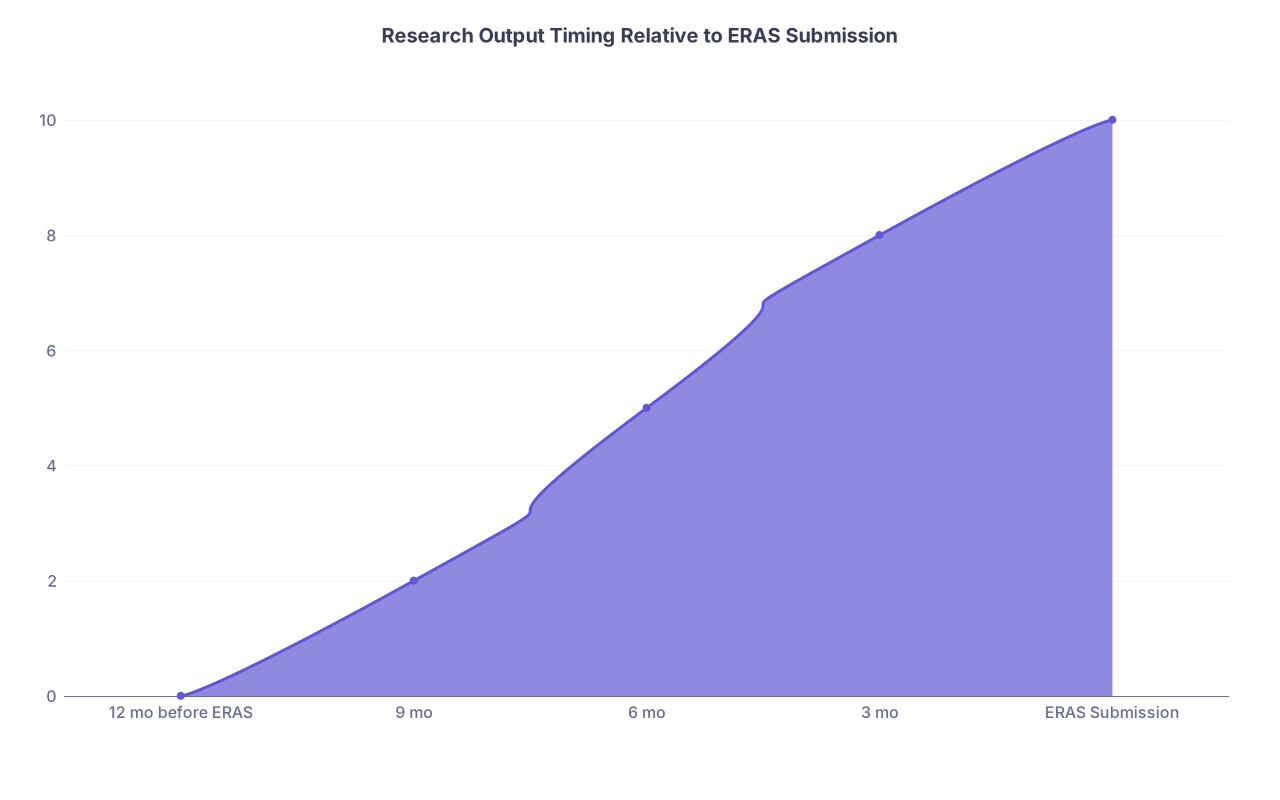
| Category | Value |
|---|---|
| 12 mo before ERAS | 0 |
| 9 mo | 2 |
| 6 mo | 5 |
| 3 mo | 8 |
| ERAS Submission | 10 |
MS4 Early (April–June, Pre-ERAS Season)
If your school starts MS4 in April/May, this overlaps with late MS3. Treat this as your research sprint window.
At this point you should:
Finish everything that can possibly count for ERAS
- Accepted or in-press publications.
- Manuscripts submitted and under review.
- Conference abstracts accepted.
- Even “submitted” can go on ERAS with appropriate status.
Clean your CV
- Standardize:
- Author order.
- Journal names.
- Abstract vs poster vs oral clearly defined.
- Make sure:
- No duplicate entries.
- No “under construction” fluff.
- Standardize:
Use any research elective wisely
- 2–4 weeks of “research elective” in MS4 is not for starting something brand-new.
- It’s for:
- Rapidly finishing and submitting 1–2 manuscripts.
- Helping mentor wrap up figures/analysis.
- Doing final touch-ups on a specialty-oriented project.
ERAS Season (July–September of MS4): Preserve Your Narrative
By the time ERAS opens (late June) and submission (September), your job is not to do more research. It’s to present it coherently.
At this point you should:
Align your personal statement and activities
- If you say you’re passionate about cardiology, but all your research is in dermatology and global health, you’ll get questions.
- Make the narrative believable:
- “Early on I explored dermatology and global health; through clinical exposure I realized my long-term fit is cardiology, and I’ve since focused projects there.”
Prepare talking points for each major project
- For every first- or second-author project, be ready to explain:
- The main question.
- Your specific role.
- One limitation.
- One thing you’d do differently next time.
- Interviewers can smell a “CV ornament” from a mile away.
- For every first- or second-author project, be ready to explain:
Don’t panic about late-breaking stuff
- If something gets accepted after ERAS submission:
- Update programs via email.
- Mention in interviews.
- Add to supplemental updates if used.
- But do not reach for low-quality, last-minute projects just to add lines.
- If something gets accepted after ERAS submission:
Post-ERAS MS4 (October–Match Day): Optional, Not Critical
Honestly? For the Match itself, most of the die is already cast.
At this point you should:
Finish what you owe mentors
- Respond to reviewer comments.
- Help with revisions.
- Be the student people want to write future letters for.
- This matters if you’re considering fellowship later.
Think one level ahead
- If you’re aiming at competitive fellowships (cards, GI, heme/onc, PCCM, etc.), residency PDs will like seeing:
- Ongoing projects.
- A track record of closing the loop on research.
- If you’re aiming at competitive fellowships (cards, GI, heme/onc, PCCM, etc.), residency PDs will like seeing:
Stop obsessing over line counts
- Once interviews are done, an extra poster will not move your Match result.
- It might help 2–4 years later. That’s a different game.
Common Failure Timelines (And How Not to Be That Person)
You’ll recognize these people. Try not to be them.
The “MS3 Awakening”
- Does zero research in MS1–MS2.
- Realizes in MS3 they want derm/ortho/rads.
- Starts 3 projects in March of MS3.
- Has nothing more than “manuscript in preparation” on ERAS.
- Outcome: Often has to overapply, rely heavily on Step 2 and school prestige, sometimes goes unmatched or pivots specialties.
The “Project Collector”
- Says yes to everything in MS1–MS2.
- Listed on 8 projects but only 1 actually finishes.
- Mentors know them as “the student who disappears when it’s time to write.”
- Outcome: Thin actual output despite tons of work; mediocre letters.
The “Single Big Lab Bet”
- Joins a famous PI’s basic science lab MS1.
- Works hard for 2 years.
- PI moves, grant gets cut, project dies, no paper.
- Outcome: Great skills, bad CV. Should’ve had at least one parallel, smaller clinical/QI project.
Final Compressed Timeline: What You Should Be Doing, When

| Step | Description |
|---|---|
| Step 1 | MS1 Fall |
| Step 2 | Identify mentors, meet 1-2 |
| Step 3 | MS1 Spring: Join 1 main project |
| Step 4 | Summer after MS1: Data + abstract draft |
| Step 5 | MS2 Fall: Submit abstracts, draft manuscript |
| Step 6 | MS2 Spring: Submit manuscripts, light research during Step prep |
| Step 7 | MS3: Maintain, 1-2 fast specialty-aligned projects late MS3 |
| Step 8 | Early MS4: Finish outputs before ERAS |
| Step 9 | ERAS Season: Clean narrative, present work well |
And because people always ask about what “good” output growth looks like, here’s a rough curve:
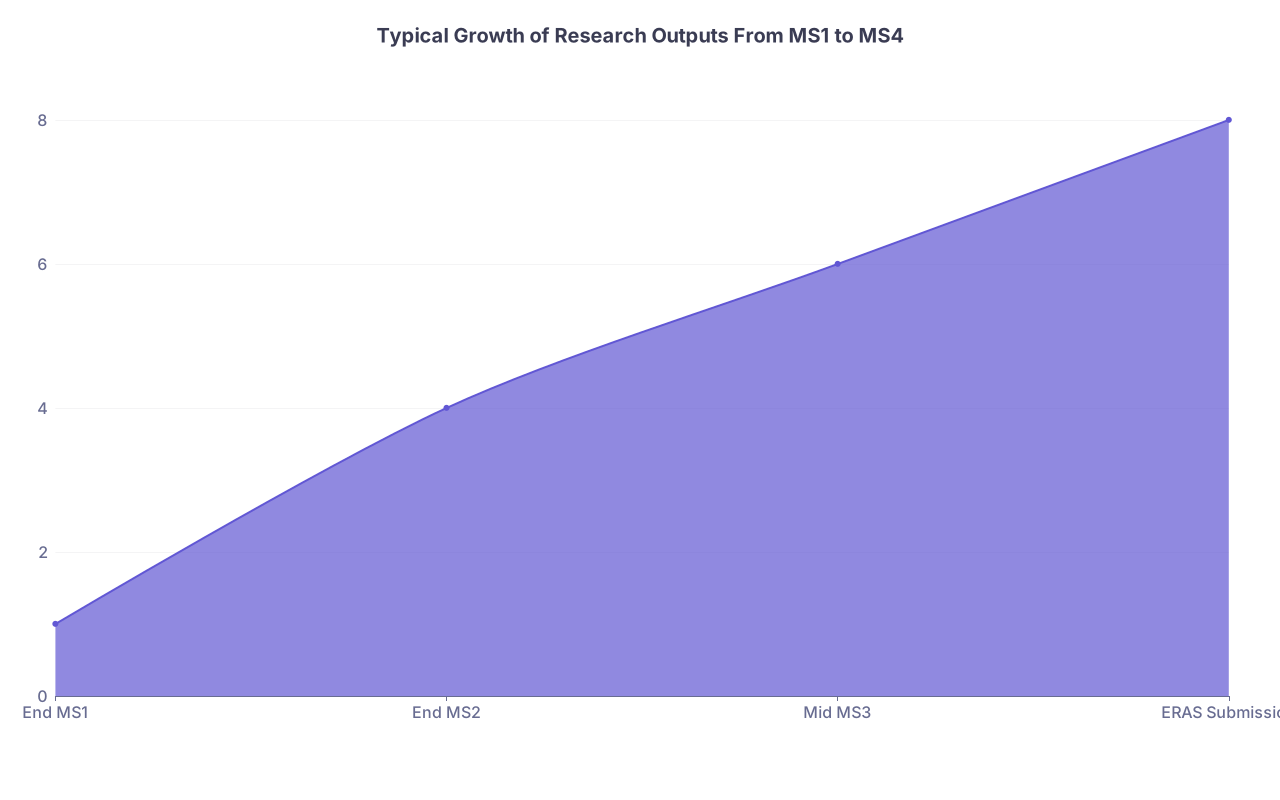
| Category | Value |
|---|---|
| End MS1 | 1 |
| End MS2 | 4 |
| Mid MS3 | 6 |
| ERAS Submission | 8 |
The 3 Things to Remember
Research takes 6–18 months to turn into something you can list. Start in MS1–MS2 if you care about matching well, especially for competitive fields.
One finished, meaningful project beats five half-done “in preparation” lines. Prioritize closing loops over chasing new shiny ideas.
By MS4, your job is not more research. It’s a coherent, believable story on ERAS, backed by a small but real body of work you can actually talk about.