The worst way to spend your MS2 summer is “doing research” for 8 weeks and ending with nothing you can actually put on ERAS.
You are not trying to have a meaningful summer. You are trying to have a productive one. That means planning your MS2 summer backwards from Match, not forwards from “what sounds interesting.”
Below is a concrete, time-based guide: what you should be doing in the months before, during, and after your MS2 summer so your research actually moves the needle for residency.
Big Picture: What Your MS2 Summer Is For
Before I chop this into weeks, you need the target.
Your MS2 summer should give you, by ERAS time (start of M4):
- At least 1–2 submitted abstracts or manuscripts
- At least 1 presentation (poster or oral) scheduled or completed
- At least 1 faculty mentor who can write a strong, specific letter
- A clear, coherent research story that matches your target specialty
The specialty matters. Research expectations are not equal:
| Specialty | Research Intensity | Typical Output for Strong Applicants |
|---|---|---|
| Dermatology | Very High | 10+ pubs/abstracts, multiple projects |
| Plastic Surgery | Very High | 8–15+ outputs, early involvement |
| Orthopedics | High | 5–10 outputs, ortho-specific |
| Internal Med | Moderate | 2–5 outputs, at least some clinical |
| Family Med | Low-Moderate | Nice to have, not mandatory |
If you’re even mildly considering a competitive field, you can’t treat this summer like optional enrichment. It’s your launchpad.
3–6 Months Before Summer: Set Up or You’ll Waste It
At this point (roughly January–March of MS2), you should not be “seeing what comes up.” You should be:
Step 1: Define Your Research Goal for Summer
Decide on one primary outcome for the summer. For example:
- “Have a case series drafted and submitted by September.”
- “Finish data collection and draft a retrospective chart review.”
- “Complete analysis and submit an abstract to ACC or ASCO.”
Vague: “Do some cardiology research.”
Useful: “Submit an abstract to AHA by August.”
You want something with a submission or concrete deliverable.
Step 2: Lock in a Mentor and Project
By 3–4 months before summer you should:
Identify 2–4 specialties you’re realistically considering.
Find faculty in those fields who:
- Publish regularly (check PubMed)
- Have a track record of involving students
- Are at your home institution (easier access)
Send tight emails, not novels. Example:
“I’m an MS2 interested in [field]. I’ll have 8–10 weeks open this summer and want to focus on a project that can realistically lead to a submission within 6–12 months. Do you have ongoing or near-ready projects where an MS2 could help with data collection/analysis and writing?”
Then:
- Meet in person or via Zoom
- Ask bluntly:
- “What projects could be finished or submitted within a year?”
- “What have recent students produced working with you?”
- “Who actually supervises day-to-day?” (Often a fellow or resident.)
Red flag: “We’ll see what we can find this spring.” That’s code for “You’ll spend 8 weeks floundering.”
Step 3: Choose the Right Kind of Project
For a single 6–10 week MS2 summer, realistic project types:
- Retrospective chart review (if IRB is already approved)
- Secondary analysis of an existing dataset
- Case series or case report (if cases already identified)
- Quality improvement / educational project with well-defined plan
Unrealistic for a single summer as a novice:
- Starting a prospective trial from scratch
- Complex basic science work with long learning curves
- Anything needing new IRB from zero, unless already drafted and almost ready
Your question to mentors:
“Which project has the shortest path from where it is now to a submission, if I’m focused for 8–10 weeks?”
At this point you should have, by April at the latest:
- A committed mentor
- A specific project
- Clear expectations of authorship and timeline
If you hit May with none of that, you’re already losing value.
4–6 Weeks Before Summer: Front-Load the Boring Stuff
This is where most students screw up. They wait until the summer starts to do all the setup, then wonder why nothing finishes.
In the month before your research block:
IRB / approvals
- Confirm IRB is active and covers your role.
- If not, push hard to submit amendments before summer.
- If the faculty shrugs here, that’s a warning sign.
Data infrastructure
- Create REDCap / Excel data collection tools.
- Define variables, coding, inclusion/exclusion criteria.
- Get a sample of 5–10 charts and test your abstraction form.
Technical prep
- Install and learn basic stats software (R, SPSS, Stata) if needed.
- Get EMR access sorted (remote if possible).
- Get added to any teams/Slack/OneDrive folders.
Literature review groundwork
- Build an EndNote/Zotero library.
- Download and skim 20–30 core papers on your topic.
- Draft a rough outline of the intro and methods.
By the week before summer, you should:
- Be fully credentialed
- Have data collection tools ready
- Know the inclusion/exclusion criteria cold
- Have a skeleton document for the manuscript or abstract
Week-by-Week: MS2 Summer Research Schedule (8 Weeks)
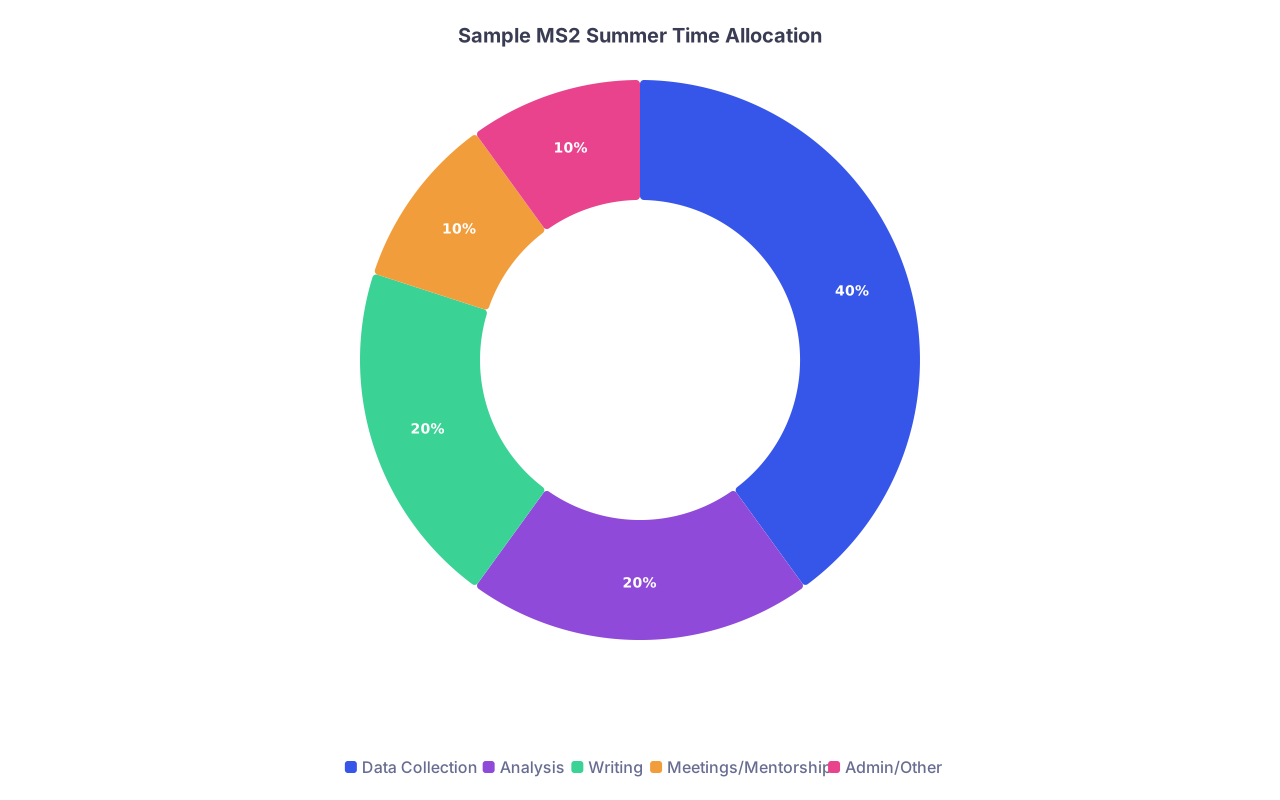
| Category | Value |
|---|---|
| Data Collection | 40 |
| Analysis | 20 |
| Writing | 20 |
| Meetings/Mentorship | 10 |
| Admin/Other | 10 |
Assume an 8-week summer. Adjust if you have 6 or 10, but keep the same structure.
Week 1: Clarify Scope and Lock the Plan
At this point you should:
- Meet with your mentor and immediate supervisor (resident/fellow).
- Confirm the exact research question and primary outcome.
- Recheck feasibility: “Can this be in submission-ready form by X date?”
Your tasks:
- Tighten data definitions and finalize the abstraction sheet.
- Do 10–20 test chart abstractions and compare with your supervisor.
- Fix inconsistencies before scaling up.
Goal by end of Week 1:
- No ambiguity in what you’re collecting or why.
- No confusion about authorship expectations and timeline.
- A written weekly target (e.g., “100 charts/week” or “5 cases fully written up”).
Week 2–3: Heavy Data Collection
These are your grind weeks.
Daily structure (this matters):
- 3–4 hours: data collection / chart review
- 1–2 hours: reading / lit review related directly to your project
- 1 hour: writing method details and notes while you still remember them
- 1–2 short touchpoints per week with your supervisor
At this point you should:
- Commit hard to velocity. Your only job now is to move the dataset from “partial” to “complete.”
- Track your progress in a simple log: date, # charts done, issues encountered.
By end of Week 3 (latest Week 4):
- Data collection should be mostly finished or obviously finishable.
- You should have a real dataset, not “we’re still pulling charts.”
If you’re still arguing about inclusion criteria in Week 3, you’re in trouble. Push for decisions, not endless tweaking.
Week 4: Finish Data + Start Real Analysis
Now you pivot.
Tasks:
- Finish remaining data collection.
- Clean the dataset: handle missing data, outliers, wrong entries.
- Sit down with someone who knows stats (fellow, biostats, experienced resident) and define:
- Primary analysis
- Secondary analyses
- Exact tests you’ll use
At this point you should:
- Not be learning statistics solo from scratch. That’s how projects stall.
- Get concrete output: initial tables, descriptive stats, maybe a simple model if applicable.
End of Week 4 goals:
- Data collection DONE or 95% done.
- A first pass of descriptive stats completed.
- A clear analysis plan in writing.
Week 5–6: Writing and Abstract Preparation
This is the part that actually shows up on ERAS.
Daily structure should shift:
- 1–2 hours: any remaining data/analysis
- 3–4 hours: writing intro, methods, results
- 30–60 minutes: dedicated figure/table work
At this point you should:
- Draft an abstract targeting a real meeting with a known deadline, ideally 3–9 months away.
- Have at least:
- Structured abstract (background, methods, results, conclusion)
- Full methods section drafted
- Results section outline with preliminary numbers
Ask your mentor explicitly:
- “What conference is most realistic for this work?”
- “What is the next manuscript you want this to turn into after the abstract?”
By the end of Week 6:
- Abstract draft should be complete and sent to your mentor for feedback.
- Manuscript should be ~40–60% drafted (intro + methods mostly done, shell of results).
Week 7–8: Manuscript Shell and Handoff Plan
These final weeks are where most students mentally check out. Don’t.
Now you focus on:
- Tightening figures and tables
- Refining the abstract with your mentor’s edits
- Progressing the manuscript to a point where:
- If someone dropped you in the middle of M3, they’d still be able to finish it.
- Or you could realistically finish it with 1–2 hours/week during clerkships.
At this point you should:
- Schedule a final, explicit “handoff” or “next steps” meeting with your mentor.
- Get commitments on:
- Who will own final drafting while you’re on rotations
- Who will handle submission logistics
- Where you’ll be placed in the author list (and why)
End-of-summer minimum deliverables:
- Clean, analyzable dataset
- At least one nearly submission-ready abstract
- Manuscript in progress with intro + methods complete and results partially written
- A clear plan for post-summer continuation with specific dates and responsibilities
If you walk away with “we made good progress and we’ll keep in touch,” you’ve wasted leverage.
After Summer: Converting Summer Work into Match Material
Your MS2 summer is only valuable if it survives into ERAS.
Here’s how to structure the 12–18 months after.
September–December of MS2: Lock the First Submission
At this point you should:
- Use 1–2 hours per week to:
- Respond to mentor edits
- Push the abstract to final form
- Help finalize the manuscript
Concrete targets:
- Abstract submitted to at least one conference by end of fall or winter.
- Manuscript submitted or near submission (realistically ~3–9 months post-summer).
If things slow down, you nudge. Politely, but consistently. Example email:
“I’d love to aim to submit the manuscript by [date] so it can appear on my ERAS. Could we set aside a time next week to go through remaining edits and a target journal list?”
Clinical Year (MS3): Maintain Momentum in Small Bites
During MS3, your research time is tiny but not zero.
At this point you should:
- Protect 1–2 hours on a lighter weekend to:
- Review proofs
- Address reviewer comments
- Update CV and ERAS entries as things get accepted/presented
Also smart:
- Try to align a rotation at the same hospital/service as your research mentor. Being physically present keeps projects alive and sets up a strong letter later.
How This Actually Shows Up on ERAS
Your MS2 summer research becomes Match-valuable only when it becomes visible:
- Publications: even “submitted” or “provisionally accepted” counts
- Abstracts: regional/national meetings (ACS, ACC, ATS, ASH, etc.)
- Posters/Presentations: poster at your institution’s research day, plus bigger meetings
Where you want to be by early M4:
- 1–2 accepted or in-press papers OR several abstracts/posters, depending on specialty
- 1–2 abstracts submitted/accepted for presentation during M4
- Your mentor ready to write:
- “This student took a project from raw data to analysis to a submitted manuscript.”
That “took it from start to finish” line shows up a lot in strong letters. And PDs love it.
Backup Moves if Your Summer Starts to Go Sideways
Not everything goes to plan. People disappear. IRBs stall. Here’s how to course-correct in real time.
If IRB Isn’t Ready by Week 2
At this point you should:
- Ask to pivot to:
- Case report / case series (often faster approvals)
- Secondary analysis of an already-approved dataset
- A QI project that may not require full IRB
If your mentor isn’t flexible, find another project, even mid-summer. Sunk cost is a trap.
If Data Collection Is Slower Than Expected
By Week 3, if you’re drowning:
- Narrow scope: tighter inclusion criteria, smaller time window.
- Turn one big project into:
- A smaller pilot you can finish now
- A follow-up “full” project later if more bandwidth appears
Ask: “What’s the minimal, still-meaningful unit of work we can finish and submit?”
If Your Mentor Is Non-Responsive
At this point you should:
- Increase contact with the fellow/resident actually doing the work.
- Loop in another attending co-author for more hands-on guidance.
- Protect your time for projects that will actually move.
I’ve seen students rescue a summer by jumping onto a nearly-done paper in Week 4 and helping with revisions, while their original project dragged on.
How to Layer In Multiple Projects (Without Diluting Everything)
Ambitious? Good. But don’t be scattered.
At this point you should:
- Have one primary project with clear deliverables.
- Add at most 1–2 secondary projects that:
- Are close to final submission (you help with last-mile edits, figures).
- Or are small (case reports, brief communications).
The danger is 5 half-finished things and nothing you can list as “submitted.” Focus hard on finishing at least one.
Visualizing the Full Timeline: MS2 Spring to ERAS
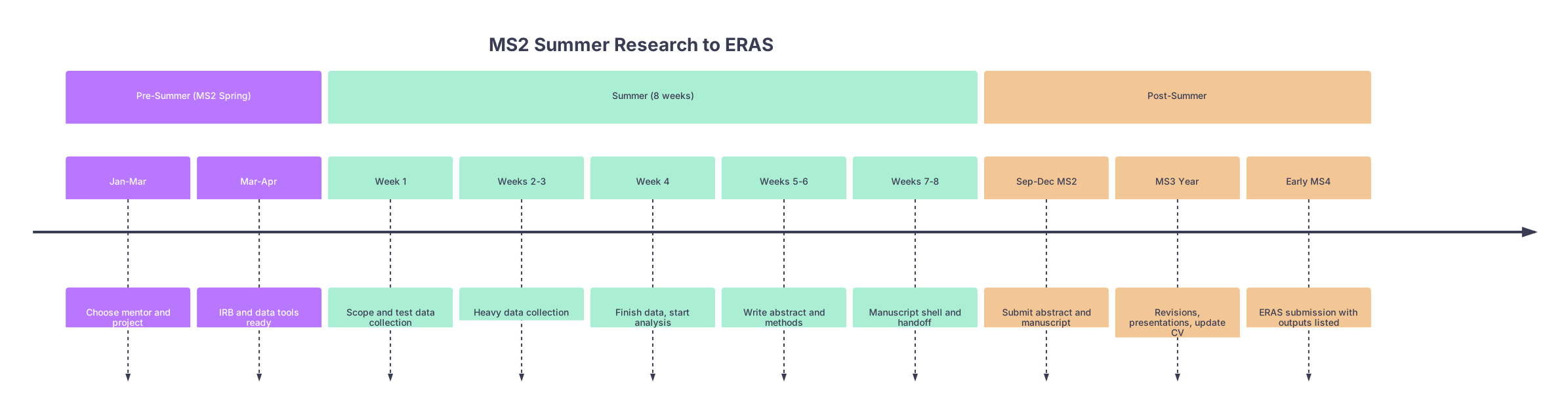
| Period | Event |
|---|---|
| Pre-Summer (MS2 Spring) - Jan-Mar | Choose mentor and project |
| Pre-Summer (MS2 Spring) - Mar-Apr | IRB and data tools ready |
| Summer (8 weeks) - Week 1 | Scope and test data collection |
| Summer (8 weeks) - Weeks 2-3 | Heavy data collection |
| Summer (8 weeks) - Week 4 | Finish data, start analysis |
| Summer (8 weeks) - Weeks 5-6 | Write abstract and methods |
| Summer (8 weeks) - Weeks 7-8 | Manuscript shell and handoff |
| Post-Summer - Sep-Dec MS2 | Submit abstract and manuscript |
| Post-Summer - MS3 Year | Revisions, presentations, update CV |
| Post-Summer - Early MS4 | ERAS submission with outputs listed |
That’s the arc you’re building toward.
Bottom Line: What Makes an “Ideal” MS2 Summer
Strip away the noise. The ideal MS2 summer:
- Starts months earlier with a specific mentor, project, and feasibility check.
- Uses the 8 weeks to aggressively move from idea → data → analysis → draft.
- Leaves you with real, visible products—abstracts, manuscripts, and a mentor who can vouch for you—by the time ERAS opens.
Do that, and your “research experience” stops being a vague line on your CV and becomes a concrete asset for your residency match.