Introduction: Why Research Matters for Residency Match Rates
In today’s competitive residency landscape, simply completing medical school with solid grades is rarely enough to guarantee a successful match. Program directors review hundreds, sometimes thousands, of applications, looking for evidence that an applicant will excel not only as a clinician, but also as a critical thinker, team member, and future leader in medicine.
Research experience has emerged as one of the most visible and quantifiable indicators that an applicant brings those qualities. Across many specialties—especially highly competitive ones—research contributions correlate with higher residency match rates and stronger candidate success.
This article explores the connection between research experience and the Residency Match, clarifies what types of research are most valued, and provides practical, step-by-step strategies to leverage your work for maximum impact in your application.
Understanding the Residency Match Process and Where Research Fits
How the NRMP Match Works
The National Resident Matching Program (NRMP) coordinates the process that pairs applicants with residency programs in the United States. While the algorithm is mathematically neutral, the inputs that drive that algorithm—program rank lists and applicant rank lists—are heavily influenced by how programs perceive each candidate.
Your application usually includes:
- Academic performance
- Medical school transcript
- USMLE/COMLEX scores (where applicable)
- Letters of Recommendation (LORs)
- From faculty, research mentors, and clinical supervisors
- Personal Statement
- Your motivations, story, and fit for the specialty/program
- Clinical Experience
- Core rotations, sub-internships, away rotations
- Research and Scholarly Activity
- Publications, abstracts, posters, presentations, quality improvement projects
- Additional factors
- Volunteer work, leadership, extracurriculars, life experience
Programs then review these components and decide whom to interview. After interviews, both applicants and programs submit rank lists. The algorithm pairs applicants with the highest-ranked programs that also rank them favorably.
Where Research Influences Match Rates
Research experience influences match outcomes in multiple ways:
Screening and interview selection
- Some specialties and programs use research productivity (publications, abstracts, presentations) as a screening marker.
- Strong research portfolios help you stand out in competitive applicant pools.
Perception of academic potential
- Programs that value scholarship (e.g., academic centers, research-oriented institutions) heavily weigh research when determining ranking.
- Applicants with ongoing or future research plans may be prioritized because they contribute to the program’s academic profile.
Letters of recommendation
- Research mentors often provide detailed, personalized LORs that highlight your work ethic, critical thinking, and persistence.
- Strong letters from respected investigators can significantly enhance candidate success.
Interview performance and fit
- Meaningful research provides rich material to discuss in interviews.
- Being able to clearly explain your hypothesis, methods, and results demonstrates maturity and depth that interviewers remember.
Why Research Experience Boosts Residency Competitiveness
Core Reasons Programs Value Research
Research is more than a box to check; it signals capabilities that are directly relevant to residency performance and long-term success in medicine.
Evidence of Curiosity and Commitment to Medicine
- Research shows you are interested in why and how disease and treatments work—not just what to memorize.
- It suggests you will continue learning, questioning, and improving practice over your career.
Critical Thinking and Problem-Solving
- Designing a study, troubleshooting methods, or interpreting unexpected data trains you to:
- Formulate clear questions
- Analyze complex information
- Make decisions under uncertainty
- These are the same skills needed in diagnostic reasoning and patient management.
- Designing a study, troubleshooting methods, or interpreting unexpected data trains you to:
Resilience, Work Ethic, and Follow-Through
- Research rarely goes perfectly. Data fail, IRB approvals take time, and manuscripts get rejected.
- Showing that you engaged persistently through to presentation or publication demonstrates grit—an attribute programs highly value.
Teamwork and Interdisciplinary Collaboration
- Most projects involve collaboration with attendings, residents, statisticians, and other students.
- Programs want residents who can function well on multidisciplinary teams; research can be concrete evidence of this.
Academic Productivity and Institutional Reputation
- Programs are often evaluated on scholarly output.
- Applicants with a track record of publications and presentations are more likely to maintain or elevate a program’s academic profile.
Specialty Differences in the Value of Research
The impact of research on match rates varies by specialty:
Highly competitive specialties
- Dermatology, Plastic Surgery, Neurosurgery, Orthopedic Surgery, Otolaryngology, Interventional Radiology, and some Internal Medicine subspecialty tracks place heavy emphasis on research.
- Many successful applicants have multiple publications, often in specialty-specific journals.
Moderately competitive specialties
- Internal Medicine, General Surgery, Emergency Medicine, Pediatrics, Anesthesiology: research is favorable and increasingly expected at academic centers, but not always required at community programs.
Less research-intensive specialties
- Family Medicine, Psychiatry, PM&R: research is beneficial and can differentiate you, especially for academic or competitive programs, but strong clinical performance and fit may carry more weight.
Even in “less research-heavy” fields, a targeted project in your chosen specialty can significantly strengthen your narrative and help secure interviews at top programs.
Types of Research Experience and How They Translate to the Match
Basic Science Research
Definition: Laboratory-based work (e.g., molecular biology, genetics, immunology, pharmacology) focused on mechanisms of disease, pathways, or drug development.
Why it’s valuable:
- Signals strong analytic skills and intellectual rigor.
- Particularly respected in specialties with a strong bench-to-bedside tradition (e.g., oncology, neurology, cardiology, some surgical subspecialties).
Tips to maximize impact:
- Aim for at least an abstract or poster presentation if a full publication is not feasible.
- Be prepared to explain your project in clinically relevant terms during interviews: “How might this eventually change patient care?”
Clinical Research
Definition: Studies involving patients or clinical data—observational studies, trials, registries, epidemiology.
Why it’s valuable:
- Directly bridges to clinical practice.
- Programs often view clinical research as more immediately relevant to patient care.
High-yield examples:
- Retrospective chart reviews (e.g., outcomes after a specific intervention).
- Prospective cohorts.
- Clinical trials involvement (e.g., enrolling patients, collecting data).
Translational Research
Definition: Work that connects laboratory findings to clinical application (“bench to bedside”).
Value for the Match:
- Demonstrates your understanding of how basic discoveries lead to therapeutic advances.
- Attractive to academic programs that emphasize innovation.
Quality Improvement (QI) and Patient Safety Projects
Definition: Structured projects aimed at improving care processes, safety, or outcomes.
Why residency programs like it:
- Every ACGME-accredited program must engage residents in QI; having prior experience is a plus.
- Shows you understand healthcare systems, metrics, and implementation science.
Example:
- Reducing central line–associated bloodstream infections by implementing a checklist and tracking infection rates.
Community-Based and Public Health Research
Definition: Projects in population health, health disparities, implementation science, or community interventions.
Match relevance:
- Particularly valued in Family Medicine, Pediatrics, Internal Medicine, Psychiatry, and EM.
- Signals commitment to health equity and population-level thinking.
Educational Research and Scholarship
Definition: Projects evaluating teaching methods, curriculum changes, or learner outcomes.
Best fit for:
- Applicants interested in clinician-educator careers.
- Programs that emphasize medical education and teaching.
Publications, Presentations, and Match Rates: What the Data Suggest
The Weight of Publications and Abstracts
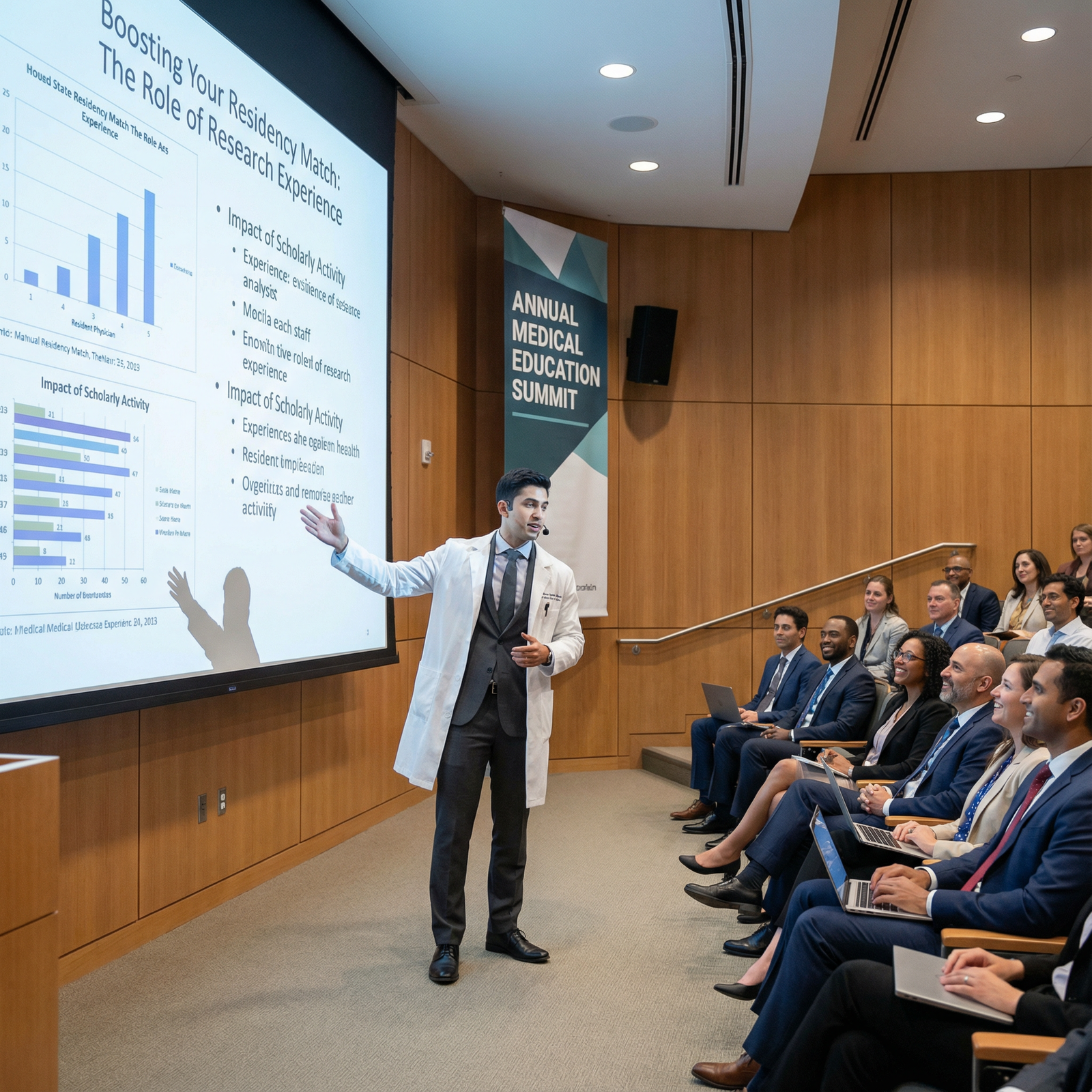
While numbers vary by specialty and year, multiple NRMP Charting Outcomes reports and studies in the Journal of Graduate Medical Education and other journals suggest:
- More research experiences correlate with higher match rates in many competitive specialties.
- First-author and specialty-specific publications are particularly influential.
- Posters and oral presentations at regional or national meetings are visible markers of scholarly productivity, especially when publications are still in progress.
However, raw numbers are not everything. Programs increasingly look at:
- Relevance to the specialty (e.g., dermatology research for dermatology applications).
- Role and contribution (first author vs. middle author vs. data entry only).
- Trajectory over time (consistent involvement vs. one short project).
Quality vs. Quantity: Finding the Right Balance
For most applicants, the ideal strategy is:
- 1–3 substantial, meaningful projects where you had a clear role.
- Aim for at least one tangible endpoint (poster, presentation, manuscript).
- Avoid padding your CV with dozens of minor roles you can’t explain well.
Programs will often test this during interviews by asking:
- “Tell me about your favorite research project.”
- “What was the most challenging part of your study?”
- “If you had another year, how would you improve or expand your work?”
Being able to answer these clearly is more important than having a long but superficial list of citations.
Practical Strategies: How to Maximize Research for Residency Success
Building a Research-Oriented CV for the Residency Match
A well-structured CV can significantly improve how your research is perceived.
Key elements to include:
Dedicated “Research Experience” section
- Project title and brief description.
- Institution and mentor’s name.
- Your role (e.g., study design, data collection, analysis, manuscript drafting).
- Dates of involvement.
Publications and Manuscripts
- Separate into:
- Peer-reviewed publications
- Manuscripts under review or in preparation (clearly labeled as such)
- Use standard citation format.
- Bold your name to highlight authorship position.
- Separate into:
Abstracts, Posters, and Presentations
- List conference name, location, and date.
- Indicate whether it was an oral or poster presentation.
- Note awards (e.g., “Best Resident/Fellow Poster Award”).
Grants, Scholarships, or Awards
- Small internal grants or travel awards also signal initiative and recognition.
Engaging in Research Early and Strategically
First and second year (pre-clinical):
- Explore broad interests; join a project to learn fundamentals of research.
- Focus on acquiring skills: data management, literature review, basic statistics.
- Try to align with emerging specialty interests if possible, but exploration is fine.
Third and fourth year (clinical):
- Narrow focus to your intended specialty.
- Participate in shorter, high-yield projects (e.g., chart reviews, case series, QI).
- Use elective time for research blocks if your school allows.
- Aim to have at least some products (poster, submitted manuscript) ready before ERAS opens.
How to Find High-Yield Research Opportunities
- Department websites
- Look for faculty who publish in your area of interest and email them directly.
- Student research offices and deans
- Many schools have centralized lists of ongoing projects or funding opportunities.
- Conferences and Grand Rounds
- Pay attention to presenters; follow up with them about potential involvement.
- Residents as entry points
- Ask senior residents: “Are you or your attendings working on anything needing help?”
When emailing potential mentors:
- Attach your CV.
- Briefly describe your interests and available time.
- Offer to help with specific tasks (data collection, chart review, literature review).
- Be honest about your schedule and skills.
Balancing Clinical Responsibilities and Research
Residency programs recognize that medical students are busy; they do not expect full-time researchers. To manage both:
- Set realistic goals with your mentor (e.g., weekly or monthly deliverables).
- Use tools like reference managers (Zotero, EndNote) and project trackers (Trello, Notion).
- Protect specific research time blocks each week, even if small (2–4 hours).
- Communicate early if exams or clinical duties will temporarily limit your availability.
Using Research to Strengthen All Parts of Your Application
Integrating Research into Your Personal Statement
Your research should not just appear as a list on your CV; it can be a powerful narrative element.
Effective ways to include research:
- Use a brief vignette: how a specific project shaped your interest in a disease, patient population, or subspecialty.
- Describe what you learned (e.g., about scientific rigor, patient-centered outcomes, health disparities).
- Connect your past work to your future goals:
- “This experience solidified my interest in pursuing a career in academic oncology, where I can continue investigating novel therapeutics while caring for patients.”
Avoid:
- Overly technical jargon that distracts from your story.
- Making research the only focus of your statement if you are genuinely clinically oriented; balance is key.
Leveraging Research in Interviews
Expect research-related questions in interviews, especially at academic programs.
Prepare in advance:
- A 1–2 minute, clear explanation of your main project:
- The question or hypothesis
- Basic methods
- Key findings or expected impact
- One personal reflection:
- A challenge you faced and how you overcame it
- What surprised you
- How it changed your perspective on medicine
Be honest about your role. Program directors can tell when applicants inflate their involvement. It is far better to say:
“I was responsible for data collection and analysis, and I assisted with the introduction and methods section of the manuscript.”
than to imply you led a project you barely participated in.
Using Research Mentors as Advocates
Mentors can be your strongest advocates during the Match:
- Request letters of recommendation early and provide:
- Your CV
- Your personal statement draft
- A brief summary of your contributions
- Ask them if they are comfortable highlighting:
- Your work ethic, independence, and potential as a resident.
- Any comparisons to peers (e.g., “among the top students I’ve worked with”).
Some mentors with strong connections may also reach out informally to programs on your behalf, particularly in smaller specialties.
Frequently Asked Questions (FAQs) About Research and Residency Match
Q1: How much research experience is “enough” to help my residency application?
There is no universal threshold. For less research-intensive specialties, one well-executed project with a poster or publication can significantly strengthen your application. For highly competitive specialties (e.g., dermatology, plastic surgery, neurosurgery), multiple specialty-specific projects and several abstracts or publications are common among matched applicants. Focus on meaningful engagement and tangible outputs rather than chasing a specific number.
Q2: I started research late in medical school. Is it still worth doing?
Yes. Even short-term projects can yield:
- Case reports or case series
- Retrospective chart reviews
- Quality improvement projects
- Abstracts or posters at local/regional meetings
These still show initiative, curiosity, and the ability to see a project through—attributes programs value regardless of when you started. Late-start research can also provide strong talking points and letters of recommendation.
Q3: Does my research have to be in the same specialty I’m applying to?
Specialty-aligned research is ideal, especially for competitive fields, because it:
- Reinforces your interest and commitment to that specialty.
- Provides more directly relevant content for interviews.
However, non-specialty research still counts. Strong basic science or clinical research in another field still demonstrates critical thinking, perseverance, and scholarly ability. If your early work is in a different area, you can bridge the gap in your personal statement and interviews by explaining how the skills and lessons translate to your chosen field.
Q4: What if I don’t have any publications by the time I apply? Will that hurt my match chances?
Not necessarily. Programs recognize that publication timelines can be long. You can still gain credit by:
- Listing submitted manuscripts (clearly labeled as “submitted” or “in revision”).
- Highlighting accepted abstracts and conference presentations.
- Emphasizing your role and what you learned.
For many applicants, especially in moderately competitive or less research-intensive specialties, strong clinical performance, solid letters, and well-presented ongoing research can offset the lack of formal publications.
Q5: How should I handle research that didn’t lead to clear results or publication?
Be honest and focus on process and skills. Many projects do not yield “positive” or publishable results, and programs know this. On your CV and in interviews, emphasize:
- What the project aimed to address.
- Your specific contributions.
- Obstacles encountered and how you adapted.
- Concrete skills you gained (e.g., statistical software, IRB processes, literature synthesis).
If the project is truly incomplete or inactive, list it under “Research Experience” rather than “Publications/Presentations,” and be prepared to discuss it constructively.
By understanding how research experience interacts with residency match rates and intentionally shaping your scholarly activities, you can present yourself as a thoughtful, capable, and future-ready physician. Whether your goal is a high-powered academic career or outstanding community practice, strategically chosen and well-leveraged research can significantly enhance your competitiveness and long-term growth in medical education and beyond.