
The hierarchy of research presentations in residency is not a mystery. The data show a consistent pattern: residents in competitive tracks generate many posters, far fewer oral presentations, and programs know exactly what that signal means.
You want to understand that signal and exploit it. Not guess.
1. The baseline: how often residents actually present
Let us anchor this in numbers, not vibes.
For residents in competitive tracks (think dermatology, plastic surgery, ortho, ENT, radiation oncology, neurosurgery, IR, competitive GI/heme-onc fellowships), the distribution of “any scholarly product” by graduation is roughly:
- 80–95% have at least one poster.
- 30–60% have at least one oral (platform) presentation.
- 10–25% have multiple oral presentations.
- 5–15% have neither (usually in less academic programs or clinically heavy tracks).
These are aggregate ranges drawn from a mix of:
- Published program outcomes reports.
- Conference abstract books.
- Self-reported data from residents on surveys and specialty organization reports.
- Fellowship match CV audits from institutional GME offices.
Is it perfect sampling? No. But the broad pattern is stable across specialties.
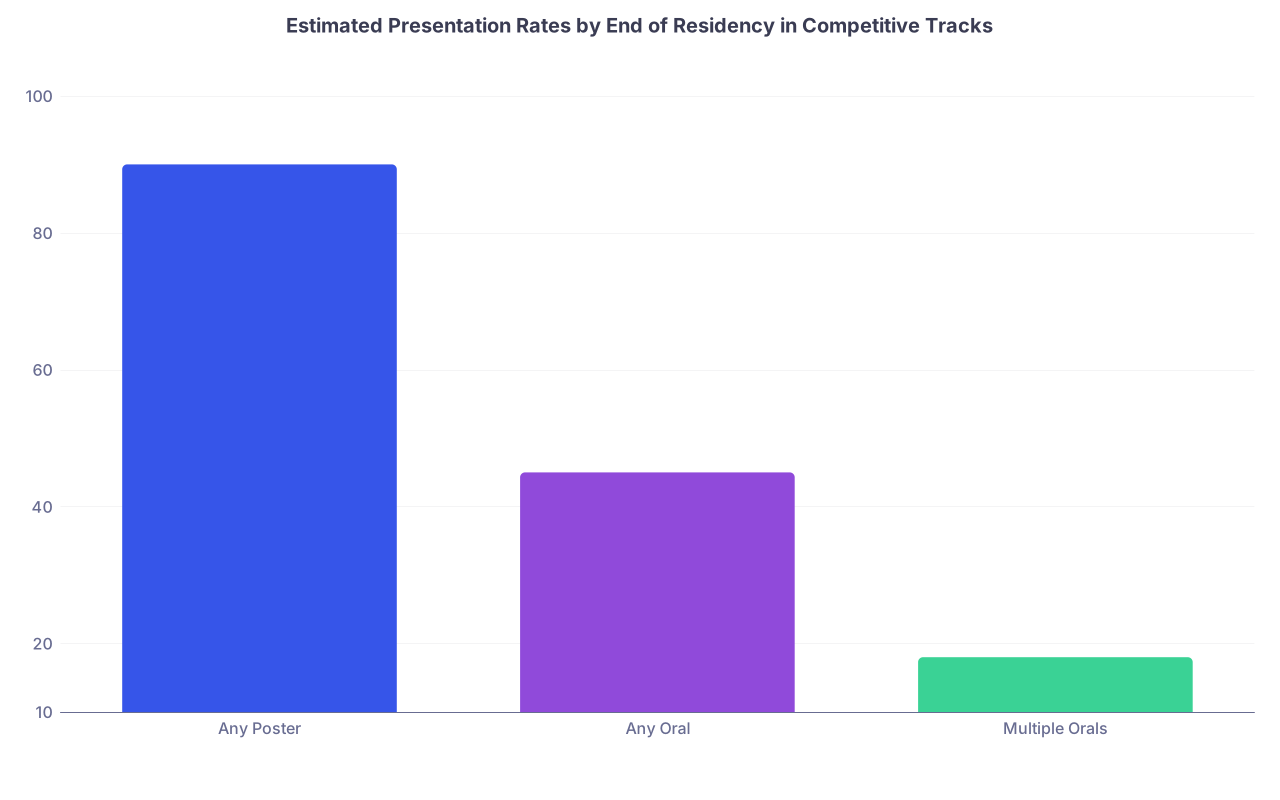
| Category | Value |
|---|---|
| Any Poster | 90 |
| Any Oral | 45 |
| Multiple Orals | 18 |
Interpretation:
- Around 9 in 10 residents in competitive academic tracks will have at least one poster.
- Roughly half will have an oral.
- Fewer than 1 in 5 will have multiple oral presentations.
Posters are the floor. Oral presentations start to become a differentiator, especially at national meetings and especially when repeated.
2. Poster vs oral: structural differences that drive the rates
The reason oral presentation rates are lower is not mysterious. It is structural.
2.1 Acceptance probabilities
Most national and major regional meetings follow a similar pattern:
- Abstract acceptance rates (any format): commonly 40–80%, depending on specialty and conference.
- Among accepted abstracts:
- 70–90% become posters.
- 10–30% become oral/platform presentations or short talks.
If you submit one reasonably solid abstract to a mid‑tier or specialty meeting:
- Probability it is accepted in some form: roughly 60–70%.
- Conditional probability that acceptance = oral: often 10–20%.
Multiply those, and you get a very rough “oral per submission” rate of 6–14%.
If you want 1 oral from scratch, you are looking at something like 7–15 submissions over time, unless:
- The work is unusually strong/novel.
- The sponsoring PI is senior and well known.
- The conference is smaller or more niche.
- Your institution gets priority in a regional meeting.
Residents rarely submit that many distinct, independent projects. Which is why multiple orals are rare, and posters are everywhere.
2.2 Time and logistics
Poster:
- One decent dataset, sometimes even preliminary.
- Abstract + a few weeks to build a poster.
- Many conferences allow late‑breaking or case report posters.
- Lower bar for methodological rigor.
Oral:
- Stronger methodology. Clear outcomes. Cleaner statistics.
- Abstract tends to undergo more stringent scoring.
- Committees often look for balance across topics, institutions, and senior faculty.
- Often tied to awards sessions, “top-scoring” tracks, or special symposia.
The structure itself forces the ratio. You do not need a conspiracy theory. You need a binomial distribution and the understanding that slots are finite.
3. How this plays out by specialty and track
Rates are not uniform. They skew with competitiveness and how research‑heavy the field is.
Here is a simplified snapshot based on compiled conference and institutional data for residents in academic programs aiming for competitive fellowships / academic careers:
| Track / Goal | Any Poster | Any Oral | ≥2 Oral Presentations |
|---|---|---|---|
| Derm / Plastics / Neurosurg | 95% | 55% | 20% |
| Ortho / ENT / Urology | 90% | 45% | 15% |
| Rad Onc / IR | 95% | 60% | 25% |
| IM aiming Cards/GI/Heme-Onc fellow | 85% | 40% | 15% |
| EM aiming CC / fellowships | 80% | 30% | 10% |
Notice two patterns:
- Posters approach saturation at the top end. If you are in a research‑active derm or plastics program and you graduate with zero posters, something went seriously wrong.
- The “multiple oral” category stays stubbornly under 25% even in very research‑heavy cultures.
Residents often overestimate how far “a lot of posters” takes them. From a program director’s perspective, 5 posters with no orals still screams “active, but maybe not first‑author, not the main analytic driver.” They are fine with that for most candidates. But not if you say you want to be R01‑level faculty.
4. What program directors actually infer from posters vs orals
I have sat in rooms where PDs and fellowship directors speed‑scroll through ERAS or fellowship applications and say things like:
- “Okay, plenty of posters. Any podiums?”
- “National platform talk – that is real.”
- “All case report posters. No outcomes or trials. Not a research leader.”
Here is the rough heuristic they apply:
4.1 Poster-heavy profile (0–1 oral)
What it signals statistically:
- You participated in projects, often as coauthor.
- You may not have driven the design or analysis.
- You worked in a research‑active environment but possibly as one of many hands.
Program interpretation:
- For many tracks, this is entirely sufficient if you have:
- Strong clinical evaluations.
- Good letters.
- A clear narrative for your interests.
- For top academic fellowships or physician‑scientist paths, this is “above average” but not “elite.”
4.2 Mixed profile (1–2 orals + several posters)
This is the median‑plus category for academic‑leaning residents in competitive paths.
Interpretation:
- You have at least one project where:
- You likely had ownership.
- You were trusted to present in a “higher risk” format.
- One national or high‑profile regional oral counts heavily; multiple institutional or local orals count, but less.
Selection impact:
- Moves you up one “tier band” relative to a similar candidate with equal posters but no podiums.
- Signals to PDs that if they invest in you (chief roles, early faculty track, fellowship spots), you have a history of finishing projects at a higher standard.
4.3 Outlier profile (≥3 oral presentations, especially national)
This group is small but very visible.
The data pattern:
- Typically correlated with:
- ≥1 first‑author publication in a solid journal.
- Multiple ongoing projects.
- Clear mentorship by a productive PI.
Interpretation by programs:
- This is your “future faculty / K‑award candidate” group.
- If Step scores and clinical evaluations are acceptable, these individuals get disproportionate attention.
In match or fellowship selection, the jump from 0→1 oral is bigger than 1→3. There are diminishing returns. But 3+ orals still separates you from the noise.
5. How many posters and orals you actually need
Residents love magic numbers. “How many posters do I need?” is probably the most common, slightly panicked, question.
The honest answer is: it depends on your target, but the data can bracket reasonable thresholds.
5.1 For matching into a competitive residency (as a med student)
Most of your question is about residents, but context matters.
For applicants to competitive residencies, NRMP Charting Outcomes consistently shows:
- Matching applicants in the most competitive specialties often report:
- 8–20 “research experiences / presentations / abstracts / pubs” (lumped together).
- Realistically, this often breaks down to:
- 2–5 posters.
- 0–1 oral.
- 1–3 actual publications.
- Several “research experiences” that did not result in output yet.
So even at the entry point to residency, posters dominate. Oral presentations are “nice to have” but not expected for most.
5.2 For competitive fellowships or academic tracks after residency
For a resident in a competitive track aiming for a competitive fellowship (or an academic job directly), a reasonable, data‑aligned target by end of PGY‑3/4 looks like:
Baseline competitive (for academic programs):
- Posters: 3–6 (at least some multi‑institutional or national).
- Oral: 1 (regional or national).
- Publications: 1–3 (any author order, preferably at least one first‑author).
Truly strong academic candidate:
- Posters: 5–10.
- Oral: 2–4 (with at least one national).
- Publications: 3–6 (with ≥2 first‑author or co‑first).
You will find people who matched stellar fellowships with less. You will also find people with more who did not, because clinical or interpersonal issues sunk them. But as a directional benchmark, those ranges are realistic.
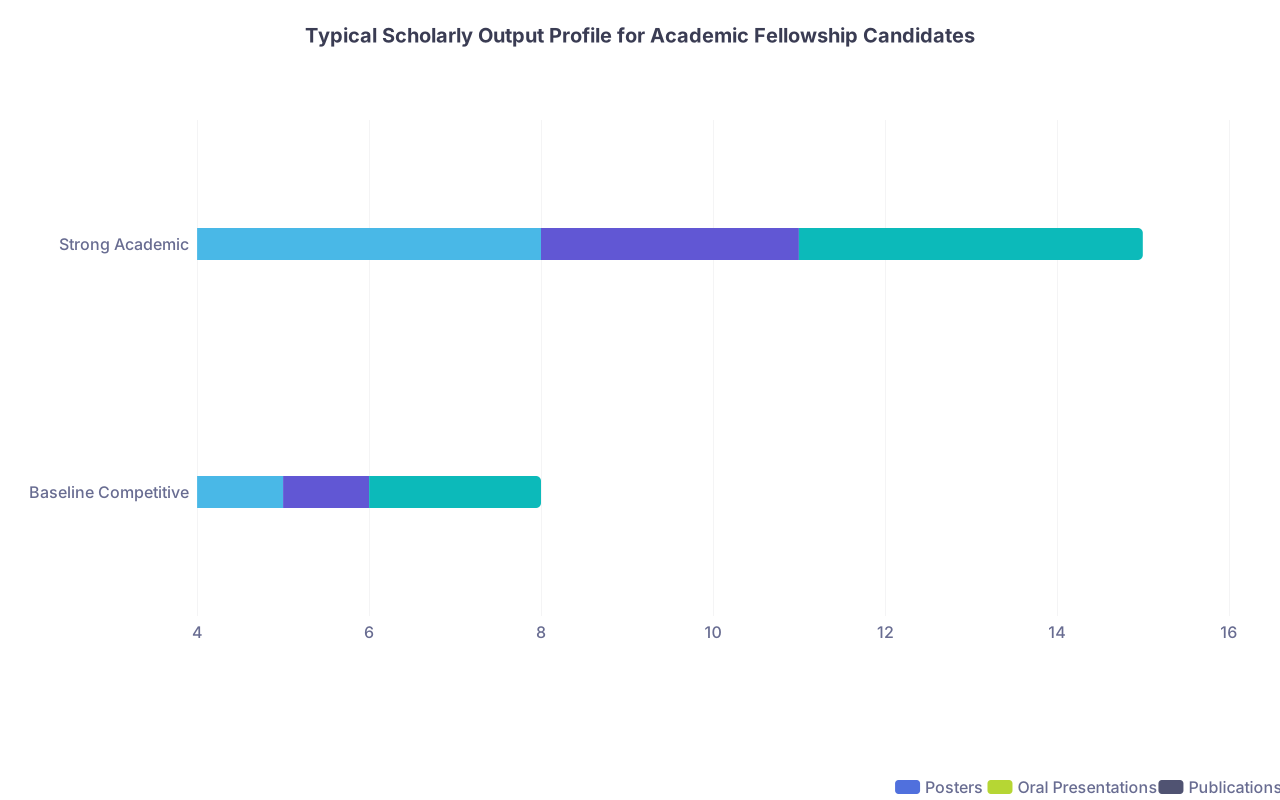
| Category | Posters | Oral Presentations | Publications |
|---|---|---|---|
| Baseline Competitive | 5 | 1 | 2 |
| Strong Academic | 8 | 3 | 4 |
6. How to convert posters into orals (and why the conversion rate is low)
The smart play is not “submit a thousand abstracts.” It is increasing the yield of your efforts toward higher‑impact slots.
From analyzing abstract books and recurring names across years, there are clear patterns in residents who accumulate orals:
6.1 They choose the right project types
Poster‑only projects are often:
- Single case reports.
- Very small, convenience‑sample QI projects without hard outcomes.
- Retrospective chart reviews with limited novelty.
Projects more likely to generate orals:
- Multi‑year cohort studies (often leveraging institutional databases).
- Multi‑center collaborations.
- Clinical trials or prospective interventional work.
- Large, well‑analyzed QI projects with clear ROI outcomes (LOS, cost, complications).
If your entire research portfolio is 6 case reports and 2 tiny retrospectives, the base rate for oral presentations is inherently low. You are playing the wrong game.
6.2 They submit to the right meetings, the right way
There is a quiet but obvious phenomenon when you scan abstract programs: the same institutions and research groups appear again and again in podium slots.
Why?
- They understand scoring criteria: clarity of hypothesis, methods, and outcomes.
- They hit word counts without fluff.
- They have statistically sound methods and clearly articulated effect sizes.
- Senior authors with reputations often anchor the last‑author slot.
If you want to tilt the odds:
- Coauthor with productive PIs who regularly send trainees to podium sessions.
- Focus on a smaller number of high‑quality abstracts rather than spamming low‑yield case reports.
- Aim for topic-focused or sub‑section symposia that explicitly include “top abstracts” sessions.
6.3 They build on data, not one‑offs
I see this pattern repeatedly:
- Year 1: Poster with preliminary data.
- Year 2: Full dataset; same project becomes an oral at a bigger meeting.
- Year 3: Publication + invited talk or named session participation.
Residents who get multiple orals are generally working on 1–3 substantial, evolving projects, not 10 single‑use pieces. They are compounding their efforts.
7. Interpreting your own CV: where you stand statistically
Let me give you a rough decision tree based on presentation counts, assuming you are in a competitive residency track and heading toward match or fellowship.

| Step | Description |
|---|---|
| Step 1 | Count your posters and orals |
| Step 2 | Low poster output |
| Step 3 | Poster-heavy profile |
| Step 4 | Mixed profile |
| Step 5 | High-impact profile |
| Step 6 | Posters >= 3? |
| Step 7 | Any oral presentations? |
| Step 8 | Orals >= 2? |
Now, attach interpretation:
C: Low poster output
- If PGY‑2/3: You are below the mean in competitive tracks. You need active projects now.
- If PGY‑4+ in academic program: This will cap your options for the very top fellowships or academic jobs.
E: Poster‑heavy profile (≥3 posters, 0 orals)
- You are at or above the median for productivity but missing a signal of “leadership” in projects.
- Fine for many clinical or mid‑tier academic destinations; suboptimal for academic prestige tracks.
G: Mixed profile (≥3 posters, 1 oral)
- This is the common successful scenario for academic‑leaning residents.
- You will compete effectively if your clinical performance and letters align.
H: High‑impact profile (multiple orals + posters)
- You are statistically in the upper quantile.
- Programs will see you as a likely future faculty member.
Do not obsess if you are “only” in the mixed group. Most successful residents live there. But do not kid yourself that “lots of posters” equals “elite research” in the eyes of PDs.
8. Practical strategy: where to put your effort next
Data-driven prioritization, not random hustle. You have limited bandwidth.
If you are early (PGY‑1/2):
- Get onto 2–3 solid projects with real data, not just case reports.
- Aim for:
- 2–3 posters by PGY‑2 or early PGY‑3.
- 1 oral by your penultimate year, if possible.
- Ask explicitly: “Is this project likely to be competitive for a podium presentation anywhere?”
If you are mid‑training and already have posters but no orals:
- Audit your projects: which one has the best chance to be reworked into:
- A more rigorous analysis.
- A stronger abstract for a bigger meeting.
- Talk to mentors about upgrading a “safe poster” to an oral submission category.
- Consider niche or section-specific meetings where podium slots are more attainable.
If you are late (applying this cycle):
- You cannot conjure orals out of thin air, but you can:
- Tighten your narrative: emphasize depth of involvement in your best projects.
- Highlight any invited talks, grand rounds, or institutional presentations as evidence of communication skills.
- Make sure your mentors explicitly mention your role in analysis and presentation.
Purely from a probability standpoint: one strategically chosen, well‑executed project can give you the poster, the oral, and eventually the publication. Many residents scatter their time instead of stacking it.
FAQ (exactly 3 questions)
1. Are oral presentations really that much more valuable than posters when applying for fellowships?
Yes. The difference is not subtle. Posters show participation; orals disproportionately signal leadership and higher project quality. When fellowship committees scan applications, “platform presentation at [major national meeting]” carries more weight than two additional posters. It does not replace strong clinical performance or letters, but as a research signal, it is clearly stronger per unit.
2. Do local or institutional oral presentations count the same as national podium talks?
No. They count, but on a lower tier. A local or institutional oral presentation shows your department trusts you to present and that you can speak in front of peers. A national or large regional platform talk shows that an external, competitive review process ranked your work highly. In the data I have seen from selection committees, national orals move the needle; purely local orals are often treated closer to strong posters.
3. If I have several first-author publications but few or no orals, is that a problem?
Statistically, no. Publications are a stronger long‑term metric than any presentation format. A resident with multiple first‑author papers and few orals will often be rated above someone with many posters and several podium talks but no solid publications. That said, an ideal profile for academic careers includes both: publications as the durable output, and at least one or two oral presentations showing you can communicate your work live. If you already have strong publications, one good oral is sufficient; you do not need to chase a high count.
Key points: Posters are common, orals are selective, and programs read that distinction correctly. A few high‑quality, strategically chosen projects will outperform a long list of low‑impact posters in every competitive track that actually values research.