
The first thing faculty notice in your ERAS research section is whether your story makes sense, not how many pubs you have.
Everyone thinks we start by counting PubMed IDs. We do not. That’s what pre-meds imagine on Reddit threads. On the selection committee side, the first pass is much simpler and much more brutal:
“Does this research profile fit who this person says they are?”
If the answer is no, you’re done before anyone cares whether your paper is in JAMA or “Midwest Regional Journal of Unread Clinical Stuff.”
Let me walk you through what really happens when attendings and program directors open your ERAS and scroll to research. I’ve sat in those rooms. I’ve watched people’s applications get killed in 15 seconds over details they never thought mattered.
How Committees Actually Read the Research Section
Let me describe the scene you’re never in the room for.
It’s 6:45 am. Half the faculty are on their second coffee, someone’s still in scrubs from night call, the program coordinator has 80 files opened on dual monitors. We have 5–8 minutes per application if we’re lucky.
Nobody is lovingly reading every word of your research descriptions. They’re skimming. Fast.
The order is almost always the same:
- Name, med school, year.
- USMLE/COMLEX, maybe class rank/awards if visible.
- Research section – quick gestalt.
- Clinical experiences/leadership for color.
- Personal statement only if we’re on the fence or intrigued.
That “quick gestalt” of your research is usually 20–40 seconds. In that half-minute, we’re asking three questions:
- Is this research believable for this person?
- Is it coherent with the specialty they’re applying to?
- Does anything impressive or concerning jump out?
Notice what’s missing: “How many total publications?” No one’s doing a running tally per applicant. We’re sorting: meaningful vs fluff, real vs padded, consistent vs random.
The First Thing We Actually Clock: Coherence, Not Count
The number one thing faculty notice first is pattern.
Does your research pattern match the story you’re selling everywhere else in ERAS?
If your personal statement is a heartfelt essay about wanting to be a community-focused primary care doc, but your research is 7 entries of basic science oncology bench work and a neurosurgery outcomes paper… we’re asking:
“So which is real? The research or the personal statement?”
That disconnect makes you look like an applicant who is telling us what you think we want to hear. And once that suspicion is in the room, it’s hard to crawl out of that hole.
What a “coherent” research section looks like
Coherent doesn’t mean you did only cardiology if you’re applying IM. It means:
- The majority of your work lives in the same broad universe as your target specialty; or
- You can see a clear evolution from “I tried X” to “I moved into what really fits me, Y.”
Here’s what faculty actually say in those meetings:
- “They've clearly been committed to peds – look, multiple pediatric projects over a few years.”
- “OR vs bench vs QI is all over the place. This looks like they just said yes to everything that came by.”
- “They pivoted from basic science to outcomes research in the same specialty – that’s a believable growth arc.”
We don’t need a perfect linear story. But we do expect a story you can defend without sounding like you invented it for ERAS week.
The Second Thing: Your Role vs. Your Title
The next thing faculty are quietly hunting for? Whether your role matches your title.
Nobody cares what your official “position” was. We care what you actually did.
When you write:
“Co–first author; collected and analyzed data, wrote manuscript, created figures”
and then we see you in person and you can’t explain the study design in basic terms, that disconnect is deadly. Faculty have been burned by this too many times.
What we’re scanning for in the research entries:
- Is the listed role believable for a med student?
- Is there obvious inflation (everyone magically “designed the study” and “led the project”)?
- Do the responsibilities vary realistically over time?
If your first project as an M1 says “designed protocol, led data analysis, wrote entire manuscript,” nobody on that committee believes you. Maybe your PI is incredibly lazy and dumped everything on you, but to faculty eyes, it looks like embellishment.
How faculty parse those one-line role descriptions
There are a few keywords that trigger reactions immediately.
| Phrase in ERAS | What Many Faculty Think |
|---|---|
| “Designed the study” | Really? As an MS1/MS2? Skepticism. |
| “Led data analysis” | Expect deep understanding in interview. |
| “Assisted with data collection” | Believable. Totally fine. |
| “Manuscript in preparation” | We’ll see. Neutral at best. |
| “Submitted for publication” | Maybe. We know this is rubbery. |
You’ll notice: the humble, specific roles actually land better than the grandiose, vague ones.
When a faculty reviewer sees:
“Contributed to chart review and data entry; helped create data collection instrument; attended weekly research meetings.”
they think: “Realistic. This person understands where they actually fit.”
That builds trust, and trust is more valuable than another half-inflated “significant contribution.”
The Third Thing: Timeline and Maturity
Faculty also immediately clock timing.
We’re not counting months. We’re looking for maturity: did you stick with anything long enough to see a result, or did you scatter into five projects that all died halfway?
Most committees read the dates almost as a character test.
Patterns that raise eyebrows:
- Five or six “projects” all started within three months of ERAS opening
- Everything is “in progress” and nothing ever gets to presentation/publication
- Long gaps of zero research followed by a sudden burst of activity right before applications
Here’s where we can be a little brutal. If it looks like you grabbed onto four different projects in March of MS3 and all of them say “manuscript in preparation,” faculty read that as: “panic research.”
It doesn’t mean you’re rejected. But it shifts you into the “they’re doing this for the application, not from actual interest” bucket.
How we visually process your research timeline
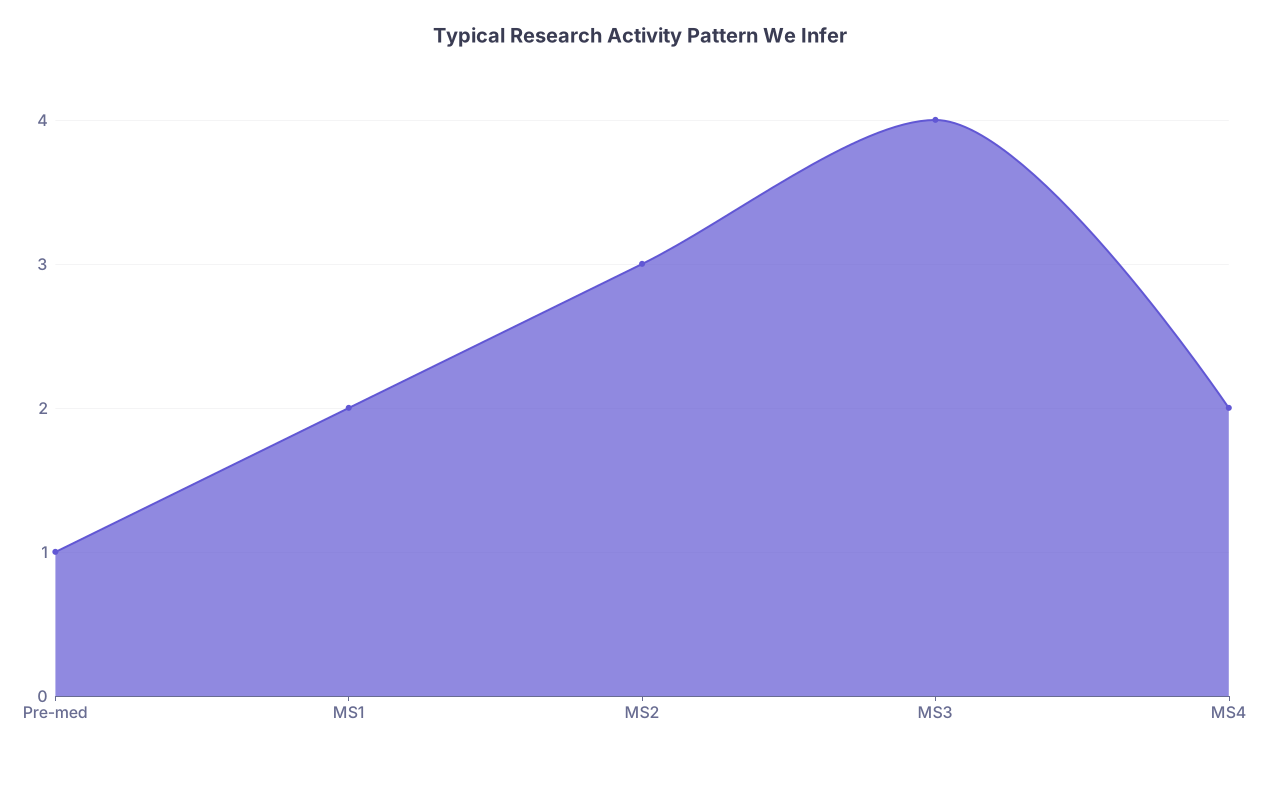
In your head, you have a narrative. In ours, we have a quick mental graph.
We roughly picture how your research load distributed across years.
| Category | Value |
|---|---|
| Pre-med | 1 |
| MS1 | 2 |
| MS2 | 3 |
| MS3 | 4 |
| MS4 | 2 |
That nice “hill” shape is what a lot of serious applicants show. If instead we see:
- Nothing MS1
- Nothing MS2
- Five new projects MS3 and MS4, all without outputs
We mentally label it as “scramble pattern.” Again: not fatal, but not impressive either.
What Impresses Faculty That You Don’t Expect
You think the magic words are “first-author” and “NEJM.” They’re not.
Let me tell you what actually makes people in that room lean forward.
1. Evidence you were trusted
If I see:
“Presented findings at weekly lab meeting; trained two junior students on protocol; maintained project database.”
I immediately know your PI did not hate you. They trusted you with something that could break the project if you were incompetent. That’s far more telling than another “poster at regional conference.”
2. Depth, not breadth
I’d take one project that spans two years, with multiple abstracts and a poster, over four one-off posters where you were just another name in the middle of the author list.
Faculty look for arc:
- You joined early
- You stuck around
- Your responsibilities grew
- Something actually came out of it
That progression tells us much more about how you’ll function as a resident than the raw publication count.
3. Projects that touch the real world
Especially in non-physician-scientist paths, quality improvement and clinical projects often hit harder than obscure basic science. A tight QI project that actually changed a workflow or reduced CLABSI rates is something clinicians respect.
I’ve seen PDs say almost verbatim:
“They did a serious QI project with measurable change. That’s more relevant to residency than their bench work.”
If you can show:
- A concrete problem
- An intervention you helped design or implement
- Measurable outcomes
you’ve just demonstrated you understand systems, not just pipettes.
What Gets You Quietly Written Off
Now for the part nobody tells you, but everyone on the committee thinks.
There are a few patterns that make seasoned faculty mentally check out before they’ve finished scrolling.
1. The “CV padding” smell
When every single research entry looks like:
“Retrospective chart review, data collection, manuscript in preparation.”
with no presentations, no abstracts, no anything, and this repeats four or five times—people assume you just said yes to being an unpaid data monkey for every resident who walked by.
The problem isn’t that you were a data monkey. That’s how most of us start. The problem is: nothing appears to have ever finished. That reads as poor follow-through or poor judgment about which projects to join.
2. Over-selling minor involvement
Faculty know exactly what undergrads and med students usually do on projects. When you describe your role in a way that doesn’t match reality, it’s obvious.
If your description sounds like you single-handedly created a multicenter RCT as a second-year med student, you don’t seem impressive. You seem untrustworthy. And lack of trust is a killer.
3. Sloppy or inconsistent details
This sounds petty. It isn’t.
Things that make people question your reliability:
- Misspelled journal names
- Wrong years that don’t match your CV or PubMed
- Listing an abstract as a “peer-reviewed publication”
- Changing your author order compared to the real citation
We’ve had applicants list themselves as first author on ERAS when PubMed clearly shows them as third. Once that happens, nothing else on your application can be taken at face value.
How Different Specialties Read Research
Here’s another insider truth: your specialty absolutely changes how your research is read. The bar isn’t the same everywhere, and pretending it is only confuses applicants.

| Specialty | Research Weight | Typical Faculty Attitude |
|---|---|---|
| Derm, Plastics | Very High | Count + quality + fit scrutinized |
| Neurosurg, Ortho | High | Expect multiple serious projects |
| Rad Onc, ENT | High | Wants genuine specialty engagement |
| IM, Gen Surg | Medium | Research helps, not everything |
| Peds, FM, Psych | Low–Medium | Coherence and maturity > raw volume |
In derm, plastics, neurosurgery, ortho, rad onc:
- People do look at volume.
- They absolutely notice specialty alignment.
- They absolutely notice whether your name shows up on PubMed.
But even in those fields, the first pass is still pattern and credibility. No one wants a resident who will fake their way through “productivity” and become a problem in their lab.
In peds, FM, psych:
- One or two meaningful projects is plenty.
- Over-weighted, desperate-looking research sections sometimes backfire—they make you seem misaligned with the actual clinical culture.
You should calibrate your expectations, but not your honesty. The expectations differ, the need to be real does not.
How to Present What You Actually Have (Without Shooting Yourself)
Let me be blunt: you’re probably not going to redo your entire research life because of this article. But you can absolutely present what you already have in a way that survives faculty scrutiny.
1. Make your story coherent
If your research history is scattered, your job is to articulate the through-line.
Maybe it’s methods (“I’ve been drawn to outcomes and database work.”)
Maybe it’s patient population (“Across projects, I’ve gravitated to oncology patients.”)
Maybe it’s system issues (“Most of my work has focused on access and disparities.”)
You do not need to force a fake narrative. Just pick the most honest, unifying thread and lean into it in how you describe and discuss your work.
2. Right-size your role
When you write the ERAS entries:
- Be specific.
- Be honest.
- Focus on what you truly owned.
For example, instead of:
“Led all aspects of data analysis and manuscript writing.”
Try:
“Cleaned and organized dataset; performed initial descriptive statistics with oversight; drafted Results section.”
That sounds like someone I’d trust more, not less.
3. Respect the timeline
If something is:
- Just an idea with no data collection: that’s “proposed project,” not “in progress.”
- Data collected but no abstract: fine to list, but keep the description modest.
- Submitted but not accepted: say “submitted,” not “under review” unless that’s accurate.
The faculty reading your file have lived in this world for decades. They know how slow research moves. Nobody believes you magically produced five fully baked manuscripts in three months as a third-year.
Behind the Scenes: What Actually Gets Said in the Room
You want the raw tape. Here’s the kind of commentary that shows up on real selection days.
Good reactions:
- “This person isn’t a machine, but they clearly stuck with that cardiology project for years.”
- “They started small, then moved up to presenting at a national meeting. That kind of growth is what we want.”
- “They did a serious QI project with outcomes. That’ll translate to residency.”
Neutral but workable:
- “Light on publications, but they at least finished one poster and seem to understand it.”
- “Not much research, but consistent with their interest in community practice.”
Red-flag territory:
- “There’s no way they had this level of responsibility as a first-year. I don’t believe this.”
- “Six ‘in progress’ projects. Nothing came out. Either they’re picking the wrong mentors, or they don’t stick with things.”
- “They listed themselves as first author here, but PubMed says different. That’s a problem.”
The biggest unspoken truth: people are looking for reasons to trust or not trust you. The research section is one of the easiest places to catch dishonesty, exaggeration, or poor judgment.
Once someone at the table says, “I don’t trust this profile,” your file might as well be on fire.
A Simple Sanity Check Before You Submit
Before you lock your ERAS, sit with just your research section and ask yourself, ruthlessly:
- Does this look like a believable progression for a med student at my school?
- Would my PI or mentor fully agree with the role I described?
- If a faculty interviewer cold-asked me to explain each project’s design and my actual contributions, could I do it calmly?
- Does the pattern of topics and timing match the rest of my application’s story?
If any answer is “no,” fix it now. That’s the leverage you have.
FAQs
1. I have zero publications. Is that a dealbreaker?
For most core specialties (IM, peds, FM, psych, even general surgery at many places), no. What matters more is whether you show any evidence of sustained engagement with something—research, QI, advocacy, teaching. For very competitive, research-heavy fields (derm, plastics, neurosurg, some ortho and rad onc), no publications can hurt at top-tier academic programs, but honest, meaningful projects still beat fake or inflated “accepted soon” nonsense.
2. Should I list projects that never led to presentations or papers?
Yes, if they were real, meaningful efforts and you can explain what you did and why they stalled. Many faculty respect, “We collected data, but the signal wasn’t there,” more than another padded abstract. Just keep the descriptions modest and accurate; don’t write them like completed, high-impact projects.
3. Can I group similar projects together to avoid looking scattered?
You can’t literally merge separate projects into one ERAS entry, but you can make your descriptions and personal statement emphasize the common threads: similar patient populations, same methods, same overarching question. The point isn’t to hide variety; it’s to make the variety make sense.
4. How bad is it if I slightly overstate my role?
Bad. Worse than you think. Faculty don’t expect you to be a hero; they expect you to tell the truth. Overstating your role is one of the fastest ways to lose trust, and if they catch you once, they’ll question everything else—from your procedures logged to your leadership claims.
5. Should I prioritize adding “one more project” or refining how I present what I’ve done?
At the ERAS stage, 9 times out of 10, you get more mileage from presenting your existing work clearly, coherently, and honestly than from tacking on another half-baked project. One more “data collection, manuscript in preparation” entry isn’t going to move the needle. A research section that tells a believable, consistent story very well might.
Key takeaways: Faculty don’t start by counting your pubs; they start by asking, “Does this research profile make sense for who this person says they are?” Your roles need to be believable, your timeline needs to suggest maturity rather than panic, and every line has to be something you can defend, out loud, in front of people who’ve done this their whole careers.