
The fastest way to look unserious to residency programs is to mix up quality improvement and research on your CV.
Why This CV Error Hurts You More Than You Think
Let me be blunt. Program directors are not confused about what counts as research versus quality improvement (QI). You are. And when you blur the line on your CV, three bad things happen immediately:
- You look like you do not understand academic work.
- You look like you are inflating your achievements.
- You force busy reviewers to mentally correct your CV. Most will not bother.
I have sat in rank list meetings where someone pulls up an applicant’s CV and says, “Half of these ‘research projects’ are really PDSA cycles.” Translation: trust in that application just dropped.
You are applying in an environment where programs are drowning in applicants. They are hunting for red flags and excuses to move on. Mislabeling QI as research—or dumping both into a messy, catch-all “Projects” section—is one of those quiet but deadly errors.
Let us dissect the main mistakes and how to fix them before your ERAS is locked.
Mistake #1: Calling Every Project “Research” Because It Sounds Stronger
Here is the core error: labeling something “research” just because it involved data, meetings, or a PowerPoint.
That hand hygiene initiative where you tracked compliance before and after an intervention?
That EMR “best practice alert” project where you looked at pre- and post-intervention metrics?
That sepsis order set implementation with run charts at M&M?
Those are QI projects. Good ones, probably. But not research.
Programs know the difference. When you call all of them “research,” they will assume one of two things:
- You do not understand what research actually is.
- Or worse, you are deliberately inflating.
Neither is acceptable.
How to tell if it is research or QI (in 30 seconds)
Stop overcomplicating this. Ask yourself:
- Did the project require IRB review (approval or exemption) because it was designed to produce generalizable knowledge?
- Was there a formal hypothesis, structured study design, and pre-specified methods?
- Is there an expectation of publication or presentation beyond the local institution?
If yes to those, you are likely in research territory.
If instead:
- You used Plan-Do-Study-Act (PDSA) cycles
- The goal was to improve local processes, metrics, or patient care in your own setting
- The main audience was your department / hospital / health system
That is QI.
Stop calling QI “research.” It does not make you look better. It makes you look careless.
Mistake #2: Throwing QI and Research Into One Sloppy Section
Another common problem: the “Research & QI & Projects & Whatever Else I Did” section. A dumping ground.
Program directors hate this.
They do not have time to decode whether “Sepsis Bundle Improvement” is a randomized trial, a QI audit, or a one-week chart review you did because the chief asked you to. They skim. They categorize. If your section is confusing, they quietly downgrade everything in it.
You need clean structure.
How to structure your CV the right way
Use clearly separated sections. For ERAS and residency CVs, a simple split works:
- “Research Experience”
- “Quality Improvement and Patient Safety Projects”
If you have substantial of both, that division is non-negotiable. If you only have one small QI project, you can still label it clearly under a broader section, but do not bury it as “research.”
Here is how that clarity actually helps you:
- It shows you know the difference between scholarly activity types.
- It lets research-heavy programs quickly find what they care about.
- It lets QI-focused programs (internal medicine, family medicine, hospitalist-heavy tracks) see that you understand systems improvement.
Blurring them helps no one, especially not you.
Mistake #3: Using Research-Style Language for Purely Local QI
Programs can smell this a mile away:
“Prospective cohort study to assess the impact of a novel evidence-based intervention on patient outcomes.”
Then you read the details and it is:
- One inpatient ward
- No control group
- No formal hypothesis
- One PDSA cycle
- Presented at the hospital QI fair only
That is not a “prospective cohort study.” It is a QI project.
Do not dress QI up in research vocabulary to make it sound more impressive. It backfires. Faculty who do actual research get irritated. They bring that irritation into the ranking discussion.
Acceptable vs overinflated wording
Look at the difference:
Honest QI description:
“Multidisciplinary quality improvement project using PDSA cycles to increase inpatient sepsis bundle adherence from 62% to 85% over 6 months on a medicine service.”Overinflated nonsense:
“Prospective interventional study evaluating the impact of a multidisciplinary sepsis management protocol on patient outcomes.”
Which one sounds more grounded, more credible, and more like you actually know what you did? Exactly.
You gain more by being precise than by being grandiose.
Mistake #4: Hiding All Evidence of Rigor in QI Work
The flip side: some of you actually did high-quality, rigorous QI work—then undersold it by listing it as a vague “project” with no detail.
That is just as bad.
A serious QI project can absolutely impress programs, especially those that live and breathe hospital systems, patient safety, and value-based care. But only if you show the rigor.
The mistake is writing entries like:
“Quality improvement project on reducing length of stay.”
“Project to improve discharge documentation.”
This tells the reader nothing. It looks like a box-checking exercise.
What your QI entries must include
At minimum, each QI entry should show:
- Aim: What problem were you solving? (e.g., “reduce 30-day readmissions for CHF patients”)
- Method/Framework: PDSA, Lean, Six Sigma, root cause analysis, etc.
- Metrics: What exactly did you measure?
- Results: With numbers. Not “improved,” but “improved from X to Y over Z time.”
- Role: What you actually did.
You are not writing a manuscript, but you should sound like someone who understands structured improvement work.
Mistake #5: Misplacing QI in the Wrong ERAS Sections
I see this constantly in ERAS:
- QI listed as “Work Experience” as if it was a paid job.
- QI dumped into “Volunteer” because there was no salary.
- Research in the “Work” section and QI in “Research,” the reverse of reality.
Programs notice this inconsistency. It reads as disorganized at best, dishonest at worst.
Where to actually put things in ERAS
There is not one perfect way, but there are clearly wrong ways. A common, safe pattern:
Research projects (with IRB, formal design, or clear scholarly intent):
→ “Research Experience”QI / patient safety projects, curriculum redesign, EMR optimization projects:
→ “Research Experience” or “Other Experience,” but explicitly labeled as “Quality Improvement Project” in the title.
Do not hide QI under “Work” just because it was time-consuming. The category is less important than the labeling. But mixing categories randomly is a mistake.
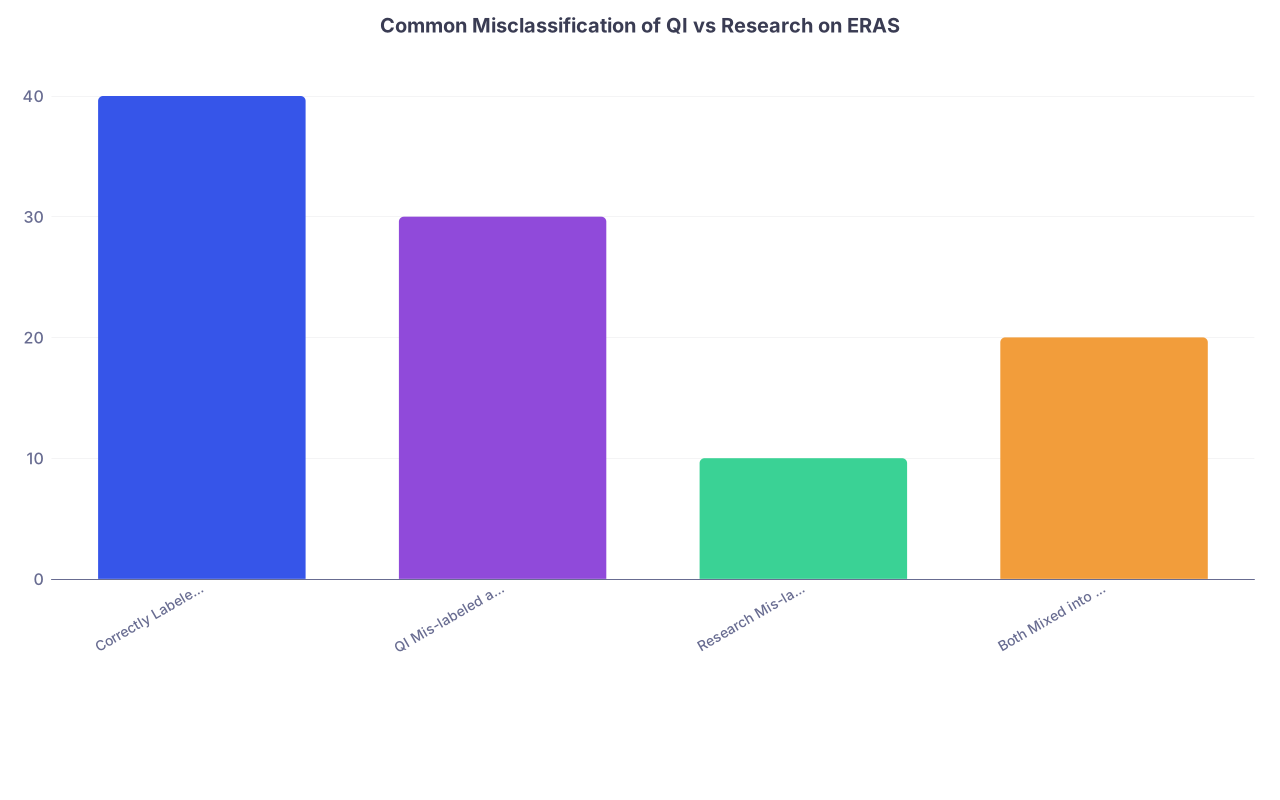
| Category | Value |
|---|---|
| Correctly Labeled QI | 40 |
| QI Mis-labeled as Research | 30 |
| Research Mis-labeled as QI | 10 |
| Both Mixed into One Section | 20 |
Mistake #6: Not Aligning Your Story Across CV, PS, and Interviews
Another subtle but deadly error: your CV says one thing, your personal statement implies another, and your interview answers contradict both.
Example I have actually heard:
- CV: Lists 5 “research projects,” all of which are essentially local QI with no IRB and no external dissemination.
- Personal statement: “My interest in academic medicine is grounded in my extensive research background.”
- Interview: When asked about study design, the applicant describes a PDSA cycle and says they “did not need IRB because it was not really research.”
You can guess how that went.
Programs are not only evaluating what you did. They are evaluating whether you understand what you did and can discuss it accurately.
How to keep your story consistent
Ask yourself:
- What is truly research in my portfolio?
- What is QI / patient safety?
- What is just a one-off audit or informal chart review?
Then:
- Label them correctly on your CV.
- Refer to them accurately in your personal statement.
- Practice explaining them coherently and consistently in mock interviews.
If you want to sell a strong QI background, then say that. Residency programs will respect it. Just do not rebrand it as basic science research when it clearly is not.
Mistake #7: Using the Wrong Metrics to “Flex” Your Work
Another pitfall: applicants try to compensate for limited or weak research by overemphasizing volume instead of depth.
You will see things like:
- “Participated in 12 QI projects during third year.”
- “Engaged in 8 research studies across departments.”
Then you dig and realize:
- No abstracts
- No posters
- No presentations
- No manuscripts
- No sustained involvement
It looks like resume padding. And it usually is.
Programs do not care how many “projects” you touched if none of them show completion, dissemination, or clear outcomes.
Depth beats quantity—especially in QI
For QI and research, you are better off with:
- 1–2 substantial projects where you can discuss the problem, methods, data, and outcomes intelligently
Than:
- 10 superficial entries that all read like “helped gather data” and “attended meetings”
If you are listing something, be prepared to talk about:
- The question or problem
- What your role was
- What the results were
- What you learned
If you cannot do that in detail, either:
- Reframe your level of involvement honestly (“assisted with data collection only”), or
- Consider whether it belongs on the CV at all.
Mistake #8: Ignoring How Different Specialties View QI vs Research
Not all specialties care about this equally, but they all care enough for you to get it right.
Here is the mistake: assuming that because you are applying to a research-heavy specialty, you should rename QI as research. Or, because you are heading into a more clinical, community-oriented specialty, you can ignore research structure and just throw everything under “Projects.”
Both are wrong.
| Specialty | Research Expectation | QI Value | Red Flag If… |
|---|---|---|---|
| Internal Med | Moderate–High | High | QI mislabeled as RCTs or trials |
| Surgery | High | Moderate | Surgical QI called “basic science” |
| Pediatrics | Moderate | High | No clear patient-outcome focus |
| Family Med | Moderate | Very High | No systems/QI involvement at all |
| EM | Moderate | High | EM QI called “retrospective cohort” |
You do not impress academic internal medicine by pretending your sepsis QI is a clinical trial. You impress them by showing you understand systems, statistics, and honesty in reporting.
You do not impress community family medicine by tossing everything into one confusing, overblown section. You impress them by showing concrete improvements in patient care with clear, practical outcomes.
Know your audience. But never at the expense of accuracy.
How To Fix Your CV Right Now
Here is a simple, ruthless audit you can do today:
- Open your CV or ERAS “Experiences” list.
- Highlight every item currently labeled as “Research,” “Scholarly Project,” or “Study.”
- For each one, ask:
- Was there IRB review/consideration?
- Was there a hypothesis and formal design?
- Is or was it intended for publication or external presentation?
If the answer is no across the board, it is QI or local improvement. Not research.
Then:
- Relabel QI items clearly as “Quality Improvement Project:” in the title line.
- Move them under a “Quality Improvement and Patient Safety” or similar subsection if your format allows.
- Rewrite descriptions to reflect the QI framework (aim, method, metrics, results).
- Strip out research-only jargon that does not fit what actually happened.
Finally, cross-check with:
- Your personal statement: Are you accurately describing your experience?
- Your interview prep: Can you explain the design and purpose of each project correctly, without stumbling over research vs QI terminology?
If any of those pieces misalign, fix them now. Before programs see them. Before you try to improvise under pressure in front of a fellowship-trained researcher who has actually run an RCT.
FAQ: Common Questions About QI vs Research on Residency Applications
1. Can a QI project ever be listed under research?
Yes, but only with precise labeling. If a QI project was designed from the start with IRB oversight and the goal of generating generalizable knowledge, it straddles the line. In that case, you can list it under “Research Experience,” but the description must clearly state that it is a QI-based or implementation science project. Do not call it a randomized trial or observational cohort study if it is not.
2. What if my school never got IRB for anything and called everything “QI”?
Then you need to describe honestly what was actually done. IRB status is a clue, not the sole determinant. If the project had a structured design, a defined question, pre-specified outcomes, and an intent to publish beyond your institution, you can frame it as research. But if it was primarily local process improvement without that structure, treat it as QI regardless of what your school informally called it.
3. I only have QI and no “real research.” Will this hurt my chances?
For many programs, no. For some, yes. Competitive academic programs and research-heavy specialties may prefer traditional research, but they still respect serious, results-driven QI with solid methodology. What hurts you is not the absence of bench or clinical research. What hurts you is exaggerating QI into something it is not. You are better off owning strong QI work and articulating how it shaped your thinking about patient care and systems.
4. How detailed should I be about methods and statistics on my CV?
Enough to show you understood what was done, not enough to write a full abstract. One line about the framework (e.g., “PDSA cycles,” “retrospective cohort,” “pre–post design”) and one line about the main outcome and result is usually sufficient. Save the deeper dive for interviews. Overloading your CV with dense statistical jargon just makes it unreadable and sometimes reveals gaps in your understanding.
5. What if my role in a project was minimal—can I still list it?
You can, but you must be honest and concise. If you only entered data or assisted with chart review, say that clearly. Do not call yourself “co-investigator” if you were not. Do not claim leadership roles you did not have. Residency faculty are very good at asking follow-up questions that reveal inflated roles. If you cannot comfortably explain the full project, from question to conclusion, your involvement was probably too limited to present as a major experience.
Open your CV or ERAS experience list right now and circle every time you wrote the word “research.” For each one, write “QI?” in the margin if you are even slightly unsure. Then, one by one, decide what it really was and relabel it accurately before you hit submit.