It’s 9:12 a.m. on interview day. You’re sitting in a small conference room at a mid-tier but realistic “reach” program you’d love to match at. Your interviewer, a cardiologist with two R01s, is flipping through your ERAS application. You watch their finger stop on one line:
“Retrospective cohort analysis of cardiovascular outcomes in CKD patients – abstract accepted, ACC 2023.”
They look up.
“Great, this is right in my wheelhouse. Tell me exactly what you did in this project and what your main finding was.”
Your stomach drops.
Because what you actually did was:
- Showed up twice.
- Screened a handful of charts.
- Then vanished when third year got busy.
- Haven’t spoken to that PI in a year and a half.
- Barely remember what the project was about, let alone what a hazard ratio is.
You start talking. They start frowning.
And in about 45 seconds, they know the truth: you put research on your application that you cannot explain.
That is the single fastest way to convert a “promising applicant” to a “do not rank.”
Let me walk you through the exact mistakes people make with research on their residency applications — and how to avoid detonating your own interview.
Why This One Mistake Hurts So Much
Programs will forgive a lot:
- A lower Step 1 score if the rest of you is strong.
- A light research portfolio in a non-competitive specialty.
- Some awkwardness in behavioral questions.
But fake, inflated, or unexplainable research?
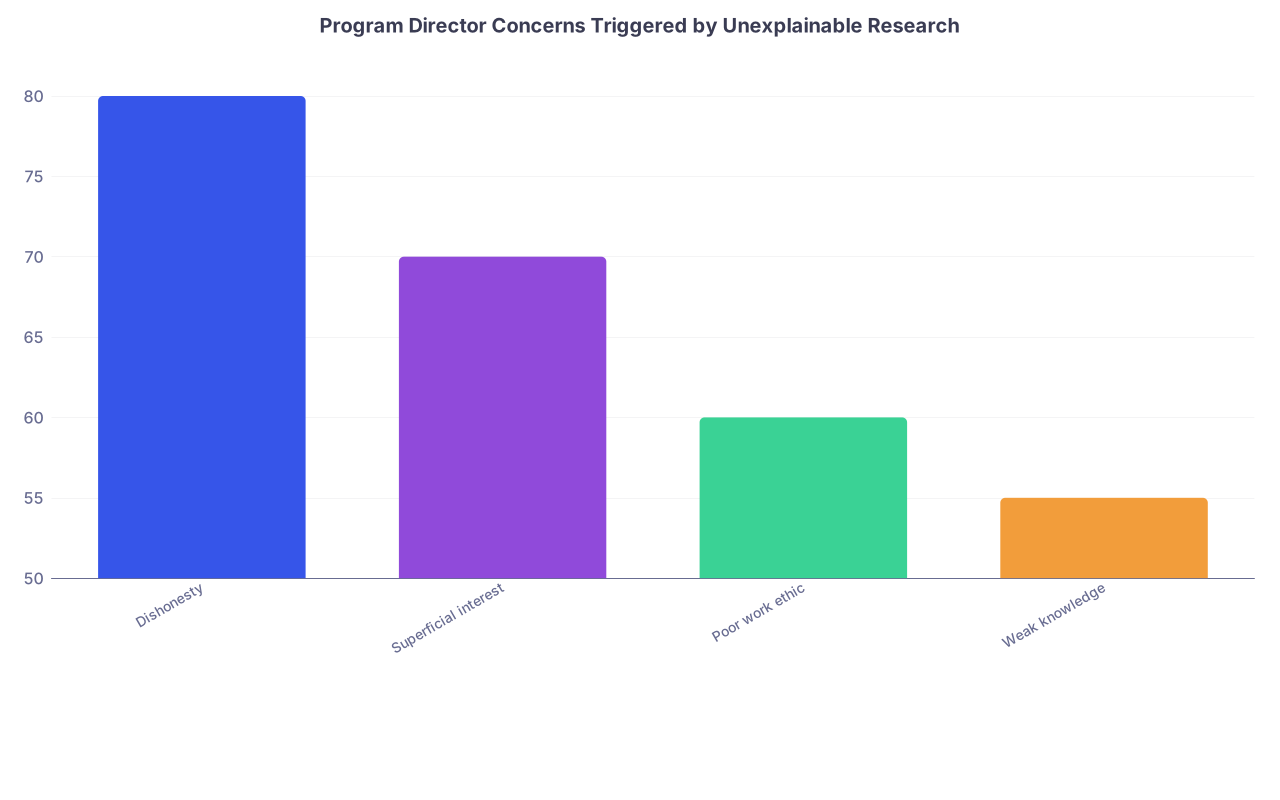
They read that as:
- Dishonesty
- Lack of insight
- Poor professionalism
- Weak understanding of your own CV
And they’re not wrong.
| Category | Value |
|---|---|
| Dishonesty | 80 |
| Superficial interest | 70 |
| Poor work ethic | 60 |
| Weak knowledge | 55 |
Those numbers aren’t from a specific paper; they’re the reality I’ve heard in PD meetings, selection committee debriefs, and hallway comments like:
- “If they can’t explain their own paper, what else is fabricated?”
- “I don’t trust this CV.”
- “If this is how they represent their work, how will they document in the chart?”
Programs don’t need hard proof that you lied. A whiff of exaggeration is enough to move you down the list.
Mistake #1: Listing Anything You Don’t Fully Understand
The core problem is simple: students list research based on what looks good, not what they actually understand.
You see your friend stacking:
- 4 abstracts
- 2 case reports
- 1 “paper in progress”
and you panic. So you:
- Add that half-forgotten first-year project.
- Slap “manuscript in preparation” on a dead project.
- List a poster you barely read, much less helped create.
Red flags that you don’t understand your own research
If any of these sound like you, that project should not be on your application until you fix it:
- You can’t explain the main question in one clear sentence.
- You don’t know the primary outcome or primary endpoint.
- You have no idea what the main table or figure shows.
- You can’t define even the most basic stats mentioned (p-value, odds ratio, hazard ratio, confidence interval).
- You don’t know what changed because of the study (why anyone should care).
Interviewers are not impressed by the number of projects if the depth is shallow.
I’ve watched faculty say, mid-interview, “Let’s move on,” after two failed attempts to get a coherent explanation from an applicant. The tone shifts. The score drops. They never recover.
The safe rule
If you can’t:
- Summarize the project.
- Describe your role.
- Explain the main result.
- Discuss at least one limitation.
Then you’re not ready to list it.
Mistake #2: Inflating Your Role — The Fast Track to “Do Not Rank”
Exaggerating your role is worse than having no research at all. I mean that literally.
Programs would rather see:
- “Student volunteer – helped with data entry”
than:
- “Co-investigator [really: showed up twice, then ghosted]”

Phrases that get abused (and make you look dishonest)
Be careful with these:
- “Co-investigator” – Did you design the study? Or were you just one of many students pulling data?
- “Led the project” – Did you actually coordinate meetings, manage timelines, create documents?
- “Wrote the manuscript” – Did you write the full draft? Or contribute sentences/sections?
- “Performed statistical analysis” – Did you run code yourself, understand it, and troubleshoot it? Or just sat in the room while the statistician did it?
If you claim:
“I did the statistics”
and then cannot explain why you used logistic regression instead of linear regression, that’s not a small gap. That’s a credibility problem.
How faculty test for inflated roles
They’ll say things like:
- “Walk me through your exact responsibilities on this project.”
- “What part of the manuscript did you draft?”
- “Which variables did you pull from the chart?”
- “How did you deal with missing data?”
They are not expecting a PhD-level answer. But they are expecting:
- Specific, concrete tasks.
- Honest recognition of what you did not do.
A good, honest answer looks like:
“I helped identify eligible patients from our EHR using specific ICD codes we’d pre-defined. I also reviewed charts to verify key variables like length of stay and readmission within 30 days. Another student and our statistician handled the actual regression modeling; I mainly helped interpret the initial output and revised the results section.”
That sounds credible. It’s clear, specific, and doesn’t overreach.
Compare that to:
“I did data collection and the analysis.”
Then, when pushed, you can’t explain what “analysis” actually meant. That’s how you end up on the “No” list.
Mistake #3: Listing Dead or Make-Believe Projects
The silent killer: “manuscript in preparation” or “submitted” for projects that are:
- Not actively being written.
- Not tracked in any shared document.
- Not going anywhere.
Programs know the game you’re playing: dressing up low-yield, unfinished work to pad your CV.
| Situation | Bad Wording | Safer Wording |
|---|---|---|
| Abandoned project | Manuscript in preparation | Data collection complete; project paused |
| Early-stage idea | Manuscript in preparation | Study concept developed; protocol not started |
| Awaiting feedback but no timeline | Manuscript submitted | Draft under mentor review |
| Not sure if it will ever be written | First author paper in progress | Former research involvement (study inactive) |
If a skeptical interviewer called your PI today and said:
“Tell me about this manuscript ‘in preparation’,”
would your mentor say:
- “Yes, we’re actively working on that, and this student was meaningfully involved.”
or:
- “…Uh, that project stalled last year. I didn’t realize the student was still listing it.”
Don’t put your mentor in that position. And don’t put yourself in a situation where a reference letter contradicts your ERAS.
Mistake #4: Not Doing a Pre-Interview Deep Dive on Your Own CV
The most preventable failure: walking into interviews without re-learning your own research.
This is pure self-sabotage.
You should be the world expert in your experience even if you’re not an expert in the field. But what do I see every year?
- Students who have to pause and squint to remember which abstract was which.
- Applicants mixing up projects, journals, or study designs.
- People blanking completely on a co-author’s last name.
All extremely avoidable.

| Step | Description |
|---|---|
| Step 1 | Print ERAS CV |
| Step 2 | Highlight all research entries |
| Step 3 | Create 1-page summary per project |
| Step 4 | Write bullet points: question, methods, results, role |
| Step 5 | Review with mentor or co-author |
| Step 6 | Practice out loud before interviews |
You should have done this before interview season. But if you haven’t, do it now.
Mistake #5: Assuming Non-Research Specialties Don’t Care
This one gets people every single year.
You’re applying to:
- Family medicine
- Psychiatry
- Pediatrics
- Internal medicine with no academic plans
So you think: “They won’t focus on my research. It’s just bonus.”
Wrong.
I’ve watched community FM programs and smaller psych programs absolutely drill applicants on tiny research experiences. Why?
Because research questions quickly reveal:
- Attention to detail
- Intellectual curiosity
- Professional honesty
- Ability to follow through
Programs don’t care if you had 1 project or 10. But they absolutely care if you:
- Patty-cake your way through the explanation.
- Clearly don’t understand what you did.
- Gloss over gaps in your involvement.
Even community programs hate fluff.
Mistake #6: Not Knowing How to Explain Basic Concepts
You do not need to be a statistician.
But if you list a project, you should be able to explain basic concepts in simple language, like you’re talking to a smart non-physician.
Examples of questions you might be asked:
- “Why did you choose a retrospective design instead of a prospective one?”
- “Why was this outcome clinically important?”
- “What’s one limitation of your study?”
- “What would you do differently if you could repeat the project?”
- “What surprised you about the results?”
| Category | Value |
|---|---|
| Study question | 25 |
| Methods | 25 |
| Key results | 25 |
| Limitations | 25 |
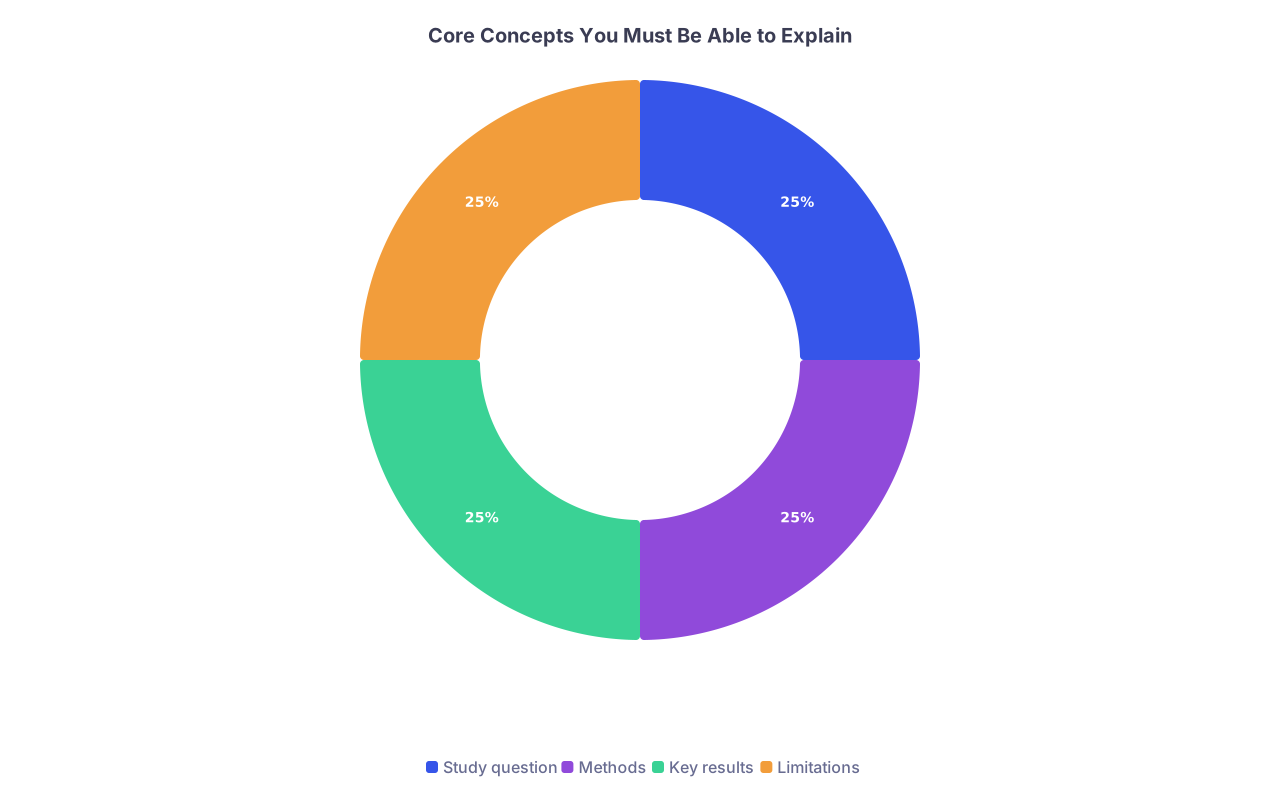
Notice what’s not on that chart: p-values to three decimal places, exact sample size, fancy statistical jargon. Nobody cares if you misremember the precise confidence interval.
They care if you:
- Understand why the study was done.
- Grasp how it was done.
- Can say what was found.
- Recognize what it doesn’t show.
If you can do those four, you’re fine. If you can’t, don’t list it without doing the work to fix that.
Mistake #7: Letting Someone Else Write You Into a Paper You Never Worked On
This happens more than people admit.
A classmate or resident says:
“We’re putting your name on this abstract since you helped early on. Go ahead and list it.”
You:
- Didn’t see the final data.
- Didn’t read the final abstract.
- Don’t have access to the poster or manuscript.
- Couldn’t summarize the project if your life depended on it.
Then on interview day, an attending says:
“I actually read this paper when it came out. Talk me through what you think was the biggest limitation.”
You’ve never even seen the paper.
That’s not generosity from the team. That’s a trap you walked into by not insisting on:
- Seeing the final product.
- Understanding the methods and results.
- Being able to articulate your contribution.
If your name is on it, you own it.
If you’re not willing to put in the time to really understand it, don’t list it. You can always say:
“I was involved early, but my contribution ultimately didn’t rise to the level where I felt comfortable listing it as a formal product.”
That shows integrity. Programs like that a lot more than CV inflation.
How to Fix This Before Your Next Interview
If you’re reading this with interviews already scheduled, don’t panic. But also don’t pretend this will solve itself.
Here’s what to do this week.
Step 1: Audit Your ERAS Research Section
Go line by line.
For each project, ask:
- Can I clearly explain:
- The question?
- The design?
- The main result?
- My role?
- One limitation?
If not, it’s in one of three categories:
- Keep but review deeply – You were actually involved; you just need a refresher.
- Keep but reword – You inflated your role; adjust wording to match reality.
- Should probably remove – You were barely involved and can’t fix that now.
Yes, you can adjust how you talk about things even if ERAS is locked. You can verbally de-escalate your role in an interview. And you absolutely should.
Step 2: Build a One-Page “Research Script” for Each Project
For every project that stays “live” in your mind:
Create a mini-sheet (digital or paper) with:
- Title / topic (in your own words)
- 1–2 sentence research question
- Study design (retrospective cohort, case-control, RCT, case report, etc.)
- Population (who, where, when)
- Primary outcome
- Key result (in plain language)
- Your actual role (specific tasks)
- 1–2 limitations
- What you learned / how it changed your thinking
Practice talking through each sheet out loud. If it sounds fake, too rehearsed, or you get lost halfway, tighten it up.
Step 3: Clarify Your Role Honestly
If you overstated your role on ERAS, correct it verbally on interview day.
Examples:
ERAS says: “Co-investigator; wrote manuscript.”
- You say: “I contributed sections to the introduction and helped revise the results. Our PI and senior resident led the main drafting.”
ERAS says: “Led data analysis.”
- You say: “Our statistician handled the formal modeling; my role was more focused on organizing the dataset, checking for missingness, and helping interpret the preliminary results.”
You’re allowed to clarify and right-size things. Interviewers respect that. What they do not respect is doubling down on an inflated claim when they press you.
Step 4: Contact Your Mentors — Briefly
If there are projects you’re shaky on:
- Email your mentor.
- Ask for:
- The final abstract / poster / paper.
- A quick 10–15 minute call to review the key points.
You don’t need a full crash course. You need:
- Clear understanding of what actually got presented/published.
- Their language for the main finding and limitation.
Take notes. Update your one-page sheet. Done.

| Step | Description |
|---|---|
| Step 1 | Identify weak projects |
| Step 2 | Email mentor |
| Step 3 | Request final document |
| Step 4 | Schedule 10-15 min call |
| Step 5 | Clarify results & your role |
| Step 6 | Update your notes |
The Bottom Line: Depth Beats Decoration
Programs don’t punish you for:
- Having only one decent project.
- Doing simple, small-scale work.
- Being early in your academic development.
They punish you for:
- Decorating your CV with things you barely touched.
- Pretending you did more than you did.
- Crumpling under basic questions about your own work.
I’ve seen applicants:
- With a single honest, well-understood QI project get ranked to match in competitive programs.
- With a huge, flashy research section get quietly buried on the rank list because they couldn’t back it up.
Your goal is not to impress with volume. It’s to be unimpeachably solid on anything you claim credit for.
Do This Today
Right now — not tomorrow, not “after this busy week” — do this:
Open your ERAS application (or your CV) and highlight every research entry in a bright color. For each one, ask yourself out loud:
“If someone grilled me on this for 5 minutes tomorrow, could I confidently explain the question, methods, results, my role, and one limitation — without bluffing?”
If the honest answer is no, that’s your to-do list.
Start with the project you’re most likely to be asked about and build that one-page script today. Not perfect, not pretty. Just clear and honest.