
The fastest way to quietly kill your residency application is not a low Step score. It’s being the resident everyone in research warns each other about.
Welcome to the stuff people actually say about you when you’re not in the room.
This is about collaborator conflicts. The behavior that gets you bad-mouthed to PDs, whispered about by fellows, and “red-flagged” by the one research mentor you really needed on your side. You will not see this in any official handbook. But I’ve watched it cost people interviews. More than once.
Let me walk you through the landmines so you don’t step on them.
The Silent Career Killer: Getting a Bad Reputation in Research
People underestimate one thing: research is a small village.
- Attendings talk to each other across departments.
- Program directors text each other about problematic applicants.
- That “big name” PI you barely responded to? They’re on the residency selection committee. Or their friend is.
You think: “It’s just a poster / small project, nobody cares.”
Wrong. What they see is your pattern:
- Do you respect other people’s time?
- Do you follow through?
- Can you be trusted with data, deadlines, and authorship?
If the answer is “no” even once with the wrong person, you can end up on the invisible do-not-touch list.
Here’s the behavior that gets you there.
Mistake #1: Ghosting After You Get What You Want
This is the most common and the most despised move.
What it looks like
- You joined a project early MS3 “to strengthen my CV.”
- The PI invested time: helped you define your role, gave you data access, maybe introduced you to a statistician.
- You got what you needed: a line on ERAS, something to mention on rotations.
- Then you:
- Stopped answering emails reliably.
- Didn’t send that “final draft” you promised.
- Vanished after your sub-I started.
- Reappeared months later asking: “Can I still be an author on this?”
People hate this. And they don’t forget.
Why it’s so damaging
- It screams: “I use people for my own gain.”
- It forces others to clean up your mess:
- Re-assigning your work to another student.
- Re-doing your sloppy data entry.
- Rewriting sections you promised to write.
- It slows or kills the project entirely.
And then—here’s the part you don’t see—your name comes up when PDs ask:
“Anyone I should be careful about? Anyone unreliable?”
You do not want your mentor saying, “Honestly, they disappeared halfway through our project.”
How to avoid this
- Before starting, agree on:
- Timeline
- Specific deliverables
- How long you’re committed (e.g., through data collection, through submission, etc.)
- When your schedule changes (sub-I, away, Step 2 prep):
- Tell your mentor early: “My schedule will be tight from X to Y, I can realistically do A and B, but not C.”
- If you realize you cannot continue:
- Own it. Early. Directly.
- Example: “I can’t do the analysis section, but I can clean up references and help with figures by next Friday.”
- Do not just disappear. Ever.
Mistake #2: Playing Games with Authorship
Nothing will get you bad-mouthed faster than messing with authorship.
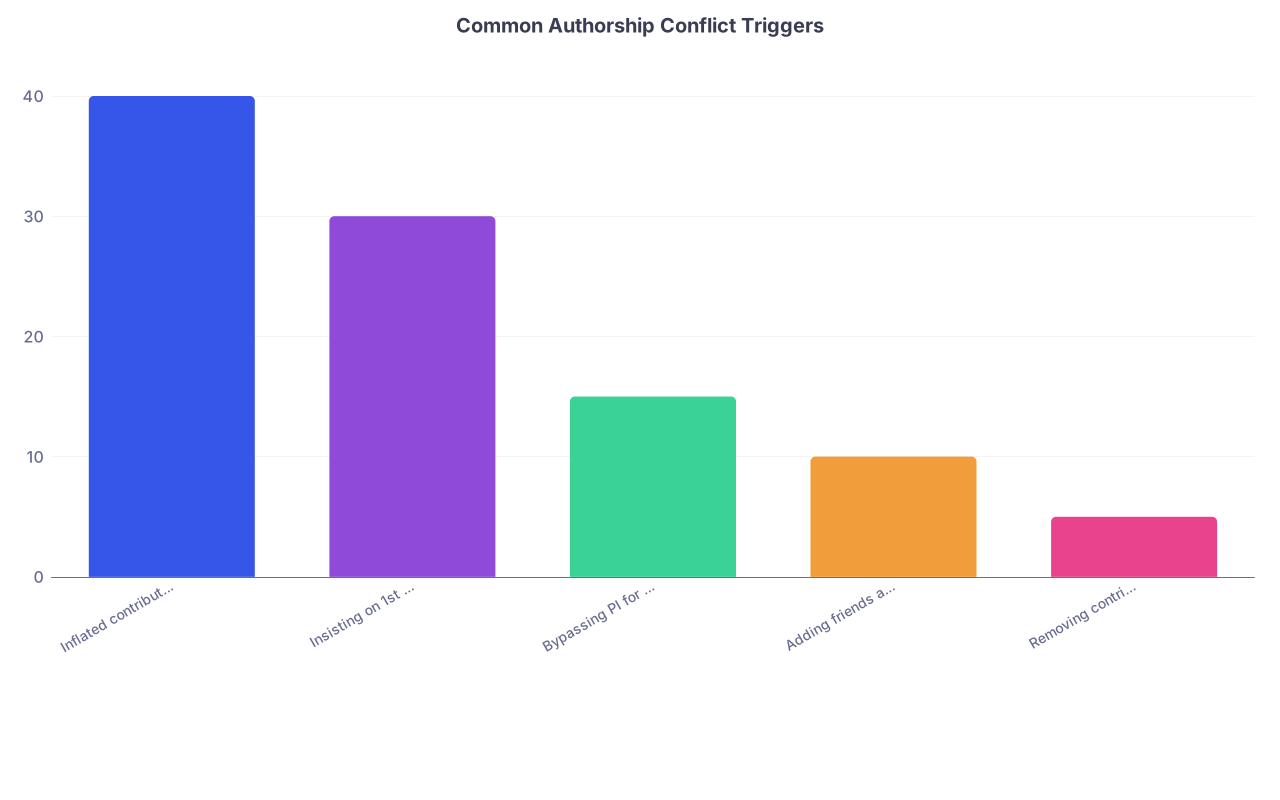
| Category | Value |
|---|---|
| Inflated contribution claims | 40 |
| Insisting on 1st author | 30 |
| Bypassing PI for changes | 15 |
| Adding friends as authors | 10 |
| Removing contributors | 5 |
The behavior that burns bridges
Here’s what I’ve seen residents and students do:
- Insisting on first authorship because “I need it for my application”
even though:- They joined halfway through.
- Someone else built the project, protocol, and dataset.
- Quietly rewriting the author order in the draft without a discussion.
- Adding a friend/co-student as an author who only “helped a little” with proof-reading.
- Downplaying another student’s contribution so they can be moved down the list.
- Going around the PI to complain to another attending about authorship decisions.
You do that once with the wrong PI or fellow, and your name becomes radioactive.
How this shows up in your reputation
- “Entitled”
- “Doesn’t understand authorship norms”
- “Only cares about how it looks on their CV”
- “Not a team player”
That’s disaster language in residency selection.
How to not be that person
- Ask early:
“How is authorship usually determined on your projects?”
And then accept that standard unless it’s clearly unethical. - Focus on earning authorship:
- Take on the unsexy work: chart review, data cleanup, reference checking.
- Be the one who consistently hits deadlines.
- If you think there’s an issue:
- Address it privately, directly, and once.
- Calmly say: “Can we review expected contributions and likely authorship order? I want to be sure I understand.”
- Never:
- Change author order on your own.
- Add anyone to the author list without explicit approval.
- Complain sideways to other faculty. That gets back to the PI 100% of the time.
Mistake #3: Sloppy, Dishonest, or Dangerous Data Behavior
You want to see a PI go from “supportive” to “never again” in 10 seconds?
Mess with their data.
The ugly stuff I’ve seen
- Fabricating or “filling in” missing values to make a table look cleaner.
- Backdating IRB forms or saying data were de-identified when they weren’t.
- Sharing actual patient data via unencrypted email or Google Sheets.
- Sending data files from personal email after being told not to.
- Making up survey responses “because we need at least 50 participants.”
You may think “It’s just a small QI project.”
They think: “This person is comfortable with research misconduct.”
That label follows you. Quietly. Permanently.
Why this kills you in residency applications
- Many programs ask: “Any concerns about professionalism or integrity?”
- A PI or faculty member who saw shady behavior is not going to lie for you.
- Best case: lukewarm letter.
- Worst case: they explicitly warn a PD they know.
You cannot recover easily from a whisper that you’re “loose with data.”
How not to screw this up
- Ask every time you’re unsure:
- “Is it okay to store this on my laptop?”
- “How should I handle missing data?”
- “Do we have IRB approval for this analysis?”
- If you discover a mistake:
- Tell them. Immediately.
- Own it: “I realized I did X incorrectly. I’ve stopped that process and am ready to help fix it.”
- Never guess about:
- IRB status
- PHI handling
- “De-identified” versus “coded” data
If a choice feels like “the easy way” versus “the right way,” you already know the answer. Choose wrong, and that’s the story people remember.
Mistake #4: Being High-Maintenance and Low-Value
This one is more subtle. But just as lethal.
Some people become known as “a lot of work” for very little payoff. Nobody wants to recommend them.
Typical pattern:
- Tons of questions, but never taking notes.
- Needing constant reminders.
- Turning in draft after draft that shows they didn’t read feedback.
- Complaining about workload while producing little.
- Expecting hand-holding for basic tasks: formatting references, using a template, emailing coordinators.
Mentors will tolerate this from a 1st year student once. They will not tolerate it from someone applying for residency.
The behind-the-scenes commentary
I’ve literally heard:
- “Nice kid, but I wouldn’t trust them with a serious project.”
- “Takes 10 emails to get one thing done.”
- “I wouldn’t want them in my residency—they need micromanagement.”
That kills strong scores and good boards in a second.
How to avoid being labeled “high-maintenance”
- Before asking for help:
- Try to solve the problem yourself.
- Read the last email carefully.
- Search your own notes.
- Batch questions:
- Send one email with 4–5 concise questions.
- Don’t drip 7 emails in 2 days.
- When you get feedback:
- Apply it globally, not just to that single paragraph.
- Next draft should show you learned, not that you copy-pasted corrections.
Your goal is simple:
Be easy to work with and obviously useful.
Mistake #5: Public Drama, Private Bitterness
You will not like every collaborator. Fine.
But voicing it the wrong way will hurt you, not them.
Problem behaviors
- Venting about your mentor or co-resident:
- In group chats that include people you barely know.
- In the resident room, door open, other teams around.
- At conferences, in hotel lobbies, over drinks.
- Trash-talking your PI’s work ethic, “poor organization,” or “old-school” style.
- Posting passive-aggressive comments or jokes on social media about:
- “Slave labor research”
- “PIs who think this is our only job”
- “If you email me at 11pm, I’m ignoring you lol”
Those screenshots travel. Fast.
How this backfires
- People don’t think, “Wow, you’re brave for saying that.”
- They think, “You’re willing to publicly undermine your team.”
- They worry you’ll talk about them that way in the future.
Program directors are already terrified of residents who bring drama. You do not want to look like that risk.
Safer ways to handle conflict
- Confide in:
- One trusted upper-year you know is discreet.
- A student affairs dean or research director if it’s serious.
- Keep the content focused:
- “I’m struggling with X expectation.”
- Not “My mentor’s a disaster.”
- Never vent where:
- Patients, nurses, or other faculty can overhear.
- People can screenshot and forward.
You can be frustrated. Just don’t be loud and sloppy about it.
Mistake #6: Overclaiming Your Role on ERAS
If you want a PD to seriously side-eye your entire application, exaggerate your research.
| Situation | Risky Description | Safer Description |
|---|---|---|
| Helped with data for 1 month | "Led project, designed study" | "Assisted with data collection" |
| Edited drafts only | "Primary author on manuscript" | "Contributed to manuscript revisions" |
| Project never submitted | "Published article" | "Manuscript in preparation" |
| Middle author on large team | "Developed and executed study" | "One of several co-authors" |
What interviewers hate
They see:
- “First-author manuscript under review at NEJM”
and then:- You cannot describe the methods clearly.
- You don’t know specifics about the dataset.
- You can’t answer basic questions beyond the abstract.
Or:
- You list 10+ “in progress” projects.
- But you cannot give a coherent 1–2 minute summary of even one of them.
This reads as inflation. Or worse: dishonesty.
How reputational damage happens
Sometimes PDs email or call your letter writers and mentors:
“Tell me about their research. How significant was their role?”
If what you wrote on ERAS doesn’t match what your PI describes? You’re done.
How to avoid overclaiming
- Use conservative language:
- “Assisted with…”
- “Contributed to…”
- “Collaborated on…”
- For status:
- “Manuscript in preparation” only if there is an actual near-final draft.
- “Data collection ongoing” if that’s literally what’s happening.
- “Submitted” only when you have a submission ID.
- Assume PDs will:
- Ask about any major paper.
- Fact-check with LOR writers.
You do not need to sound like a superstar. You need to sound reliable and honest.
Mistake #7: Ignoring Power Dynamics and Burning the Wrong Bridges
You might think, “It’s just a fellow, who cares if I annoy them?”
Big mistake.

| Step | Description |
|---|---|
| Step 1 | You on Project |
| Step 2 | Fellow |
| Step 3 | PI |
| Step 4 | Other Faculty |
| Step 5 | Program Director |
| Step 6 | Residency Selection Committee |
| Step 7 | Other Fellows |
Who actually shapes your reputation
- Fellows who:
- Run the day-to-day work.
- Report directly to attendings about you.
- Senior residents on the project.
- Research coordinators and statisticians.
When they say:
- “They were great—always responsive.”
- Or “They were a headache from start to finish.”
That funnels straight up.
Subtle behaviors that make you look bad
- Being overly casual with deadlines because “I’m just reporting to the fellow.”
- Arguing over minor things in front of the team.
- Ignoring emails from the coordinator but replying immediately when the PI emails.
- Acting arrogant because you have good scores or a fancy med school.
You’re being evaluated even when you think you’re “just working with a fellow.”
How to respect the power structure without being fake
- Treat:
- Fellows like future letter writers.
- Coordinators like the gatekeepers they are.
- Update people proactively:
- “I’ll have the draft by Friday; if anything changes I’ll let you know.”
- Say thank you. Specifically.
- “Thanks for walking me through that analysis; I know it took time.”
You’re not sucking up. You’re being professional in a field where relationships matter.
FAQs
1. What if I already made some of these mistakes? Am I screwed?
Not automatically. But you cannot pretend it didn’t happen. The best move:
- Acknowledge it to the person you wronged.
- Take responsibility without excuses.
- Offer something concrete to help repair it (finish a task, take a less glamorous role, etc.).
- Then change your behavior going forward—consistently.
Redemption in research is about patterns. One bad episode followed by two years of solid, reliable work? People usually remember the improvement.
2. I’m overwhelmed with clinical work. How do I avoid ghosting without killing myself?
You set expectations early and you reset them before you drop the ball.
- Tell your mentor when your schedule will tighten.
- Negotiate a smaller, clearly defined role.
- If you need a pause, say: “I can’t meaningfully contribute until X date; I don’t want to hold the project up. Do you want to reassign my parts or keep me for Y task later?”
Owning your capacity is seen as maturity. Silent disappearing is seen as immaturity.
3. Is it better to do fewer projects well than many projects superficially?
Yes. Every time. A few well-executed projects where people describe you as:
- Reliable
- Low-drama
- Honest
- Useful
will beat a bloated ERAS with 15 half-baked “in progress” entries and three people quietly telling PDs, “I’d be cautious.”
Key Takeaways
- Your research reputation is built on how you treat collaborators, not on how many pubs you list.
- The biggest career killers: ghosting, authorship games, data sloppiness, and public drama.
- Protect yourself by being boringly reliable: clear expectations, honest contributions, and no surprises.