
Last December, I sat at the end of a long conference table while a surgery program hashed out their final rank list. On the screen was an applicant who’d done “all the right things”: AOA, strong letters, solid interview. The room was quiet until one faculty member said, “He’s got three papers, but nothing first-author, and all case reports. Pass.” They moved on in under 15 seconds.
You think research is a box. A line on ERAS. A count of “publications, presentations, abstracts.” It is not. Behind closed doors, research is used as a weapon, a filter, an excuse, and occasionally, a golden ticket. Let me walk you through how it actually plays out when programs build their rank list.
The First Hard Truth: Research Matters Most When You’re Not Obviously Perfect
Inside a rank meeting, people are tired, over-caffeinated, and drowning in “excellent” applicants. Everyone is “hard-working,” “teachable,” “team player.” The differentiators are thin. That’s where research sneaks in.
Here’s how the internal hierarchy really works for most competitive and mid-tier academic programs:
First pass:
Board scores, class rank, major red flags, and interview impression.
If you’re top-decile interview + strong boards + no weirdness? You get ranked high almost automatically.
In that tier, research is nice, but not decisive.Second pass:
This is where borderline or “clustered” applicants get compared. You’ll hear things like:- “OK, between these three, who has stronger research?”
- “She’s got serious research, he’s got almost none, so I’d bump her up.”
- “He wants academics but has zero scholarly work… that’s inconsistent.”
Third pass (clean-up / tie-breakers):
Research becomes a tie-breaker, a narrative check, or a justification:- “We liked her, but for an academic program she’s light on research.”
- “If we’re choosing one of these for the research track, it’s obviously the one with two first-author clinical trials.”
If you’re aiming for derm, plastics, ortho, rad onc, neurosurg, ENT, or academic internal medicine, pretending research is optional is delusional. In community-heavy programs and less competitive specialties, it still matters, but more as a signal than a requirement.
The real rule:
- Research rarely saves a terrible applicant.
- It frequently elevates a “good” applicant into “we can’t let this one get away.”
What They Actually Look At (Not What You Think)
On your side of the portal, you see a simple count: publications, presentations, abstracts. You think: big number = good. Behind the door, that’s not how it’s read.
Faculty who do research read those lines very differently than you think. Let me translate.
1. Type of research
Basic science alone, with no clinical anything? For many clinical departments, that’s a “nice but probably irrelevant” signal unless the PI is big-name.
What quietly carries more weight than you realize:
- Clinical outcomes work in their field
- QI projects that show real implementation
- Retrospective chart reviews with some statistical rigor
- Subspecialty research that matches the division chief’s interests
You know what impresses far less than you hope?
- Single case reports in obscure journals
- Poster at local student day treated like it’s ASCO
- “Manuscript in preparation” or “submitted” that’s clearly fluff
People on the committee have been at this for years. They know fluff when they see it.
2. Authorship
This comes up more often than students think. I’ve literally watched someone zoom into the PDF of a CV and count the author position.
You’ll hear:
- “She’s actually first author on two of these. That’s real work.”
- “He’s like eighth author on all of them. Sounds like a data monkey, not a driver.”
Translation:
First-author clinical or translational pieces in the specialty or close to it? Heavy weight.
Your name buried on five big papers? Better than nothing, but not game-changing.
3. Continuity and trajectory
Committees look for a pattern:
- Did you stick with one group or one mentor over time?
- Is there a progression: poster → oral → paper?
- Does your work match what you say in your personal statement?
They don’t love:
- Random one-off projects in three unrelated fields
- A flurry of low-quality output crammed into your last six months
- “Wants academic cardiology” with zero cardiology or even IM-related work
They do love:
- “Started with a QI project in PGY-1, then expanded it, then turned it into a multicenter study.”
That story sells itself in the room.
How Research Changes Your Label in the Room
The most honest thing I can tell you: programs put invisible labels on people during rank meetings. No one writes them on the board, but the language is there.
I’ve heard versions of all of these:
- “Clinician–educator type”
- “Research star”
- “Very solid clinically, not academic”
- “Wildcard, not sure what he wants”
- “Workhorse, probably not publishing”
Research is the difference between being called a “research star” and just “solid.” And those labels stick.
Let me break down how research shapes those labels.
The “Research Star” Category
This is rare and heavily debated in the room:
Profile:
- Multiple first-author papers
- National presentations
- Strong letter from a big-name PI saying “top 1–2% in my career”
The PD will say something like:
- “If we want to boost our academic output, this is the kind of resident we need.”
- “Could be junior faculty material.”
The hesitation that does come up:
- “Are they going to be too research-focused and avoid the scut?”
- “Will they be a good teammate or always in the lab?”
If your research profile is too strong, ironically, they start wondering whether you’ll be miserable doing service-heavy rotations. Some services have scars from “too good for the floor” residents.
The “Serious About Academics” Category
This is where strong, realistic research helps most.
Profile:
- 1–3 solid clinical projects
- Maybe 1–2 first-author works
- A PI letter that describes them as dependable, persistent, organized
That applicant gets described as:
- “Committed to scholarship”
- “Likely to do QI or education projects here”
- “A good fit for our academic mission”
Those residents get picked higher for chief roles, internal fellowships, or research tracks later. Everyone in the room knows that.
The “Light on Research” but Strong Clinically Category
For many community or hybrid programs, this is acceptable, but they literally say:
- “She’s not going to be our academic driver, but she will be a phenomenal resident.”
If a program is trying to raise its academic profile, you can feel the tension:
- “We can’t fill the entire class with people who’ll never publish.”
That’s where research becomes a quota issue:
They want a mix of profiles. If you add nothing scholarly, you better be absolutely outstanding in other ways.
What Actually Gets Said In Rank Meetings (Real Phrases)
Here’s where I’ll pull back the curtain fully. These are real lines I’ve heard in multiple specialties.
On research volume:
- “He has 10 things listed, but once you remove the case reports, it’s really just one actual study.”
- “She’s got fewer projects, but the quality is much higher.”
On relevance:
- “All of his research is in neurology and he’s applying to anesthesia. Makes me wonder what happened.”
- “Her projects are in our specialty and even in our subspecialty. She’ll plug into our group on day one.”
On honesty:
- “Half of these ‘submitted’ manuscripts are probably never getting published.”
- “I’d like to see actual PubMed IDs. I don’t trust ‘in press’ without details.”
On impact:
- “National oral presentation at our big meeting? That carries more weight than two posters at local conferences.”
If you think they do not read the details, you’re wrong. Not every faculty member knows how to interpret research, but the 2–3 people in the room who do will drive that part of the conversation.
Different Program Types: How Research Weight Really Varies
Not every program uses research the same way. You need to know your target.
| Program Type | Research Weight | Typical Use of Research |
|---|---|---|
| Top Academic University | High | Filter, ranking tier, track selection |
| Mid-tier University/Hybrid | Moderate | Tie-breaker, signal of potential |
| Community with Fellowship | Low–Moderate | Helps for fellowship-minded |
| Pure Community Program | Low | Occasional tie-breaker |
At a top academic program (think MGH, UCSF, Penn, Mayo):
- Research is expected in serious applicants
- Thin research = “why didn’t this person ever plug into something?”
- Strong research can move you up significantly if you’re already solid
At mid-tier academic or hybrid:
- They care more than they admit publicly
- They’re often trying to grow their academic reputation, so a few strong research residents per class are prized
- It’s common to hear: “We need at least 2–3 residents who’ll publish consistently.”
At heavy community programs:
- Research is mainly used to predict fellowship success or whether you’ll “chase academia” and then leave
- They may prefer workhorses over academic climbers
Do not treat “research importance” as one uniform concept. It varies wildly by program culture, not just specialty.
The Red Flags and Quiet Warnings Committees See in Your Research
Research doesn’t just help you. It can hurt you if it’s sloppy, inflated, or clearly misrepresented.
Here’s what raises eyebrows in the room:
Obvious padding
Ten “in progress” manuscripts. Multiple “submitted” with no journals listed. Vague descriptions.The internal thought: “If they’re this loose on their CV, imagine their progress notes.”
Mismatch with stated goals
You swear you’re “deeply committed to academic pediatrics,” but:- No peds-related work
- No QI or education projects
- No evidence you actually tried to build that path
People notice the disconnect.
Mentor letters that damn with faint praise
I’ve read “research letters” that kill applicants:- “He completed the tasks assigned to him.” (That’s it. That’s the whole vibe.)
That’s code for: not a self-starter, not particularly impressive.
- “He completed the tasks assigned to him.” (That’s it. That’s the whole vibe.)
Dishonesty
Faculty do look up some of your papers. If they cannot find what you claim is “published,” you’re done. Maybe not this year. But your name will spread.
I’ve sat in a room where someone said, “We couldn’t verify two of her claimed publications; I’m not comfortable ranking her.” That was it. One sentence. Off the list.
How Research Actually Gets Used to Justify Risk
This part you probably haven’t heard before.
Sometimes a resident is clearly a bit of a gamble:
- Maybe they’re from a lesser-known med school
- Or they have a Step 1 fail they later recovered from
- Or their interview was a bit flat, but their story is compelling
In those cases, research becomes a safety net argument.
You’ll hear:
- “Yes, she had a rough first year, but look at the sustained work with this PI—she can commit and deliver.”
- “If he struggles clinically at first, at least we know he can be productive on the academic side.”
Research becomes a way to calm fears: “This person finishes what they start. They can generate something concrete.”
I’ve seen applicants with problematic transcripts get pulled back onto the rank list because their research mentor vouched for their work ethic and reliability with specifics.
What You Should Actually Be Doing About This (Starting Now)
You cannot change your past, but you can absolutely change how your research looks by the time a rank committee reads it.
Forget the generic “do research.” Focus on making your record read well in a rank meeting.
You want:
- At least one project where you can clearly describe your role and impact
- Something that reached a real endpoint: submission, poster, talk, PubMed ID
- Alignment between your stated career goals and your actual work
- A mentor or PI who will write a detailed letter describing how you think and work, not just what you did
And you need to be able to talk about it intelligently. Weak, superficial discussion of your own project is an instant credibility hit. People remember: “He did this big-sounding project but couldn’t explain the hypothesis.”
How Committees Connect Research to Your Future
One more behind-the-scenes truth: programs are not just picking residents; they’re picking future alumni they can brag about.
Here’s the calculus:
- Will this person match into a strong fellowship?
- Will they publish under our institution’s name?
- Could they feed our own fellowship pipeline?
- Could they become junior faculty here?
Research is one of the only early predictors they have for that kind of trajectory.
So, when someone on the committee says:
- “She’s already got work in GI and wants GI fellowship. That’s a likely success story.”
Everyone hears: future fellowship match, future papers, future recruitment slides.
That’s why some people with very strong research look “over-ranked” from the outside. It’s not about fairness. It’s about yield for the program.
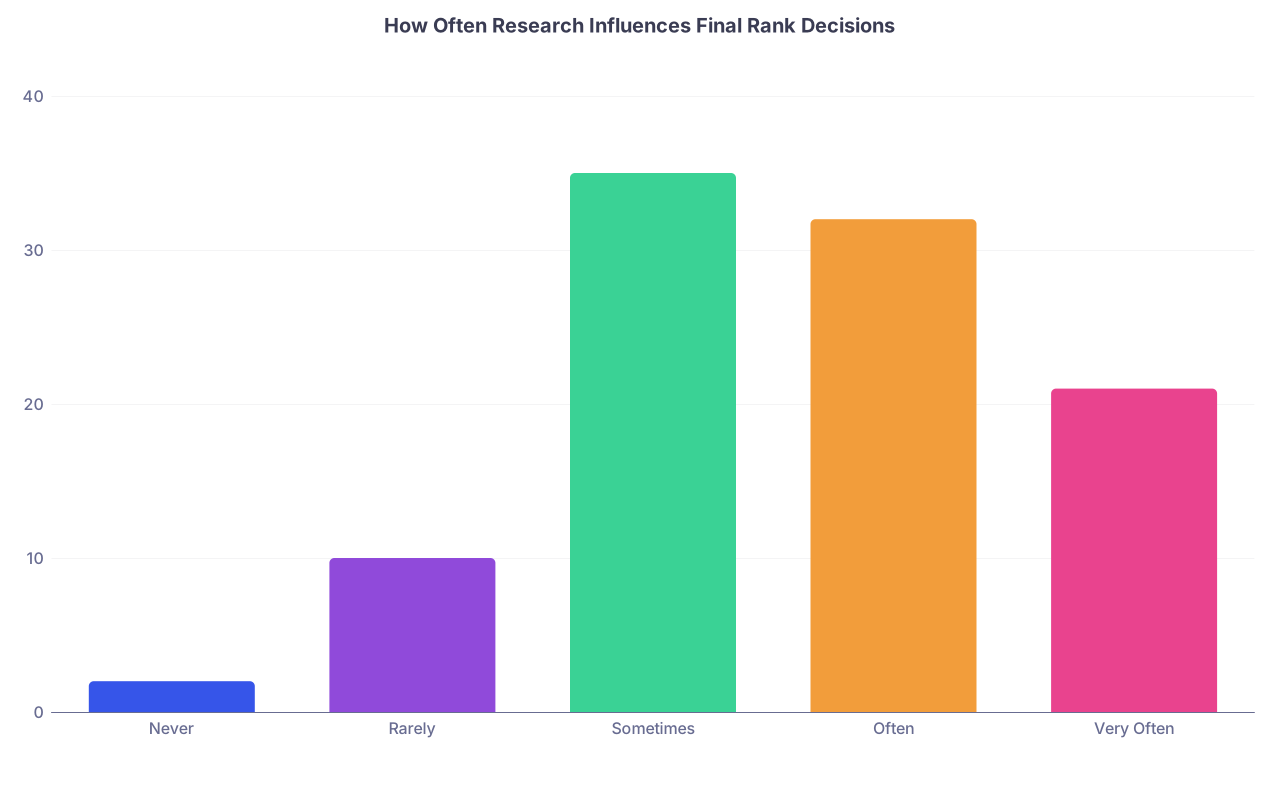
| Category | Value |
|---|---|
| Never | 2 |
| Rarely | 10 |
| Sometimes | 35 |
| Often | 32 |
| Very Often | 21 |

| Step | Description |
|---|---|
| Step 1 | Applicant Pool |
| Step 2 | Initial Screen: Scores, Red Flags |
| Step 3 | Interview Performance |
| Step 4 | Rank Based on Overall Impression |
| Step 5 | Compare Research & Fit |
| Step 6 | Move Up Tier |
| Step 7 | Stay or Move Down |
| Step 8 | Borderline or Clustered? |
| Step 9 | Strong Research? |
FAQ: Research and Rank Meetings Behind Closed Doors
1. If I have no publications but a couple of posters and abstracts, does that hurt me?
It depends on the program. At pure community programs, no, not really. At academic or hybrid programs, zero publications but credible posters and real involvement is still very workable, especially in less research-heavy specialties. The real problem is when there’s nothing—no scholarly activity at all—while you claim to be “academically driven.” That mismatch is what actually hurts you.
2. Do committees care what journal my papers are in?
Yes, but not in the way you fear. People notice the difference between a mid-tier specialty journal and “Journal of Unclear Medicine Online.” A couple of solid specialty or subspecialty journals carry far more weight than five papers in predatory or obviously low-quality outlets. They don’t need NEJM. They just want to see that your work is legitimate and that you didn’t shotgun-submit to garbage.
3. I did a year of basic science research but have only one paper and a poster. Is that considered weak?
Not necessarily. Inside the room, someone who understands that world will say, “Basic science timelines are long; a paper in a decent journal from a one-year stint is actually solid.” What matters more is: can you explain the project clearly, do you understand the methods, and does your PI back you up in a strong letter? A single strong-authorship basic paper beats five low-effort case reports almost every time.
4. How do I talk about my research in interviews so it actually helps in rank meetings?
Tell a tight story that shows you understand the “why,” not just the “what.” One to two minutes on the clinical problem, your hypothesis or question, what you personally did, and what changed because of it. Then one sentence that links it to your future: “That experience is why I’m interested in [QI/education/fellowship X].” Interviewers remember that clarity. And when they’re in the rank meeting, they’ll say, “She really understood her project and where she’s headed.” That’s how your research actually moves your name up the list.
Key points to keep in your head:
- Research is not a checkbox; it’s a narrative weapon in rank meetings—used to justify moving you up, down, or off the list.
- Quality, authorship, relevance, and continuity matter far more than raw numbers.
- Programs use your research to predict your trajectory and their own future bragging rights. Plan and present it accordingly.