Last cycle, a student from a mid-tier school matched into a top-10 IM program with stats that would’ve gotten most people auto-filtered. The difference? A three-line email from a nationally known PI to the program director. Another student, same year, similar “big name” email… and it did almost nothing. The PD rolled his eyes, said, “He does this for everyone,” and moved on.
You hear it constantly: “Get a famous mentor to email the PD for you. That’s what really matters.” Let me tell you what actually happens on the other side of that inbox—and when it helps, when it backfires, and when it’s just noise.
The Reality: PD Inboxes and Name-Brand Mentors
Most applicants imagine PD email like some sacred channel: your mentor hits send, the PD stops rounds, prints your ERAS, and circles your name in red. No. That fantasy dies here.
Here’s what’s true:
Program directors are drowning in email during application season. Faculty plugging “their” students. Chairs asking for “special consideration.” Old friends forwarding CVs. Residents pushing their home students. If you think your mentor is the only one sending those emails, you’re living in brochure-land, not reality.
The name matters. But not the way you think.
There are three broad categories of “big names” as PDs see them:
- The true heavyweights whose opinions change rank lists
- The respected but routine recommenders who get you a second look
- The spammy “he writes this for everyone” people who get ignored
Where your mentor lands on that spectrum determines whether their email is gold, copper, or plastic.
What Actually Happens When That Email Arrives
Let’s walk through what happens, because the sequence matters more than the mythology.

| Step | Description |
|---|---|
| Step 1 | Big-name mentor emails PD |
| Step 2 | PD forwards to coordinator: Flag this applicant |
| Step 3 | PD replies politely, skims ERAS |
| Step 4 | Email acknowledged or ignored |
| Step 5 | Interview offer very likely |
| Step 6 | Maybe one closer review, still can be rejected |
| Step 7 | Minor bump in review priority |
| Step 8 | No practical effect |
| Step 9 | PD knows/trusts mentor? |
| Step 10 | Applicant stats reasonable? |
Here’s what that looks like in real life:
Scenario 1: The email that actually moves mountains
Your mentor is legitimately influential in that field. Example: A national figure in cardiology emailing a cardiology-heavy IM program’s PD that he personally supervised your work, you crushed it, and he’d rank you in his own top 5.
What happens:
- The PD recognizes the name immediately
- The PD forwards it to the coordinator: “Flag this applicant”
- Your ERAS gets pulled out of the normal pile
- If your scores and record are within reasonable range, you are almost certainly getting an interview
Does that guarantee you’ll rank high or match there? No. But it often guarantees that your file is actually read with attention and that you are not screened out by numbers alone.
Scenario 2: The email that gets you a courtesy bump
More common. This is the “solid academic attending with some publications, maybe on a few committees” tier.
PD sees the name. Thinks: “Yeah, I know him. Decent guy. Doesn’t oversell… usually.” What happens:
- They glance at your ERAS or forward it to an APD with “take a look at this one”
- You might move from the gray-zone pile to “review seriously”
- If you’re on the cusp of getting an invite, this can nudge you above the line
- If your application is weak across the board, the bump is not magic—it won’t rescue a trainwreck
This is what most students should be aiming for. Not the miracle. The bump.
Scenario 3: The email that hurts more than it helps
This is the part nobody tells you.
When the PD sees a certain name and literally sighs. I’ve heard this verbatim:
“He sends me this same ‘this is the best student ever’ email every year. I don’t trust it at all.”
When that name pops up:
- The email is often ignored or filed away mentally as “noise”
- If the PD knows this person inflates everyone, the effect is neutral or negative
- Over-selling, especially with vague superlatives, can devalue you
People forget something basic: your mentor’s reputation is already baked into how their email is read. If they’re known for being selective and blunt, their praise sticks. If they’re known for turning every student into “the best I’ve worked with,” PDs mentally divide that by ten.
What PDs Actually Look For in These Emails
The strongest emails have a few specific features. PDs aren’t stupid; they’re reading between the lines.
They care about:
- Relationship depth – Did this person actually work closely with you, or just sign something?
- Specific, concrete praise – “Completed and first-author on X project in Y timeframe” beats “hardworking and enthusiastic.”
- Honesty and selectivity – Known to be stingy with endorsements and accurate judges of talent.
- Alignment with your narrative – The email should match what your ERAS, LORs, and PS say about you.
An email that says:
“I directly supervised Alex for 18 months on two prospective studies. He independently handled data management, IRB submissions, and manuscript drafting. Of the students I’ve worked with in the last five years, he’s easily in the top 10% in initiative and follow-through.”
…carries far more weight than:
“Alex is the best student I’ve ever worked with. He’s incredibly hardworking, compassionate, and will be a wonderful resident.”
Guess which second type we see constantly? The cotton candy one. PDs are sick of it.
The Hidden Variable: The Mentor–PD Relationship
Here’s the part pre-meds and students almost never consider: your mentor’s relationship with that specific PD or institution is everything.
Let me spell out the levels.
| Relationship Type | Typical Impact on Your Application |
|---|---|
| Close colleague/friend | Strong boost, likely interview |
| Known, respected peer | Moderate bump, serious second look |
| Name recognized only | Mild bump at best |
| Unknown or distant | Minimal to no effect |
| Known to be inflated | Neutral or negative |
If your “big name” has:
- Sat on national committees with that PD
- Co-authored papers with them
- Shared fellowship programs or residency in the past
- Exchanged favors or referrals over the years
…then their email is not just a letter. It’s a small social capital transaction. “I’m vouching for this one. Treat them well.”
But when the “big name” has zero real connection to that PD or program?
You’re gambling on name recognition alone. At best you get curiosity: “Oh, that guy.” At worst: “So what? He doesn’t know our program, and I don’t know him.”
Students obsess about “famous.” PDs care about “trusted.”
How Much Can a Big-Name Email Actually Override Weaknesses?
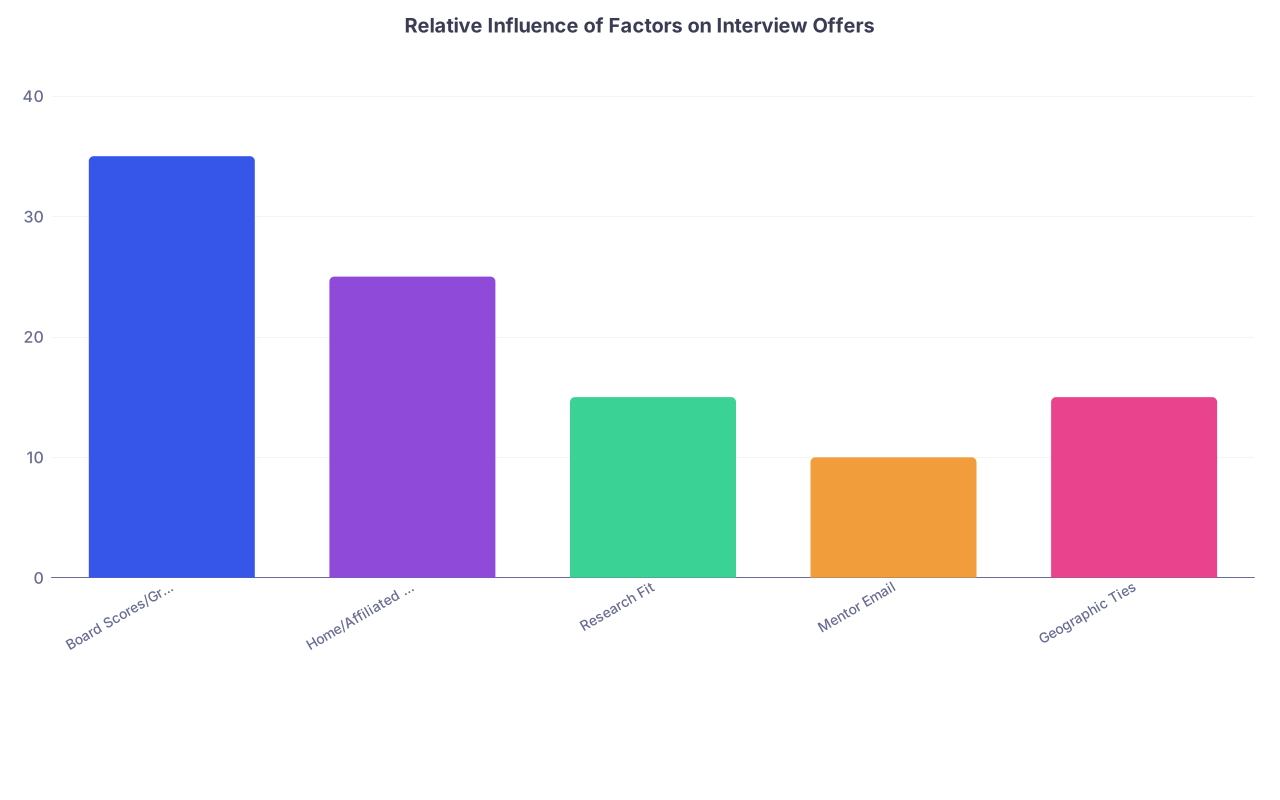
Here’s the blunt truth: an email can’t fully erase a bad application. It can sometimes open a door that would otherwise stay closed. That’s it.
To make this concrete, let’s talk typical scenarios.
| Category | Value |
|---|---|
| Board Scores/Grades | 35 |
| Home/Affiliated Status | 25 |
| Research Fit | 15 |
| Mentor Email | 10 |
| Geographic Ties | 15 |
Roughly how a lot of PDs think about priority:
- Your board scores and overall academic record still matter the most.
- Being home institution or affiliated is huge.
- Research fit and geographic ties matter.
- A high-trust email is often in the 5–15% influence range.
So what can a powerful email do?
- Step score slightly below their average? It can absolutely get you looked at and often interviewed if the rest is solid.
- Pass/fail blemish with strong progression afterwards? It can help PDs feel comfortable “taking a chance.”
- No research in a research-heavy program? Here, even a big name doesn’t save you. You’re mismatched.
- Serious professionalism flags? Forget it. An email will not scrub a major concern.
The PD still has to justify your interview to their faculty. “X from Yale told me this person is excellent and I trust him” is a reason. But it’s not a magic excuse to ignore all metrics.
The Ugly Side: When These Emails Backfire on You
You think the risk is zero. It isn’t.
I’ve seen applicants quietly downgraded because of how these emails were handled.
The common failure patterns:
1. The desperate “can you email every PD I’m applying to?” move
You ask your mentor to blast 10–20 PDs with a generic endorsement. PDs talk. And they remember patterns.
Outcomes:
- Your mentor starts to look unserious
- You look like you’re trying to brute-force your way in instead of being genuinely connected to the programs
- At some places, you’ll be seen as just another mass-circulated name, not a personalized advocate situation
Better: two or three carefully targeted emails where there’s an actual connection or fit. Not a carpet bomb.
2. Misaligned content
Your mentor raves about how you’re “sure to become an R01-funded physician-scientist” while your PS screams “I want to be a clinician educator” and your CV has one poster and no long-term projects.
PD thought process: “Either the mentor doesn’t know this student that well, or the student is telling different stories to different people. Neither is good.”
3. Over-selling someone who clearly isn’t at that level
If the PD reads: “Top 1% of students I’ve worked with,” then opens ERAS and sees:
- Mediocre clerkship comments
- Unimpressive letters from other writers
- Limited responsibility on research projects
Now there’s cognitive dissonance. And PDs resolve that by downgrading the writer’s credibility. You get caught in that blast radius.
How to Use a Big-Name Mentor the Right Way
You can’t control PD behavior, but you can absolutely influence how your mentor advocates for you. Most students handle this poorly. They mumble something generic like, “If you’re comfortable, would you mind sending an email to some PDs?”
Do better.
1. Choose realistic, high-yield targets
Look at:
- Where your mentor actually has relationships
- Programs where your research area is clearly represented
- Places where your stats fall near but slightly below their typical interview range
Aim for programs where the email might swing you from borderline to “yes,” not from “no chance” to fantasy.
2. Give your mentor a focused brief
Do not write their email for them. But you can and should give:
- Your finalized CV and ERAS
- Your personal statement
- A 1-page summary: “These are the 3–5 programs where I think your name might matter and why”
And explicitly say something like:
“If you feel you can honestly and strongly recommend me to any of these PDs you know well, I’d be incredibly grateful. And if not, I completely understand.”
You’re giving them an easy out if they’re not comfortable going to bat. You want them to only send that email if they’re willing to put real weight behind it.
3. Align your story
Make sure what they’re going to emphasize is what you actually sell everywhere else.
If your main strength with this mentor is research grit, your PS should not be exclusively about global health missions and “finding yourself in Tanzania.” Your research story should be visible across:
- ERAS activities
- Letters
- Personal statement
- Interview answers
So when the PD sees “This student drove our project across the finish line,” they can see concrete evidence in your record.
What PDs Say Off the Record About These Emails
Let me lift the curtain a bit.
In rank meetings, I’ve heard some consistent themes.
On a truly trusted email:
“Look, I know her. If she says this student is special, I believe it. We should keep them high on the list.”
On a generic-famous name:
“Yes, he emailed me too. He emailed everyone this year.”
On a mismatched superstar endorsement:
“He says top 1%, but the rest of this file is not top 1%. So either he’s disconnected or he’s being political.”
On a spot-on, specific email:
“I love that she mentioned concrete stuff: manuscript drafts, independence, taking feedback. That matches what I see here.”
The pattern is obvious: the email isn’t judged in a vacuum. It’s judged against your file and against the mentor’s reputation.
If both line up, it works like a spotlight. If they don’t, it can make everyone squint and step back.
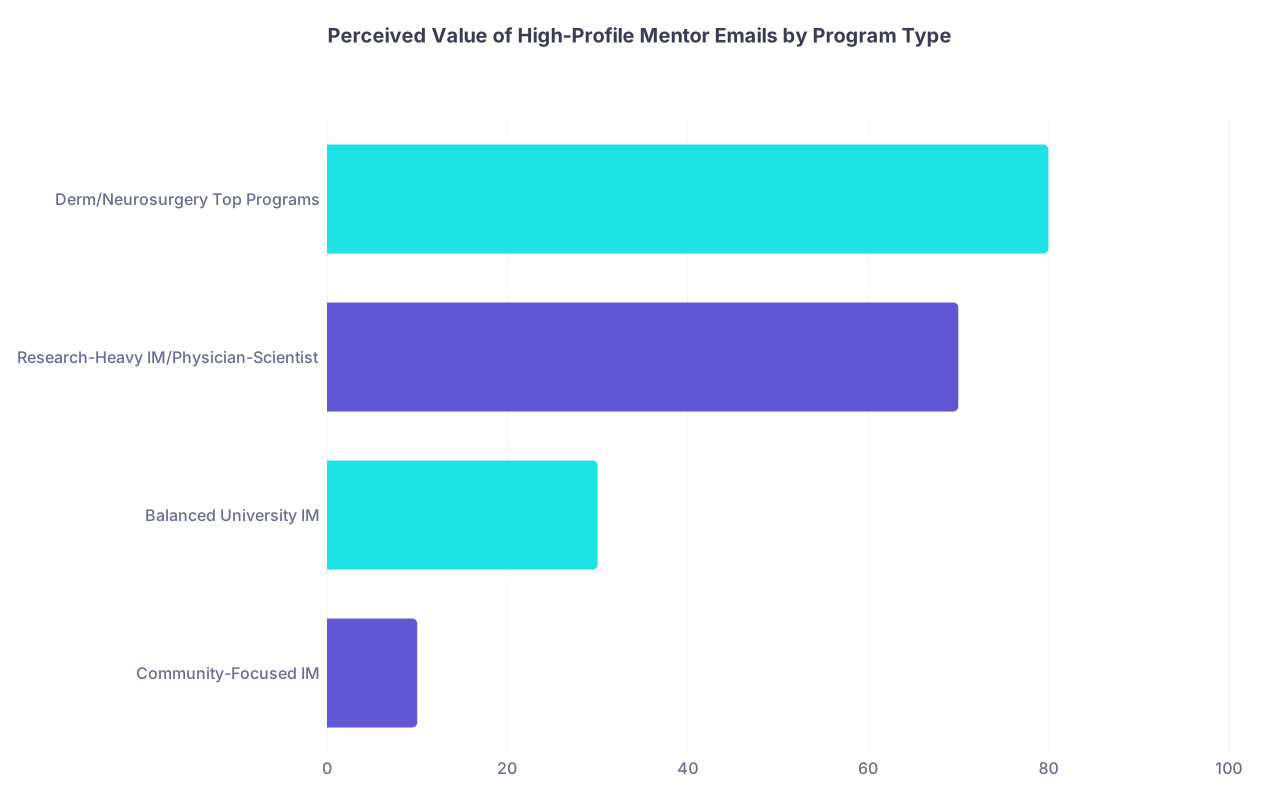
For Research-Heavy Applicants: Where This Matters Most
In research-heavy specialties and tracks—radiation oncology, dermatology, academic IM, neurosurgery, certain PSTP-style programs—the mentor email has extra weight. Not because PDs are starstruck, but because these fields are small and incestuous. Everyone knows everyone.
| Category | Value |
|---|---|
| Community-Focused IM | 10 |
| Balanced University IM | 30 |
| Research-Heavy IM/Physician-Scientist | 70 |
| Derm/Neurosurgery Top Programs | 80 |
If you’re applying in these environments:
- The mentor–PD relationship is often direct and long-standing
- Your productivity under that mentor is a major part of your identity
- A targeted email that says “I would take this person in my own program if I could” is a big deal
But there’s a flip side. If you had access to a “famous” mentor in a tight-knit field and they don’t go to bat for you? That’s a silent data point too. People notice when someone doesn’t endorse their own trainee.
FAQ (Exactly 4 Questions)
1. Should I always ask a big-name mentor to email PDs for me if I have one?
No. If your relationship was superficial, you didn’t perform particularly well, or your work with them isn’t central to your application, pushing for that email can backfire. You want selective, sincere advocacy, not perfunctory name-dropping. When in doubt, ask for a strong letter first; if they’re enthusiastic and you have clear overlap with certain programs, then raise the possibility of a targeted email.
2. Does a PD email from a non-famous but very hands-on mentor matter?
Yes—sometimes more than a “name” who barely knows you. PDs read for substance. A well-respected, mid-level faculty member who supervised you closely and writes a very concrete, specific, and obviously honest email can give you a substantial bump. “Trusted and accurate judge” beats “famous but vague” in a lot of PD’s mental calculus.
3. Can a strong email get me an interview at a program where my Step score is way below their usual range?
Occasionally, but not commonly. If you’re slightly below their typical threshold and the rest of your file is strong, a high-trust email can definitely tip you into the “interview” group. If you’re dramatically below their range, the PD has to justify bringing you in to a committee, and one email usually isn’t enough. Think “tilt the odds,” not “rewrite the rules.”
4. Is it better to have my mentor email the PD or the chair of the department?
For residency applications, the PD is usually the key decision-maker for interviews and rank lists. A chair can matter at certain places, especially where the chair is heavily involved in resident selection, but many chairs are more removed from the day-to-day process. The highest-yield path is: someone the PD personally trusts and works with—whether that’s a chair, co-investigator, fellowship director, or another PD—emailing the PD or associate PD who runs recruitment. Relationships beat titles.
The Bottom Line
Three things to walk away with:
- A “big name” email is only powerful when the PD actually trusts that person and their praise aligns with your file. Fame alone doesn’t cut it.
- Used well—selectively, honestly, and with real mentor–PD connection—it can nudge you from borderline to interview, especially in research-heavy programs.
- Overused, over-inflated, or misaligned, it turns into background noise—or worse, a red flag that your story and your advocates aren’t credible.