The fastest way to make a program director distrust your entire application is to exaggerate your research. They recognize it immediately. And they do not forget it.
You are not competing on who can tell the biggest story. You are competing on who looks reliable enough to bring into a hospital full of sick patients and overloaded residents.
Let me walk you through the most common research exaggerations PDs see every single year, why they hate them, and how to avoid burning your credibility for a few extra lines on ERAS.
1. Inflating Your Role: “First Author” In Name Only
This is the classic move. And it backfires constantly.
You list:
- “First author manuscript in preparation”
- “First author retrospective chart review”
- “Designed study and analyzed all data”
Then the PD emails your PI. Or meets them at a conference. Or already knows them personally. And the truth comes out:
You entered data. You maybe helped with a draft paragraph. You absolutely did not “lead” the project.
Here is how this goes in real life:
PD to your attending: “So how involved was this student on your sepsis project?”
Attending: “Good worker. Helped with data collection. The fellow really led it though.”
That one sentence destroys your credibility more than if you had never listed the project at all.
Red flags PDs look for
- Every project: you are first or second author
- Vague verbs: “spearheaded”, “drove”, “led”, “principal designer”
- No clear description of what you actually did
- Senior faculty they know well supposedly “supervised” you closely on 6+ projects in 18 months
They have read thousands of research sections. The patterns scream at them.
How to avoid this mistake
Specify your real role plainly. Something like:
- “Assisted with data collection and chart abstraction; contributed to methods section draft.”
- “Performed literature search and prepared annotated bibliography; presented preliminary data at lab meeting.”
- “Coordinated patient recruitment and maintained REDCap database.”
Not glamorous. But honest. PDs prefer a reliable workhorse over a self-anointed “project leader” who is clearly embellishing.
2. “Manuscript In Preparation”: The Most Overused Phrase On ERAS
If PDs could delete one phrase from every application, it would be this: “manuscript in preparation.”
You know why they hate it? Because in 80–90% of cases, that “manuscript” never leaves Google Docs.
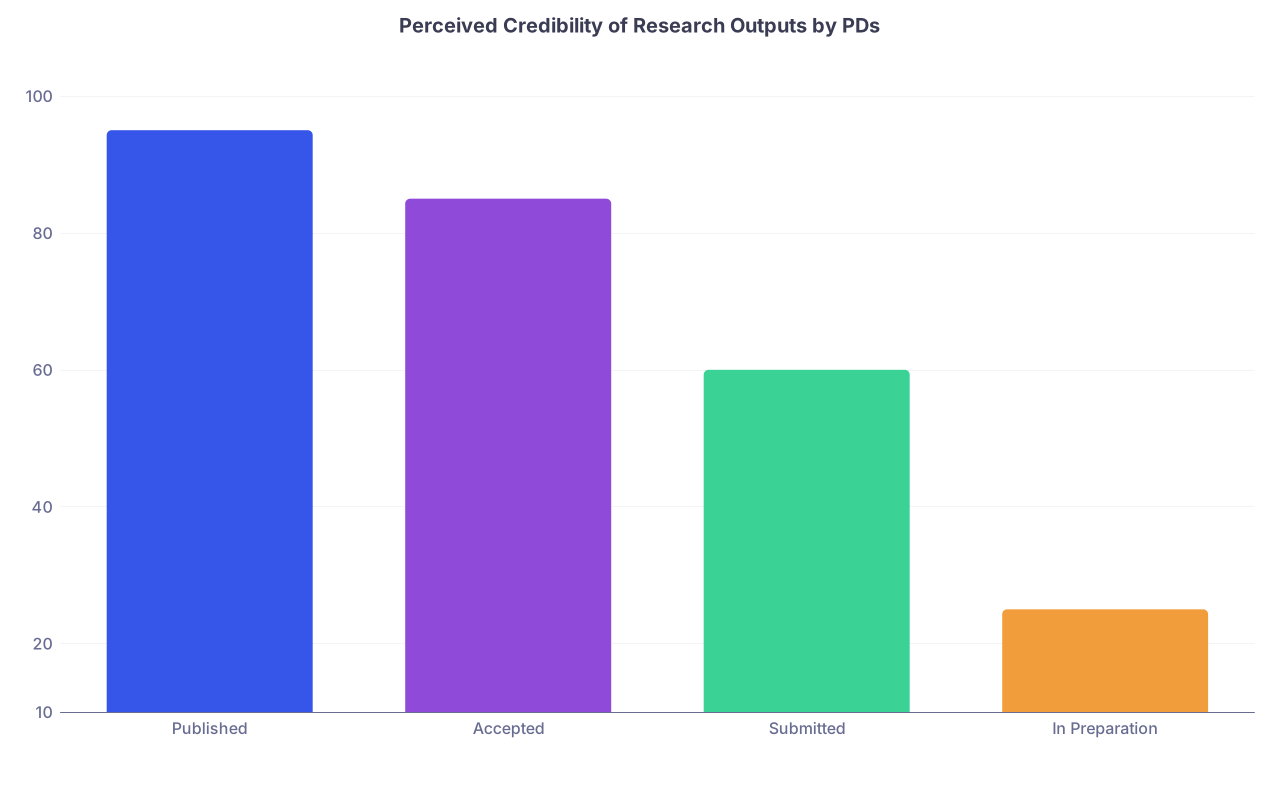
Look at how programs actually perceive this:
| Category | Value |
|---|---|
| Published | 95 |
| Accepted | 85 |
| Submitted | 60 |
| In Preparation | 25 |
Published or accepted is real. Submitted is maybe real. “In preparation” is mostly noise.
When “in preparation” becomes exaggeration
You list:
- “First author randomized controlled trial – manuscript in preparation”
- “Review article – in preparation”
- “Case series – in preparation”
Then on interview day you cannot:
- Name the journal you are targeting
- Describe the current draft status beyond “we are working on it”
- Explain the main figures or results clearly
PDs have been around long enough to know: if you cannot discuss it fluently, it is not really “in preparation.” It is barely an idea.
Safer, more honest alternatives
Use language that matches reality:
- If it is an idea discussed in lab meetings: “Contributed to study design discussions for planned retrospective analysis of X.”
- If you have a partial draft: “Drafted introduction and methods for planned manuscript on Y; project currently in analysis phase.”
- If the chance of submission before match is basically zero, do not pretend otherwise.
Your goal is not to look impressive on paper. Your goal is to survive a 3-minute grilling by someone who writes real manuscripts for a living.
3. Mislabeling Posters, Abstracts, and Publications
This one irritates PDs more than you think. Because it looks like you are counting on them not reading carefully.
Typical mistakes:
- Listing an abstract as a “publication”
- Calling a conference poster “peer-reviewed publication”
- Putting a poster under “Journal Articles/Abstracts” in ERAS without specifying it was only a meeting abstract
- Using journal-like citation format for something that was never in a journal at all
If they see you blur the line between a national oral presentation and a med school research day poster, you look careless at best, dishonest at worst.
How PDs mentally rank research output
They roughly think like this (they will not say it to your face, but this is the hierarchy):
| Output Type | Relative Weight |
|---|---|
| First-author peer-reviewed paper | Very High |
| Co-author peer-reviewed paper | High |
| National conference oral presentation | High |
| National poster / regional oral | Moderate |
| Local institutional poster/abstract | Low–Moderate |
| “In preparation” / unfunded idea | Very Low |
The mistake is not having “low-level” items. The mistake is dressing those low-level items up as something else.
How to label things correctly
Do not do this:
- “Doe J, Smith A, et al. Hypertension control in urban clinics. JAMA. Abstract presented at…”
That reads like a JAMA paper. It is not.
Instead:
- “Doe J, Smith A, et al. Hypertension control in urban clinics. Abstract accepted for poster presentation, American College of Physicians Annual Meeting, 2024.”
Or:
- “Poster presentation, Johns Hopkins Research Day, 2023 – Retrospective study of X.”
You do not lose points for being accurate. You lose points for looking like you are hoping they do not notice the difference.
4. Overclaiming Statistical and Methodological Skills
Nothing makes statistician PDs roll their eyes faster than an MS4 or PGY-1 applicant claiming:
- “Performed multivariate regression analysis”
- “Conducted survival analysis and Cox proportional hazards modeling”
- “Designed prospective randomized trial methodology”
Then, in the interview:
- You cannot explain what confounder means
- You stumble trying to describe what regression actually does
- You confuse p-values with confidence intervals
I have seen PDs stop someone mid-sentence and ask, “So what is a hazard ratio?” Just to test if the ERAS language matches reality. It often does not.
Common exaggerations in this category
- Taking credit for “data analysis” when you only clicked pre-built SPSS templates someone else set up
- Saying “designed the study” when a fellow handed you a fully built REDCap database
- Listing “performed power calculation” because you watched your PI do it over their shoulder
- Claiming “expertise in R / Python” because you ran a few scripts written by the postdoc
Those phrases trigger suspicion. PDs know what real analysis work looks like. And how long it takes to get good.
How to describe technical skills honestly
Use concrete, narrow descriptions:
- “Cleaned and organized dataset of 300 patients; ran descriptive statistics (means, medians, proportions) in SPSS.”
- “Created graphs and tables from result outputs for manuscript.”
- “Assisted with univariate analyses under supervision of biostatistician.”
If you truly wrote the code and designed the analysis, you will be able to explain:
- Why you chose that model
- What assumptions it makes
- What main limitation it has
If you cannot, you should not claim full credit.
5. Hiding the Team: Pretending Solo Work In Team Projects
PDs do not hate research teams. They run them. What they dislike is someone airbrushing out everyone else to aggrandize their own role.
Red flag phrases:
- “Solely responsible for…”
- “Independently designed and executed…”
- “Single-handedly created…”
On a project from a major academic center with a full research infrastructure? No chance.
Here is what happens behind the scenes: PDs know those labs. They know:
- There is always a coordinator
- There is almost always a fellow
- PIs do not let MS4s “independently” run a trial
When you pretend otherwise, you look either naive or deceptive.
Better way to frame team projects
Explicitly show the collaborative context while still presenting your contribution clearly:
- “Part of a 5-person research team studying X; my role focused on data collection and drafting the methods section.”
- “Worked with a cardiology fellow and biostatistician to analyze data; I prepared figures and tables for the manuscript.”
You lose nothing by acknowledging others. You gain trust.
6. Listing Every Half-Baked Idea as a “Project”
Another pattern that stands out like a neon sign: 18 “projects,” almost none published, and no one can explain what actually happened to them.
PDs can spot the “CV stuffing” instantly:
- Dozens of titles that sound like half-done retrospective reviews
- No consistent theme or continuity
- Every item “in progress” or “in preparation” for 2+ years
- Titles so vague they could apply to any hospital: “Outcomes in patients with X at a tertiary center”
Then on interview day, you cannot remember half the details.
What this signals:
- Poor follow-through
- Inflated sense of productivity
- Possibly someone who abandoned projects once the “CV line” was secured
Programs want residents who can finish something. Not just start twenty things and get bored.
How to avoid the “project graveyard” problem
If a project never progressed beyond:
- A single brainstorming meeting
- A partially filled spreadsheet
- A one-page proposal that died quietly
It should not be on your ERAS as a full “research activity.”
You can mention these experiences in a personal statement or in conversation if they meaningfully shaped your interest, but they do not deserve to be listed as if they are equivalent to completed work.
Focus on:
- 3–6 projects you can discuss fluently
- Outcomes you can point to: abstract, poster, grand rounds, small presentation, even if not published
Depth beats volume. PDs know the difference.
7. “Research Year” That Was Mostly Just Being Around Research
A brutal truth: PDs are skeptical of “dedicated research years” that yield very little tangible work.
The exaggeration trap:
- You call it a “full-time research fellowship”
- You list 7–10 “projects” from that year
- Actual outputs: one poster, maybe a submitted manuscript that has been “under review” for 11 months
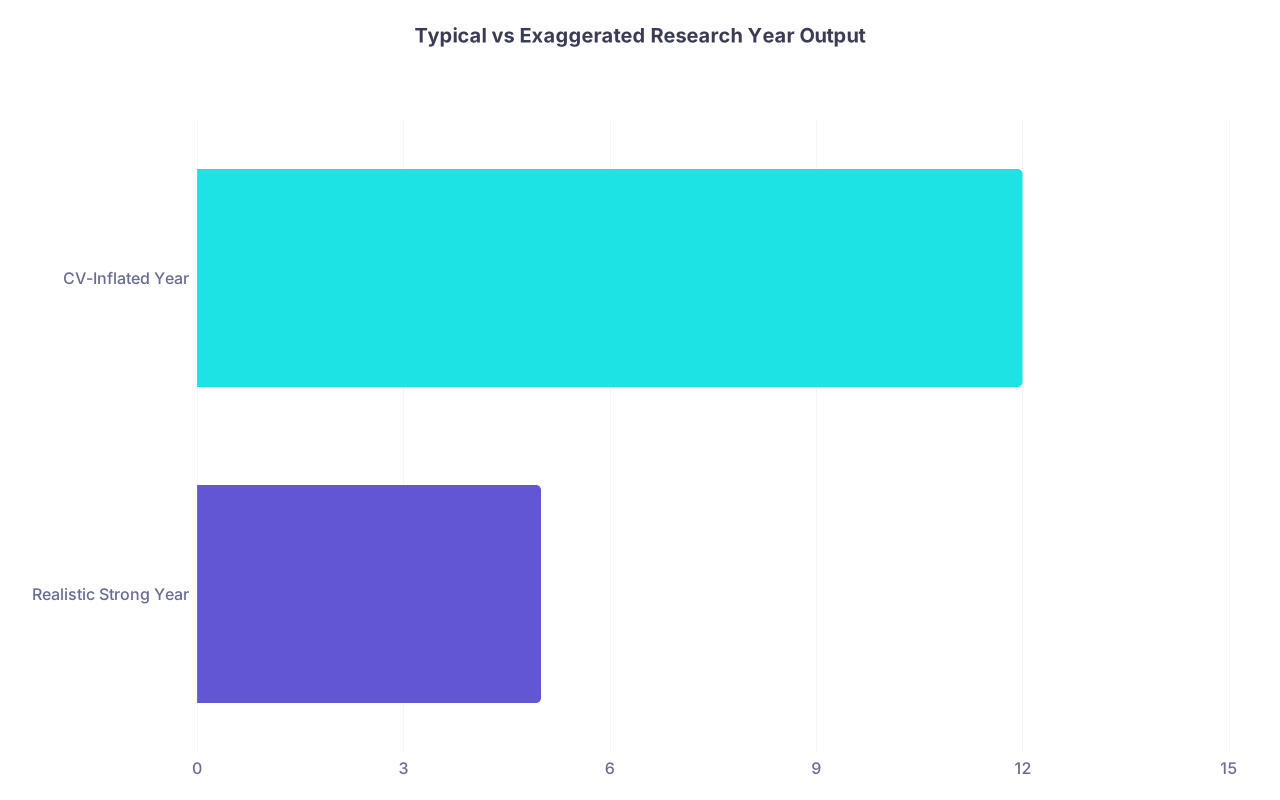
If you claim “full-time research,” they expect output. Not perfection. But consistency.
| Category | Value |
|---|---|
| Realistic Strong Year | 5 |
| CV-Inflated Year | 12 |
The issue is not the number. It is the mismatch between reported effort and real, verifiable work.
The other giveaway: your mentor’s letter. If you truly worked hard, they will describe:
- Specific responsibilities
- Concrete deliverables
- How you reacted to setbacks
If the letter uses vague language like “was exposed to research methods” or “participated in multiple projects,” PDs quietly downgrade everything you wrote.
How to describe a research year without overselling
- Be explicit about obstacles: “Two planned manuscripts delayed due to PI departure / database errors / IRB issues.”
- Emphasize what you learned and what you actually did day to day.
- Own the output honestly: “Co-author on 1 submitted manuscript, 2 posters, 1 ongoing project with planned submission next year.”
Owning shortcomings beats pretending you had a powerhouse year when PubMed says otherwise.
8. Quoting Journal Names Before Reality Exists
Another common exaggeration: attaching high-impact journal names to hypotheticals.
I have seen this on ERAS and in personal statements:
- “Preparing manuscript targeting NEJM”
- “Aiming to submit to Circulation”
- “Manuscript intended for JAMA Surgery”
PDs know the acceptance rates at these journals. They know even established faculty struggle. When an MS4 writes like this, it reads as either naive or self-promotional.
More dangerous: if they ask in January where that “NEJM” paper is, and you suddenly admit it was never written, you look foolish.
If your mentor truly thinks a major journal is realistic, that is fine—but let the work speak for itself when it is submitted or accepted. Not before.
The safer, smarter version
Drop the speculative journal names. Say:
- “Manuscript draft in progress for submission to a peer-reviewed cardiology journal.”
- Or skip the journal mention entirely and describe the work, not your wishful thinking.
You are not being evaluated on ambition fantasy. You are being evaluated on integrity and follow-through.
9. Faking “Passion for Research” You Clearly Do Not Have
This is more subtle but PDs pick it up instantly.
You wrote an entire paragraph about your “deep commitment to academic scholarship” and your goal to be a “physician-scientist,” but:
- Your research history is minimal
- You cannot answer simple questions about your own project design
- You admit you did the project only because your school required it
- When asked about future plans, you vaguely say “maybe some research if I have time”
PDs talk about this later as: “The application reads like they think we only value research, so they played that card.”
If you exaggerate your love for research to impress “academic” programs, you risk ending up in a program that expects actual productivity. Then everyone is unhappy, especially you.
What to do instead
If you are research-light or simply not that interested, own it:
- “I enjoyed contributing to one quality improvement project and learned basic research methods, but I see myself primarily as a clinician-educator.”
- “I value evidence-based practice and would join projects opportunistically, but I am not seeking a research-heavy career.”
Some programs will move on. Good. The ones that still interview you will actually fit you.
10. Sloppy Inconsistencies That Scream “I Did Not Expect You To Check”
The last category is mundane but deadly: inconsistencies between your:
- ERAS entries
- CV
- Personal statement
- Letters of recommendation
PDs catch:
- Different author orders for the same paper
- Years that do not match (poster in 2023 on CV, 2022 on ERAS)
- A “submitted” manuscript that your letter writer clearly calls “still being drafted”
- A claim that something is “accepted” when PubMed shows no record and your mentor has no idea what you are talking about
Once they see one inconsistency, they start to question everything else.
How to not sabotage yourself here
Before you submit:
- Make a single master list of all projects, with final, correct titles, authors, dates, and statuses.
- Align ERAS, CV, and personal statement language with that list.
- Ask at least one mentor who knows your work to sanity-check the research section only, line by line.
This is boring work. Do it anyway. Because “sloppy with facts” is not a trait PDs want in someone who will write orders and notes.
A Quick Reality Check: What PDs Actually Want To See
They are not expecting you to be a mini-PI. What they want:
- A coherent, believable story about your academic engagement
- Evidence that you can see something through to completion
- A track record of reliability more than raw brilliance
- Honest descriptions that match what their colleagues say about you
You can absolutely match into strong programs with:
- One or two small posters
- A single co-authored paper
- A serious QI project you owned from start to finish
As long as it is real, you understand it, and you are not inflating it.

| Step | Description |
|---|---|
| Step 1 | List all projects |
| Step 2 | Remove dead/idea-only ones |
| Step 3 | Confirm details with mentor |
| Step 4 | Write specific role descriptions |
| Step 5 | Check consistency across ERAS/CV/PS |
| Step 6 | Practice explaining each project out loud |
Final Warnings: The 30-Second Sanity Test
Before you certify your ERAS, run every research line through this brutal filter:
- If my PI or fellow were sitting next to me, would they agree with this wording?
- Could I comfortably explain this to a PD in 3 minutes without scrambling or bluffing?
- If they checked PubMed or emailed my mentor, would everything align?
If the answer to any of these is no, change the line. Now.
Two things to take with you:
- Exaggeration does not just fail to help you. It actively brands you as untrustworthy in a profession that lives and dies on trust.
- Modest, accurate research descriptions backed by confident, specific explanations in interviews will always beat a “stacked” but suspicious ERAS.
Protect your credibility. Your reputation is worth far more than one extra “first-author manuscript in preparation” line.