The way most students decide to take a research year is backwards.
They decide first, and only later try to justify it.
That’s how people tank otherwise solid residency applications.
You’re not just risking “lost time.” The wrong research year, at the wrong time, for the wrong reasons, can:
- Make programs question your judgment
- Create red flags about your clinical skills
- Waste a year with zero boost to your competitiveness
- Worse, make you less competitive than if you never took the year at all
Let’s walk through the missteps I see over and over—and how to avoid turning a “research year” into “application sabotage.”
1. Taking a Research Year for the Wrong Primary Reason
The most dangerous mistake starts before the year even begins: why you’re doing it.
Red-flag motivations
These are the reasons that almost always backfire:
- “Everyone applying to derm/ortho/ENT is doing one.”
- “I don’t know what else to do after failing Step/Level.”
- “I hate clinicals; research will be easier.”
- “I’m burned out and want a ‘lighter’ year.”
- “My mentor said it might help.”
Programs are usually pretty good at sniffing this out. They see:
- One unfocused year
- Little tangible output
- A story that doesn’t hang together
And they think: avoid.
A research year only makes sense when:
- You’re targeting a competitive specialty and
- You already have decent stats/clinicals and
- You have genuine research interest or a clear strategy to fix a gap
If none of those are true, stepping away from clinical training just to “take a research year” is almost always a mistake.
How this shows up on your application
On your ERAS and in interviews, weak motivations leak out as:
- Vague explanations: “I just thought it would help my application.”
- Confused timeline: gaps, no clear planning
- Contradictions: claiming “passion for research” with no prior track record
Programs interpret that as:
- Poor decision-making
- Following trends instead of thinking
- Possible burnout or avoidance of clinical work
Fix:
Before you commit, force yourself to answer in one sentence:
“I am taking a research year to [specific goal] so that I can [clear application outcome].”
If you can’t state it that cleanly, you’re not ready—and probably about to make a bad decision.
2. Not Matching the Research Year to Your Actual Targets
Another classic: doing a research year that has nothing to do with where you’re applying.
Example I’ve seen more than once:
- Student wants orthopedic surgery
- Takes a year in basic science spine biomechanics
- Ends up with one middle-author paper and a poster
- Has almost no clinical ortho exposure, no strong ortho letters
Or worse:
- Wants EM
- Takes a year in bench immunology because “it was available”
- Programs see no EM involvement, no EM mentors, no EM letters
You might think: “But research is research, right?”
No. Not for residency selection.
How this mismatch hurts you
Programs don’t just care that you did research. They care about:
- Relevance to their field (or at least medicine)
- Mentors they know or respect in that field
- Evidence that you understand and are committed to that specialty
If your research is far from your target specialty with no obvious tie-in, it can look like:
- You picked what was convenient, not strategic
- You might be undecided or directionless
- You’re padding your CV instead of building meaningful experience
| Goal Specialty | Strong Alignment Example | Weak / Problematic Example |
|---|---|---|
| Dermatology | Clinical derm outcomes, derm trials | Basic fly genetics lab |
| Ortho | Ortho sports outcomes, trauma registry | Generic bench biochemistry |
| Radiology | Imaging AI, diagnostic accuracy work | Nutrition survey in primary care |
| EM | ED ops, sepsis protocols, EM QI | Bench oncology lab |
| IM | Clinical epidemiology, QI in wards | Pure engineering project |
Fix:
If you’re going to step out for a year, it should check at least two of these:
- Involves patients or clinical data related to your field
- Involves faculty in your target specialty
- Has clear potential for letters from recognizable people in that specialty
- Lets you work in that department, attend their conferences, be seen
If it doesn’t, you’re gambling a year of your life on marginal benefit.
3. Ignoring Timing: When a Research Year Hurts More Than Helps
Timing matters more than most students realize. A poorly timed research year can look like:
- You’re running away from clinical performance issues
- You’re delaying graduation with no plan
- You preferred “research” to being in the hospital
The worst timing patterns
Early” research year with no foundation
Doing a year after M1, with no prior meaningful research and no idea of specialty, then nothing sustained after? Programs see a one-off hobby, not commitment.Research year without addressing the real problem
Example:- Step 1 barely passed or failed
- Weak clinical grades
- Then… research year
If you don’t also fix exams or clinical performance, the year looks like camouflage, not growth.
Back-to-back leaves
Med school leave of absence → come back → then research year → then try to apply. Now your timeline looks unstable and you’d better have a rock-solid, well-documented explanation.
Programs’ internal calculus
Directly or not, PDs are asking:
- Did this person avoid patient care?
- Did they step away at a time that makes sense?
- Did they use the time to grow in ways that fix or explain their weaknesses?
If the answer seems to be no, you’ve turned your research year into a liability.
Fix:
Think of timing with three questions:
- Will I have at least some clinical evaluations/rotations on record before or right after this year?
- Is there a clear weakness this research year helps address (e.g., no research track record for derm, need a strong letter, building credibility)?
- Can I explain the order of events in 2–3 coherent sentences that make me look intentional, not reactive?
If the timing story sounds chaotic, programs will read it that way.
4. Treating the Year Like a “Soft” Year
This one kills me because it’s so avoidable.
A lot of students secretly think:
“Research year = lighter schedule = time to breathe.”
Reality: programs expect output. Not vibes.
The mistake: you treat it like a part-time job, drift between projects, show up inconsistently, and then arrive at ERAS season with:
- One poster abstract
- One “manuscript in preparation”
- A PI who sees you as unreliable and writes a bland letter
That will absolutely hurt you more than if you’d stayed in your normal curriculum.
What “underperformance” looks like on paper
By fall application season, a productive research year should usually have at least:
- A few submitted abstracts (or presentations scheduled)
- Manuscripts submitted or in revision (preferably with you as first or second author on at least one)
- A very detailed, enthusiastic letter from your PI
When you have:
- No submissions
- No clear ownership of projects
- Vague lines like “I assisted with various projects during my research year”
Programs read that as: you wasted structured, protected time. That’s a red flag for residency, where time is not protected.
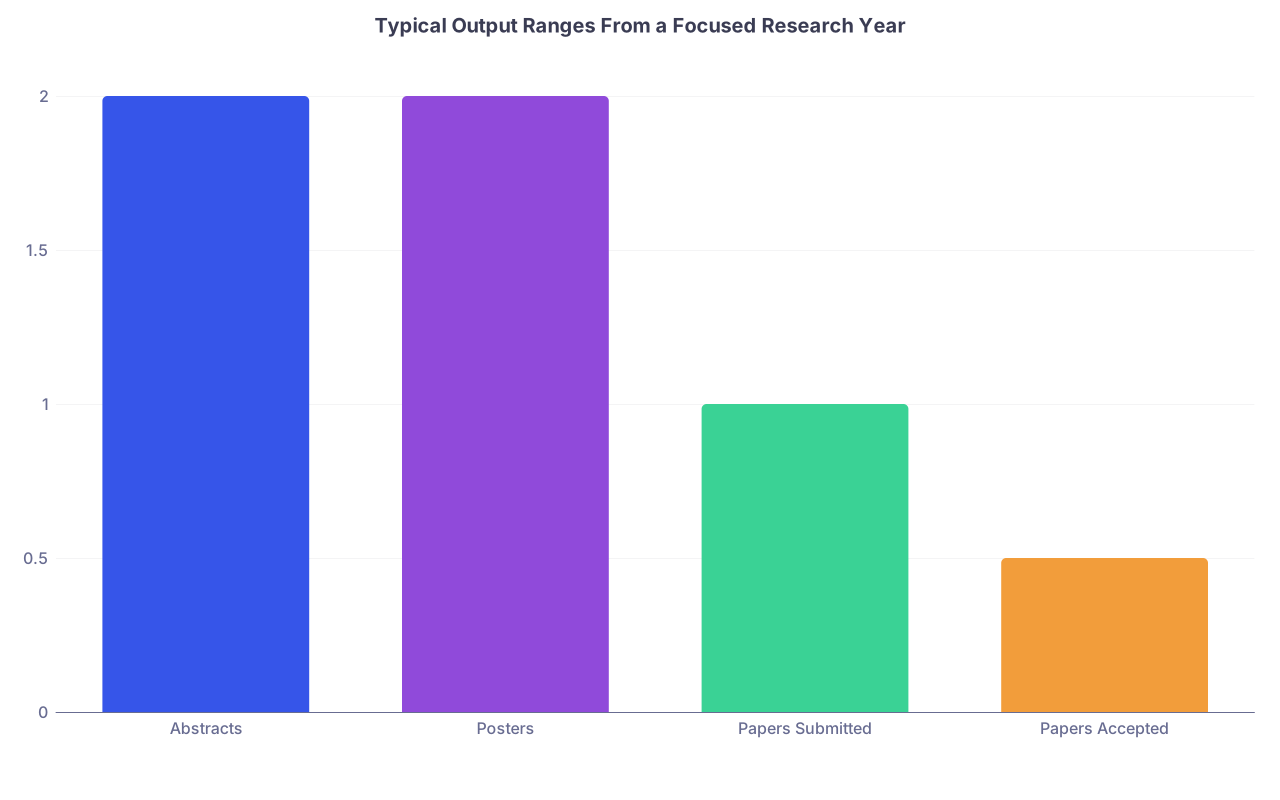
| Category | Value |
|---|---|
| Abstracts | 2 |
| Posters | 2 |
| Papers Submitted | 1 |
| Papers Accepted | 0.5 |
Fix:
If you do take a research year, treat it like a demanding job:
- Get project ownership early: “This chart review is mine; I’m first author if I do the work.”
- Sit down with your PI in month 1 and map a timeline to submissions before ERAS
- Track weekly goals: data collected, analysis done, drafts written
- Protect your work hours as seriously as intern year
A mediocre research year reads as “poor follow-through.” That’s poison in residency.
5. Choosing the Wrong Mentor and Environment
You’re not just picking a project; you’re picking a person and a culture.
The wrong PI can wreck your year.
Red flags in a potential mentor
Watch for these when you meet or email:
- They’re vague about your role: “We’ll figure out projects as we go.”
- They won’t discuss authorship clearly.
- They have a reputation for being absent, disorganized, or using students as free labor.
- Their prior students have no output to show for a year.
- They scoff when you mention “timelines aligned with ERAS.”
I’ve seen students trapped in labs where:
- They spent 10 months doing menial data cleaning
- Nothing got written or submitted
- The PI kept saying “Let’s hold off on authorship decisions”
- The letter ended up generic: “They assisted in several projects…”
That is fatal for a competitive specialty.
How to scout properly
You must be a little ruthless here. Before you commit:
- Talk to current and former students who did a dedicated year. Ask:
- How many papers/abstracts did you get?
- Did the PI respect your time?
- Would you do it again?
- Look up the PI’s recent publications and see if med students are first or second authors.
- Ask directly in your meeting:
- “What projects would I own?”
- “What is realistic output in 12 months?”
- “Have your prior students matched into [your specialty]?”
If they can’t answer clearly, you’re volunteering to be exploited.
Fix:
Choose labs and mentors where:
- There’s a track record of students matching well after working with them
- The PI understands residency timelines
- Authorship is transparent and discussed before you start
If you feel like you’re begging for scraps in the first meeting, walk away.
6. Failing to Maintain or Demonstrate Clinical Engagement
Programs get nervous when they see someone step away from clinical medicine for a year and do nothing clinical.
Huge mistake: you disappear into a lab and don’t:
- Work with patients
- Attend conferences
- Stay in touch with clinical mentors
- Keep your clinical skills or references current
That tells PDs:
- You might be rusty when you return
- You might actually dislike clinical work
- You’ve lost momentum
Subtle signs that trigger concern
On your application:
- No clinical experiences listed during that year
- No new clinical letters
- No mention of conferences, shadowing, or clinical roles tied to your research
In interviews, when asked, “How did you stay clinically engaged?” you stammer something about reading journals.
Not good.
Fix:
During a research year, build in clinical touchpoints:
- Attend your specialty’s weekly didactics or conferences
- Join inpatient or clinic days when relevant to your research
- Shadow your PI or other attendings periodically
- Take on clinically adjacent roles: QI projects, guideline work, outcomes research that puts you on the wards
You want to be able to say:
“Even during my research year, I was in clinic X days per month and attended weekly conferences. I never felt disconnected from patient care.”
That line alone reassures a lot of PDs.
7. Telling a Terrible Story About the Year
You can have objectively good output and still hurt yourself if you explain it badly.
Common narrative mistakes:
- Sounding defensive:
“Well, I had to take a research year to be competitive because everyone else was doing it.” - Over-selling “passion for research” when your CV shows this is your first real exposure
- Glossing over bad scores or failed attempts and acting like the research year magically fixes them
- Giving rambling explanations that make your decision sound impulsive
Programs are reading your personal statement, experiences, and interview answers as one question:
“Does this person make thoughtful, mature decisions that I can trust?”
If your story is incoherent, it doesn’t matter how many posters you have.
A clean, strong research-year narrative
You should be able to answer these clearly:
- Why did you decide to take a research year?
- What exactly did you do and accomplish?
- How did it change you as a future resident/physician?
- How did you stay clinically engaged?
An example of good framing:
“After my third-year rotations, I knew I wanted to pursue dermatology, but I lacked meaningful research and mentorship in the field. I took a structured research year in the derm department, led two clinical projects on psoriasis outcomes, and submitted one first-author manuscript and two abstracts. I also attended weekly derm conferences and staffed clinic two half-days a month, which solidified that this is the right specialty for me.”
Clear. Intentional. Credible.
Compare this with:
“I took a research year because derm is really competitive and research is expected. I worked on some projects and learned a lot about the research process.”
That second one will sink you.
Fix:
Before you apply, write out answers to those four questions. Out loud. If a non-med friend can follow the logic and says, “Yeah, that makes sense,” you’re okay. If they look confused, PDs will be too.
8. Overestimating What a Research Year Can Actually Fix
Hard truth: a research year is not a magic eraser.
Students make a critical miscalculation:
- Step 1/Level 1 failed or very low
- Weak clinical comments or professionalism concerns
- Minimal prior research or specialty exposure
Then they assume:
“If I just do a research year, programs will look past all that.”
They won’t. At least not automatically.
What a research year can help with
- Showing serious commitment to a competitive specialty
- Turning light research into a respectable track record
- Building strong letters from big-name faculty
- Adding depth and maturity to your application story
What it cannot reliably fix alone
- Multiple exam failures with no retake improvement
- Poor professionalism comments
- Chronically weak clinical performance
- A completely incoherent application timeline
PDs may admire your effort, but they won’t ignore fundamental concerns about safety, reliability, or baseline knowledge.
Fix:
If you have significant red flags, you need a global plan, not just “research year as band-aid”:
- Retake exams with clear improvement
- Get stellar clinical evaluations after your issues
- Collect letters that specifically address growth and reliability
- Then, if research fits in that plan, fine—but it shouldn’t be your only play.
9. Neglecting Logistics That Quietly Undermine You
Boring, but deadly.
Students get so focused on projects that they ignore:
- Funding and cost of living
- Visa/timing issues for IMGs
- Graduation date and eligibility rules
- Malpractice/insurance coverage if doing clinical work
I’ve seen people almost unable to graduate on time because their research-year paperwork wasn’t coordinated with the school properly.
Or they start a research year that doesn’t actually qualify as “enrollment,” lose loan deferral status, and suddenly they’re drowning financially and can’t focus.
Fix:
Before you commit:
- Confirm with your dean’s office how this affects:
- Graduation date
- Loan deferral
- Transcript wording (is it called a “leave,” “scholarly year,” etc.?)
- Get details in writing from your PI about:
- Expected schedule
- Funding (stipend? none?)
- Benefits (health insurance?)
- If you’re an IMG or on a visa, talk to someone who actually knows the rules before you pause clinical training
If the logistics are shaky, you’ll be too distracted to produce anything meaningful—which circles back to the “unproductive year” problem.

| Step | Description |
|---|---|
| Step 1 | Thinking about research year |
| Step 2 | Probably skip research year |
| Step 3 | Research year makes sense |
| Step 4 | Targeting competitive specialty? |
| Step 5 | Major research gap & strong interest? |
| Step 6 | Clear plan & mentor identified? |
| Step 7 | Mentor with track record? |
| Step 8 | Timeline & output realistic? |
FAQ (Exactly 3 Questions)
1. If I’m not sure about my specialty, should I take a research year to “figure it out”?
No. That’s one of the worst reasons to take a research year. You’ll end up with unfocused work that doesn’t clearly support any particular application. Instead, use electives, shadowing, and honest advising during medical school to explore. A research year should sharpen a path you already see, not replace basic career exploration.
2. How many publications do I “need” from a research year for it to be worth it?
There’s no magic number, but if you spend a full year in research and come out with zero submissions, that’s usually a problem. For most clinical specialties, a realistic and respectable outcome is: 1–2 first- or second-author papers submitted, a couple of abstracts or posters, and strong, specific letters. Quality and ownership beat raw quantity.
3. Will not doing a research year hurt me for competitive specialties like derm, ortho, or ENT?
Not automatically. Strong board scores, honors in core rotations, meaningful shorter-term research, impactful experiences, and excellent letters can absolutely match without a dedicated year—plenty of people do it every cycle. What hurts you is a weak overall application, not the absence of a research year itself. A poorly executed or pointless research year is far worse than none at all.
Key points to walk away with:
- Don’t take a research year by default or out of panic—have a precise, defensible reason that fits your situation.
- If you do it, treat it like a serious job: pick the right mentor, demand project ownership, and stay clinically connected.
- A research year should sharpen and strengthen an already coherent story, not hide or replace fundamental problems in your application.