
Overloading on Research and Neglecting Clinical Evaluations: A Costly Trade
It’s early January. ERAS is long gone, interview season is mostly over, and you’re refreshing your email every 10 minutes. You’ve got 10+ PubMed-indexed papers, posters from three national conferences, and your CV looks like a PhD applicant’s.
But your inbox is quiet. Programs that should have loved you… didn’t bite. A couple of PDs politely hinted at being “concerned about clinical performance.” One faculty mentor finally levels with you:
“Your research is stellar. Your clinical evals are average at best. That’s why you didn’t get more interviews.”
This is the mistake I’m warning you about: overloading on research and quietly tanking your clinical evaluations. It’s one of the most expensive trades students make during residency applications—and they rarely see the bill until it’s too late.
You’re here to avoid that.
The Core Mistake: Treating Research as a Shortcut Past Clinical Performance
Let me be blunt: research is not a cheat code that bypasses mediocre clinical skills.
Programs want physicians, not junior scientists who can’t function on the wards. They will absolutely take a solid clinician with modest research over a research all-star who has lukewarm evals and a concerning MSPE.
The core mistake looks like this:
- Saying yes to every research project while on busy rotations
- Trading sleep, reading, and patient follow-up time for data analysis and writing
- Skimming H&Ps and plans because “I’ll catch up later” (you don’t)
- Brushing off average evals because “my pubs will make up for it”
That last part is fantasy. They don’t.
Programs read your application like this:
| Factor | Real Weight (Typical) |
|---|---|
| Clinical evaluations | Very High |
| MSPE comments | Very High |
| Letters of rec (clinical) | Very High |
| Research productivity | Low–Moderate (High only in research-heavy fields) |
| USMLE/COMLEX scores | High |
You overload on research at the expense of clinical work, you’re betting against the most heavily weighted part of your application. It’s a losing bet.
Why Clinical Evaluations Quietly Outweigh Your Entire PubMed List
Programs trust patterns. Not isolated achievements.
Evaluations and narrative comments are viewed as repeated, real-world measurements of how you actually function on a care team. A research paper is a controlled, narrow slice of competence. It shows discipline, persistence, and maybe some intellect. It doesn’t tell them if they can trust you with 12 cross-cover patients at 2 a.m.
Here’s what you’re up against.
1. The MSPE Will Out You
You can’t hide your clinical performance. The Dean’s Letter (MSPE) aggregates:
- Rotation grades
- Comparative performance vs classmates
- Narrative comments—good and bad
If your transcript and MSPE show:
- Several “Pass” or “Low Pass” in core rotations
- Repeated phrases like “needs to work on reliability,” “questionable ownership,” “sometimes disorganized,” “doesn’t always follow through”
…then no one cares that you’re second author in a high-impact journal.
Programs assume: this is how you’ll behave as a resident. And if you make their intern year harder, you become a liability, not an asset.
2. Letters from Clinicians Trump Letters from PIs
You can stack three glowing letters from research mentors. If your core clinical letters are bland or subtly negative, that’s what sticks.
Programs read between the lines. They know:
- “Pleasant to work with” with no mention of work ethic, reliability, or initiative = red flag
- “Will make a fine resident” with no specifics = damning with faint praise
- “Improved over time” often translates to “started weak, we’re being polite”
I’ve seen applicants with 10+ publications, first-author, impressive presentations—and they did not match at their desired tier because their clinical letters were generic and forgettable.
3. Clinical Red Flags Override Research Gold Stars
Your research helps if you are already solid clinically. It doesn’t rescue you from:
- Failed or remediated clerkships
- Unprofessional behavior documented in MSPE
- Repeated “barely meets expectations” trends
If a PD sees a pattern of questionable clinical performance plus heavy research—they don’t think “impressive multitasker.” They think:
“This person cares more about PubMed than patients. Hard pass.”
How Overloaded Research Schedules Sabotage Your Clinical Life (Step by Step)
No one wakes up and says, “I’d like to destroy my clinical evals this year.” It happens by accumulation and denial. Let’s walk through the progression.

| Step | Description |
|---|---|
| Step 1 | Say yes to multiple projects |
| Step 2 | Late nights / little rest |
| Step 3 | Less prep for rounds and patients |
| Step 4 | Missed details, slower notes |
| Step 5 | Average or weak evaluations |
| Step 6 | MSPE reflects mediocre clinical skills |
| Step 7 | Residency programs doubt reliability |
Common Behaviors That Wreck Your Evals
I’ve seen these play out over and over:
- Answering research emails during rounds instead of anticipating next steps
- Leaving the hospital as soon as “required” tasks are done so you can work on data or a manuscript
- Not pre-reading patients the night before because you “had to” clean a dataset
- Turning down chances to present at noon conference or teach juniors because “I’m behind on this abstract”
- Constantly mentioning research to attendings while doing the bare minimum clinically
Attendings notice. Residents notice. Your evals reflect it.
Specialties Where This Trade Is Especially Dangerous
You might think: “But I’m going into a competitive field—research is mandatory.”
Research helps, yes. But programs in competitive fields are often even more ruthless about clinical performance. They can afford to be.
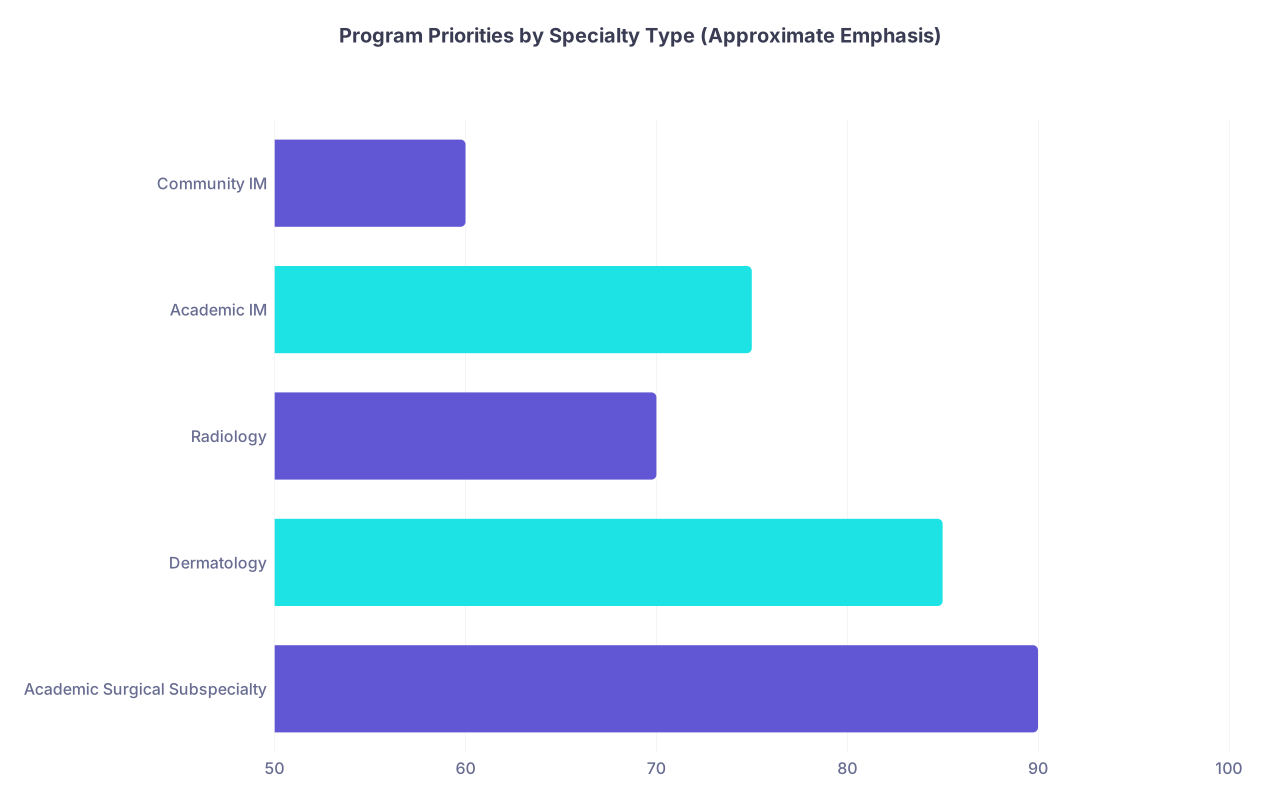
| Category | Value |
|---|---|
| Academic Surgical Subspecialty | 90 |
| Dermatology | 85 |
| Radiology | 70 |
| Academic IM | 75 |
| Community IM | 60 |
Those high values are not “importance of research.” They’re “importance of being someone we can trust clinically while you’re also doing research.”
Some examples:
- Surgical subspecialties (ortho, ENT, neurosurg): If your OR evals say “slow learner, limited situational awareness,” your 5 ortho papers will not save you.
- Derm: Yes, research is common. But they still want proof that you can function in medicine and handle complex patients before they hand you a lifestyle field.
- Radiology: They care that you’re thoughtful, meticulous, and reliable. Sloppy or distracted on medicine or surgery clerkships? That’s a problem.
- Academic IM: They want both. They especially hate the “I’m too important with my R01 mentors to manage scut” attitude.
The Hidden Cost: Burnout and Mediocrity in Both Realms
Overloading on research while trying to be a full-time third-year or sub-I is a fantastic way to become average at both.
You end up:
- Too tired to be sharp on rounds
- Too scattered to read around your patients
- Too rushed to produce genuinely high-quality research
The result?
- Clinical evals: “fine,” “okay,” “met expectations”
- Research: a couple of mid-tier posters, maybe a paper or two where you weren’t actually that involved
- Personal well-being: fried
You traded depth for volume. Programs can smell that.
Smart Balance: How to Do Strong Research Without Sacrificing Clinical Evaluations
I’m not telling you to avoid research. I’m telling you not to be reckless about it.
Here’s how you avoid the trap.
1. Protect Your Core Clinical Year Like It’s Step 1
Third year (and any key sub-Is) are non-negotiable. Those evals shape your MSPE and letters. You cannot redo them.
Practical rules:
- During core clerkships: limit active research projects to 1–2 max and only low-intensity work (data entry, lit review, small tasks).
- During sub-Is / acting internships: treat them like an extended job interview. Research moves to maintenance mode only. No new projects. If someone says “small, quick paper,” assume they’re lying.
- Front-load research on lighter rotations (psych, outpatient, elective), not inpatient heavy months.
If you ignore this and run five projects during your medicine sub-I? Do not be surprised when your evaluation reads “seemed distracted” and “did not consistently take ownership.”
2. Choose Projects That Justify Their Time Cost
Not all research is created equal. Three poster presentations from weak retrospective analyses that you barely understood won’t impress anyone.
Pick projects that:
- Have clear mentorship and structure
- Are realistic in timeline
- Will likely lead to a meaningful product (paper, strong abstract)
- Complement your clinical interests
Let me be clear: saying yes to every project because you’re “building your portfolio” is how you bury yourself. Most of those won’t finish by ERAS anyway. Meanwhile, your clinical grades are permanent.
3. Divide Your Days Ruthlessly
If you are on a rotation where research is truly feasible (light outpatient, elective), compartmentalize:
- Clinical hours: fully clinical. No research emails on rounds. No analysis during downtime unless your responsibilities are unquestionably handled.
- After hours: block specific time for research and specific time for reading about your patients and prepping for the next day.
If your research work is bleeding into time you need to read for your patients, you’re already making the wrong trade.
Red Flags You’re Already Making This Mistake
If you recognize any of these, you need to pull back. Now.
- You haven’t read a full UpToDate or guideline page on a patient in over a week, but you’ve done hours of research work.
- More than one attending has commented directly or indirectly that you seem distracted or rushed.
- Your last 2–3 evals use phrases like “met expectations” without anything stronger.
- You feel constant guilt: when you’re on the wards, you’re worried about research; when you’re at home doing research, you feel behind clinically.
- You’re banking on “my PI will write me a killer letter, that will balance out everything else.”
That last one is fantasy. Research letters complement clinical performance. They don’t overwrite it.
How Programs Actually Think When They See Heavy Research + Mediocre Evals
Let me translate what goes through a PD’s head when your application looks like:
- 8+ publications
- Multiple posters
- Average or mixed evals, some lukewarm language
- No top-tier clinical letters
- No clear narrative that explains or redeems the pattern
Common interpretations:
- “This person prioritized research over patients.”
- “If they did that as a student, they’ll do it as a resident.”
- “They’ll disappear to work on papers when we need them to cross-cover.”
- “We’re going to be cleaning up their mess at 3 a.m. while they’re emailing their mentor.”
So they rank the other candidate. The one with strong clinical comments and fewer papers. Every time.
Concrete Scenarios: Who Gets Hurt Most by This Trade
Three profiles that get burned regularly.
The “Future Physician-Scientist” Who Forgot the Physician Part
Student: Wants academic IM or heme/onc, stacked research since M1, multiple high-quality publications.
Problem: Medicine and sub-I evals say “good fund of knowledge but occasionally disorganized, sometimes slow with follow-through.”
Outcome: Great interviews at research-focused places… but ranked lower because of doubts about ward reliability.
The “Gun for Derm/Rads/Ortho” With Weak Clinical Substance
Student: Knew they wanted a competitive field early, loaded up with specialty-specific projects, networked well.
Problem: Third-year surgery and medicine comments read “met expectations, occasionally disengaged,” nothing effusive.
Outcome: Gets mid-tier interviews. Shut out of the top places where their research mentors wanted to push them.
The “Poster Collector”
Student: 7 conference posters, 0 first-author papers, scattered involvement in many projects.
Problem: Clinical evals are uniformly “fine,” no resident or attending feels strongly enough to write a powerful letter.
Outcome: Application looks busy but shallow. Programs sense that pattern. Ranking suffers.
Use Research to Amplify Strong Clinical Performance, Not Hide Weakness
The right mental model is simple:
- Clinical performance is your foundation.
- Research is your upgrade.
If your base is cracked, adding weight on top just stresses the structure.
Use research to:
- Show depth in a specific area of interest (ICU, heme/onc, cards, etc.)
- Demonstrate persistence and curiosity
- Signal that you’ll be an academic contributor
But first, prove you’re someone they can trust with real patients, real pages, and real responsibility.

Quick Self-Audit: Are You Balanced or Overloaded?
Use this as a brutally honest checklist.
If you answer “yes” to more than 2 of these, you’re flirting with the mistake:
- Am I taking on new research during core rotations or sub-Is?
- Am I relying on research output to “compensate” for less-than-stellar clinical grades?
- Have my last few evals lacked strong, enthusiastic comments?
- Do I feel like I’m constantly choosing between reading about my patients and doing research tasks—and research usually wins?
- Am I assuming that because my peers in competitive specialties do a ton of research, I must match or exceed their volume, regardless of impact on my clinical work?
If that stings a little, good. Better a sting now than a disaster on Match Day.
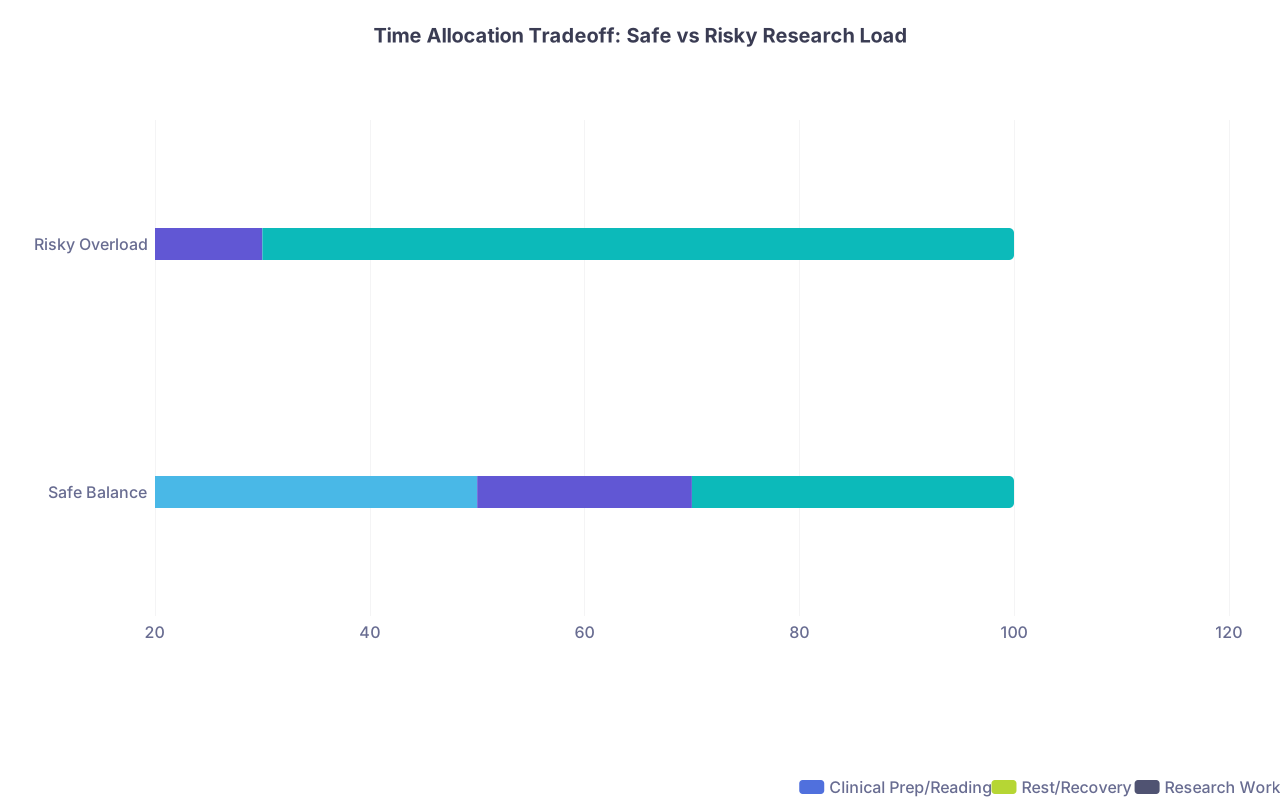
| Category | Clinical Prep/Reading | Rest/Recovery | Research Work |
|---|---|---|---|
| Safe Balance | 50 | 20 | 30 |
| Risky Overload | 20 | 10 | 70 |
FAQs
1. I had one weaker rotation with mediocre evals. Should I stop doing research to fix this?
No, not automatically. One weaker rotation is common. What you must avoid is a pattern. If your last two rotations and a sub-I are strong, and future evals improve, that earlier weakness is often forgiven. But if you’re seeing a trend—or if your weaker eval coincided with a heavy research month—then yes, scale back research until your clinical comments are consistently strong.
2. For competitive specialties, is it worse to have fewer publications or average clinical evals?
Average clinical evals are worse. Programs may forgive a lighter research portfolio if you’re a clearly strong clinician with excellent letters. But they rarely overlook mediocrity on the wards, no matter how good your CV looks. You can supplement research with a dedicated year if needed. You cannot easily rewrite two years of so-so clinical performance.
3. Can a dedicated research year help if my clinical evals are already mediocre?
A research year helps your academic profile, not your clinical one. It can make you more interesting, more specialized, and more connected—but it doesn’t erase weak MSPE comments or bland letters from core rotations. If you already have concerning clinical feedback, your priority should be: crush your sub-Is, secure powerful clinical letters, and demonstrate a clear upward trajectory. Research year is optional; clinical redemption is not.
4. My PI expects a lot from me during third year. How do I push back without burning the bridge?
You say something like: “I’m committed to this project, but I need to focus on my clinical performance this year because evaluations and letters are critical for residency. I can reliably contribute X hours per week and focus on [specific tasks], but I can’t take on new major responsibilities until after this rotation/block.” Any reasonable mentor understands that your clinical grades are career-defining. If they don’t respect that boundary, that’s not a mentor you should be sacrificing your future for.
Key points to walk away with:
- Clinical evaluations, MSPE comments, and core rotation letters carry more weight than your entire publication list. Don’t trade them away.
- Research should amplify solid clinical performance, not hide or compensate for weak evaluations. That compensation strategy fails.
- Protect third year and sub-Is ruthlessly; say no to research that endangers those rotations, or you’ll pay for it on Match Day.