
Last cycle, I sat in a rank meeting where a PD literally waved a CV in the air and said, “This is what I want to see—one real project, not this shotgun nonsense.” The CV he liked? One first‑author abstract at a major meeting, with a strong letter attached. The one he tossed back on the table? Five “publications” in tier‑4 journals no one in the room respected.
Let me walk you through why that happens over and over, and why one solid abstract can absolutely outweigh five weak pubs when people like me are behind closed doors deciding your fate.
How PDs Actually Look at “Research Productivity”
You’ve been trained by forums and classmates to count. “I have 7 pubs, 4 abstracts, 3 presentations.” Sounds impressive on Reddit. Inside a PD’s office, that’s not what we’re counting.
We’re scanning for signals. And a good abstract—done right—lights up more of those signals than a pile of flimsy, low‑quality papers.
Here’s what we actually scan when we open your ERAS application and see the “Scholarly Activity” section:
Venue and prestige
An abstract at ATS, ACC, ASCO, RSNA, AANS, etc. is not the same as a “publication” in International Journal of Contemporary Medicine and Health Sciences. We immediately know which meetings are hard to get into. Big national meetings in your specialty = signal. Local student conference with 40 posters in a hotel hallway = weaker signal.Your role
First author or “presenting author” matters. Co‑author on 5 papers from a basic science lab where the PI lists everyone who’s ever touched a pipette? That’s white noise. One first‑author abstract where you clearly led the analysis and presented it yourself—very different.Narrative coherence
We look for a story. Does your abstract tie directly into your personal statement, your Sub‑I, your mentor’s letter? Or is it just random: one paper in dermatology, another in neurosurgery, a couple in psychiatry, and you’re applying to IM? That scatter makes you look like a CV‑maximizer, not someone engaged in real work.Independent work vs. honorary authorship
A thoughtful abstract usually implies: you collected data, analyzed something, wrote the thing, defended it to reviewers. Five weak, low‑impact papers often scream “data factory” or “gift authorship.”
Let me be blunt: a single, well‑executed abstract at a respected, specialty‑relevant national meeting, with you as first/presenting author, is a much stronger signal of future academic potential than five “publications” in predatory or obscure journals where your role is unclear.
And PDs know the difference at a glance.
Why Abstracts Punch Above Their Weight Behind Closed Doors
You’ve been sold the idea that only full‑length manuscripts matter. That’s not how rank meetings work. Here’s why one abstract can carry so much weight.
1. Abstracts Are Time‑Stamped Proof You Actually Did the Work
When we see:
- Abstract: ACC 2025, first author, presented
- Manuscript: “In preparation”
I know exactly what happened. You did the work, got accepted to a competitive conference, and the clock simply beat you to graduation. That doesn’t bother faculty nearly as much as students think.
What that tells us:
- You can get a project from conception to data to presentation on a real timeline.
- Real reviewers saw your work and said yes.
- You moved it far enough along that publication is plausible.
Compare that with five “publications” that all appeared in the same six‑month span in completely different fields, in journals we’ve never seen before. That pattern is common now, and many faculty have grown openly suspicious of it.
2. Presentations = Visibility, Mentorship, and Real Skills
A national‑meeting abstract usually means:
- You stood in front of strangers and defended your work.
- You talked to faculty in that specialty.
- You spent time with a mentor serious enough about scholarship to bring you into that world.
PDs know what happens at those meetings. They’ve been there. They’ve reviewed abstracts, graded posters, led sessions. When they see “Presented at AANS 2024,” they picture you in that environment, interacting with their colleagues.
That’s miles more meaningful than a weak paper that no one has read, in a journal no one cites, that never required you to actually present or discuss the science.
3. Good Abstract → Strong Letter
This is the real hidden value.
A solid abstract almost always rides with a strong, specific letter from your research mentor. I’ve seen this hundreds of times:
Applicant A: “7 publications,” all weak, no single project they owned.
Letter from PI: “They were a valuable member of the team and contributed to multiple projects.” Generic. Vague. Dead on arrival.Applicant B: One big project, abstract at national meeting.
Letter: “She designed this study herself, cleaned the data, ran the analysis, and presented the findings as first author at ATS. She handled critical questions from senior faculty with maturity beyond her level.” That letter changes the room.
In rank committee, we read letters far more carefully than we read your actual abstracts or papers. The abstract is just the breadcrumb that points to real work. And the letter either proves it or exposes the fluff.
Weak pubs almost never come with powerful, specific letters. Strong abstracts often do.
What Makes an Abstract “Solid” in PD Eyes
Let me spell this out, because students misjudge it constantly. A “solid” abstract is not just something that got accepted somewhere. There’s a pattern to what faculty quietly respect.
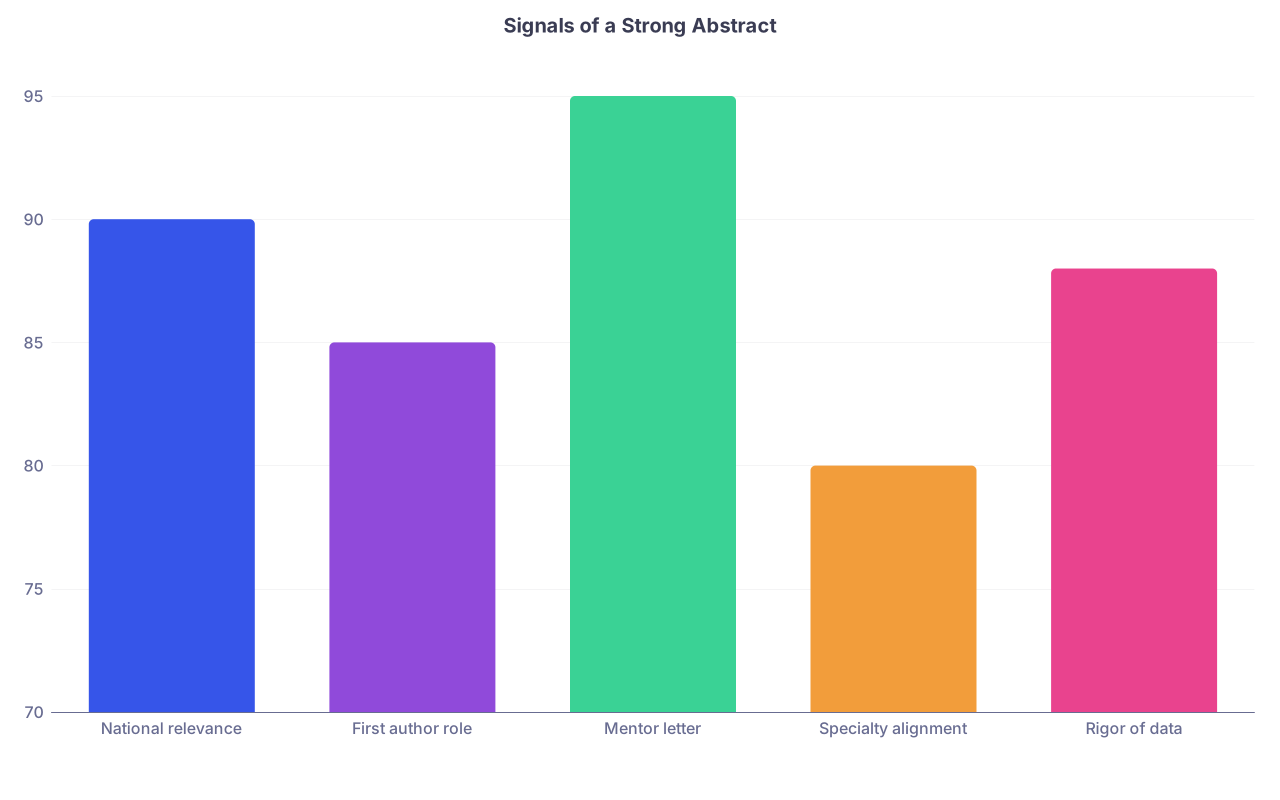
| Category | Value |
|---|---|
| National relevance | 90 |
| First author role | 85 |
| Mentor letter | 95 |
| Specialty alignment | 80 |
| Rigor of data | 88 |
Five elements matter most:
Venue quality
National > regional > school‑level. Specialty society > random “medical conference.” An internal medicine applicant with an abstract at AHA or ATS? That makes people perk up. An ortho applicant with a poster at AAOS? Strong.Your position and ownership
First author or clearly the main presenter. On ERAS, if you bury yourself as “middle author, not presenting,” you’ve weakened your own work. We’re asking: did you drive this, or did you orbit around someone else’s project?Concrete, believable methods and impact
The abstract text itself matters. Sloppy stats, meaningless buzzwords, or “convenience sample of 20 patients” with grand conclusions… faculty do notice. A clean, modest, well‑described analysis reads much better than inflated nonsense.Integration with your application narrative
If your personal statement talks about your interest in ICU delirium, your Sub‑I letter is from the MICU, and your one abstract is on ICU outcomes—this looks cohesive and authentic. That’s exactly the kind of story programs like to see.A mentor we recognize or can respect
This part is uncomfortable, but true: names matter. If your mentor is someone active in the field—publishing, presenting, serving on committees—that abstract is a bigger signal. Even if we don’t know them personally, we look at their institution, their track record.
Weak pubs usually fail on at least two or three of those dimensions. A good abstract often hits almost all of them.
Why Five Weak Publications Can Backfire
This is the part nobody tells you publicly because it sounds harsh. Inside the room, though, it gets said out loud.
Here’s what I and my colleagues have actually said during rank meetings:
- “They have eight publications, but half are in totally random fields. Feels like CV padding.”
- “This looks like a predatory journal mill. I don’t trust any of this data.”
- “If you’re on 10 papers in med school, you probably didn’t lead much of anything.”
The difference is simple: depth vs. volume.
| Feature | One Strong Abstract | Five Weak Publications |
|---|---|---|
| Venue quality | National specialty meeting | Low-tier / predatory journals |
| Your role | First/presenting author | Mostly middle / unclear authorship |
| Mentor letter quality | Specific, detailed, project-focused | Generic, vague, “part of the team” |
| Narrative alignment | Directly tied to specialty & interests | Scatter across unrelated topics |
| PD interpretation | Serious, capable, upward trajectory | CV padding, questionable rigor |
When we see five weak pubs, three thoughts immediately appear:
You chased numbers instead of substance.
It suggests you were more focused on building a spreadsheet of citations than on asking a real question and answering it well.Your mentors might not be serious scholars.
Mass‑produced papers in no‑name journals with 20 co‑authors and no coherent theme—this is a red flag about the lab, not just you.Your time might have been poorly used.
If you spent two years cranking out low‑impact papers, what did you not do? Did you skip deep clinical experiences, electives, or a meaningful Sub‑I to chase fluff?
Residents and junior faculty sitting in on rank meetings are often the first to call this out; they’ve just been through the same CV arms race and know exactly what these publications look like.
How a Single Abstract Shapes Discussion in Rank Meetings
Let me show you how this really plays out when we’re building a rank list.
Picture two applicants.
Applicant X:
- 5 publications
- 3 in marginal journals, 2 in completely unrelated fields
- Middle author on all, no clear role
- PS talks vaguely about “liking research”
- Letters: “They participated in multiple ongoing projects”
Applicant Y:
- 1 first‑author abstract at a major national meeting in the target specialty
- Presented orally or as a well‑received poster
- Same mentor writes a strong, specific letter about their independence
- PS clearly ties the project to their career interest
Here’s how the discussion goes:
“Applicant X has more publications, but I honestly question the quality. Nothing stands out.”
“Applicant Y only has one project, but they drove it to a national meeting. Their mentor’s letter is excellent. They look like someone who could actually publish during residency.”
Applicant Y ends up ranked higher at academic programs nearly every time. Applicant X sometimes even drops if someone in the room recognizes the journals and says, “Yeah, those are pay‑to‑publish.”
You don’t see any of that on your end. You just see the match result and assume “more pubs must’ve helped them.” Often, it did not.
How to Build “One Solid Abstract” That Actually Moves the Needle
If you’re early enough in the process, you can still pivot. Stop thinking “I need X number of pubs” and start thinking “I need one real story of meaningful work.”
Here’s the sequence that works—this is the pattern you’ll see in successful applicants who match well into competitive programs:

| Step | Description |
|---|---|
| Step 1 | Find serious mentor in target specialty |
| Step 2 | Join 1 focused project |
| Step 3 | Own a specific piece: data, analysis, or writing |
| Step 4 | Submit abstract to strong specialty meeting |
| Step 5 | Present and network at conference |
| Step 6 | Get a detailed, project-based letter |
Notice what’s not in there: “Join six random projects in any field that offers you authorship.”
Some real‑world examples I’ve seen:
A future cardiology applicant who did one retrospective study on HFpEF readmissions, presented at ACC, then extended it into a manuscript during their fourth year. One abstract in ERAS, paper accepted mid‑intern year. Matched comfortably at a strong academic IM program.
A neurosurgery applicant with one major spine outcomes abstract at CNS, first author, plus a glowing letter explicitly describing their contribution. That single abstract carried more weight than a competitor’s seven co‑author case reports scattered across different subspecialties.
An EM applicant who partnered with the ED QI team on a sepsis protocol. Single abstract at SAEM, local QI presentation, detailed PD letter. The committee literally said, “This is the kind of resident who will build projects here.”
All of them beat applicants with longer, emptier research sections.
When You Already Have Multiple Weak Pubs: What Now?
If you’re reading this too late and already sitting on a pile of weak publications, don’t panic. You can’t erase them, but you can reshape the narrative.
Here’s what faculty respect when someone comes in with a messy record:
- You highlight one project as your “main work” and talk about it clearly in your personal statement and interviews.
- You stop adding fluff and instead push that one project to a better endpoint: a stronger abstract, better analysis, or a more respectable submission.
- You get one strong letter that goes deep into your role, rather than three weak letters all vaguely referencing your name on papers.
We do notice growth. If most of your early stuff is scattershot but your most recent work is coherent, higher quality, and better mentored—that counts. Residents turn the corner all the time; we know students can too.
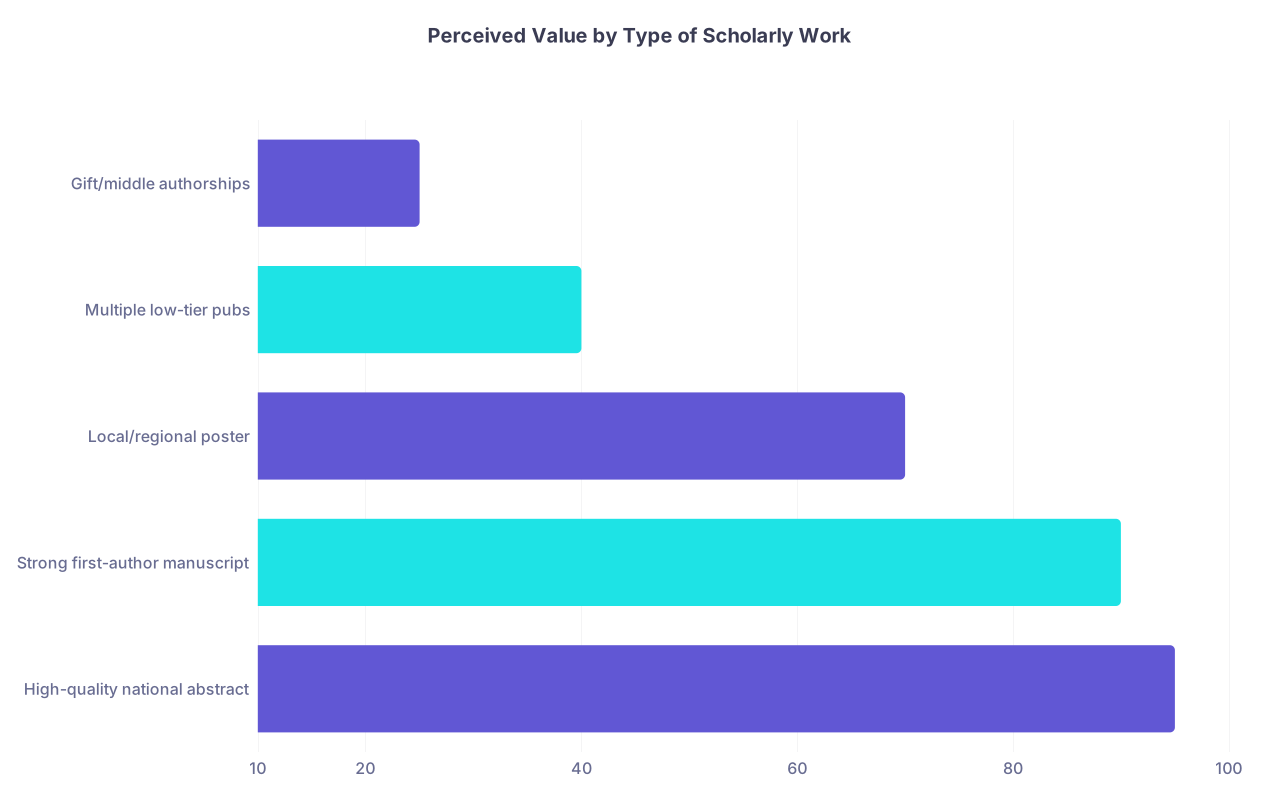
| Category | Value |
|---|---|
| High-quality national abstract | 95 |
| Strong first-author manuscript | 90 |
| Local/regional poster | 70 |
| Multiple low-tier pubs | 40 |
| Gift/middle authorships | 25 |
Where This Matters Most: Academic vs. Community Programs
Another little secret: the “one good abstract > five weak pubs” rule is especially true at academic programs.
Academic, research‑oriented residencies
They care about your potential to do funded work, publish in real journals, present at national meetings. They’d rather see one serious, mentor‑driven project than sprawling fluff.Mid‑tier or community‑heavy programs
They still respect quality over quantity, but they’re less obsessed with research altogether. Here, the right abstract can still help, but it’s icing, not the cake. Strong clinical performance and letters will swamp any differences in your CV’s research section.
The applicants who get burned are the ones applying to top‑tier academic places with CVs full of junk publications, thinking the raw number will impress. It doesn’t. Those are the programs most familiar with the dichotomy I’m describing.
The Real Takeaway: PDs Want Evidence, Not Decoration
Program directors aren’t anti‑research and they’re not scorecards. They’re trying to answer a single question:
“If this person joins my program, will they be capable of meaningful scholarly work that doesn’t waste my faculty’s time?”
One solid abstract at the right venue, with you clearly at the helm, answers that question far better than five weak, forgettable papers where your role is opaque and the science is unimpressive.
If you’re early in med school or at the start of M3/M4, this is your moment to pivot:
- Pick one mentor who actually publishes in your target field.
- Commit to one real project instead of chasing every case report that floats by.
- Drive that project to a specialty‑relevant meeting as first author or main presenter.
- Get the letter that proves you did the work.
You do that, and I promise: inside the room, your single abstract will carry more weight than you think—often more than you’d get from five shallow “publications” you rushed to stack onto your ERAS.