
The fastest way to make a selection committee distrust your entire application is bad research. Not a lack of research—bad, sloppy, or suspicious research.
Let me tell you what really happens when your ERAS file pops up in the room and your CV looks “impressive” at first glance. People lean in. Then they start hunting for red flags. And research is where those red flags scream the loudest.
This is the part nobody tells you: the more research you list, the more they try to poke holes in it. Because we’ve all been burned by fake productivity, ghost contributions, and inflated CVs.
You’re worried about “not enough pubs.” They’re worried about: “Can I trust this person?”
How Committees Actually Read Your Research Section
Here’s the truth: your research is not just a list of bullets. It’s a personality test.
We’re not just counting manuscripts. We’re asking:
- Does this person exaggerate?
- Do they understand what they did?
- Are they teachable or just chasing lines on a CV?
- Did someone hand them data, or did they actually grind?
And the most important unspoken question:
“If I put this person on one of my projects, will they deliver or make my life harder?”
On a typical selection day for a research-leaning program, we’ll have a stack (or digital queue) of applicants who all have:
- A couple of posters
- Maybe a pub or two
- Some “in progress” work
- “Pending submission” lines
We start cross-checking. Not just the quantity. The patterns. The story.
You want to know what actually makes us nervous? Let’s go through it.
Red Flag #1: The “Too Good To Be True” Publication List
No one says this to applicants, but everyone says it in the room:
“This looks…fake.”
What triggers that?
Explosive productivity in a suspiciously short window
You did “no research” for three years of medical school, then magically produced:- 5+ papers “submitted”
- 3 “accepted” in the last two months
- 4 posters
- All with the same attending you barely mention elsewhere
Committees have seen this movie. Usually it’s:
- A senior threw your name on old projects
- A lab padded your CV
- Or the dates are massaged
We don’t automatically reject you for this. But you go into the “interrogate research” bucket. On interview day, someone will ask about the methods and design of at least one of those studies. Not the title. The guts.
If you stumble? Every “in progress” item on your CV instantly loses value.
High-impact journals that don’t match your trajectory
M3, zero prior research, and you’re first author on a NEJM/Cell/JAMA-level paper? Could it happen? Technically. Do we believe it at face value? No.What we quietly do:
- Look up the paper during the meeting
- Check author order, group, institution
- Check if your name is buried on a huge consortium list
If it doesn’t line up with your narrative or the rest of your application, it’s a trust problem, not a prestige boost.
Author order games
When someone has:- 6 papers
- All “co–first author”
- All with the same two seniors
- Or they list “equal contribution” without the paper actually saying that
Programs know students sometimes “promote” themselves on ERAS. Faculty resent that.
I’ve heard this exact line from a PD: “If they’re already inflating author order as a student, what are they going to do as a resident?”
Red Flag #2: Mislabeling What Counts as “Research”
This one is more common than you think, especially from schools with weak advising.
Here’s what raises eyebrows:
Quality improvement labeled as “original research”
Don’t play cute games with terminology. If your “study” is:- A PDSA cycle on discharge summaries
- A compliance project
- An audit without a real hypothesis or analytic plan
That’s fine work. But if you dress it up as “prospective cohort study” with complex language and then cannot defend it in detail, faculty feel misled.
We know what IRB-backed clinical research looks like. We know what a QI project looks like. When students try to rebrand the latter as the former, the committee starts wondering what else you’re spinning.
Case reports as core research experience
Case reports are fine. But:- Listing 6 case reports as your primary “research” and then claiming “strong research interest” in your personal statement doesn’t impress serious academic programs.
- It tells us you haven’t actually been in the trenches of data collection or analysis.
If all you have is case reports, you’re better off being honest about the level of experience rather than overselling it.
Chart reviews treated like randomized trials
Saying “we randomized patients” when what you did was retrospectively compare two groups that already existed? That’s the kind of thing that leads to eye-rolls in the room.Committees are full of people who have had manuscripts rejected for much less. They’re hyper-allergic to methodological nonsense.
If we sense you don’t understand what type of study you did, we assume you were a passive passenger, not an actual contributor.
Red Flag #3: The “Mystery Mentor” Problem
Faculty look for patterns in mentor relationships. Who vouched for you matters just as much as what you did.
The things that spook us:
Big-name mentor, shallow story
Your CV: 4 pubs with Dr. Famous, well-known in the field.
Your LORs: none from Dr. Famous.
Your PS: no meaningful story of working with them.
Your interview: vague “I helped with data and wrote some sections.”Translation in the committee room: “Someone added this student’s name to be nice” or “They were one of 10 students helping with chart abstractions.”
Does that mean we throw you out? No. But that “wow” factor from the famous name evaporates fast.
No letter from your primary research mentor
This is a bigger red flag than applicants realize.If you’ve got:
- 2+ years in a lab or research group
- 3+ outputs with the same PI
…and no letter from that person, we always ask “Why?”
A few guesses we make, none of them good:- The mentor doesn’t trust your reliability
- You barely interacted with them directly
- You did minimal work and they won’t stake their name on you
Committees live on pattern recognition. When a strong research portfolio is missing the obvious letter, that pattern usually means “something went wrong.”
Projects that don’t exist outside your CV
You’d be surprised how often we look up a “published” paper and can’t find it. Or the journal is suspiciously predatory.More than once I’ve seen:
- “Journal of Clinical and Translational Something” that’s basically a spam operation
- A “published ahead of print” article that has no DOI, no PubMed entry, and no accessible proof
Programs are increasingly aware of predatory journals. Certain program directors literally keep a mental blacklist.
| Venue Type | Committee Reaction |
|---|---|
| Top-tier journals | Scrutinize contribution |
| Solid mid-tier journals | Generally reassuring |
| Low-quality niche | Neutral to mildly skeptical |
| Predatory journals | Major trust red flag |
| Conference abstracts | Positive but limited weight |
If we smell CV padding with junk publications, it doesn’t destroy you automatically. But it tells us you care more about lines than learning. That’s not the resident we want on important projects.
Red Flag #4: The “In Progress” Graveyard
Nothing triggers skepticism faster than bloated “in progress” sections.
Let me be blunt: committees know students lie, exaggerate, or misrepresent project status. They just do not call it that in front of you.
What makes us nervous:
Too many “submitted” / “in revision” items
If you have:- 1–2 “submitted” papers → fine, normal.
- 5+ “submitted” → we assume at least half are nowhere near submission.
We understand lag times and slow mentors. But when everything is “under review” or “in revision,” it reeks of wishful thinking.
Vague future papers
The worst phrasing is stuff like:- “Manuscript in preparation”
- “Data analysis underway, planning to write paper”
- “Abstract to be submitted”
On a busy selection day, those lines may as well be invisible. If your portfolio is mostly smoke and no fire, it annoys some faculty. I’ve heard: “If we stripped the fantasy papers out, what’s actually left?”
No coherent timeline
When we ask in interviews:- “When did you join this project?”
- “What stage is it at now?”
- “What’s your role in getting it to submission?”
…we’re not just chatting. We’re checking whether your timeline matches the CV. If you can’t explain clearly why something is still “in progress” after 18–24 months, we assume your involvement was minimal or unreliable.
Here’s the real rule insiders use:
If your “in progress” column is bigger than your “finished” column, we treat your research reliability as unproven.
Red Flag #5: You Can’t Explain What You Did
This is what kills applicants who look perfect on paper.
The behind-closed-doors reality: every program has at least one faculty member who loves grilling research-heavy applicants for sport. Not maliciously. They just want to separate the doers from the passengers.
Common failure patterns:
You can recite the abstract but not the methods
You say:- “We did a retrospective cohort study looking at outcomes after X…”
But when pressed:
- “How did you select your cohort?”
- “What was your primary outcome?”
- “What did you use for your multivariable model?”
…you stumble, get vague, or contradict the actual paper. I’ve watched attendings write “likely passenger on research” next to an applicant’s name during the interview.
You don’t know basic stats from your own paper
Nobody expects you to be a biostatistician. But if you list a paper that uses:- Logistic regression
- Cox models
- Kaplan–Meier curves
…and you cannot explain, in plain language, what those are doing, it’s a problem.
We’re not testing your math. We’re testing if you actually engaged that far or just slotted your name in. A simple, honest explanation beats jargon every time.
You can’t explain your specific contribution
The deadliest answer you can give:“I helped with data collection and writing.”
Everyone says that. It means nothing. If you can’t point to:
- A section you drafted
- A figure you created
- A chunk of data you personally cleaned or abstracted
…you sound like background noise, not a core team member.
On the flip side, when a student says:
“I was responsible for screening charts and building the REDCap database, then I drafted the results section and figure 2.”
You instantly move into the “real contributor” category.
Red Flag #6: The CV–Personality Mismatch
There’s a subtler kind of red flag that committees talk about after you log off Zoom or leave the room.
Your CV and your personality do not match.
Things that set that off:
Hyper-research CV, zero curiosity in person
You claim a “passion for academic medicine,” but:- You don’t ask any research questions on interview day
- You show no interest when faculty describe ongoing projects
- You don’t light up when talking about your own work
In the wash-up meeting, someone says: “They look like they did research because they had to, not because they cared.” For academic-heavy programs, that’s often enough to push you below someone with fewer pubs but more authenticity.
Grand research statements in PS that your record doesn’t support
You write about:- “A long-term goal of running an NIH-funded lab…”
- “…shaping national guidelines through my research…”
And your actual research experience is:
- One summer project
- One poster
- No sustained track record
Ambition is good. But when the scale of your vision far exceeds your current grounding, it feels performative. Faculty can spot “personal statement fiction” a mile away.
Big talk, no technical depth
Students who talk a lot about “machine learning,” “AI,” “big data,” or “cutting-edge translational work” but cannot answer basic follow-up questions on:- Sample size
- Inclusion criteria
- Why they used one test instead of another
That’s a trust killer. No program wants a resident who will oversell half-baked work and drag the department into awkward conversations.
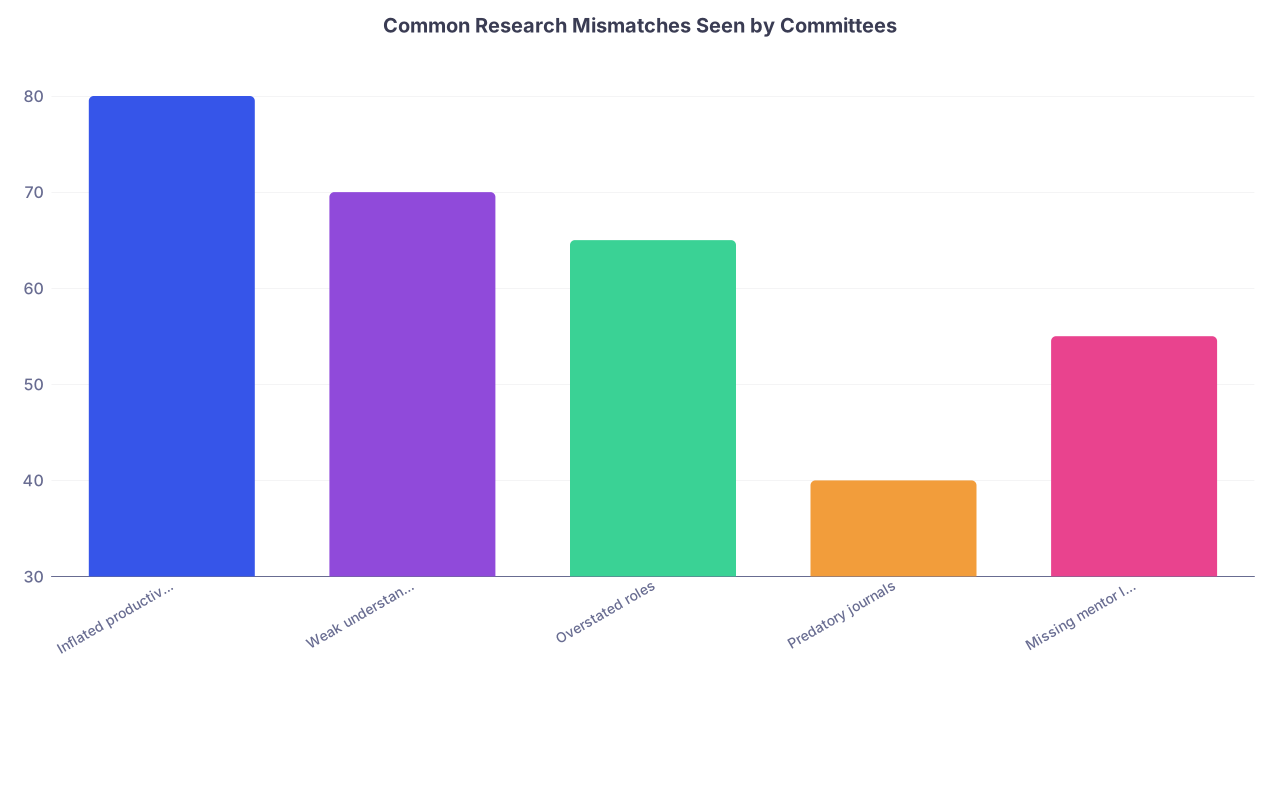
| Category | Value |
|---|---|
| Inflated productivity | 80 |
| Weak understanding | 70 |
| Overstated roles | 65 |
| Predatory journals | 40 |
| Missing mentor letters | 55 |
Red Flag #7: Sloppy, Inconsistent, or Dishonest Details
This is where some applicants torpedo themselves without realizing.
We notice:
Inconsistent author lists or titles
If the title on your CV does not match what’s on PubMed, or:- The author order is off
- The journal is misnamed
- The year is wrong
…it looks sloppy at best and dishonest at worst. One PD said in a meeting: “If they can’t get their own pub right, what are they going to do with medication orders at 3 a.m.?”
Listing papers as “published” when they’re not
Calling something “accepted” when it’s “submitted.”
Calling something “in press” with no evidence.We check. Maybe not for everyone, but definitely for borderline cases and people we’re fighting over. If we catch you upgrading the status, that’s a major integrity hit.
Predatory or vanity journals with inflated framing
Some committees will give you the benefit of the doubt and assume your mentor pushed you toward a bad journal. Others won’t.What helps? Owning it. If asked, a mature answer is:
“At the time I didn’t understand the journal landscape well; now I realize that wasn’t an ideal venue. I learned to check indexing and journal reputation more carefully.”
That shows growth. Trying to defend a junk journal as prestigious? That’s the red flag.
Copy-paste errors that reveal padding
Repeated descriptions that are obviously cloned. Wrong study details under the wrong project. Wrong author role. Trust erodes with each careless 반복.Committees assume: if you’re careless on your CV, you’ll be careless on the wards. And they’re not wrong.
What Committees Actually Want to See Instead
Now for the part that doesn’t get advertised on website blurbs.
The committees that value research are not looking for a perfect CV. They are looking for signal:
- Has this person stuck with something hard over time?
- Do they understand at least one project in real depth?
- Are they honest about what they did and what they didn’t do?
- Will I be comfortable putting my name on them as a mentee?
You think they want 8 papers and 12 posters. What they actually trust is:
- One longitudinal project where you clearly grew
- A sane ratio of “done” to “in progress”
- Clean, accurate descriptions
- A mentor who writes, “They drove this project”
I’ve seen applicants with:
- One real, well-understood retrospective study
- A thoughtful explanation of their role
- A humble, accurate CV
…beat out applicants with triple the “output” but an obviously inflated profile. Especially in mid-tier and strong academic programs that have been burned by CV gamers in the past.
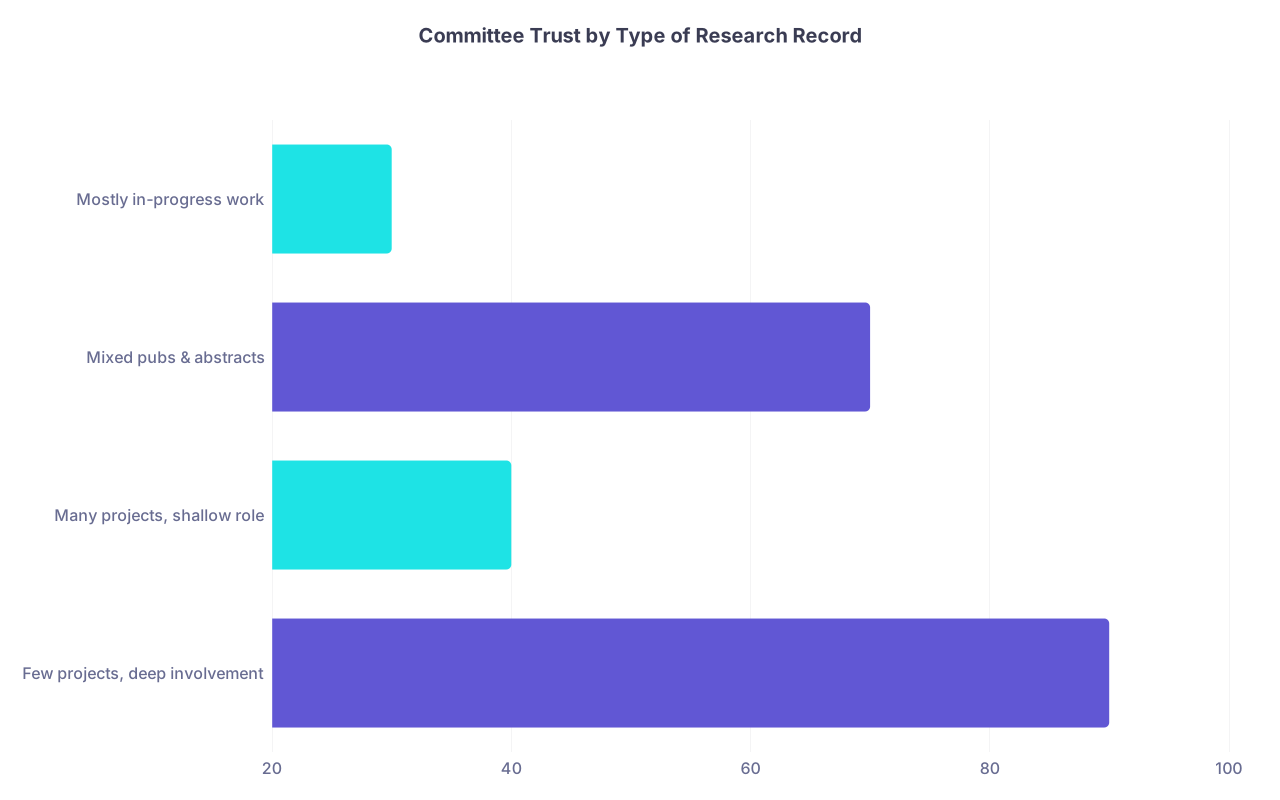
| Category | Value |
|---|---|
| Few projects, deep involvement | 90 |
| Many projects, shallow role | 40 |
| Mixed pubs & abstracts | 70 |
| Mostly in-progress work | 30 |
How to Clean Up Your Research Before You Hit Submit
You want to avoid making committees nervous? Do three things before you finalize ERAS.
Audit every single line for truth and clarity
Ask yourself, project by project:- Can I explain this in detail if asked?
- Is the status exactly accurate today?
- Is the venue real, legitimate, and spelled correctly?
If the answer is “no” to any of those, fix it or cut it.
Right-size your descriptions
Stop trying to make small things look big. A simple, accurate description is far more powerful:- “Retrospective chart review of 150 patients, I helped create the REDCap database and performed initial descriptive analyses.”
…is better than: - “Led a large-scale, multi-center outcomes trial…”
Faculty know what honest student involvement looks like. When they see it, they relax.
- “Retrospective chart review of 150 patients, I helped create the REDCap database and performed initial descriptive analyses.”
Prepare to defend 1–2 key projects cold
Pick the one or two projects most central to your story. For each:- Know the hypothesis, design, sample, and main result
- Be able to explain the stats in plain language
- Have a concrete example of your contribution
That way, if you run into the research-interrogator attending, you come out looking like the rare student who actually understands what they did.

| Step | Description |
|---|---|
| Step 1 | List all research items |
| Step 2 | Verify status & details |
| Step 3 | Trim or simplify description |
| Step 4 | Keep as is |
| Step 5 | Identify 1-2 anchor projects |
| Step 6 | Prepare talking points for interviews |
| Step 7 | Can explain methods and role? |

The Bottom Line: What Actually Scares Committees
Programs aren’t scared of you having “little research.” They’re scared of something else entirely.
They’re scared of:
- Applicants who lie or exaggerate
- Residents who will drop the ball on projects and embarrass them
- People who look great on paper but cannot back it up in person
If you avoid the red flags—inflate nothing, mislabel nothing, understand what you did—you’re already ahead of a shocking number of applicants.
Three key truths to walk away with:
- Committees trust depth and honesty over raw publication count.
- Any research item you cannot clearly explain becomes a liability, not an asset.
- A clean, accurate, defensible research story beats an impressive but suspicious CV every single time.