
It’s late September. Your ERAS just went out. You’re refreshing your inbox like it owes you money, trying to convince yourself that your 3 case reports and one poster will “probably be fine.”
Meanwhile, in a windowless conference room at 7:15 a.m., your application is on a projector screen, and someone just said:
“Research… light. Next.”
You will never hear that sentence. But I have. Many times.
Let me walk you through the thing nobody spells out: the unofficial research tiers programs actually use when they screen ERAS. Not the glossy “we value well-rounded applicants” nonsense on their websites. The real filters, the mental buckets, and how your name gets quietly moved into “interview,” “maybe,” or “delete” based on your PubMed footprint and who you did it with.
The Quiet Math: How Programs Really Read Your Research
Here’s the first truth: almost nobody is reading your research the way you think.
They are scanning, at speed, with pattern recognition they’ve built over hundreds of applications. In most mid-to-high tier programs, research is not a binary (has it vs. doesn’t). It’s a tiered system. Unspoken, but very consistent.
They look at four things in under 20 seconds:
- Volume
- Type
- Signal (where, with whom, on what)
- Trajectory
They’re not counting every abstract; they’re deciding which bucket you fall into. That bucket dictates how harshly they judge your board scores, your school, your clinical grades.
I’ve watched PDs flip through apps like this:
“Anything PubMed? Yes. How many? … ok, decent. Any first-author? With who? At [big-name institution]? Got it. This one’s strong.”
or
“Non-academic DO, Step 230, no pubs. Maybe if everything else is glowing. Otherwise, pass.”
They won’t say, “This is Tier 3 research,” but that’s exactly what they’re doing.
The Real Research Tiers (That Nobody Admits Exist)
Let’s get concrete. This is how research is mentally tiered in many academic IM, neuro, EM, anesthesia, and most competitive specialties. The exact thresholds vary, but the structure is surprisingly similar.
| Tier | Label (Informal) | Typical Outcome in Academic Programs |
|---|---|---|
| 0 | No Real Research | Major handicap unless stellar elsewhere |
| 1 | Token / Box-Checking | Neutral at best, weak in competitive fields |
| 2 | Solid Applicant | Acceptable, won’t hurt you |
| 3 | Strong Academic | Actively helps, especially with mid scores |
| 4 | Serious Future PI | Flagged as top academic recruit |
Now I’ll translate those labels into what they really mean when your ERAS hits the committee.
Tier 0 – “No Real Research”
What this actually looks like on ERAS:
- “Quality improvement project” with no product, no poster, no abstract, no identifiable output
- “Assisted with data collection for…” but you’re not on the paper or abstract
- One summer “research experience” with absolutely nothing to show from it
- Or literally: blank research section
How it’s read in the room:
For competitive fields (DERM, RAD ONC, ORTHO, PLASTICS, ENT, NEUROSURG, top GAS/ANES, some IM subspecialty programs):
This is basically a non-starter at most academic programs unless you bring something huge elsewhere (gold-lettered mentor, insane Step 2, varsity-level connections, or coming from a powerhouse school with big-name letters).
For mid-tier IM, EM, peds, FM:
You’re not dead, but you’re definitely not “interesting.” If there are 50 similar apps with some research and yours has none, you fall to the bottom of the pile. Especially if you’re from a less-known school or outside the US.
Behind-the-scenes sentiment:
“Didn’t even try. Or couldn’t get in anywhere. Either way, not ideal.”
If you’re already here, your strategy needs to be: overperform clinically, bang out Step 2, and get letter writers who explicitly vouch for your academic curiosity and work ethic. But that’s another conversation.
Tier 1 – “Token / Box-Checking Research”
This is where a huge chunk of applicants live.
What this usually looks like:
- 1–2 posters at local/regional conferences
- A case report (maybe two), often still “in preparation” or “submitted”
- One retrospective chart review where you’re middle or end of the author list
- No PubMed-indexed publications, or maybe one, buried in a journal no one’s heard of
Typical ERAS entry:
- “Smith J, You A, Patel R. Spontaneous pneumomediastinum in a young adult. Poster presented at XYZ Regional Conference, 2023.”
How it’s read:
For moderately competitive academic programs:
“Ok, they played the game. Not an academic star, but not a zero either.”
Your research neither sells you nor kills you. It just stops the conversation from turning negative. Which matters more than you think.
For research-heavy or top-10 style programs:
“Box-checked. Probably not an academic heavyweight unless everything else is stunning.”
Behind-the-scenes commentary I’ve literally heard during screening:
- “Yeah, this is classic med school box-checking.”
- “Local posters only. No real output. Ok, move on.”
Does this help you? Slightly. It keeps you out of the penalty box, but you’re not getting bonus points.
Tier 2 – “Solid Applicant Research”
This is the “respectable” tier. Programs are very comfortable interviewing people in this zone, especially if other aspects of the app are good.
What this usually looks like:
- 1–3 PubMed-indexed publications
- At least one where you’re first or second author
- Mix of posters/abstracts at regional or national meetings
- Work is at least somewhat related to your chosen specialty, OR done at a known institution with recognizable mentors
Example profile:
- One first-author original article in a mid-tier journal
- One co-author retrospective study with your home department
- Two national posters (ACP, AAN, ACEP, CHEST, etc.)
- Maybe one case report in a reputable case journal
How it’s read:
In mid-to-high tier academic programs:
- “Good. This is fine. They’ve actually completed projects and gotten to publication. They can produce.”
- “Not a basic science beast, but clinically academic. That’s great for us.”
This tier actively helps you when:
- Your Step 2 is in the “fine but not fireworks” range
- You’re from a lower-profile school
- You’re an IMG/DO aiming at academic programs
You basically stop being a question mark. You become trusted as someone who can carry a project to the finish line.
Tier 3 – “Strong Academic Candidate”
This is where people on the selection committee start paying real attention.
What this looks like:
- 3–7 PubMed-indexed pubs, with at least 1–2 first-author
- A clear theme related to your field: stroke outcomes for neuro; sepsis or ICU for IM; airway/ventilation for EM; imaging outcomes for radiology
- Multiple national presentations (poster or oral)
- At least one recognizable mentor or institution attached to the work
- Some evidence of progression: M2 poster → M3 pub → M4 bigger project
Example ERAS:
- 5 pubs in PubMed
- 2 first-author clinical papers in mid-to-upper tier specialty journals
- 3–4 national abstracts (CHEST, SCCM, ASN, AAEM, RSNA, etc.)
- Ongoing project with a big-name PI, listed as “manuscript in preparation” but with enough detail to be credible
How committees react:
You’ll hear things like:
- “This one’s actually academic.”
- “If they want to do fellowship, they’ll have no problem.”
- “We should flag them for our research track.”
Tier 3 buys you forgiveness:
- Step 2 slightly below their usual cut? They’ll look twice.
- Coming from a non-top-50 school? You get upgraded in their mind.
- Had a rough clerkship comment or one B in medicine? They’re less spooked.
This is where research starts to become a real asset, not just a box.
Tier 4 – “Serious Future PI / Star”
Very rare. And heavily favored by certain programs.
What this looks like:
- 8–20+ PubMed-indexed papers
- Multiple first-authors, maybe even one in a high-impact specialty journal or a well-respected general journal
- Clear academic brand: all in one niche, with depth
- Formal research year, MPH, PhD, or NIH-level work
- Named grants or awards; maybe an oral talk at a big national conference
- Strong letters from big-name PIs saying: “This person is the real deal.”
Typical ERAS comments in the room:
- “This is someone we could build a project or line of research around.”
- “They’re basically a junior faculty in the making.”
- “We should push hard to match this one.”
For research-heavy departments, this tier gets you:
- Priority for interviews
- Early “yes” from the PD
- Consideration for research tracks, PSTP, ABIM research pathways, etc.
But here’s the nuance:
If you’re applying to a largely community-based program? This might be overkill. They’ll be impressed, but it won’t matter as much as you think. They care more that you can grind on the wards and not complain.
The Hidden Axis: Signal vs. Noise
Within each tier, there’s another unspoken filter: signal quality.
Programs look for recognizable signals:
- Is the work in the specialty you’re applying to?
- Are the journals real and at least moderately respected?
- Are your mentors known to anyone in the department?
- Does your research story match your personal statement and letters?
A single first-author paper in a solid specialty journal with a known PI can outweigh three random case reports in low-impact, pay-to-publish outlets that everyone in academics quietly rolls their eyes at.
Here’s the kind of mental math I’ve heard:
“He’s got four pubs, but two are in basically junk journals, one is a case report in an obscure outlet, and one is a letter to the editor. Compare that to her – two legit original papers in [respectable specialty journal] and [another decent journal] with Dr. X as a co-author. She’s clearly higher yield academically.”
Same numeric count. Very different tiering.
How This Plays Out Across Different Specialties
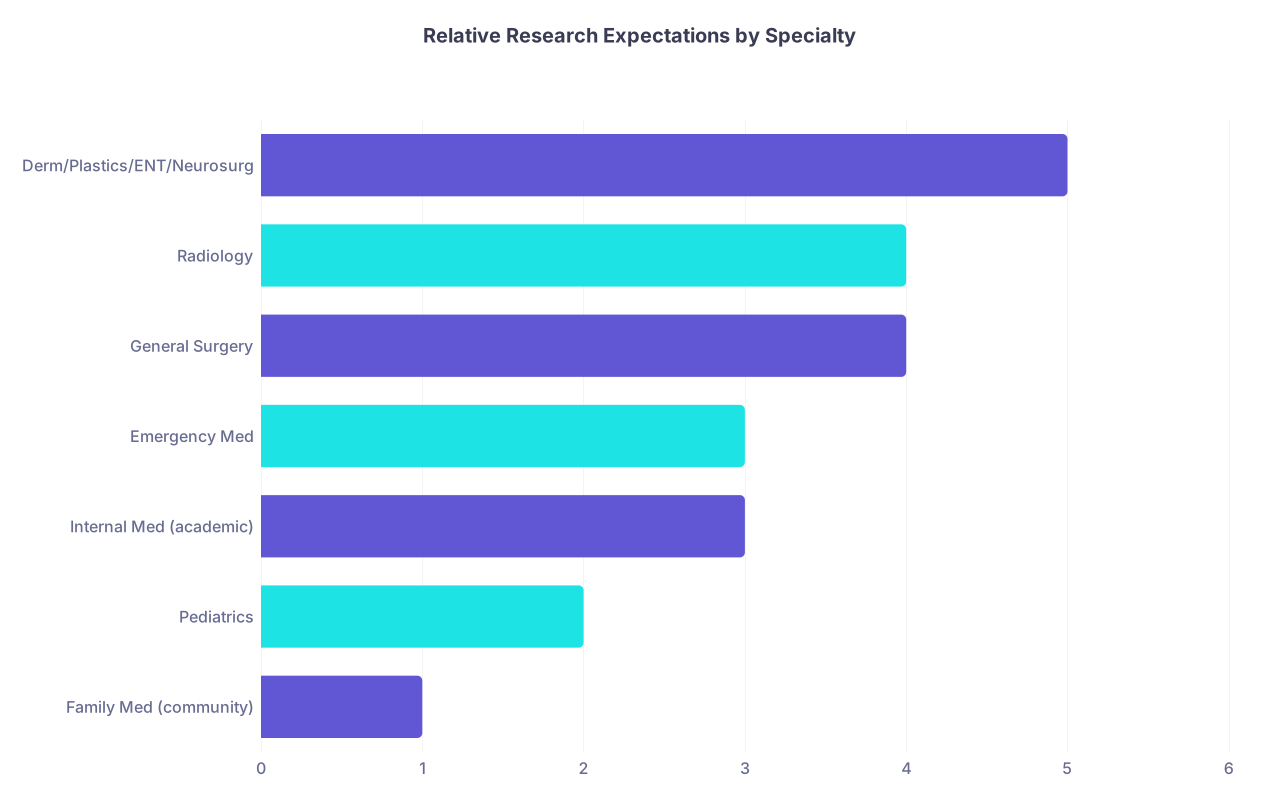
The research tier expectations are not uniform. A Tier 2 in FM can be a star. A Tier 2 in derm can be dead on arrival.
| Category | Value |
|---|---|
| Family Med (community) | 1 |
| Pediatrics | 2 |
| Internal Med (academic) | 3 |
| Emergency Med | 3 |
| General Surgery | 4 |
| Radiology | 4 |
| Derm/Plastics/ENT/Neurosurg | 5 |
Scale: 1 = minimal research expected; 5 = heavy research expected at most academic programs.
A few inside observations:
Derm / Plastics / Neurosurgery / ENT
The upper programs expect Tier 3–4 to even be in the serious conversation, unless you have massive connections or a top 5 med school plus 260+ Step 2. Case reports and one poster do basically nothing.Radiology, Rad Onc, Gas, Heme/Onc-focused IM
Tier 2 is baseline for good academic programs. Tier 3 gets people excited. Tier 1 at a competitive place? You’re relying on something major elsewhere.Academic IM, Peds, EM
Tier 2 is very solid; Tier 3 pushes you into their “this is someone we can develop” bucket. Tier 1 is okay if other things are strong, but you’re not going to stand out at the heavy-hitter places.FM, community-focused programs in any specialty
Tier 1–2 is more than enough. They care more that you can function, communicate, and won’t burn out in a high-volume setting. Tier 3–4 is “nice,” but often not decisive.
The Stuff Committees Actually Say (That You Never Hear)
A few real phrases I’ve heard behind closed doors when research comes up:
- “This looks like someone who needed to check a box for their CV.”
- “Oh, they worked with [PI name]. I know him. He wouldn’t put his name on junk. That’s a plus.”
- “Lots of case reports, no real original work. I’m not convinced they can carry a project themselves.”
- “She has three first-author papers while in med school and still honored medicine and surgery? That’s impressive.”
- “IMG, but strong publications in solid journals. We should take them seriously.”
You see how fast the conversation shifts? It’s not about raw counts. It’s “What does this research say about how this person will function in our department?”
How to Move Yourself Up a Tier (Without Wasting Time)
If you’re still in med school or early in your timeline, the actual game is shifting which tier they’ll put you in when they first glance at your ERAS.
Two key principles:
- Depth beats scatter.
- Finished beats “in progress.”
You’re far better off with:
- 2–3 completed, PubMed-indexed clinical projects in your chosen specialty
than - 8 half-baked “in preparation” projects, 5 case reports, and nothing actually published.
Programs value proof of completion. Half of med students who “do research” never end up on a single paper. Faculty know this. They can smell fluff.
Example strategy that actually works:
You’re an MS2/MS3 aiming for academic IM:
- Join one PI’s lab/service and commit for 1–2 years
- Aim for: 1 first-author retrospective paper + 1–2 co-author papers + 2 national posters
- Keep all of it in a coherent area (heart failure outcomes, ICU sepsis, readmission risk, whatever)
That alone puts you solidly into Tier 2–3 for many IM programs.
If you’re late in the game (already applying), the only thing you can control is how you present what you already have:
- Clean up your ERAS descriptions. Emphasize outcome, not process.
- Don’t list junky “I helped collect data” if you’re nowhere on the paper or abstract. It looks like noise.
- Make it obvious which projects are published vs accepted vs in preparation. Committees value clarity.
The Harsh Truth About “In Preparation”
Let me share a dirty little secret: “In preparation” is widely ignored unless your PI’s name carries serious weight.
By the time you’re submitting ERAS:
- Published = real
- Accepted = almost real
- Under review = maybe
- In preparation = I’ll believe it when I see a DOI
When we see:
“First-author manuscript in preparation, targeting [big-name journal]”
The unspoken translation is: “This probably won’t exist by Match.”
If you list 8 “in preparation” manuscripts against 0 actual publications, you are signaling that you’re either:
- Overinflating your output
- Not good at finishing projects
- Being “helped” with how to pad your CV
None of those are flattering.
Better: list only serious in-prep projects with a clear, specific description and authorship position, and do not overload the section.
Program Type vs. Research Tier: What Really Matters
Not all programs weight these tiers the same way. A community hospital EM program and a university hospital IM program do not care about research equally.

| Step | Description |
|---|---|
| Step 1 | ERAS Submitted |
| Step 2 | Community-Based |
| Step 3 | Hybrid / University-Affiliated |
| Step 4 | Research-Heavy Academic |
| Step 5 | Neutral if strong clinically |
| Step 6 | Small bonus, not decisive |
| Step 7 | Tier 0-1: Weakness |
| Step 8 | Tier 2: Solid |
| Step 9 | Tier 3-4: Advantage |
| Step 10 | Tier 0-1: Often screened out |
| Step 11 | Tier 2: Baseline |
| Step 12 | Tier 3-4: Priority interview |
| Step 13 | Program Type |
| Step 14 | Any Research? |
| Step 15 | Tier 1-4 |
| Step 16 | Tier Level |
If you’re applying to:
- Mostly community programs
- Less competitive specialties
- Regions where you have strong ties
Then Tier 1–2 is more than enough and you should not be losing sleep trying to become a Tier 4 unicorn.
If you’re gunning for:
- Top-20 academic programs in competitive specialties
- Research tracks
- Programs bragging about NIH funding on every page of their website
Then you cannot show up with Tier 0–1 and expect anything but disappointment.
FAQs
1. Is it better to have many case reports or one solid original paper?
One solid original paper beats a stack of case reports almost every time in academic eyes. Case reports are fine for exposure and teaching yourself the process, but they’re not viewed as evidence that you can do real, hypothesis-driven work. A good rule: 1–2 case reports is fine; beyond that, they start to look like noise unless you also have original work.
2. Do basic science projects “count” as much as clinical research?
They do, but with caveats. If you have serious basic science with real output (pubs, real bench work, strong PI), that absolutely counts as Tier 2–3. However, if you’re applying to a very clinically focused program and all your research is obscure bench work unrelated to patient care, they may question how that translates to their environment. For PSTP or research-heavy places, though, strong basic science is gold.
3. I’m a DO/IMG with limited research. How doomed am I for academic programs?
Not doomed, but the bar is higher for you. For an IMG/DO targeting academic programs, Tier 2 becomes almost necessary to offset bias and lack of home-institution name recognition. That usually means at least 1–2 PubMed-indexed papers and some evidence of completion. The good news: committees often look favorably on IMGs/DOs who managed to publish despite fewer resources. It can actually be a positive signal if your output is real and your letters back it up.
4. Should I list pre-med or undergrad research on ERAS?
Only if it resulted in something tangible: a publication, national presentation, or serious long-term involvement. “Did lab work for one summer in undergrad” with no products carries basically no weight for most residency PDs. If you have strong med school research, undergrad stuff is almost irrelevant. If you’re thin on med school research, one legit undergrad publication can still help, but it won’t fully compensate.
5. My school pushes us to list lots of “in progress” work. Should I?
Use restraint. A couple of truly active, clearly described “under review” or “in preparation” projects is fine. A laundry list looks desperate and unserious. Remember: faculty know how slow the process is. If it’s not likely to be accepted or published by the time you’re interviewing, it won’t move your tier much. Better to look like someone who finishes 2–3 serious things than someone “doing” 10 things with nothing completed.
You’re sitting there wondering whether your three abstracts and one borderline journal publication are “enough.” Now you know that’s the wrong question. The real question is: Which tier will they silently drop you into when they glance at your ERAS? And does that tier match the programs you’re applying to?
If your answer is no, you adjust your target list or your expectations. If you still have time before you apply, you adjust your research strategy and push at least one serious project across the finish line.
With these unspoken tiers in your head, you’re no longer flying blind. You can choose, deliberately, where your application will realistically land.
Getting from where you are now to a stronger tier is possible—but that’s a whole strategy of project selection, mentor choice, and timing. And that, frankly, is the next part of your journey.