
It’s mid-January. You’re on Zoom for a residency interview. The PD smiles, glances at your ERAS, and says:
“So tell me more about your role in this randomized controlled trial you listed. Interesting that it was accepted to JAMA Surgery.”
Your heart rate spikes. You “helped with data,” whatever that means. Your name is somewhere in the middle of a 12-author list. You haven’t actually read the full paper since it came out. And you definitely didn’t design the trial.
What you don’t realize is this: that PD has already clicked through to the paper, checked the timeline, looked at your school and mentor, and silently tagged your application as “possibly inflated.”
Let me walk you through how program directors actually vet your research claims. How we spot ghostwriting, bought papers, and CV padding. And what gets you quietly blackballed in the rank meeting.
The Real Backchannel: What PDs Already Know About Your Research
People imagine PDs as isolated reviewers reading whatever’s in front of them. That’s cute. That’s not how it works.
In any moderately academic specialty—IM, EM, gen surg, ortho, neurology, rads—PDs live in a tiny research ecosystem. We all know:
- Which med schools actually produce real, trainee-driven projects
- Which “mentors” are running research mills churning out low-quality, student-written or ghostwritten manuscripts
- Which journals are essentially pay-to-play or predatory
- Which students are serial “middle authors” with zero real involvement
There’s a mental map in the back of our heads. I’ve watched PDs scroll through an applicant’s PubMed list and say things like:
- “Oh, this is Dr. X’s group. Students never touch the real analysis there.”
- “This journal? Yeah, I get three spam invites a week from them.”
- “This timeline doesn’t make sense with their M3 schedule.”
You see a list of papers. We see a pattern of behavior, institutional reputation, and feasibility.
This is where ghostwriting and inflated claims fall apart. Because your CV is not read in isolation—it’s read against what we already know about how real research happens.
How Ghostwritten and “Too Good To Be True” Papers Look From the Other Side
Let me be blunt: PDs are not stupid. Most of us have been burned by a “superstar” on paper who was terrible on the wards. We learned.
Certain research profiles set off alarms immediately.
1. The Impossible Volume Problem
You’re a U.S. MD, average grades, no gap years, clinical rotations like everyone else. Yet your ERAS lists:
- 14 peer-reviewed publications
- 7 in the last 18 months
- Several in high-impact journals
- Multiple first-author original research papers
All while being a full-time student with no research year?
No. Just no.
So what happens next is not mysterious. The PD (or the research-heavy faculty interviewer) does exactly this:
- Pulls up PubMed and searches your name.
- Checks the author position pattern. Are you first author or buried in the middle every time?
- Looks at the journal list. Legit or trash? Are they all obscure open-access titles none of us cite?
- Looks at the topic domain. Are you magically first author on highly technical papers in completely different subspecialties?
If the volume and complexity are incompatible with your training level, we assume:
- Ghostwriting
- Data fabrication or paper mills
- Honorary authorship with minimal contribution
Nobody says that out loud during your interview. They just quietly move you down the rank list.
2. The Voice-Mismatch Problem During Interviews
This is where ghostwritten or mentor-written projects explode.
Common pattern:
- Application: “Led data analysis and contributed significantly to the manuscript, including results and discussion sections.”
- Interview: You can’t clearly explain what a multivariate regression is, how missing data were handled, or what your primary outcome actually was.
You don’t have to be a stats wizard. But if you “led the analysis” and can’t explain anything beyond “we used SPSS,” you’re done.
Faculty ask deceptively simple questions that expose this instantly:
- “Walk me through the main question your study was asking, from hypothesis to conclusion.”
- “What was your sample size, roughly?”
- “What was the biggest limitation of your study?”
- “If you reran the project, what would you change about the design?”
Real authors have opinions. Ghost authors have vague buzzwords.
When your verbal explanation doesn’t match the sophistication claimed on paper, you get flagged as inflated. Nobody argues about it; it’s obvious in the room.
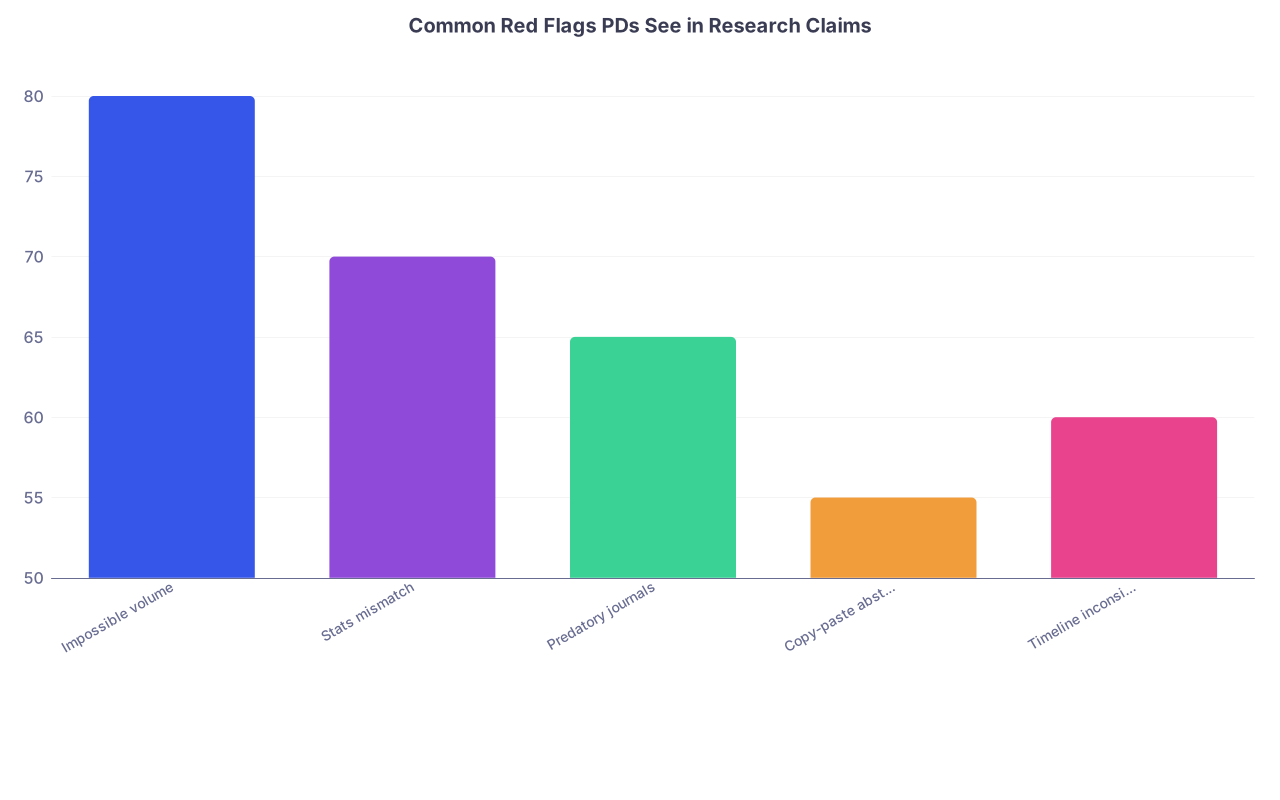
| Category | Value |
|---|---|
| Impossible volume | 80 |
| Stats mismatch | 70 |
| Predatory journals | 65 |
| Copy-paste abstracts | 55 |
| Timeline inconsistency | 60 |
Specific Tells: How PDs and Faculty Sniff Out Inflated Claims
Let’s get very concrete. These are the exact signals people use. I’ve heard these in rank meetings, verbatim.
1. Author Order and Project Type Don’t Line Up
If you’re first author on something highly technical—say, a complex imaging AI paper with deep learning pipelines—and you can’t explain, in human words, what was actually done, we know you didn’t “lead” that paper.
First author implies:
- You understand the research question, methods, and limitations in detail
- You were involved across the project life cycle: design, data, drafting, revisions
If we press you on those things and you can’t answer, we assume you got “gift authorship” or a ghostwritten first-author slot.
On the flip side: 15 middle-author case reports, all with the same attending, across multiple topic areas? That screams “sign on to group projects and write a paragraph in the intro.”
Is that the worst sin in the world? No. But don’t call that “designed and led” on ERAS.
2. The “I Don’t Remember” Problem
Ask yourself this: could you sit down, with just the citation, and talk through each paper on your CV for 5 minutes?
PDs use this simple test:
- Ask you to pick one project you’re proud of
- Dig into that project deeply
If you seem fuzzy on details—dates, role, mentor interactions, even what triggered the idea—they rapidly downgrade all your other publications in their mind. If you can’t remember the one you supposedly “led,” the rest are probably fluff.
I’ve sat in interviews where an applicant listed 8 papers and, when asked about one, said:
“Honestly that was a while ago, I don’t exactly remember the methods.”
Done. That’s it. You are now “CV inflator, low integrity” in the PD’s mental file.
3. Sloppy or Copy-Paste Abstracts
You’d be amazed how many people literally paste the published abstract text into ERAS, claim major intellectual involvement, and then can’t explain the study without reading off their own CV.
Faculty pick up on certain patterns:
- Highly polished, jargon-laden abstract text in ERAS
- But your interview speech about the same project is vague, full of hand-waving, and missing key numbers
A real contributor knows:
- The sample size (ballpark is fine: “around 180 patients”)
- The primary outcome and main effect direction
- One or two key statistics or p-values
- At least one concrete limitation
If your ERAS reads like a seasoned PhD wrote it but you talk about it like a student skimming a poster, that contrast is a huge tell.
4. Timeline vs Training Year: The Feasibility Test
PDs are constantly doing feasibility math in their heads.
“I see you were M3 in 2023–2024 and did a sub-I away rotation at our place. You also list three clinical trials that enrolled patients during that time, two with you as a primary data abstractor, and a multi-center registry you ‘coordinated.’ How?”
They know exactly how busy M3/M4 are. They know call schedules, rotation demands, shelf exams. If your research timeline suggests you were cloning yourself, they assume exaggeration.
People forget all your entries show dates:
- Start and end dates for experiences
- Publication dates
- “Work hours per week”
When these contradict each other or reality, you lose credibility.

| Step | Description |
|---|---|
| Step 1 | See heavy research on ERAS |
| Step 2 | Flag as inflated |
| Step 3 | Open PubMed / Google Scholar |
| Step 4 | Ask targeted questions on interview |
| Step 5 | Consider as genuine strength |
| Step 6 | Volume realistic? |
| Step 7 | Author order / journals make sense? |
| Step 8 | Verbal explanation matches CV? |
Ghostwriting and Paper Mills: What PDs Actually Recognize
No, we don’t have a secret database of which papers were ghostwritten. But patterns are very loud if you know where to look.
1. The “Bought Paper” Signature
This usually looks like:
- One-off paper in a totally random international journal with no connection to your med school’s usual collaborators
- Very generic topic, often public health or “cross-sectional survey of X” from a country you’ve never lived in
- You as middle author or co-author with 10–15 total authors, none of whom are from your institution
- No logical explanation when asked, “How did you end up working with this group?”
If you tell me you “met the mentor online” and “helped with manuscript editing,” but can’t name a single actual meeting, data file, or feedback round, I assume you paid or were gifted a slot. We’ve seen these schemes. We’ve read the ads.
Programs differ in how hard they penalize this. But the undercurrent is the same: if you’ll cheat now to get into residency, what will you do with patient care?
2. Predatory Journals and Fake Peer Review
PDs might not memorize every obscure journal, but the academic faculty around them do. In rank meetings, I have literally heard:
“Half of Applicant X’s publications are in journals on the predatory list. They were probably just shoveling content.”
There’s a quiet hierarchy:
- High-tier, reputable journals: trust is high
- Mid-tier, specialty-specific: generally respectable, context matters
- Low-impact but legitimate journals: fine, especially for students
- Predatory / vanity / known spam journals: huge red flag if they dominate your CV
One or two questionable outlets among several solid ones? Whatever. A whole stack of them? That’s not an accident.
The Dark Side of “Helping” on Papers: How Over-Claiming Backfires
Here’s the part most students never hear: plenty of faculty actually know you barely did anything on certain papers. Because they engineered it that way.
Common scenario:
- Big-name research attending runs 20 ongoing projects
- Residents need publications for fellowship
- Students are pulled in as warm bodies to collect a bit of data, do some chart reviews, maybe draft a section
- Everyone gets their name on something
That’s not always unethical. But the line gets crossed when you write your ERAS as if you:
- Designed the study
- Performed the main analysis
- Wrote the bulk of the manuscript
PDs love asking you to walk through your “main” paper. If your description of your role sounds much bigger than what your mentor would say if we cold-called them, that mismatch matters.
And yes, PDs sometimes do call people.
I’ve seen it:
- PD: “Hey, I’m looking at your former student, X. They say they led that large sepsis outcomes paper with you. Is that accurate?”
- Mentor: awkward pause, then, “They helped with chart review and some references, but the fellow did most of the heavy lifting.”
That applicant just tanked their credibility at that program.
How PDs Actually Weigh Research vs Integrity
Here’s the part most applicants don’t get: programs care less about how many papers you have and much more about what your behavior says about you.
We’re asking:
- Does this person exaggerate?
- Can they own what they know and admit what they don’t?
- Are they the kind of resident who will cut corners and then lie about it?
Because residency is full of opportunities to fudge reality. Did you examine the patient? Did you actually follow up that critical lab? Did you really staff the case with your attending?
An applicant who inflates research is doing a test run of that behavior.
So in the ranking room, the conversation sounds like this:
- “Technically strong, but I don’t trust their CV.”
- “Good clinical letters, but their research story fell apart on questioning.”
- “I’d rather take someone with 1–2 genuine projects they understand than 12 papers they can’t explain.”
And the “honest but modest” student often beats the “flashy but shady” one.
| Applicant Type | PD Interpretation |
|---|---|
| 1–3 solid projects, knows them well | Trustworthy, intellectually engaged |
| 8–10 papers, vague explanations | CV inflation, possible integrity issues |
| Mostly case reports, clear about role | Reasonable for level, honest effort |
| Predatory-heavy with big claims | Desperate, willing to cut corners |
| Strong research year, realistic output | Serious about academics, credible track |
If You Already Padded or Ghostwrote: Damage Control
Let’s deal with the uncomfortable scenario: you already have questionable entries. You exaggerated your role. You “sort of” helped on something and claimed more. Or you got dragged into one of those sketchy paper mills.
You’re not the first. You won’t be the last. But you do need to be strategic.
1. Stop Lying Upward
From this point forward, don’t add more inflation. Don’t upgrade “edited a few sentences” to “co-wrote the manuscript.” If anything, dial your claims down to what you can comfortably defend under pressure.
On ERAS or in your personal statement, describe:
- What you actually did: data collection, literature review, figure formatting, proofreading
- What you did not do: statistical design, protocol writing, primary authorship
You’ll seem more mature and grounded. Faculty notice when students are very precise about their contribution. That’s a green flag.
2. Know Every Paper Cold
If it’s on your CV, it’s fair game. So you:
- Re-read every published paper with your name on it
- Skim at least once any major paper that’s “submitted” or “in preparation”
- Jot down the key facts: question, methods, sample size, key result, limitation, your actual role
If in doubt, drop it from the “featured” projects you plan to talk about when they say “tell me about your research.”
3. Own the Learning Curve (Carefully)
You don’t need to confess, “I padded my CV, forgive me.” That’s not going to help you.
You can, however, frame things honestly if probed:
- “That was early in my research experience. My role was relatively limited to data entry and a small section of the intro, but it got me interested in doing more meaningful projects later.”
That kind of sentence is exactly how you defuse suspicion and redirect them to projects you actually understand.

How To Build a Research Story PDs Actually Respect
You want the opposite of ghostwritten and inflated. You want a research profile that feels coherent, believable, and owned.
Here’s what that looks like from the PD side.
1. A Coherent Narrative, Not Random Noise
The best applications tell a simple, consistent story:
- “I got involved in quality improvement in M2 after seeing X problem on the wards.”
- “That led to a small retrospective study, then a prospective QI intervention.”
- “Now I’m genuinely interested in outcomes research in this field.”
Publications may be few. But the continuity makes sense.
Compare that with:
- One paper in orthopedic surgery
- One in dermatology
- Two random global health papers from another continent
- A neurology AI imaging study
All in unrelated groups, across different countries, with you as middle author, with no supervising continuity.
That looks like someone chasing lines on a CV, not building expertise.
2. An Appropriate Level of Sophistication
You’re a med student or early resident. We don’t expect you to have PI-level mastery.
We do expect:
- Clear understanding of the question and why it mattered
- A basic grasp of the design (retrospective vs prospective, observational vs interventional)
- Awareness of the biggest limitation and how it affects interpretation
You earn a lot of respect by saying:
“I didn’t design the study—that was my mentor and the fellow—but I learned a lot about X by doing Y.”
That’s how grownups talk about collaborative work.
3. Humility Plus Curiosity
When in doubt during an interview, say the honest thing:
- “I don’t know the exact details of that part of the analysis. I was more involved in the data collection and initial drafting. But my understanding is that…”
That’s miles better than trying to fake expertise and getting nailed on follow-up.
The residents we want are the ones who say “I don’t know” on rounds before they go look it up, not the ones who bluff.
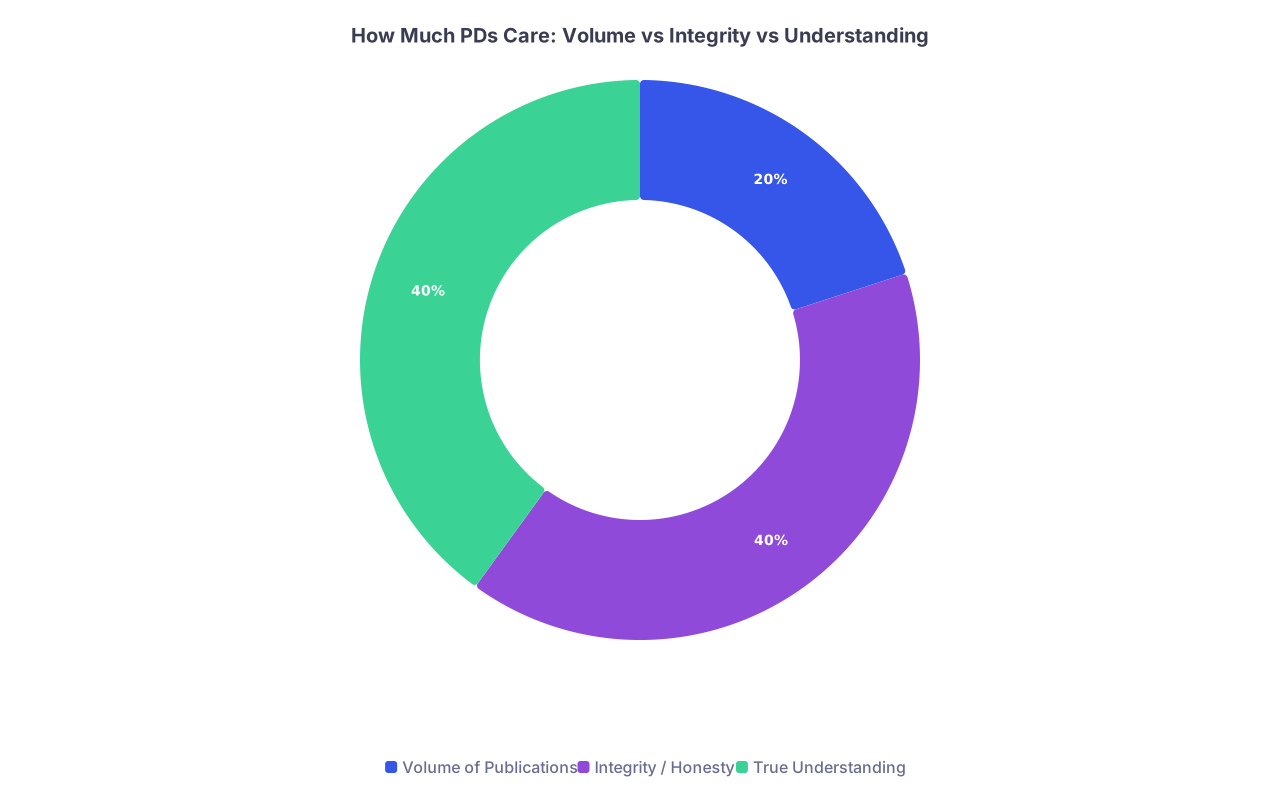
| Category | Value |
|---|---|
| Volume of Publications | 20 |
| Integrity / Honesty | 40 |
| True Understanding | 40 |
FAQs
1. Is it better to leave off sketchy or low-quality papers from my CV?
If you truly did work on them, you don’t have to erase history. But if a paper is:
- In a clearly predatory journal
- One where your role was essentially zero
- Something you can’t comfortably defend
You’re often better off not spotlighting it. Keep it listed if you must, but don’t use it as your flagship project and don’t exaggerate your role. If you feel sick at the idea of being asked about it—that’s a clue.
2. What if my mentor really did write most of the paper but put me as first author?
That happens. Senior mentors sometimes gift first authorship for effort in earlier phases. Your job is to tell the story accurately:
- “I led data collection and the initial draft. My mentor did a lot of the heavy lifting on the final analysis and revisions.”
If that’s how it went, say so. Nobody expects you to have single-handedly written a flawless RCT as a student. They do expect honesty about contribution.
3. How many publications do I “need” to be competitive?
For most residencies (even competitive ones), you don’t “need” a specific number. One to three genuine, well-understood projects are often enough. A productive research year may give you more, but beyond a certain point, marginal publications add very little. The curve flattens quickly. Quality, coherence, and your ability to talk about them matter much more than raw counts.
4. How do I prepare for research questions on interview day?
Do a focused prep:
- Make a one-page summary per key project: question, design, role, main result, limitation
- Practice explaining each project in 60–90 seconds, in plain language
- Anticipate follow-ups: “What did you actually do?” “What was hardest?” “What did you learn?”
If you can talk through 2–3 projects clearly and humbly, you’ll outperform the applicant with 10 papers and foggy answers.
Three things to remember.
First, PDs and academic faculty are very good at smelling nonsense; impossible volume, mismatched skills, and vague answers will hurt you more than no research at all.
Second, your research record is less about how “impressive” it looks and more about what it says about your honesty, judgment, and ability to own your work.
Third, a small number of real, coherent projects you truly understand will beat a ghostwritten, inflated CV every single time—especially once you’re sitting in front of someone who’s spent 20 years doing this for real.