What do you think a program director sees when they read a personal statement that screams “I did research” but quietly whispers “I learned nothing”?
If you frame your research badly in your residency personal statement, it doesn’t just “fail to help” you. It actively hurts you. It raises red flags you didn’t intend. It makes programs question your judgment, your insight, and sometimes your honesty.
Let me walk you through how that happens—and how to avoid burning yourself with something that was supposed to be a strength.
The Biggest Misconception: “Any Research Is Automatically Good”
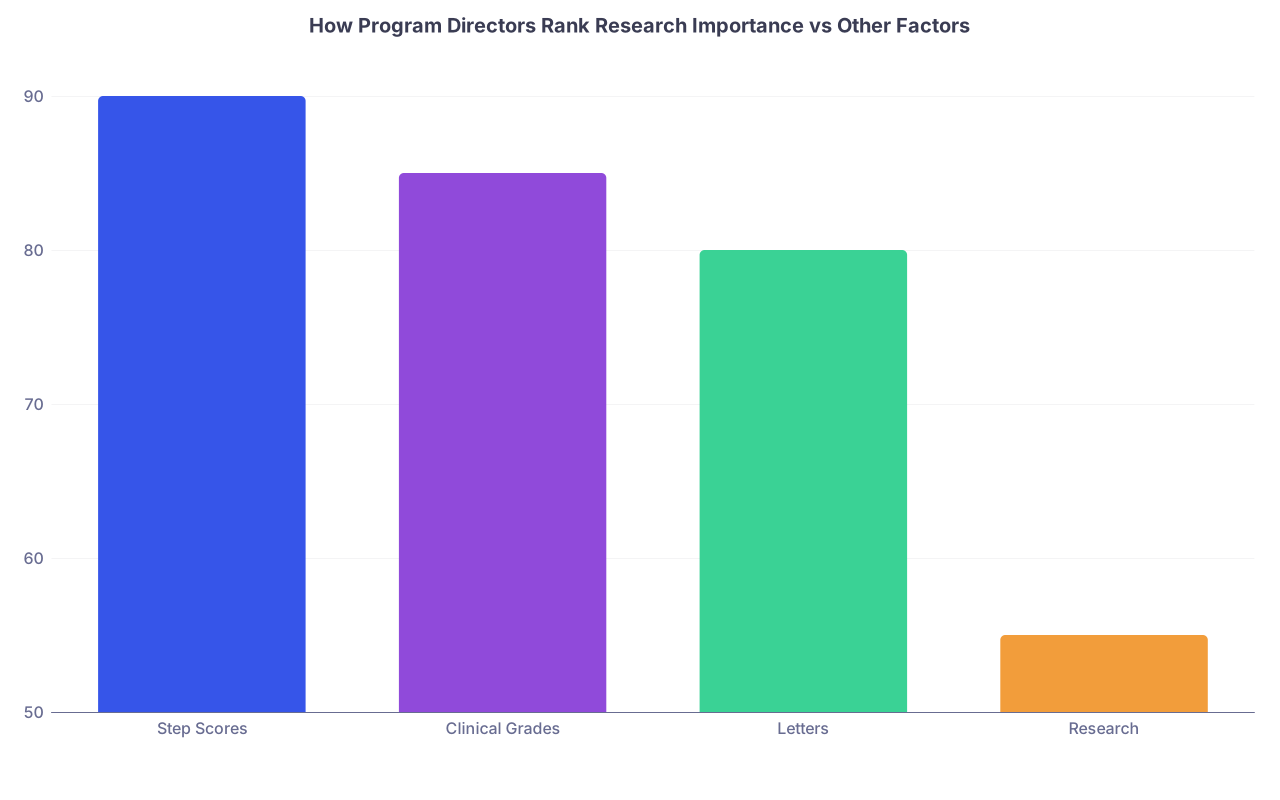
| Category | Value |
|---|---|
| Step Scores | 90 |
| Clinical Grades | 85 |
| Letters | 80 |
| Research | 55 |
Here’s the first mistake: believing that simply having research means you should shove it front-and-center in your personal statement.
Programs don’t reward you for “doing research.” They care whether it:
- Shows you can think.
- Shows you’re intellectually honest.
- Shows you understand the specialty.
- Shows some maturity about uncertainty and failure.
If your personal statement turns your research into:
- A brag list of publications
- A vague “I did research and loved it”
- A disconnected side quest that has nothing to do with your clinical identity
…then your “strength” becomes a liability.
I’ve watched selection meetings where someone says, “This PS is basically a research grant application. Do they even like taking care of patients?” And that applicant drops on the rank list.
Do not be that person.
Mistake #1: Making Your Personal Statement a Mini-CV of Research
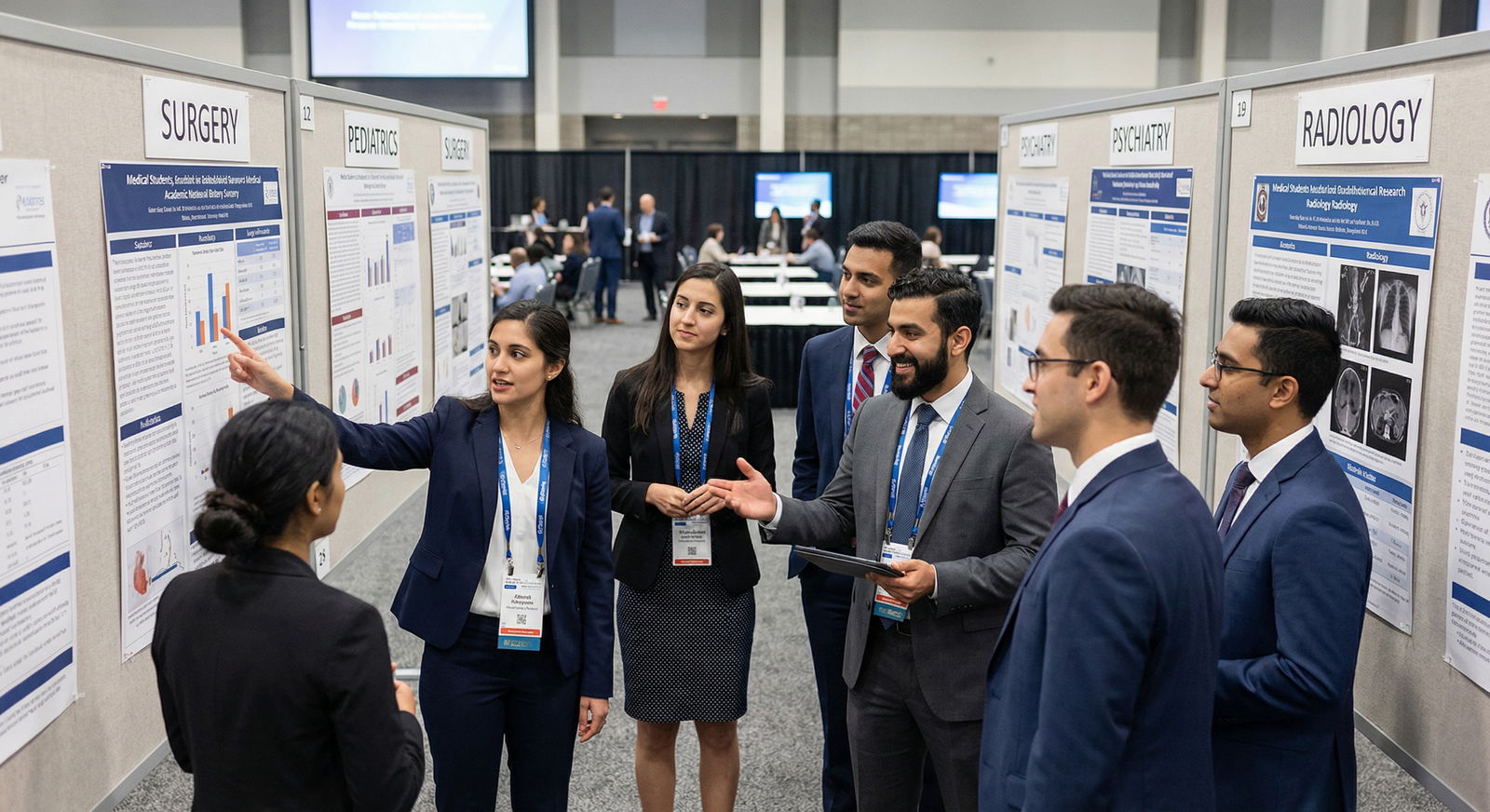
The classic failure: using your personal statement to recite everything already in ERAS.
You’ve seen this structure:
“I worked in the Smith Lab where I studied X. I presented at Y conference. I published in Z journal. Then I worked in another lab on A. We used B technique. I again presented at C meeting…”
You might think this screams productivity. It actually screams three things to a reviewer:
- You don’t understand the purpose of a personal statement.
- You’re insecure about your research and overcompensating.
- You may be boring to talk to.
The personal statement is not:
- A methods section
- A bibliography
- An abstract repository
It’s about who you are as a future resident. Not “how many posters I cranked out under a desperate PI.”
How this backfires:
- They assume you lack reflection.
- They assume you can’t prioritize what actually matters.
- They worry that you’ll talk like this on rounds—facts without interpretation.
How to avoid this:
- Pick one or at most two research experiences that actually shaped you.
- Focus on what changed in your thinking, not how many PubMed IDs you collected.
- If a detail doesn’t show growth, judgment, or curiosity—cut it.
You want them thinking, “This person uses research to think better,” not “This person knows how to grind out posters.”
Mistake #2: Over-Claiming Your Role and Getting Caught in an Interview
This one kills people.
You write: “I led a project that demonstrated…”
Reality: you entered data into REDCap, missed half the meetings, and your name is third author.
Program directors and faculty are not stupid. They’ve seen thousands of applications. Your wording choices signal whether you’re honest or inflating.
Risky phrases that raise eyebrows:
- “I led a project…” (Did you actually lead? Or were you one of eight sub-I’s?)
- “I designed a study…” (Did you create the protocol? Or suggest one idea in a meeting?)
- “I wrote a manuscript…” (Or did you help with the intro and never touch revisions?)
Then comes the interview:
Attending: “So tell me about how you designed this RCT.”
You: “Um…well…my mentor mostly did that part.”
Boom. Credibility gone.
One awkward research conversation can nuke all the nice things in your letters. People remember when they feel misled.
Here’s the rule:
If you can’t clearly walk someone through:
- The study question
- The basic design
- Your specific role
- One limitation
- One thing you’d do differently
…you should not frame yourself as “leading” or “designing” that project.
Better phrasing that doesn’t backfire:
- “I contributed to data collection and preliminary analysis for…”
- “I assisted with drafting the introduction and discussion for…”
- “As part of a team of students, I worked on…”
It sounds less glamorous, but it sounds honest. And honesty is worth more than fake “leadership” in research.
Mistake #3: Making Research Sound Totally Detached From Patient Care

| Step | Description |
|---|---|
| Step 1 | Research Experience |
| Step 2 | Insight Gained |
| Step 3 | Impact on Clinical Thinking |
| Step 4 | Relevance to Chosen Specialty |
Another big red flag: research paragraphs that could have been written by someone who never stepped into a hospital.
Typical offending lines:
- “This experience solidified my love for research.”
- “I discovered my passion for data analysis.”
- “I realized how much I enjoy working independently at a computer.”
Programs are not hiring PhD students. They’re hiring residents who will:
- Show up at 5:30 AM
- Talk to families
- Manage a crashing patient at 2 AM
If your PS makes it sound like you’d rather be in a quiet office with SPSS than in a noisy ED, you’re tanking your application. Especially in patient-heavy fields like EM, FM, IM, OB/GYN, peds.
You can love research. Just don’t accidentally imply you prefer it over clinical work.
To avoid this:
Tie every research insight back to:
- How you think about patients
- How you approach uncertainty
- How you assess evidence at the bedside
Example of bad framing:
“My project studying biomarkers in sepsis inspired me to pursue a career in research-driven medicine.”
Vague. Detached. Self-centered.
Example of good framing:
“Working on a sepsis biomarker project forced me to confront how messy real-world data is. Now, when I’m admitting a borderline patient from the ED, I think more critically about which labs actually change management and which I’m ordering out of habit.”
That second version makes you sound like a real clinician who uses research to make better decisions—not a statistician who somehow ended up in residency.
Mistake #4: Over-Focusing on Technical Detail and Losing the Reader
If your research paragraph reads like a methods section, you’ve already lost.
Red-flag sentences:
- “We used a mixed-effects multivariate regression model to control for confounding variables…”
- “Using CRISPR-Cas9 mediated gene editing…”
- “We performed LC/MS-based metabolomic profiling…”
The problem isn’t that faculty don’t understand the methods. The problem is that they don’t care. Not in your personal statement.
All they want to know is:
- What were you trying to figure out?
- What was hard about it?
- What did you learn from the difficulty?
Technical flexing signals insecurity. It reads like, “Please think I’m smart.” It also makes them worry you explain everything this way—over-detailed, under-focused.
Here’s the fix:
- Cut 80% of the technical detail.
- Replace it with: the question, the challenge, the impact on your thinking.
For example:
Instead of:
“We employed a Bayesian hierarchical model to adjust for center-level variation…”
Use:
“Because each hospital treated patients a bit differently, we had to account for that variation before making any conclusions. That taught me how easy it is to draw the wrong lesson from complex data if you aren’t careful about bias.”
See the difference? That’s interpretable by literally any physician. And it actually shows judgment.
Mistake #5: Treating Research as a Flex to Justify a Competitive Specialty
| Specialty | Typical Research Depth Expected |
|---|---|
| Dermatology | High |
| Radiation Onc | High |
| Neurosurgery | High |
| Internal Medicine | Moderate |
| Family Medicine | Low-Moderate |
If you’re applying to something like derm, rad onc, neurosurgery, ortho, plastics—you probably feel pressure to scream “I did research!” from the rooftops.
The trap: using your research as your only justification for why you belong in that field.
I’ve seen personal statements like:
“My passion for dermatology was ignited by my research on psoriasis biomarkers…”
Ok. But do you care about the patients? Can you handle clinic volume? Do you understand anything about longitudinal care? Or do you just like keratinocytes and high-impact journals?
Programs want people who can function as clinicians first. Research is gravy. Not the main course.
When your PS reads like:
- “I want derm because I did derm research.”
- “I want ortho because I did ortho biomechanics research.”
…faculty wonder if you’d still want the field if your PI had been in nephrology instead.
Fix this by:
- Anchoring your motivation in clinical experiences.
- Showing that research deepened, not created, your interest.
- Making it clear you’d still want the specialty even if you never published again.
Mistake #6: Dodging the Reality of Failure and Uncertainty
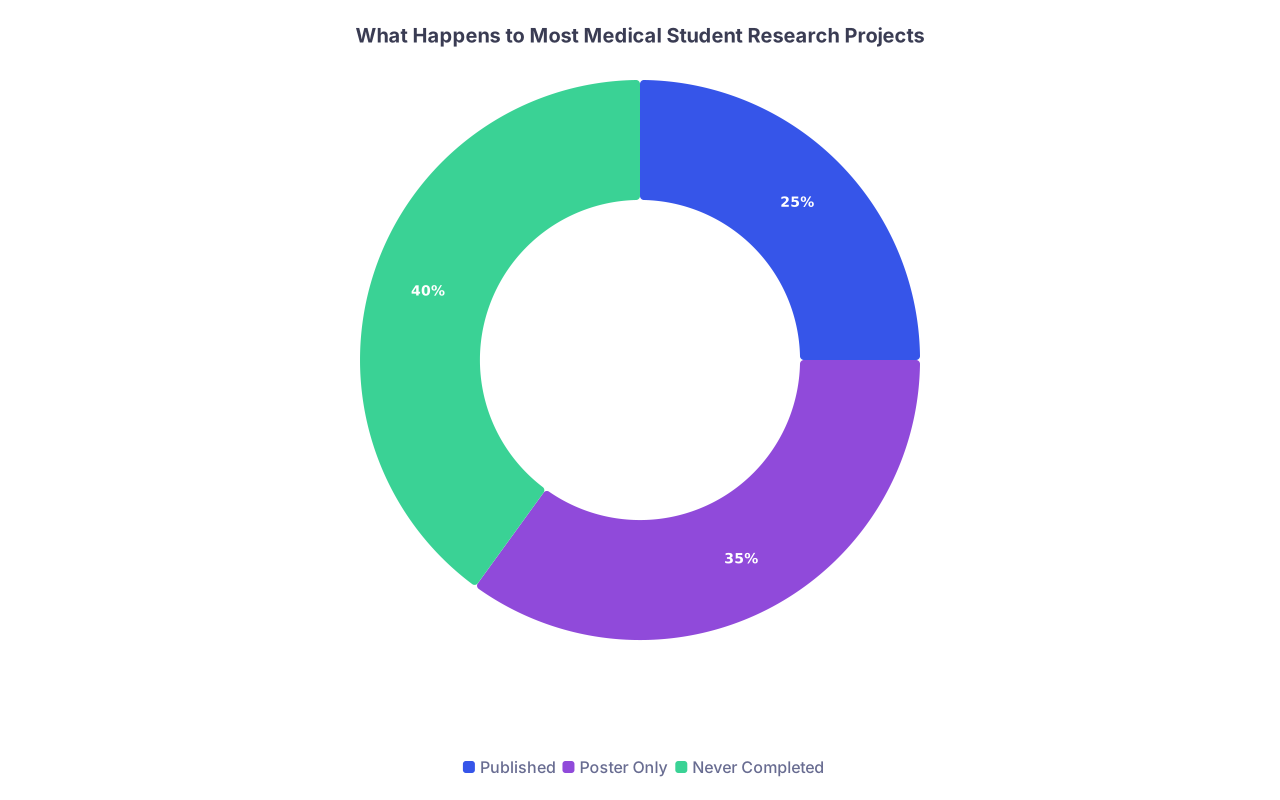
| Category | Value |
|---|---|
| Published | 25 |
| Poster Only | 35 |
| Never Completed | 40 |
Most student research does not become a paper in JAMA. Programs know this.
So when every sentence in your PS makes your research sound clean, linear, and triumphant, it looks fake.
Red flags:
- “We found a significant result that changed practice.” (Did it really? At your local clinic maybe.)
- “I realized that research always yields clear answers.” (No, it doesn’t.)
- “Our study was a complete success.” (Nothing ever is.)
Strong applicants don’t hide the mess. They show they learned from it.
Better framing:
“Our initial analysis suggested an exciting effect, but when we adjusted for missing data, it mostly disappeared. That was humbling. It reminded me that medicine is full of tempting but misleading shortcuts.”
“The project dragged on for months longer than expected because of IRB delays. It forced me to practice patience and keep showing up even when there was no immediate reward.”
That kind of honesty signals maturity. Programs like residents who understand that real clinical work is full of delays, ambiguity, and partial answers.
When you pretend everything in your research was neat and glorious, you sound either naïve or dishonest. Neither plays well.
Mistake #7: Copy-Paste Generic “Research Is Important” Language
You’ve seen these paragraphs:
“Research is critical to advancing the field of medicine. It allows us to develop new treatments and improve patient care. Through my research, I have gained an appreciation for the importance of evidence-based practice…”
This language is dead. Faculty’s eyes glaze over. They’ve read versions of this 500 times.
Why it backfires:
- It sounds like ChatGPT, not like you.
- It wastes precious space saying things everyone already knows.
- It makes them doubt you have any real, specific insight.
Instead of announcing that “research is important,” show one actual moment where research intersected with reality:
- A patient who didn’t fit the evidence
- A paper that changed how your team treated something
- A trial you discussed on rounds that affected real people
Specific beats generic every single time.
Mistake #8: Over-Centering Yourself and Erasing the Team
Research is a team sport. When you write like you did everything yourself, people who actually do research start rolling their eyes.
“I developed…”
“I conducted…”
“I wrote…”
“I presented…”
Maybe you did. But usually, you did that with:
- A PI
- A resident or fellow
- A statistician
- Other students
When you erase them, you signal poor insight into how academic work actually happens—and possibly poor collegiality.
Better framing:
- “Working with my PI and a senior resident, I helped develop…”
- “Under the guidance of our statistician, I performed…”
- “As part of a small team, I presented…”
Little words like “with” and “helped” go a long way. They don’t diminish you. They make you sound grounded and believable.
Programs want residents who can function in teams. If your PS makes you sound like a solo genius, that’s not a compliment. It’s a warning.
Putting It Together: What Good Research Framing Actually Looks Like

| Step | Description |
|---|---|
| Step 1 | Clinical Motivation |
| Step 2 | Relevant Research Experience |
| Step 3 | Challenge or Setback |
| Step 4 | Insight Gained |
| Step 5 | How You Will Be as a Resident |
Here’s a skeleton that doesn’t backfire:
- Briefly set the context: clinical or personal reason you care about a question or population.
- Introduce one key research project connected to that context. One or two sentences, simple language.
- Describe a challenge, failure, or complexity in that project.
- Reflect on what that taught you about:
- Evidence
- Bias
- Uncertainty
- Systems of care
- Tie that insight directly to how you will think and behave as a resident in that specialty.
You’ll notice what’s missing:
- Overblown claims
- Verbose methods
- Publication counts
- Hero narratives
You’re not trying to convince them you’re a future Nobel laureate. Just that you’re smart, honest, curious, and realistic.
FAQs
1. If I have no publications, should I even mention my research in my personal statement?
Yes—but carefully. Don’t pretend it’s more than it is. You can say you worked on a project that’s “in progress” or “submitted,” but the key is to focus on what you actually did and learned. A well-framed, unfinished project is far better than an exaggerated “almost publication” that falls apart in an interview.
2. How much of my personal statement should be about research?
For most applicants, research should be a section, not the whole story. Rough rule: maybe 20–30% of the statement if research is significant for you. If you’re applying to a very research-heavy specialty and you have serious depth, you can push it higher—but only if you still clearly show clinical motivation and identity.
3. What if I did research in a completely different field than the specialty I’m applying to?
That’s fine, and common. Just don’t pretend it directly “made you love” the specialty if it didn’t. Instead, highlight transferable skills: critical thinking, handling uncertainty, writing, working with a team. Then connect those skills to the kind of resident you’ll be in your chosen field.
4. Is it a problem if I can’t explain the statistics in detail?
You should understand the basics of what your team did and why. You don’t need to be a statistician, but if you can’t explain the core idea of the analysis in plain language, it’s a sign you didn’t really engage with the project. In your PS and interviews, describe the statistics conceptually, not with jargon—what problem were you solving by using that method?
5. Can I reuse parts of my med school research essay for my residency personal statement?
You can reuse ideas, not copy-paste text. Residency readers want to know who you are now as a graduating medical student, not who you were as an M1 writing for AMCAS. Old essays also tend to have that generic “research is important” fluff. Strip the clichés, keep the real stories and insights, and reframe them to show how they shaped you as a future resident.
Key points to walk away with:
- Poorly framed research doesn’t just “fail to help”—it actively undermines your credibility and clinical identity.
- Focus on honest roles, clear insights, and direct links between your research and how you’ll think and act as a resident.
- If a research sentence doesn’t show judgment, growth, or relevance to patient care, it belongs in your CV, not your personal statement.