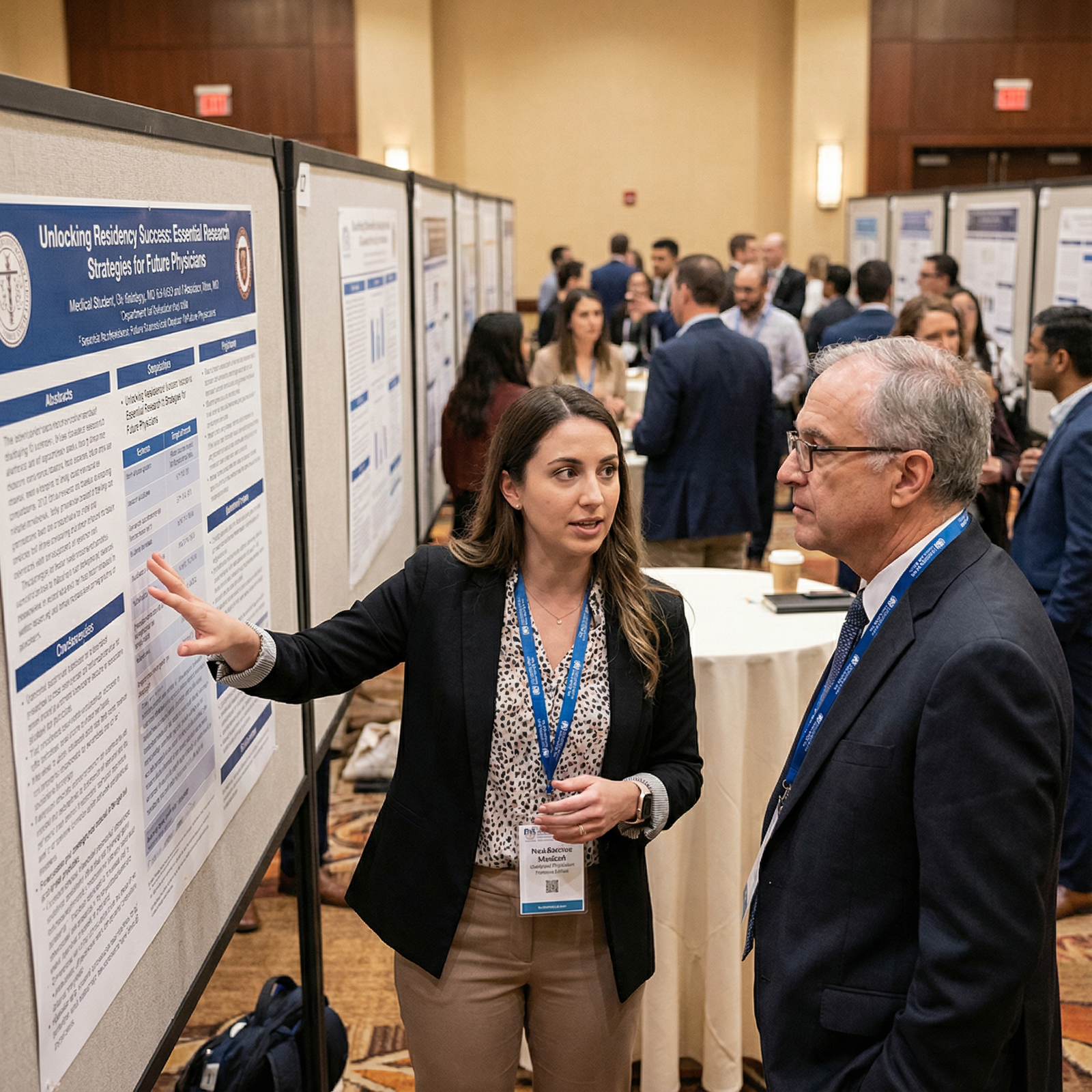
What happens when the “20 posters” on your ERAS turn into the reason a PD quietly moves your file to the rejection pile?
Let me be blunt: research posters can absolutely help your residency application. They can also make you look dishonest, clueless, or worse — inflated and unpleasant to work with.
I’ve watched program directors scroll through ERAS, stop at an applicant listing 18 “poster presentations,” snort, and say: “Okay, let’s see how fake this gets.” That’s the reaction you’re trying to avoid.
This isn’t about scaring you away from conferences. It’s about stopping you from stepping on the landmines that turn “research experience” into a giant red flag.
1. The Biggest Trap: Calling Everything a “Poster Presentation”
Here’s the first mistake almost everyone makes: treating every association of your name with a poster as if you personally presented it.
Program directors know the game. They know how group posters work. Five, ten, sometimes fifteen names. One or two people actually stand at the board. The rest? Technically authors. Not presenters.
The trap is this: you list every single poster on ERAS as if you were the one in front of it.
Red flag phrases in a PD’s head:
- “Inflated”
- “Dishonest”
- “Doesn’t understand academic norms”
- “Will be a headache in a research-heavy program”
You want none of those.
How you get yourself in trouble
Classic scenario:
You: “I presented 12 posters at national conferences.”
Interviewer: “Wow, that’s a lot. Tell me about the one you presented at AHA 2023. What was your role on that project?”
You (panicking internally): “Uh, I was third author. Our PI couldn’t make it… I helped with data collection… I, uh, contributed to the poster…”
They quickly realize: you never actually presented it.
You’ve just told them — to their face — that your CV is “aspirational.”
Fix: Differentiate clearly between roles
You avoid this trap by being painfully, almost annoyingly clear about your role.
On ERAS:
- Use “Poster author” vs “Poster presenter” intentionally.
- If you never stood at the board during the session, you were not the presenter. You were an author.
A better pattern:
- “Smith J, You R, et al. ‘Title.’ Poster presented at ACC, 2024. Role: data analysis, figure creation, co-author of abstract.”
- Only say “Presented by [Your Name]” when you actually stood there during the assigned session.
If your school or mentor pushed you to list everything as “presented” — do not follow that advice blindly. They are not the one being grilled in a residency interview. You are.
2. The “Impressive but Empty” Poster Farm
The second major trap: posters with zero substance behind them.
I’ve seen applicants with:
- 10+ posters
- 0 manuscripts
- Vague project descriptions
- No concrete numbers
- No idea how the analysis was done
Program directors are busy, but they’re not stupid. When they see a poster farm — huge volume, no depth — they get suspicious fast.
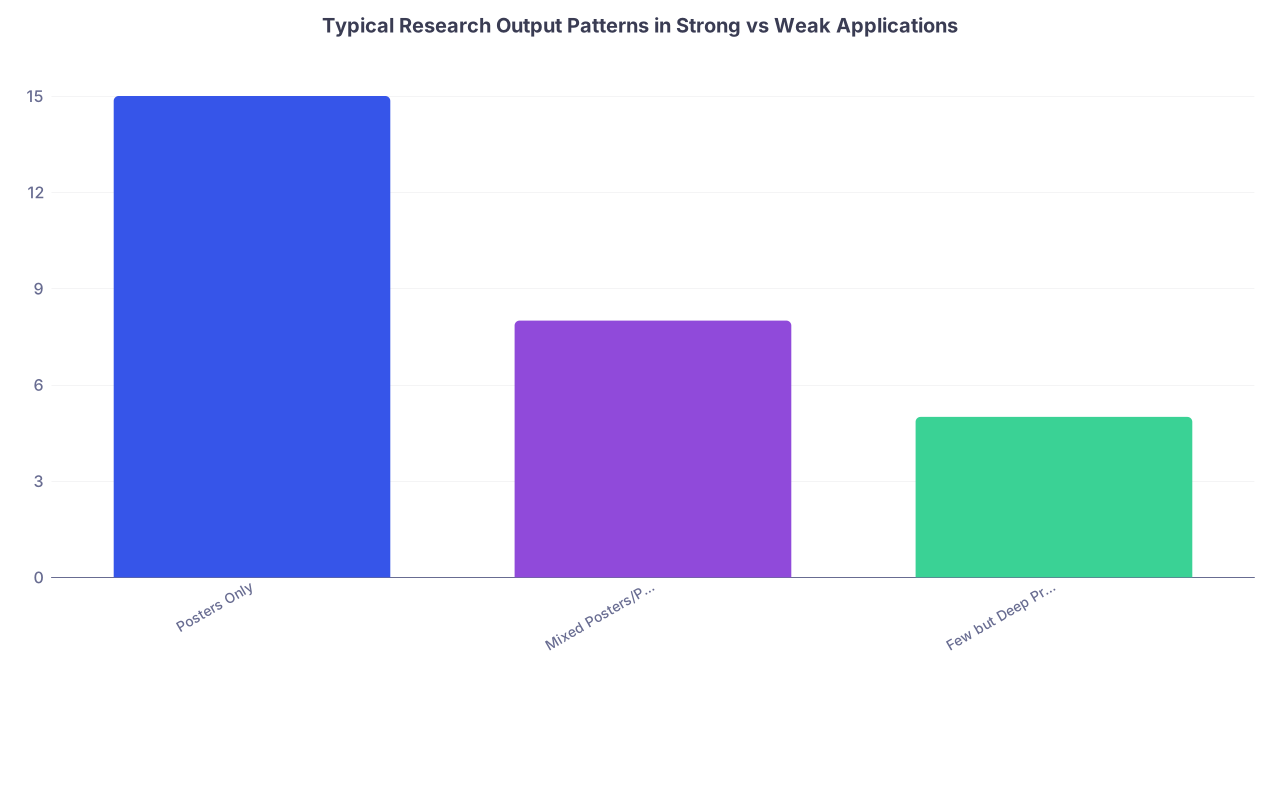
| Category | Value |
|---|---|
| Posters Only | 15 |
| Mixed Posters/Pubs | 8 |
| Few but Deep Projects | 5 |
Guess which group gets more respect? It’s not the one with the most posters.
Signs your posters are fluff
If any of these are true, you’re drifting into red flag territory:
- You “helped” on more posters than you can describe in detail.
- You can’t explain the primary outcome, main result, or stats method for multiple projects you’re listed on.
- You need to re-open the PDF to even remember what the project was.
- You list every local quality improvement poster from a tiny internal event like it was an international conference.
Posters are supposed to represent real engagement. Not attendance certificates.
What PDs really think seeing 15+ posters and no publications
I’ve literally heard:
- “This is a CV padded to death.”
- “They say they’re ‘interested in academic medicine’ but have never taken a project beyond poster stage.”
- “Either their mentor never publishes, or they give up early.”
You do not want to be the candidate who looks like they stopped at the lowest bar of academic output every single time.
Safer strategy
You don’t need a thousand posters. What you need:
- A few posters you can discuss in depth, including:
- Question
- Design
- Methods
- Main result
- Limitations
- Ideally 1–2 projects that moved beyond poster: in review, accepted, or submitted manuscripts.
- Evidence you followed something from idea → data → poster → paper (even if it’s still in process).
If you have many superficial poster lines and nothing deeper, you’ve built a house out of styrofoam.
3. Mislabeling and Misclassifying: How You Accidentally Lie
You will get burned if you:
- Call a local student research day “National Conference”
- Label an institutional QI day as “Regional Meeting”
- Put “Oral presentation” when you mean “3-minute poster pitch”
- Inflate your role: co-author → “primary author”; “helped with data” → “principal investigator”
These look like small tweaks. They are not. To people who live in academia, they’re neon signs: “I bend the truth when it benefits me.”

The worst offenders
Watch for these:
- Upgrading your conference level:
- “Institutional research day” → “Regional conference”
- A hospital grand rounds abstract → “Invited oral presentation at regional meeting”
- Calling yourself “first author” because the PI says “you did most of the work,” but the abstract shows you second or third.
- Listing “accepted poster” with no date, no location, and no category — because it was only submitted, never accepted.
Residency programs cross-check. They Google abstracts. They recognize conference names. They attend the same meetings. Do not test them.
How to list things correctly (and safely)
Keep it clean and defensible:
Conference type:
- Institutional: within your school/hospital
- Regional: multi-institution within a geographic area
- National/International: recognized large professional body (ACC, RSNA, ASCO, ATS, etc.)
Status:
- “Abstract submitted” ≠ “accepted”
- “Accepted” is not the same as “presented” if no one actually went
If you never traveled, never logged in to a virtual platform, never stood by the poster, you did not present it.
4. The “I Don’t Remember That Project” Interview Disaster
Here’s where the trap really snaps shut: the interview.
Programs love to pick something from your CV and say:
“Tell me about this project.”
That’s not a casual question. They’re testing:
- Ownership
- Honesty
- Intellectual engagement
- Whether your CV is real
If you have more posters than you can remember, you’re at high risk of this scenario:
Interviewer: “Walk me through your poster on ‘Risk factors for readmission after CHF hospitalization’ at ACC 2022. What was your main finding?”
You: “… I would have to look that up. I helped with data collection. I don’t remember the exact results.”
You just told them:
- You put your name on research you never really understood.
- You cannot stand behind what you claim as your work.
Huge trust hit.
The safe rule: If you can’t defend it, don’t list it
Before you add any poster to ERAS, ask yourself:
- Can I explain the research question clearly?
- Do I understand the study design and main analysis?
- Can I summarize the key results in 2–3 sentences?
- Do I know my specific role and contribution?
If the answer is no, you either:
- Need to review the project properly, or
- Need to leave it off
Yes — leave it off. Better to have fewer believable entries than a bloated list that collapses under basic questioning.
5. Low-Yield Conferences and Predatory Meetings
Another trap I see constantly: chasing any conference that will say yes just to pad your CV.
Some meetings are:
- Poorly attended
- Non-peer-reviewed
- Clearly pay-to-play
- Unknown to anyone outside a tiny bubble
Are these automatically useless? No. But if most of your posters belong to that category, your CV starts to look…off.
| Conference Type | PD Reaction (Typical) |
|---|---|
| Major national society | Strong, credible |
| Specialty subsociety/regional | Reasonable, context-dependent |
| Institutional research day | Fine, but lower weight |
| Predatory / pay-to-play | Skeptical to negative |
You don’t want your poster list made entirely of conferences that sound like spam emails.
Red flags that a conference is low-credibility
Watch for:
- Extremely fast abstract “acceptance” for almost everything.
- High fees but very little organization or recognized faculty.
- Not affiliated with any known society or academic institution.
- Overly generic titles like “World Congress on Medicine & Healthcare Innovation 2025” with no clear specialty anchor.
Programs do not care that you flew to an obscure, half-empty meeting in another country to present a five-minute poster that no one saw.
They care whether your research experience means you’ll contribute meaningfully as a resident.
Better strategy
Prioritize:
- Your institution’s research day (this is fine, especially early on).
- Regional or national meetings linked to real societies in your field.
- Fewer good conferences over many random ones.
If you must present at a tiny or niche conference, fine. Just don’t over-sell it. And don’t build your entire “research identity” on them.
6. Over-Indexing on Posters to Hide a Weak Application
Here’s the harsh truth: some applicants use posters as camouflage.
Low Step score? Weak clinical grades? No real letters? They try to cover all of that with sheer volume of research lines — mostly posters.
Program directors can spot this pattern in about 5 seconds:
- 2 failed attempts at Step 1 or 2
- Marginal clerkship comments
- Dozens of posters, zero papers, no awards, generic letters
They see it as:
“You’re trying to distract me.”
Posters are supposed to support a solid clinical application. Not replace it.
How to avoid this impression
Use posters strategically:
- A handful to show you’ve engaged in research
- A few with clear continuity (same mentor, same topic)
- Evidence of follow-through (submitted/accepted manuscripts, conference follow-ups, QI projects implemented in practice)
If your personal statement screams “future academic” but your record shows 15 posters and nothing rigorously completed, you look like you love checking boxes, not actually doing work.
7. Authorship Order and Credit Games
Another subtle trap: playing games with authorship and “primary investigator” titles.
I’ve heard applicants say:
- “I was essentially first author, but my name is second.”
- “My mentor is technically first, but I did most of it.”
- “We’re all ‘co-first authors’ but the abstract doesn’t say that.”
On paper, none of that matters. PDs read what’s printed. If you’re listed third, you are third.
Trying to verbally reassign authorship in the interview is a bad look. It suggests:
- Ego
- Difficulty playing on a team
- Discomfort with academic norms
If you claim “PI” or “primary investigator” as a med student, you’re also asking for trouble. That title carries real regulatory and legal meaning in research.
How to describe your contribution without exaggeration
Do this instead of inventing titles:
- “I led data collection and analysis.”
- “I wrote the first draft of the abstract.”
- “I designed the survey and worked with my mentor on the protocol.”
- “I coordinated the student team and handled revisions.”
That’s strong. Honest. Clear. No fake promotions needed.
8. How to Poster Smart (Without Creating Red Flags)
Let me pull this together into a safer roadmap.
Poster presentations are helpful when:
- They show progressive engagement:
- Early: helping with data, being middle author
- Later: leading a project, presenting yourself, drafting manuscripts
- They’re truthful:
- Role and level of involvement match what’s on ERAS
- Conference types and names are accurate
- You’re prepared:
- You can discuss every listed project without scrambling
- You understand the methods and limitations, not just the title
Here’s a clean mental checklist before you hit “submit” on your ERAS research section:

| Step | Description |
|---|---|
| Step 1 | Poster on your CV |
| Step 2 | Remove or review deeply |
| Step 3 | Fix author/presenter/PI labels |
| Step 4 | Correct to institutional/regional/etc. |
| Step 5 | Consider trimming low-yield entries |
| Step 6 | Safe to keep |
| Step 7 | Can you explain it clearly? |
| Step 8 | Role accurately labeled? |
| Step 9 | Conference type accurate? |
| Step 10 | Reasonable number overall? |
If you’re honest at each step, you’ll avoid most of the traps I see every single cycle.
FAQ (4 Questions)
1. Is it bad if I only have institutional or local poster presentations and no national conferences?
No, not inherently. For many students, especially without strong research infrastructure, institutional research days are all they realistically get. The problem isn’t “only local,” it’s pretending local is national or inflating its importance. If you can talk about the project thoughtfully, show real involvement, and ideally show progress beyond a single poster (manuscript in progress, QI implementation, etc.), you’re fine.
2. Should I list posters where I was just a minor contributor on a large team?
Only if you can actually discuss the work. Being author #12 on a big multi-center project is not shameful. But if you barely remember the study question and never saw the analysis, listing it creates risk in interviews. A smaller number of posters you truly understand beats a giant list padded with work you can’t explain.
3. How many posters is “too many” before it starts to look suspicious?
There’s no fixed number, but context matters. Five to ten posters with clear continuity and a couple of related manuscripts looks strong. Fifteen to twenty posters with no publications, scattered topics, and vague roles looks inflated. Once you pass ~10, each additional poster should earn its place: substantial role, clear impact, and something you can defend easily.
4. What if I submitted a poster that was accepted but I couldn’t attend the conference — can I still say I ‘presented’ it?
No. You can list the abstract as “accepted poster” or “accepted for presentation,” but you should not say you presented it if you never actually did. That distinction matters. If asked, you can explain: “The abstract was accepted to [Conference], but due to scheduling/funding I was unable to attend. I still completed the work and am working toward publication.” Honest, clean, no games.
Key points to walk away with:
- Do not inflate your role, your conference level, or your number of actual presentations. If you didn’t stand at the board, you weren’t the presenter.
- A few honest, well-understood posters plus real follow-through beat a bloated, shallow list every time.