
You’ve hit “submit” on ERAS. Programs are downloading your application. Your LORs are in. Step scores are what they are.
And now someone offers you a new research project.
Your brain:
“Is there any point? Or is this just stress for zero benefit?”
Let me answer that upfront:
If we’re talking about starting a brand‑new research project after ERAS is submitted, it’s sometimes worth it—but only in specific scenarios. In many others, it’s busywork that won’t move the needle.
Let’s break down when it helps, when it doesn’t, and exactly how to decide.
The Short Answer: When Is It Worth It?
Here’s the clean framework:
It’s usually worth starting a new project post‑ERAS if:
- You’re applying to a research‑heavy or hyper‑competitive specialty (derm, plastics, ortho, neurosurgery, rad onc, ENT, some IM fellow‑track programs), and
- You can realistically get something concrete out of it before rank lists are due: abstract submission, poster, preprint, accepted manuscript, at least “submitted” status, and
- You’re working with a reliable mentor who responds quickly and has a track record of getting students on papers.
It’s usually not worth it if:
- The project has a long time horizon (basic science bench work, big prospective study).
- You already have “enough” research for your specialty and competitiveness level.
- You’re sacrificing audition rotation performance, Step 2 studying (if not taken), or interview prep to squeeze it in.
So the project has to compete against your other priorities. A lot of students forget that part.
What Actually Changes After ERAS Is Submitted?
You’re probably thinking: “Programs already downloaded my ERAS. How would new research help?”
Good question. Here’s what can still be influenced after submission:
Interview impressions
You can bring up ongoing projects when they ask:- “Tell me about your research.”
- “What are you working on currently?”
- “Any recent academic interests?”
Update emails
Some programs do read and file updates, especially:- New publications
- National abstracts/posters
- Major awards or leadership roles
Rank list decisions
Faculty you met on interview may:- Remember you as “the student working on X project”
- Be updated by your mentor if they know each other
- See an updated CV if they request it
Your own future
Even if it doesn’t move this year’s match much, it can:- Help for future fellowship applications
- Build a relationship with a mentor in your field
- Lead to letters down the line
Bottom line: you’re not changing your ERAS snapshot, but you can still change the story you tell and what’s on your CV by the time ranking happens.
How Programs View “New” Research Started Late
Let me be blunt: no one is impressed that you “started a project” last week.
They care about:
- Can you finish things?
- Can you work in a team?
- Do you understand the field enough to talk about your work intelligently?
So they’re looking for evidence of completion and impact, not just participation points.
Here’s how different stages of a project typically land:
| Research Stage | How Programs Usually View It |
|---|---|
| Idea only | Basically zero value |
| Data collection | Minor value, shows initiative |
| Abstract submitted | Moderate value, especially national |
| Abstract accepted | Solid value, good talking point |
| Manuscript submitted | Stronger, shows follow‑through |
| Accepted/published | Highest value, clearly completed |
So if your new project is likely to stall at “we’re still collecting data”, it’s not worth sacrificing other high‑yield priorities.
Decision Framework: Should You Start This New Project?
Here’s the real meat. Before you say yes, run the project through this filter.
1. What specialty are you applying to?
If you’re applying to:
- Dermatology
- Plastic surgery
- Neurosurgery
- Orthopedic surgery
- ENT
- Interventional radiology
- Radiation oncology
- Some academic‑heavy IM programs (think research‑track, PSTP, big‑name places)
…then extra research can still help, if it’s high quality and visible.
If you’re applying to:
- Family medicine
- Pediatrics
- Psychiatry (non‑research‑heavy programs)
- Many community internal medicine programs
- EM (for most programs, unless you’re gunning for very academic ones)
…then another late‑breaking project generally has diminishing returns unless:
- You currently have zero research and want something to talk about.
- You’re trying to build a long‑term niche (e.g., child psych research for child psych fellowship).
2. How strong is your existing research portfolio?
Quick sanity check:
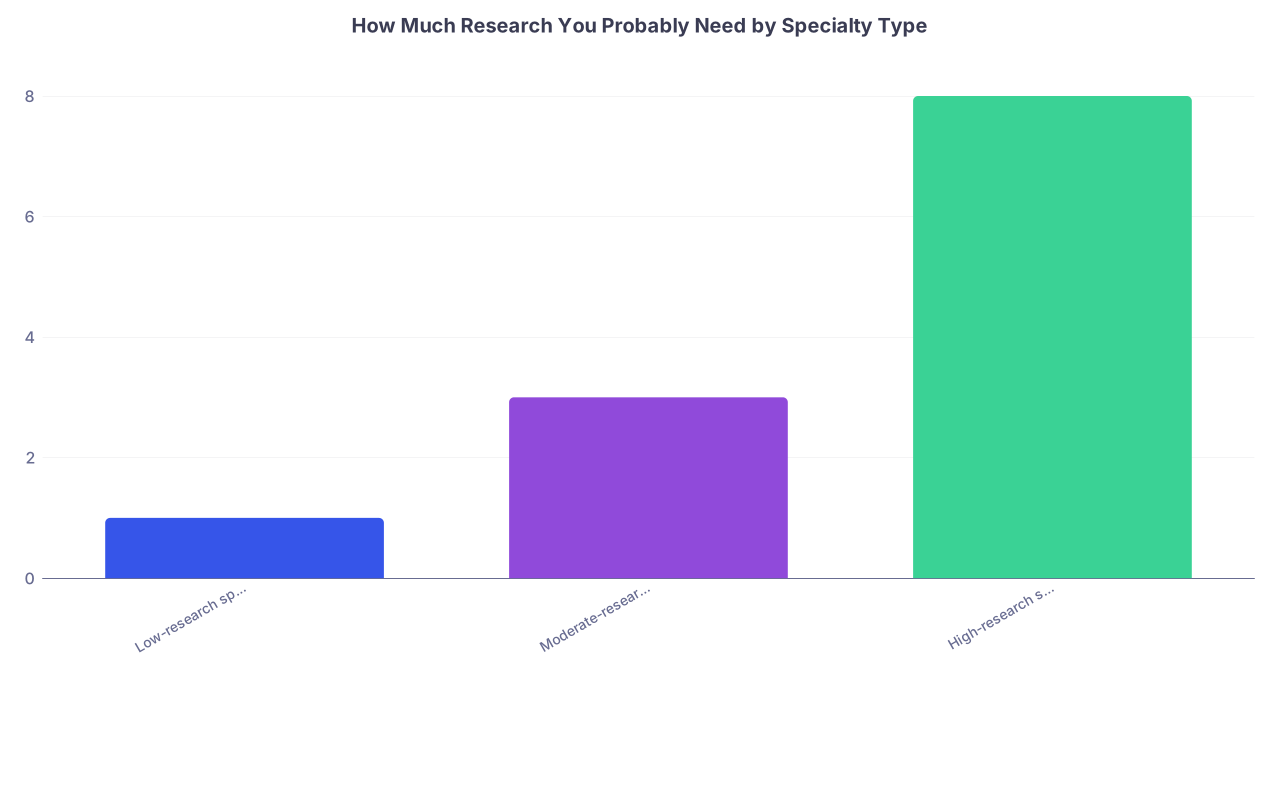
| Category | Value |
|---|---|
| Low-research specialties | 1 |
| Moderate-research specialties | 3 |
| High-research specialties | 8 |
Interpretation (rough, but directionally right):
- Low‑research specialties: 0–1 projects is usually fine.
- Moderate‑research specialties: 2–4 solid line items is good.
- High‑research specialties: 5–10+ total “things” (posters, abstracts, papers) is common.
If you’re already at or above “typical” for your specialty, a late project will likely have much less marginal impact than:
- Crushing your away rotation
- Prepping well for interviews
- Networking professionally with faculty you meet
3. What’s the realistic timeline?
This is where students lie to themselves.
Ask the attending or mentor very directly:
- What’s the scope? (Chart review, case series, big database analysis, bench work?)
- What’s the target? (National meeting? Journal?)
- What’s the timeline? (Weeks? Months? Next year?)
If the honest answer is “we might submit something in 6–9 months,” that does almost nothing for this match cycle. It might still be worth it for your future academic life, but don’t pretend it’ll change interview invites this year.
On the other hand, things that can realistically happen before rank lists:
- Single‑case report that’s mostly written already, just needs polishing and submission.
- Small retrospective chart review with a pre‑existing database and clear question.
- Secondary analysis of previously collected data where your job is writing and formatting.
- Abstracts for a conference with a near‑term deadline.
If your name could be on an accepted abstract or submitted manuscript by late winter, that’s actually something.
4. Who’s the mentor?
This matters more than the topic.
You want:
- Someone who has published recently (check PubMed).
- Someone who has previously gotten students on papers.
- Someone responsive and realistic about timelines.
Red flags:
- “We’ll figure out the details later.”
- No clear authorship plan.
- Vague description like “large database project, maybe next year.”
- The doc is clearly already overcommitted and slow to respond.
I’ve seen too many MS4s burn 30–40 hours into a project that never even gets submitted.
Where Late Projects Can Help A Lot
Let’s talk about the edge cases where starting something post‑ERAS is actually smart.
1. You’re weak on research for a research‑heavy specialty
Example: Applying neurology or IM to big academic centers, and you currently have:
- One poster from M1, and
- No publications
A focused, manageable project that gets you:
- 1 abstract
- 1 eventual paper (even if after match)
…can change how you pitch yourself on interviews and in your personal story.
You can say: “Earlier on, my research exposure was limited. This year I intentionally joined Dr. X’s project on Y, and we’re submitting an abstract to [Major Meeting]. It’s been a great way to deepen my interest in Z.”
That sounds a lot better than, “No, I’m not doing anything currently.”
2. You’ve got a big interview at a research‑heavy place
If you get an interview at somewhere like MGH, UCSF, Penn, Hopkins, or any program where they clearly value academic output, and a mentor at your home institution says:
“Let’s quickly spin up this retrospective that you can lead, we can probably submit an abstract by January.”
That’s worth considering. Especially if:
- It’s directly in the field you’re interviewing for.
- Your interviewer might actually know your mentor.
Mentors mentioning “I’m working with [Your Name] on a really solid project” during backchannel communications does happen.
3. You’re positioning yourself for future fellowship
Even if it barely affects residency, it can absolutely affect:
- GI, cards, heme/onc, pulm/crit, etc. (for IM)
- Child, forensics, addiction (for psych)
- NICU, PICU, cards, etc. (for peds)
If you know you’re aiming academic long‑term, saying yes to a strategically chosen MS4 project can pay off during fellowship ERAS, not this one.
So you’re playing a longer game.
Where It’s Usually Not Worth It
I’ll be direct. It’s usually not worth starting a totally fresh project after ERAS if:
- You’re already mid‑pack or better for research within your specialty.
- Your Step 2 isn’t done or isn’t great yet and needs focus.
- Your audition rotations are ongoing and you’re tired.
- You’re applying to less research‑heavy specialties where personality, fit, and clinical performance matter more.
Also not worth it:
- Basic science lab work that clearly won’t be done for a year.
- “Maybe we’ll write this up someday” verbal promises.
- Massive retrospective studies with no clear IRB, no timeline, and 8 other authors involved.
In those cases, your energy is better spent on:
- Being outstanding on rotations (which directly leads to better letters and better word‑of‑mouth).
- Practicing interview answers and having strong, coherent stories.
- Resting enough that you don’t show up to interviews fried and lifeless.
If You Decide to Start: How to Make It High‑Yield
If you say yes, do it intelligently.
Clarify deliverable and timeline in writing
“So the goal is: I’ll draft the case report by X date, then we’ll submit to [Journal/Meeting] by Y. Does that sound right?”Get on tasks that lead to authorship
Data collection alone often doesn’t. Aim for:- Leading the write‑up
- Creating figures/tables
- Submitting the abstract/manuscript
Keep a clean, updated CV
As soon as you:- Submit an abstract
- Get acceptance
- Submit a manuscript
Update your CV. If a program asks for updates or allows document uploads later, this is what you send.
Know how you’ll talk about it
You need a 30–60 second, clear, non‑rambling description:- Question
- What you did
- What you found or hope to find
- Why it matters to your field
Visual: Where Late‑Stage Research Sits in Your Priorities

| Step | Description |
|---|---|
| Step 1 | ERAS Submitted |
| Step 2 | Focus on rotations & interviews |
| Step 3 | Consider targeted new project |
| Step 4 | Start small, high-yield project |
| Step 5 | Specialty research-heavy? |
| Step 6 | Research portfolio weak? |
| Step 7 | Mentor & timeline solid? |
And another way to think about “what actually moves the needle” for most MS4s after ERAS:
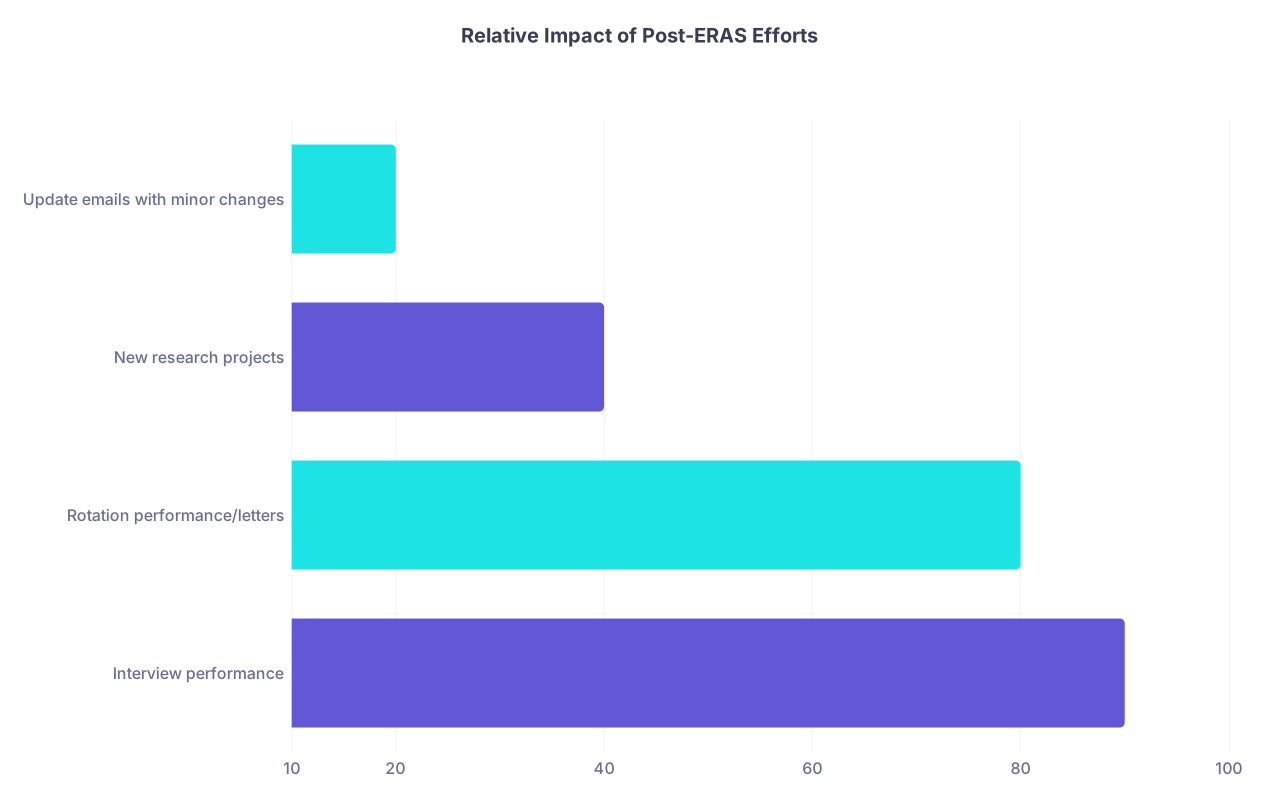
| Category | Value |
|---|---|
| Interview performance | 90 |
| Rotation performance/letters | 80 |
| New research projects | 40 |
| Update emails with minor changes | 20 |
Research isn’t irrelevant. It’s just not king at this stage.
Quick Case Examples
Case 1: Derm applicant, low research
You: 2 posters, no publications. Applying to derm.
Mentor offers: database project with realistic chance of abstract submission in 2–3 months.
Verdict: Say yes, if mentor is proven and you’re not drowning clinically. Derm is brutal; incremental improvements matter.
Case 2: FM applicant, strong clinicals, zero research
You: Great clinical evals, average board scores, no research. Applying family medicine.
Mentor offers: new QI project that won’t be finished before Match.
Verdict: Probably no—unless you’re genuinely interested and see it as part of your long‑term career, not for match leverage.
Case 3: IM applicant, mid‑tier research, wants cards fellowship
You: 1 publication, 2 posters in unrelated fields. Applying IM, already have a few strong interviews.
Mentor offers: cardiology retrospective that’ll take months but will likely publish.
Verdict: Yes, if you like cards—even though it won’t change this match much, it can strongly help fellowship apps.
FAQs
1. Can I update ERAS with new publications after submission?
Not directly. Once ERAS is submitted, you can’t edit the main application. But you can:
- Update your CV.
- Email select programs with a concise update (major publication, notable abstract).
- Mention new work during interviews.
2. Is it better to deepen an existing project or start a new one?
Deepening an existing project is almost always better. If you can turn:
- “data collection” → “abstract submitted,” or
- “abstract” → “manuscript submitted”
…that’s higher yield than starting from scratch.
3. How do I mention a brand‑new project on interviews without sounding like I’m stretching?
Be honest and concrete: “I recently started a small retrospective project in X with Dr. Y. We’re focusing on Z, and I’m working on the data extraction and write‑up. It’s early, but it’s been a good way to build skills in [specific area].”
Skip vague hype like “huge groundbreaking project.”
4. Will a single new abstract really change my interview invites?
Usually not in a dramatic way, especially this cycle. It might matter more at the margins:
- Helping impressions at already‑scheduled interviews.
- Slightly boosting perception of academic interest at research‑heavy places.
It’s rarely the difference between 0 and 10 interviews.
5. Should I send every program an update email if I start a project?
No. Sending “I started a project” emails is noise. Send updates only when you have:
- An accepted abstract (especially national).
- A submitted/accepted manuscript.
- A major award or leadership position.
And even then, keep it short and selective.
6. I feel behind on research and guilty for not doing more. Should I force myself into a project now?
No. Guilt is a terrible reason to start a time‑intensive project during MS4. If a project:
- Has a clear mentor,
- Has a realistic deliverable,
- Aligns with your actual interests,
…then do it. Otherwise, put that energy into being excellent clinically and strong in interviews. That combination carries a lot more weight than a rushed, half‑baked research line.
Key takeaways:
- A new MS4 project after ERAS can help, but mainly in research‑heavy fields and only if it leads to a concrete result on a short timeline with a reliable mentor.
- For most applicants, your time is better spent on rotation performance, letters, and interview prep than scrambling for last‑minute research.
- Say yes only to projects with clear scope, timeline, and authorship—don’t let vague “we’ll figure it out” projects steal your bandwidth this late in the game.