
Can Strong Research Compensate for a Lower Step Score in Residency Matching?
It’s November. ERAS is submitted, Step 1 is Pass, Step 2 CK didn’t land where you wanted, and you’re staring at your CV thinking: “Maybe my research saves me. Or not.” You’ve got posters, maybe a first-author paper, maybe an MPH or a research year. But you keep hearing conflicting things:
“Research can totally make up for scores.”
“Programs screen by Step and never even see your papers.”
So here’s the actual answer you’re looking for: research can help. Sometimes a lot. But it does not work the way people want it to work, and it does not rescue everyone.
Let’s break it down specialty by specialty, and then into concrete decisions you can make now.
The Short Answer: Research Helps, But Only Inside a Certain Range
Let me be blunt first, then explain.
- Strong research can absolutely move you up within the pile of people who are roughly in range for a program.
- Strong research cannot reliably overcome an automatic screen for very low Step 2 or multiple failures.
- The more academic and research-heavy the specialty/program, the more research matters.
- The more community-based and service-heavy the program, the more Step 2, clerkship performance, and letters matter relative to research.
Think of Step 2 and red flags (fails, professionalism issues) as “door openers.” If the door is firmly shut because your score is below a hard cutoff, no amount of research on your CV gets read.
Once you clear the door though? That’s where strong research can absolutely change your outcome.
Where Research Can Really Compensate (and Where It Can’t)
| Specialty Type | Research Impact | Score Flexibility |
|---|---|---|
| Physician-scientist tracks | Very High | Moderate |
| Academic neurology / IM / heme-onc | High | Moderate |
| Neurosurgery / Derm / Rad Onc | High | Low–Moderate |
| Mid-competitive academic (EM, OB, Anes) | Moderate | Low–Moderate |
| Community IM / FM / Psych | Low–Moderate | Low |
High-impact scenarios
Research tends to matter most in these contexts:
- You’re targeting academic programs or research-heavy subspecialties.
Examples:- IM with goal of cards/onc/GI at places like UCSF, Duke, Michigan
- Neurology wanting movement disorders, epilepsy, or stroke at big-name centers
- Programs with explicit “physician-scientist” or “research track” pathways
Here, strong research can absolutely compensate for being 10–15 points below their typical Step 2 median. You might not match MGH IM with a 210 Step 2, but 225 with serious research and strong letters? You’re in the conversation.
- Your research is in the exact niche the program cares about.
Example:- Applying neurology with 225 Step 2 to a stroke-heavy program, with 3 first-author stroke papers, grant support, and a glowing letter from a well-known stroke PI.
- Applying IM with 218 Step 2, but 2 years of serious outcomes research in hospital medicine and a strong letter from a nationally known hospitalist.
Now your “lower” score becomes more forgivable because your value proposition is concrete: you bring scholarship that matters to their department.
- You’re clearly on a physician-scientist track.
MD/PhD, heavy research years, multiple high-quality publications, maybe K-type grant interest. These applicants often have Step 2 scores that are good but not elite, and still match at excellent places because departments are recruiting future funded faculty.
Where research won’t save you
Research is much weaker in these situations:
You’re below hard cutoffs.
Some programs literally never see your file if Step 2 < a number. For competitive specialties, that might be 225–235. For less competitive, maybe 210–215. I’ve watched PDs filter a 1000-applicant list down to 300 with a couple of clicks.If you’re at 195 with a fail and then a pass, even brilliant research will not “compensate” at most places. It might help you at selective, holistic programs, but that’s the exception, not the rule.
Your research is weak or inflated.
“One poster as 13th author, one abstract at a local meeting” is not strong research. That’s baseline academic participation. Programs know the difference.Your story doesn’t match your research.
If you say you want to be a serious academic but:- You have 1 poster from M1 and nothing since
- You cannot discuss your project clearly at interview
- Your letter from your PI is lukewarm
Then research doesn’t help much. It looks like padding, not commitment.
How Programs Actually Weigh Step vs Research
Most students imagine this as some mysterious holistic algorithm. It’s not. It’s usually a two-step process:
Screening phase
Programs quickly filter based on:- Step 2 CK (and occasionally medical school, class rank, fails)
- Sometimes geographic ties or visa status
At this stage, your research only helps at places that:
- Manually look at research early, or
- Use flags like “MD/PhD” or “>= X publications” when deciding who to rescue from the borderline pool
Sorting phase (after screen)
Among those who made it through, PDs and faculty start asking:- Who fits our academic mission?
- Who has serious scholarly potential?
- Who has mentorship and letters that we trust?
This is where your research can jump you from “meh” to “definitely interview.” And from “standard interviewee” to “top rank-list tier.”
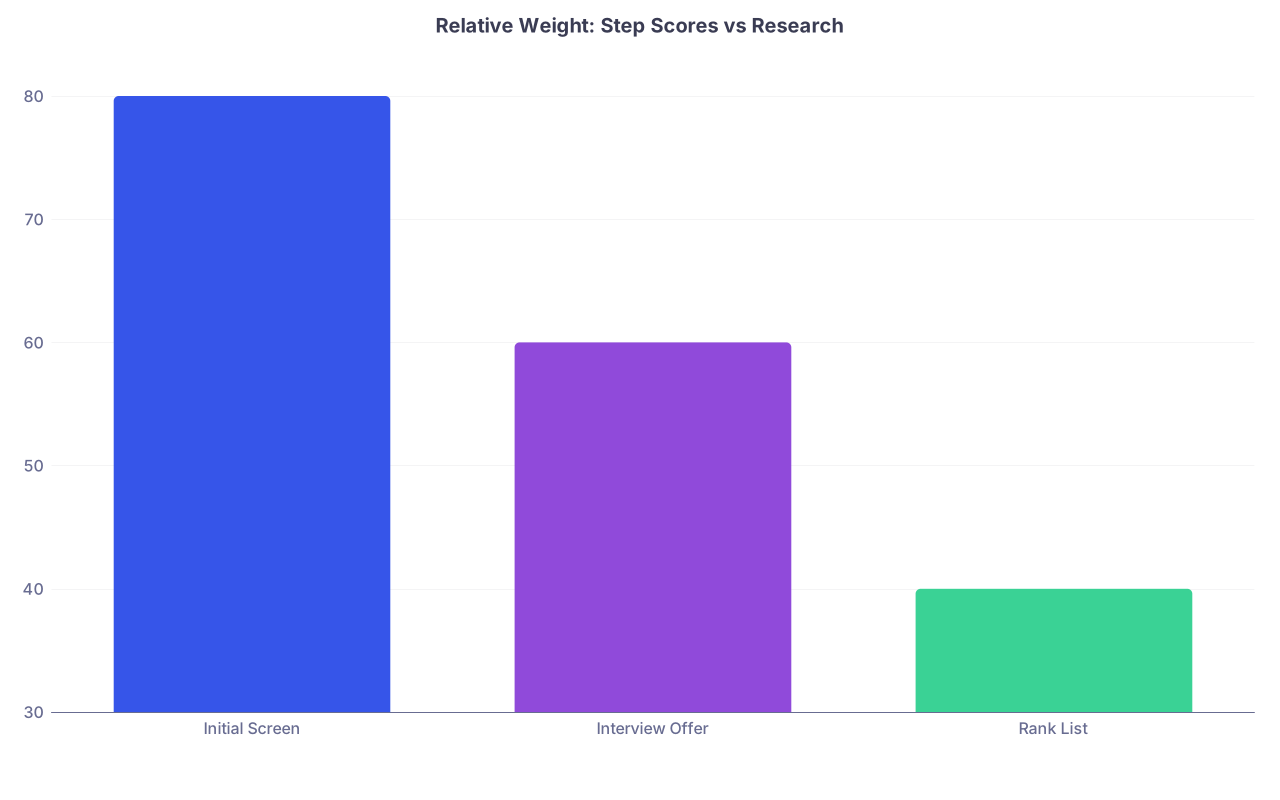
| Category | Value |
|---|---|
| Initial Screen | 80 |
| Interview Offer | 60 |
| Rank List | 40 |
As the chart implies: Step 2 dominates early. Research matters more later.
Specialty-Specific Realities
Internal Medicine (especially academic)
If you’re shooting for mid–upper tier academic IM with a lower Step 2 (say 215–225):
Research can:
- Make you competitive at solid academic programs if:
- You have multiple meaningful projects (ideally QI, clinical research, or outcomes)
- You’ve got at least one first- or second-author paper or strong abstracts
- You have a well-known mentor vouching for you
Won’t fix:
- Multiple Step attempts or a Step 2 well below 210 at elite programs
- A transcript full of marginal clerkship comments
Neurology
Neurology is very research-friendly and historically more forgiving on scores than, say, ortho or derm.
Lower Step 2 (210–220) + strong neuro research can:
- Get you looks at big-name places, especially if:
- Your work is in epilepsy, stroke, movement, or neuroimmunology
- You’ve got a neurologist-PI writing a strong letter
- You rotated at that program and showed up well
Again, catastrophic Step history is harder to overcome, but moderate underperformance is often forgiven if you look like a future academic neurologist.
Very competitive specialties (derm, neurosurg, plastics, ortho, rad onc)
Here the bar is higher, and cutoffs are brutal.
Research helps:
- If your score is slightly below their mean, not way below
- If:
- Your research output is truly exceptional (multiple first-author, big-name journals, basic science bench work, funded projects)
- Your PI has national-level name recognition
- You’re clearly all-in on academic work
If your Step 2 is dramatically below typical matches in these specialties, you’re often better off:
- Pivoting specialties, or
- Strategically targeting a research-heavy gap year before applying
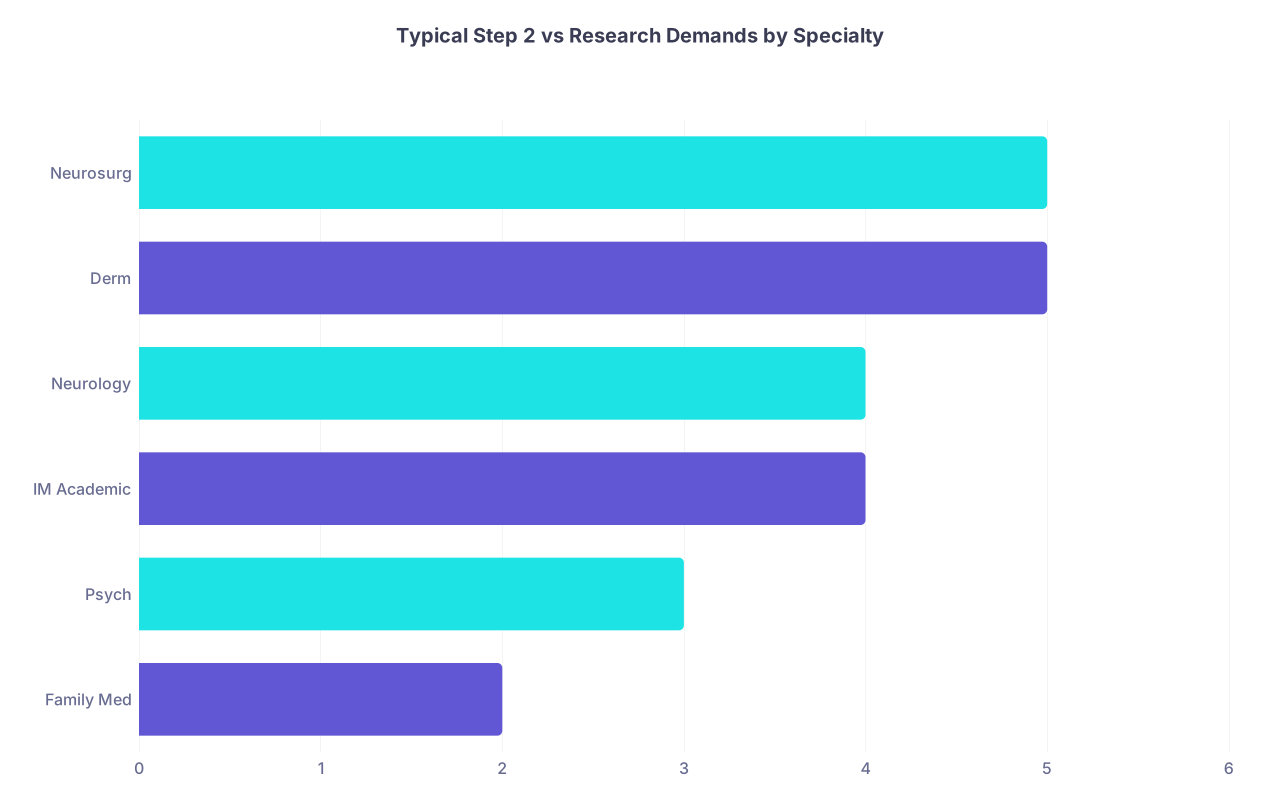
| Category | Value |
|---|---|
| Family Med | 2 |
| Psych | 3 |
| IM Academic | 4 |
| Neurology | 4 |
| Derm | 5 |
| Neurosurg | 5 |
Scale 1–5: higher number = higher combined demand for both score and research.
What “Strong Research” Actually Looks Like
People overestimate what counts and underestimate what programs care about.
Strong research tends to include:
- Clear theme or continuity (not 10 random unrelated posters)
- Depth: you stayed with a project long enough to see it published or presented at a reputable meeting
- Ownership: you can explain:
- The question
- The methods
- The results
- The limitations
- Your exact role
- External signals:
- First-/second-author manuscripts in real journals
- National meeting presentations (AAN, AHA, ASCO, ATS, etc.)
- Awards, grants, or competitive research programs
Weak research:
- One poster as middle author you barely remember
- A manuscript “in preparation” that has been “in preparation” for 2 years
- Listing 12 “projects” that never saw the light of day
If your Step 2 is lower, you do not have the luxury of fluff. Whatever is on your CV needs to be rock solid.
How to Strategically Use Research to Offset a Lower Step
Here’s the practical part: what you actually do.
1. Anchor your story around your research
On your ERAS, in your personal statement, and in interviews, the story should be:
“I am committed to being an academic [specialty] physician. My research to date shows that, and I want to continue that trajectory in residency.”
That narrative works even with a lower Step 2 if:
- Your clinical performance is strong
- Your letters back it up
- Your research is coherent and meaningful
2. Pick programs where research actually matters
You should be deliberately applying to programs that:
- List research as a core mission
- Have a track record of resident publications
- Offer research tracks, T32 grants, or protected time
Those are the PDs who look at a 220 Step 2 plus excellent research and say, “Good enough, let’s talk to them.”

3. Get letters that explicitly connect the dots
You want letters that say something like:
- “Their Step 2 score is not reflective of their true capabilities; in my lab they’ve handled complex data and shown exceptional analytic ability.”
- “They function at the level of a junior fellow in terms of research thought and independence.”
When a PD is on the fence because of your score, this kind of letter can tip the balance.
4. Do not hide your Step issues; contextualize them
If your Step is lower because of:
- Illness, family crisis, or timing issues
- Over-commitment to research during that period
You address it briefly and then pivot to how your later performance (clerkship honors, research output, shelf scores) better reflects who you are now.
Excuses don’t help. Coherent explanations plus evidence of growth do.
When an Extra Research Year Actually Makes Sense
If you’re early enough in the timeline (M2–M3 or early M4), and your Step 2 is clearly below what your target specialty usually wants, a dedicated research year can be smart.
It makes sense if:
- You can plug into a high-yield, productive lab or outcomes group
- You’ll realistically leave with:
- Several abstracts and at least one or two real manuscripts
- A heavyweight letter
- Possibly a degree or certificate (MPH, MS) that aligns with your goals
It doesn’t make sense if:
- The lab is disorganized and rarely publishes
- You’re doing it mainly to avoid facing your Step performance
- You won’t have substantial output by the time you apply

| Step | Description |
|---|---|
| Step 1 | Low Step 2 |
| Step 2 | Focus on strong clinical apps |
| Step 3 | Probably skip research year |
| Step 4 | Research year may be worth it |
| Step 5 | Targeting competitive/academic field? |
| Step 6 | Access to high-yield mentor? |
| Step 7 | Will have output before ERAS? |
How to Read Your Own Situation Honestly
Here’s how I’d quickly triage an applicant who asks me this:
What’s your Step 2 CK?
- Under 205: research won’t broadly compensate; we strategize specialty and program list very carefully.
- 205–220: research can help at research-friendly, holistic programs; we lean heavily into academic story and letters.
- 220–235: in range for many fields; strong research can push you up to stronger academic places than your score alone would predict.
How strong is your research actually?
- 0–1 low-impact items: it won’t “compensate”; we treat it as a bonus, not a core asset.
- Multiple meaningful projects + some publications: this can absolutely counterbalance being below average on Step.
Do your letters and MSPE align with the “academic” persona?
- If yes, research has more weight.
- If no, scores matter more, and research looks like a side hobby.

Bottom Line
- Strong research can compensate partially, but not infinitely, for a lower Step score—especially in academic, research-oriented programs.
- It works best when your score is moderately below average, not catastrophically low, and your research is real, substantial, and clearly tied to your specialty.
- You win by choosing programs that value research, getting heavyweight letters that vouch for you, and telling one coherent story: “I am a future academic in this field, and my record already shows it.”