
You’re staring at the ERAS “Scholarly Activities” section.
You’ve got a couple of quality improvement (QI) projects, maybe a chart audit you did on VTE prophylaxis, and a hand hygiene compliance project your chief roped you into. But no basic science. No big-name RCT. And now you’re asking:
“Can I actually list QI and audits as ‘research’ on ERAS… or am I stretching it?”
Let me give you the short, honest answer first, then we’ll unpack the details.
Yes, quality improvement and audits absolutely can count as ‘research’-type activities for ERAS — if you present them correctly and don’t over-sell what they are.
The nuance is in 3 places:
- How you categorize them in ERAS
- How rigorous the project actually was
- How you talk about them in interviews
Let’s walk through exactly how to handle this.
1. What ERAS Actually Cares About (Not Just “Basic Science”)
Program directors don’t sit down and say, “I only care about wet-lab research.” What they care about is:
- Can you identify a problem?
- Can you collect and interpret data?
- Can you work in a structured, systematic way?
- Can you follow a project through to completion and dissemination?
QI and clinical audits check all of those boxes when they’re done well.
You’ll see this real-world attitude in most non-physician-scientist programs. Internal Medicine, EM, Pediatrics, FM, OB/GYN, Psych — the majority of program directors now view meaningful QI work as a legitimate form of scholarship. Especially if:
- You presented it at a conference
- You wrote up a poster or abstract
- It actually changed something in practice or process
Where it gets weaker is:
- “I sat in on a QI meeting once”
- “We talked about maybe changing a template in Epic”
- “We did an audit but I don’t remember the numbers or outcome”
Those aren’t really projects. Those are experiences. Don’t try to dress those up as “research.”
2. Where Do QI and Audits Go in ERAS?
ERAS gives you a few relevant buckets:
- “Publications”
- “Presentations/Posters”
- “Research Experience”
- “Work/Volunteer Experience”
Here’s how I’d map things out, based on what I’ve seen residents and applicants actually do effectively:
| Type of Output | Best ERAS Section |
|---|---|
| QI project with poster at a conference | Presentations / Posters |
| QI/audit with published abstract/paper | Publications |
| Ongoing structured QI project | Research Experience |
| Simple chart audit with no dissemination | Research or Work Experience |
| Committee-only, no clear project | Work / Volunteer Experience |
You’re not committing fraud by calling a rigorous QI project “research experience.” It’s absolutely research methodologically, even if it’s not NIH-funded.
The key is that you’re honest in the description:
- Use words like “quality improvement project,” “retrospective chart audit,” “process improvement initiative”
- Don’t call it a randomized controlled trial if it wasn’t
- Don’t claim publication if it’s not at least accepted
If you:
- Defined a problem
- Collected baseline data
- Implemented an intervention
- Measured outcomes
- Iterated or analyzed results
…then listing it in Research Experience is fair game.
3. What Counts as a “Real” QI / Audit Project vs. Fluff
Let’s draw a clean line because this is where people get sloppy.
Strong QI/audit project that “counts”:
- Has a clear question: “Can we improve discharge summary completion within 48 hours from 60% to 90%?”
- Uses actual data: baseline numbers, follow-up numbers
- Has a method: PDSA cycles, pre/post intervention, defined sample
- Has outcomes: improved rates, reduced errors, increased adherence
- Ideally: presented at a hospital day, regional meeting, or national conference
Weak “project” that doesn’t really impress:
- “Joined the QI committee” with no specific role
- “We discussed patient safety issues” — vague, no data, no structure
- “I was present while my attending did an audit” but you didn’t design, collect, or analyze
Program directors can sniff out fluff.
If your QI work looks like the strong version, treat it as scholarly work. If it looks like the weak version, list it as involvement or experience, but don’t try to sell it as a “research project.”
4. How to Describe QI and Audits on ERAS (Do This, Not That)
This is where most applicants fumble. They either undersell (“just a QI thing”) or oversell (“major research project” when it was a simple chart review).
Here’s a clean structure you can use for each QI/audit entry:
Title – Use a clear, professional title.
- “Improving Inpatient VTE Prophylaxis Compliance Through EMR Alerts”
- “Retrospective Audit of Antibiotic Stewardship in Community-Acquired Pneumonia”
Your role – Be specific.
- “Designed data collection tool and performed data analysis (n=250 admissions).”
- “Led PDSA cycles and presented results to department QI committee.”
Methods – One line on how you did it.
- “Retrospective chart review comparing pre- and post-intervention periods.”
- “Collected process and outcome measures monthly over 6 months.”
Outcome – Show impact or at least completion.
- “VTE prophylaxis ordering increased from 62% to 88% over 4 months.”
- “Findings informed updated discharge instructions template.”
Dissemination – If any.
- “Presented as a poster at [Institution] Research Day (2024).”
- “Abstract accepted to [Regional Conference].”
That’s how you convert a “yeah I did some QI” into something a PD actually respects.
5. How Programs Actually View QI vs Traditional Research
Let me be straightforward:
For competitive academic specialties (Derm, Rad Onc, Neurosurgery, ENT, Plastics):
QI alone is usually not enough. They want publications, PubMed IDs, real research infrastructure.For most core specialties (IM, Peds, EM, FM, Psych, OB/GYN, Anesthesia):
Good QI is absolutely valued. In some places, it’s more valued than a basic science lab project you didn’t understand.For community-heavy programs or clinically focused ones:
A strong QI project that demonstrably improved care on the ward is gold. It signals you’ll be useful from day one.
Here’s the rough hierarchy programs tend to have in their heads, if they’re being honest:
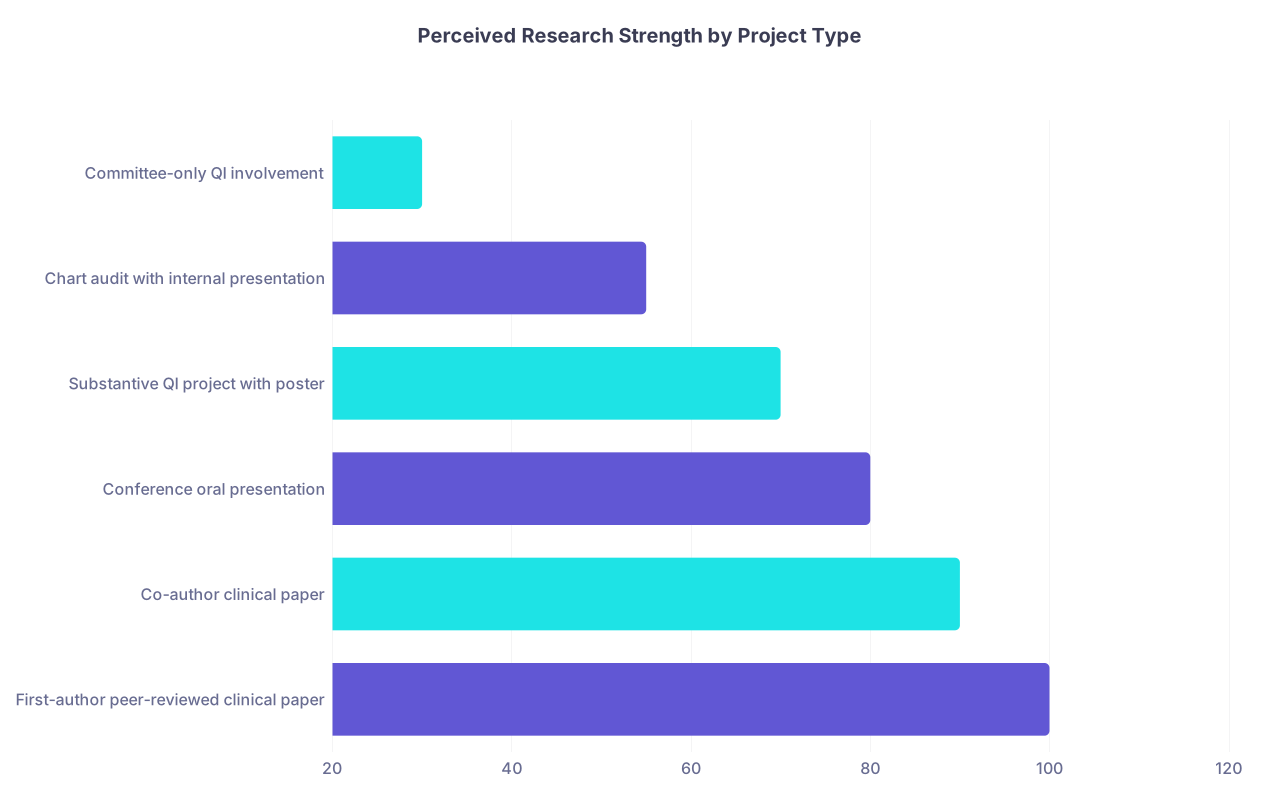
| Category | Value |
|---|---|
| First-author peer-reviewed clinical paper | 100 |
| Co-author clinical paper | 90 |
| Conference oral presentation | 80 |
| Substantive QI project with poster | 70 |
| Chart audit with internal presentation | 55 |
| Committee-only QI involvement | 30 |
QI is legit, but it sits below high-impact, peer-reviewed original research. That doesn’t make it worthless. It just means don’t pretend it’s something it’s not.
6. How to Talk About QI in Interviews (So It Actually Helps You)
If you list QI/audits, you’ll get asked about them. This is where many applicants expose that they were just “name on a poster” level involved.
You need to be able to clearly answer these:
What was the specific problem you were addressing?
Not “to improve care” — that’s meaningless.
Say: “We had low rates of appropriate DVT prophylaxis orders on the medicine floor, around 60%.”How did you measure it?
- “We did a retrospective chart review of 200 admissions over 3 months and tracked whether high-risk patients had prophylaxis ordered.”
What intervention did you implement?
- “We added an EMR reminder tied to admission orders and did an educational session with residents.”
What changed?
- “Prophylaxis orders increased to 87%, and the rate of documented VTE events trended down, though numbers were small.”
What did you personally do?
- “I pulled and cleaned the data, ran the basic analysis, and gave the final presentation to the department.”
This kind of answer makes QI look like what it is: applied, clinically relevant research.
7. Common Mistakes with QI/Audit on ERAS
Let me call out the biggest errors I see:
Over-labeling everything as “research”
Sitting in a meeting ≠ research.
Listening to someone present data ≠ research.
If you didn’t design, collect, or analyze, be humble about it.Being vague in the description
“Participated in a QI project to improve patient care.”
That line is useless. It tells the reader nothing.No outcomes
Even if the outcome was “no significant difference found,” say that. It still shows completion and critical thinking.No dissemination shown
If you presented at even a local hospital poster day — list it. ERAS cares about products, not just effort.Not connecting it to your specialty interest
If you’re applying IM and you did a sepsis bundle QI, that’s directly relevant. Spell that out in your personal statement or interview.
8. How to Turn a Weak QI/Audit into a Stronger Application Asset
If you’re early in the cycle or still have some months before ERAS submission, you can quickly upgrade your QI/audit work:
Write it up as a poster
Push to present at:- Your institution’s research day
- A regional ACP/APA/ACEP/AAFP meeting
- Specialty-specific regional conferences
Get actual numbers
If you’ve been hand-wavy about “it improved,” go back and pull clean pre/post data. This alone makes it sound 10x more serious.Clarify your role
Step up now — volunteer to finalize data, create figures, draft the abstract. Then your ERAS entry can honestly say you led major components.Link it to future plans
Think: “If I matched at your program, I’d want to continue this kind of QI around X in your Y-clinic.” That’s how you pitch it in interviews.
9. Quick Reality Check: Is What You Did “Enough”?
If you’re asking, “Is this enough research?” here’s the blunt framework:
Applying to very research-heavy or competitive specialties:
QI alone = usually not enough. You want at least:- One real clinical research project
- Ideally a poster or publication
Applying to most core specialties and mid-competitive fields:
A couple of strong QI/audit projects, especially with presentations, can absolutely be enough, especially if the rest of your app is solid.Applying to community or clinically focused programs:
Good QI is often better than random, highly technical bench research that you can’t explain.
If you’re still unsure, benchmark yourself against peers from your school going into the same specialty, not random Reddit superstars.
FAQ: QI & Audits as “Research” on ERAS
1. Should I label my QI project under “Research Experience” or “Work/Volunteer Experience”?
If it had a structured question, data collection, analysis, and defined outcomes, put it under Research Experience. If you mainly attended meetings or provided logistical support with no real data or design involvement, Work/Volunteer Experience is more honest.
2. Can I list a QI/audit project that’s not finished yet?
Yes — just clearly mark it as ongoing. Describe what’s been done so far (problem definition, data collection started, intervention designed) and what you’re planning for dissemination (poster, abstract submission). Don’t fabricate completed results.
3. Does a locally presented QI poster actually help my application?
Yes. Is it equivalent to a first-author JAMA paper? No. But a local hospital research day or regional meeting poster still shows you carried a project to a finish line and were able to communicate your findings publicly. That matters.
4. My only “research” is two QI projects with posters. Is that enough for Internal Medicine?
For many IM programs — including some academic ones — yes, that can absolutely be enough, especially if your projects are substantive and you can explain them well. For top-10 research-powerhouse IM programs, you’d ideally want more traditional research as well, but QI still helps.
5. Should I call my chart audit “retrospective observational research” to sound more impressive?
No. Call it what it is: a retrospective chart audit or retrospective review. You can still describe methods and outcomes in a rigorous way, but don’t play word games. Program directors have seen thousands of applications; they won’t be fooled by inflated terminology.
6. I was one of many students on a big QI project. Can I still list it?
Yes, as long as you’re accurate about your role. Say exactly what you did: data collection, building a survey, running statistics, making figures, writing a section of the poster. Don’t claim “led project” if you didn’t. Shared credit is still real credit.
7. What’s one thing I should change today to make my QI/audit entries stronger?
Rewrite each ERAS entry so it clearly includes: the specific problem, your methods, at least one concrete number (baseline and/or post-intervention), and your personal role. If your current description doesn’t have those four elements, fix that first.
Open your ERAS “Research Experience” section right now and look at each QI/audit entry. Ask yourself: “Could a stranger read this and know exactly what the problem was, what we did, what changed, and what I contributed?”
If the answer is anything short of “yes,” rewrite one entry today. Then do the rest.