
One deep, meaningful project beats a pile of half-baked research lines almost every time for residency applications.
But that statement needs nuance. Because what actually helps you is not just “one vs many,” it’s the story your research tells about you, and whether programs can trust you to finish what you start, think critically, and contribute academically in residency.
Let’s break it down like someone who’s sat in on selection meetings and watched how PDs react to ERAS CVs.
The Short Answer: What Programs Actually Prefer
If you’re choosing between:
- One substantial, well-executed, completed project
vs. - Several scattered, shallow experiences with no clear output
Choose the one strong project every time.
But the real “best case” is this:
- One or two anchor projects (deep, clearly your work, with a tangible outcome: abstract, poster, publication, QI implementation, etc.),
- Plus a small number of supporting experiences that show breadth (chart review help, data collection, smaller collaborations).
Where people go wrong: they chase “many” without thinking about depth, continuity, or outcome. Programs can tell.
How PDs Actually Look at Research on Your Application
Program leadership doesn’t sit there counting publications like baseball cards for most specialties. They ask three practical questions:
Can this person finish things?
A completed QI project with implemented changes can outweigh a “submitted” paper that never sees daylight.Does their research story make sense?
Some cohesion is good. For example:- 1 big stroke project + 1 outcomes study in neurology clinic = coherent for neurology.
- 6 random posters in unrelated fields you barely understand? Looks like noise.
Did they actually do anything or just get their name on stuff?
If, in an interview, you can’t explain:- The study question
- The methods in plain language
- The results and limitations
you’ve just told them all your “research” is fluff.
That’s why one serious project where you can talk like you owned it can beat five projects where you were “the third data abstractor for three weeks.”
One Strong Project: What “Strong” Really Means
Let’s define “strong,” because people overestimate what counts as impressive.
A strong project typically has:
- Clear role: You can say “I designed the survey and performed the initial data analysis” or “I led the chart review and wrote the methods and results sections.”
- Continuity: You worked on it over months, not a weekend.
- Outcome: At least one of:
- Abstract submitted/accepted
- Poster or oral presentation
- Manuscript submitted/accepted
- QI project with implemented change and follow-up data
- Understanding: In an interview, you can explain it like you’re teaching a smart MS2.
What it doesn’t have to be:
- A first-author NEJM paper.
- A randomized controlled trial.
- A basic science project with years of bench work.
For most residency applicants, a carefully done retrospective chart review, clinical case series, or QI intervention that actually went somewhere is more realistic—and absolutely “counts.”
Many Small Projects: When That Helps and When It Hurts
Having multiple research experiences is good when they show:
- Progression: Early on you did data entry. Later you did analysis. Then you presented. That’s a trajectory.
- Breadth in a focused way: A few cardiology studies + an ICU project + a QI bundle for heart failure = good breadth within an interest area.
- Multiple outputs: A couple posters here, a small publication there—spread over 2–3 years.
It backfires when:
- Every entry is “assisted with data collection,” no outcome listed.
- You can’t explain half of them in any depth.
- They look like checkbox hunting: “retina project, ortho project, derm project, oncology project” with no real pattern or interest.
Nobody’s impressed by a bloated ERAS research section if, when asked, you give vague, generic answers.
Specialty Differences: Where the Bar Moves
Some programs absolutely care more about research than others.
| Specialty | Research Weight | What Helps Most |
|---|---|---|
| Dermatology | Very High | Multiple projects, some with strong output |
| Plastic Surgery | Very High | Sustained work, pubs, strong mentorship |
| Radiation Onc | High | Focused, oncology-related work |
| Internal Med (academic) | Moderate–High | 1–2 strong projects + some breadth |
| EM, FM, Psych | Low–Moderate | 1 solid project/QI is usually enough |
For hyper-competitive fields (derm, plastics, neurosurgery):
- You’re competing against people with both: deep anchor projects and several smaller works, often with multiple first-/co-first-author pubs.
- In that setting, “one project” is better than many small things, but realistically, you’ll want more than just one if you can.
For most core specialties (IM, peds, EM, psych, FM):
- One strong, well-described project (especially if presented or published) is more than enough for most programs, unless you’re targeting top-tier academic centers.
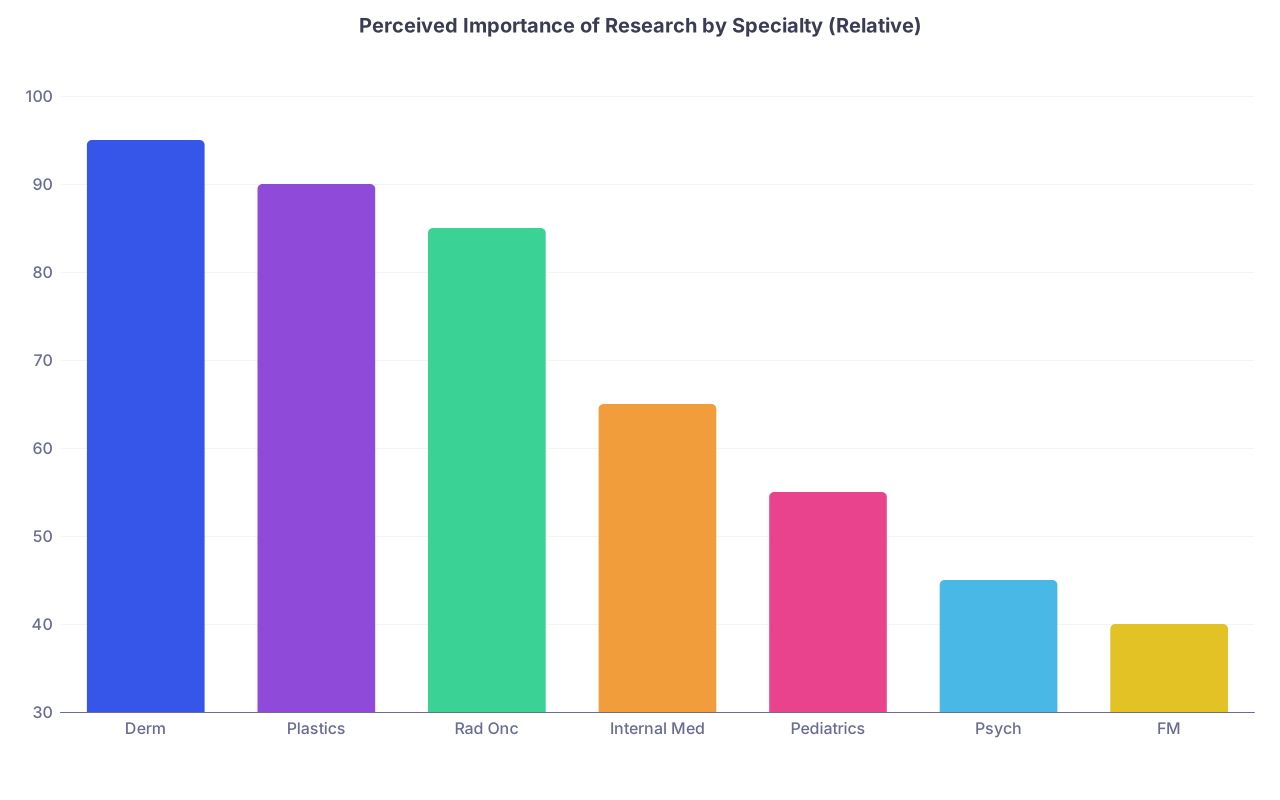
| Category | Value |
|---|---|
| Derm | 95 |
| Plastics | 90 |
| Rad Onc | 85 |
| Internal Med | 65 |
| Pediatrics | 55 |
| Psych | 45 |
| FM | 40 |
How to Decide What You Should Prioritize
Use this decision framework:
What year are you?
- Early MS: You have time to build depth. Choose 1–2 anchor projects and stick with them.
- Late MS or applying soon: You don’t have 18 months. Prioritize getting one project to completion and output rather than starting three new ones.
What’s your target specialty?
- Research-heavy (derm, plastics, ortho, neurosurg, rad onc): Aim for
- 1–2 deep projects,
- Plus a small handful of shorter collaborations if realistic.
- Other specialties: One meaningful project is usually enough. A second is a bonus, not a requirement.
- Research-heavy (derm, plastics, ortho, neurosurg, rad onc): Aim for
What do you currently have?
- No research at all? Start with one project that you can actually finish.
- Many tiny, unfinished things? Stop collecting projects. Push 1–2 to a tangible endpoint.
What resources/mentors do you have?
- Strong, engaged mentor in one area? Lean into that. Depth with a good letter is gold.
- Weak mentorship? You may need to be more selective and avoid spreading thin with flaky projects that never finish.
What PDs Hear When They See Your CV
Here’s what your profile “says” depending on how you structure your research.
Scenario 1: One Anchor Project, Clear Output
ERAS shows:
- 1 clinical project with you as second author on a manuscript
- Presented at a regional or national meeting
In interview, you:
- Explain the question, methods, stats in simple language
- Can say what you’d do differently next time
What the PD hears:
- “This applicant can take a project from idea to completion. They’re teachable, reliable, and will likely contribute academically during residency.”
Scenario 2: Six Projects, No Clear Ownership
ERAS shows:
- 6 “projects in progress”
- All “data collection” or “literature review”
- No accepted abstracts, no posters, no manuscripts
In interview, you:
- Struggle to recall details
- Say “I mainly helped with data entry” multiple times
What the PD hears:
- “They chased lines on a CV but didn’t really learn the process. They may need a lot of hand-holding.”
(See also: Should you delay applying a year to finish a big research project? for guidance.)
Scenario 3: Balanced Portfolio
ERAS shows:
- 1–2 main projects with outcomes (poster, paper, QI implementation)
- 2–3 smaller roles (e.g., helped on a faculty project with a small authorship or local presentation)
What the PD hears:
- “They commit deeply but are also willing to collaborate and chip in. This is someone who fits an academic department well.”
Concrete Strategy: How to Build a “Strong” Research Profile
If you’re not sure how to implement this, here’s the playbook.
Pick your anchor project intentionally
- Clinical or QI projects are usually the most realistic to complete in time.
- Aim for something aligned with your intended specialty if you have one.
Define your role clearly from the start
- Negotiate for meaningful work:
- Data extraction + basic analysis
- Writing methods or results
- Designing surveys or tools
- Ask directly: “If I follow through, is there a path to authorship and presentation?”
- Negotiate for meaningful work:
Push hard for an outcome
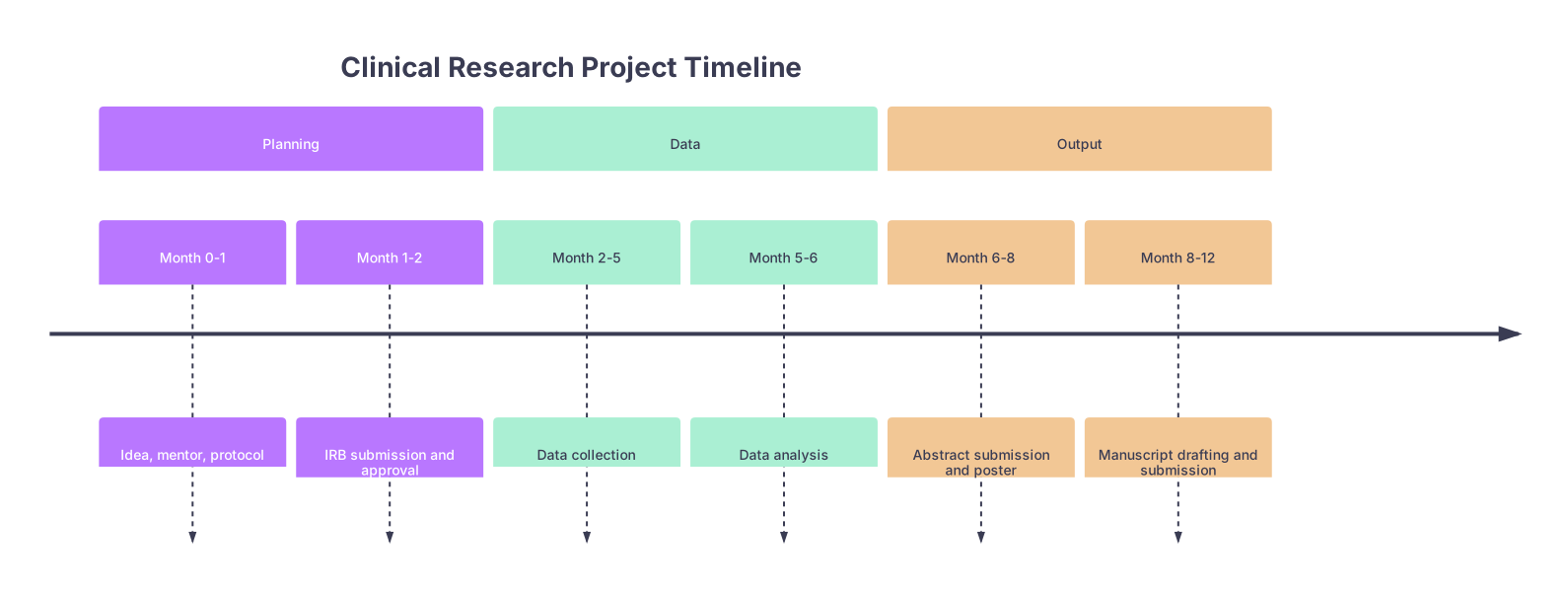
- Timeline-based goal:
- Within 3–6 months: Have data and basic results.
- Within 6–9 months: Poster/abstract submitted.
- Within 9–12 months: Manuscript drafted or QI implemented.
- Timeline-based goal:
| Period | Event |
|---|---|
| Planning - Month 0-1 | Idea, mentor, protocol |
| Planning - Month 1-2 | IRB submission and approval |
| Data - Month 2-5 | Data collection |
| Data - Month 5-6 | Data analysis |
| Output - Month 6-8 | Abstract submission and poster |
| Output - Month 8-12 | Manuscript drafting and submission |
Limit the number of additional projects
- Cap it at what you can realistically explain and complete:
- Usually 1–3 extra, smaller roles.
- Cap it at what you can realistically explain and complete:
Prepare to talk intelligently about your work
- Before interviews, for each project write:
- 2–3 sentences: Research question + why it matters
- 2–3 sentences: Methods (in normal language)
- 1–2 sentences: Results and limitations
- 1–2 sentences: What you learned / next steps
- Before interviews, for each project write:
This prep matters more than having an extra weak publication.
Common Mistakes That Make Your Research Look Worse
I’ve watched applicants sabotage themselves with these:
- Listing everything as “in progress” when nothing will ever be finished.
- Exaggerating your role and getting caught when asked about the stats or design.
- Being spread across too many fields, so it looks like you’re just CV farming: ortho + derm + neurosurg + GI + ICU with no coherent story.
- Focusing only on basic science without anything clinically relevant, when you’re applying to clinically heavy programs that rarely do bench work.
- Dropping long-term projects early to chase new ones, so you end up with five half-finished things and no final product.
If you’re doing this right, your research should feel slightly uncomfortable but manageable, not like you’re drowning in half-promises to ten different attendings.
A Quick Visual: Depth vs Breadth Tradeoff
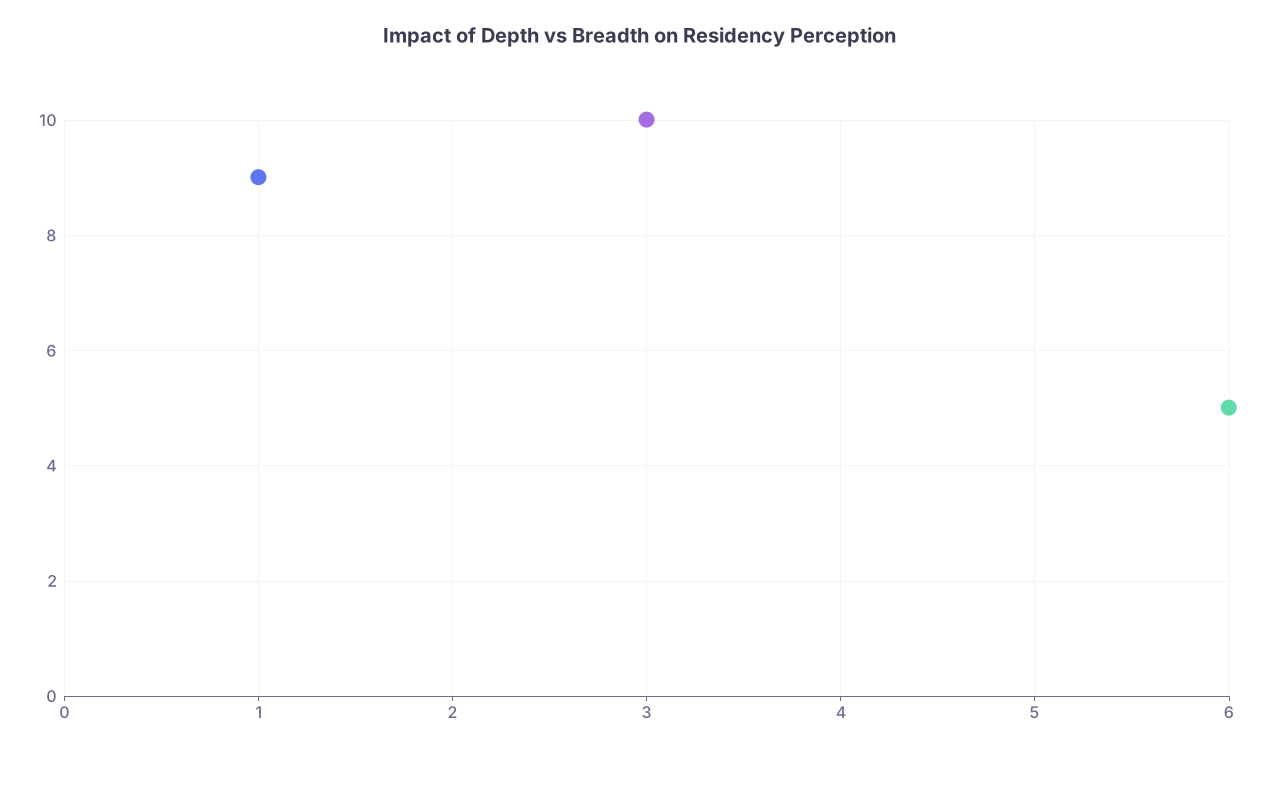
| Category | Value |
|---|---|
| Single Deep Project | 1,9 |
| Balanced Portfolio | 3,10 |
| Many Shallow Projects | 6,5 |
Interpretation (informally):
- More projects isn’t linearly better.
- Once you lose depth and ownership, the perceived value drops.
FAQ: One Strong Project vs Many Small Research Experiences
1. I’m an MS3 with zero research and applying next cycle. Should I even start?
Yes, but be realistic. One clearly defined, fast-moving project (QI or retrospective chart review) with a strong mentor is your best bet. Aim for:
- IRB-light or exempt if possible
- A poster/abstract before ERAS submission
Don’t start three projects—you won’t finish them.
2. Is a poster presentation enough, or do I need a publication?
For most specialties, a poster or oral presentation is plenty to show you can finish work and contribute. Publications help, but a well-understood, presented project often beats a “submitted manuscript” you can’t explain. Only for the most competitive research-heavy fields does publication volume start to matter more.
3. I helped on 5 projects but don’t have authorship yet. Do I still list them?
List them only if:
- They’re legitimate projects
- Your role was real (even if small)
- You can describe what you did and what the project is about
But don’t flood your CV. It’s fine to leave off ultra-minor, one-week, no-impact work that adds noise.
4. Does my research have to be in my chosen specialty?
No, but it helps. One or two projects in your chosen field strengthen your narrative. That said, methodologically solid work in any clinical area shows you understand research. Better to have a completed project in another field than a dead project in your target specialty.
5. What’s worse: no research or bad/obviously inflated research?
Bad or obviously inflated research is worse. Programs remember the applicant who clearly lied or oversold their role. If you truly have no research, lean into other strengths (clinical performance, leadership, teaching) and, if possible, start one small honest project. Don’t manufacture a fake “research portfolio.”
6. If I already have one strong project, should I still add more?
If you have time and bandwidth, sure—as long as it doesn’t dilute what you already have. One strong anchor plus 1–3 smaller, real contributions creates a great profile. But if adding more means sacrificing quality, understanding, or sleep, focus on being able to talk brilliantly about the work you’ve already done.
Key points to walk away with:
- One deep, complete, well-understood project is more valuable than a pile of shallow, unfinished ones.
- The best setup is 1–2 anchor projects plus a few smaller roles you can explain clearly.
- Depth, outcome, and your ability to talk intelligently about your research matter more than raw project count.