You’re in a Zoom interview for residency. The faculty member pulls up your ERAS application, scrolls to “Scholarly Activities,” pauses, and says:
“I see you’re on three publications here. Tell me about your role in this project.”
And now the panic hits: you did some data cleaning, part of the chart review, and a tiny bit of editing on the manuscript. You’re author #6 of 12. How honest do you need to be?
Let me be direct: you need to be fully honest, but not self‑sabotaging. There’s a smart way to talk about your role without either inflating it or making yourself sound useless.
Here’s the framework.
The Core Rule: Full Honesty, Zero Inflation
If you remember nothing else, remember this: interviewers care far more about integrity than about how “big” your role was.
They know most med students aren’t first‑author RCT masterminds. What they’re screening for is:
- Are you honest about what you did?
- Do you understand the project and its methods?
- Can you articulate what you learned and how you think?
So how honest should you be?
- Don’t overstate. Ever. “I led the project” when you didn’t is fatal if they dig even slightly.
- Don’t understate to the point of sounding disengaged or passive. “Oh, I barely did anything” is also bad.
- Do state your actual role clearly and confidently: “My primary responsibilities were X and Y; I also contributed to Z.”
If you can’t clearly describe your concrete responsibilities in 1–2 sentences, you’re either not ready to discuss that project or you weren’t actually involved enough to list it prominently.
How to Describe Your Role Without Sounding Small
Most students mess up here. They either:
- Use vague fluff: “I helped with the study”
- Or they shrug and minimize everything: “I just did data entry”
You can do better. Use this simple structure whenever you’re asked:
- One‑line project summary
- Your specific responsibilities
- One thing you learned or took away
Example:
“Sure. This was a retrospective chart review of patients admitted with decompensated heart failure, looking at factors associated with 30‑day readmission. My main roles were helping develop and pilot the data collection tool in REDCap and performing the initial data extraction for about 200 charts. I also participated in the weekly research meetings and helped revise the Results section of the manuscript. I learned a lot about data reliability issues and how small changes in variable definitions can impact your final analysis.”
That’s honest. You didn’t pretend to be PI. But you also didn’t reduce yourself to “I just clicked boxes.”
Use action verbs that actually mean something: collected, coded, abstracted, built, analyzed, drafted, revised, presented, coordinated, consented, followed up, etc.
What If You Did Very Little?
Ok, the uncomfortable scenario: you’re middle author on a big paper but your role was genuinely small or early.
Should you even list it? Usually yes, but be ready to:
- Place it appropriately (not as your “flagship” project)
- Be very transparent about your limited role
Example language:
“I joined this project after the design phase. My contribution was focused on recruiting patients in clinic sessions and maintaining the enrollment log. I also attended some of the data meetings to understand how recruitment issues were affecting the sample. I wasn’t involved in the initial conceptualization or stats, but it was my first real exposure to prospective clinical research.”
Notice what you’re doing there:
- You’re not pretending you designed the study.
- You’re not apologizing.
- You’re framing it as an early experience where you learned foundational skills.
If your role is truly microscopic—“I edited typos in the abstract once”—don’t list that project or at least don’t bring it up unless directly asked. If you wouldn’t feel comfortable explaining your role to the PI with them in the room, it’s too thin.
Group Research vs. “My” Research: How to Talk About Team Projects
Most residency interviewers are used to collaborative work. They won’t be surprised your project had 8 authors, a PI, and 2 fellows.
The trick is to:
- Acknowledge the team
- Still clearly define what was yours
Bad: “We did a study on sepsis outcomes and we found…”
Better: “Our team, led by Dr. X, did a study on sepsis outcomes. My piece of the project was primarily building the initial patient list from the EMR, reviewing charts for exclusion criteria, and drafting the abstract we submitted to SCCM.”
A clean formula:
- “This project was led by…”
- “My main role in the team was…”
- “I also contributed by…”
That’s honest about hierarchy but still gives you ownership.
How Deep Should You Go on Methods and Stats?
You should be able to discuss the project at a level that matches your claimed role.
If you say “I conducted the analysis,” then:
- You should know what tests were used and why
- You should know your primary outcomes, covariates, and at least the broad analytic approach (e.g., multivariable logistic regression)
If you say “I collected data and attended meetings,” then:
- You should understand the study question, design, population, and basic outcomes
- You should know what problems came up: missing data, enrollment issues, IRB modifications, etc.
A good self‑check for each project you list:
- Can I explain the research question in one sentence?
- Can I explain why the question matters clinically or scientifically?
- Can I outline the design (retrospective cohort, RCT, cross‑sectional, etc.)?
- Can I describe my exact tasks?
- Can I say one limitation and one potential next step?
If the answer to any of those is “no,” review the paper/abstract before interview season. I’ve watched applicants completely tank a strong CV because they plainly hadn’t read their own paper since submission.
Handling the “Authorship vs. Contribution” Question
Some interviewers are blunt:
“I see you’re author #7. What got you authorship on this work?”
Do not get defensive. Answer directly.
Example:
“Our group followed ICMJE guidelines. I was responsible for building and maintaining the screening log, coordinating follow‑up phone calls, and I also contributed to several rounds of manuscript revisions, especially clarifying the Methods section. That combination met our group’s criteria for authorship, though I wasn’t involved in initial study design.”
That’s the level of transparency they like. Shows integrity and awareness.
If you’re on a paper and even you aren’t sure why you’re an author: that’s a problem. At minimum, understand your lab’s/authors’ criteria and how you fit in.
What If You Think You “Oversold” in ERAS?
You wrote your ERAS activities in August. It’s January now. You’re looking back and thinking… “Yeah, that sounds a little bigger than it was.”
You have two jobs:
- Don’t double down on exaggeration during interviews.
- Recalibrate your spoken description to reality.
Example: Your ERAS bullet says, “Led data collection and contributed to analysis.” In reality, you supervised some data entry but didn’t design the data fields, and your analysis “contribution” was mostly sitting in on meetings.
What you say in the interview:
“For this study, I helped coordinate the data collection phase—training two fellow students on our chart abstraction protocol and spot‑checking entries for consistency. I also attended the analysis meetings to understand how the data were being used, but the actual statistical work was done by our fellow and biostatistician.”
That’s not perfect alignment with the original wording, but it’s honest and specific enough that nobody sensible will call that misleading.
If something is truly inaccurate in ERAS (like you claimed first‑author when you weren’t), own it if directly asked and correct it verbally. Most people will accept, “I realized later I worded that poorly—I should have said…”
How to Talk About “Failed” or Unpublished Projects
Another common trap: you did real work, but the project stalled. No paper. Maybe just a poster. Or not even that.
Programs still care about that experience, and being honest about outcomes makes you look more mature, not less.
You can say:
“We did complete data collection and a preliminary analysis, but we hit some issues: the effect size was much smaller than expected, and the PI ultimately decided it wasn’t strong enough for a paper. I still learned a lot about structuring a protocol and seeing where projects can fall apart.”
Or:
“This was initially aimed at a manuscript, but our team’s bandwidth shifted when COVID hit. We ended up presenting it as a poster at our institutional research day only.”
Owning the imperfection, while extracting what you learned, is exactly what interviewers want to see.
Red Flags Interviewers Notice (And How to Avoid Them)
I’ve seen these play out in real time:
You don’t know the basics of your own paper.
Fix: Before interviews, reread every abstract/paper you’re on. Make a 3–4 sentence “cheat summary” for yourself.Your story doesn’t match your title/order.
Saying “I led the project” while you’re middle author is suspicious. If you led the student arm in a larger project, say that clearly.You speak in buzzwords instead of specifics.
“I was involved in data analysis” vs. “I ran the descriptive stats in R and built the first draft of the tables.”You seem annoyed to be asked.
Don’t roll your eyes or act like research is beneath you. Even if you’re not research‑obsessed, be professional about the work you chose to list.
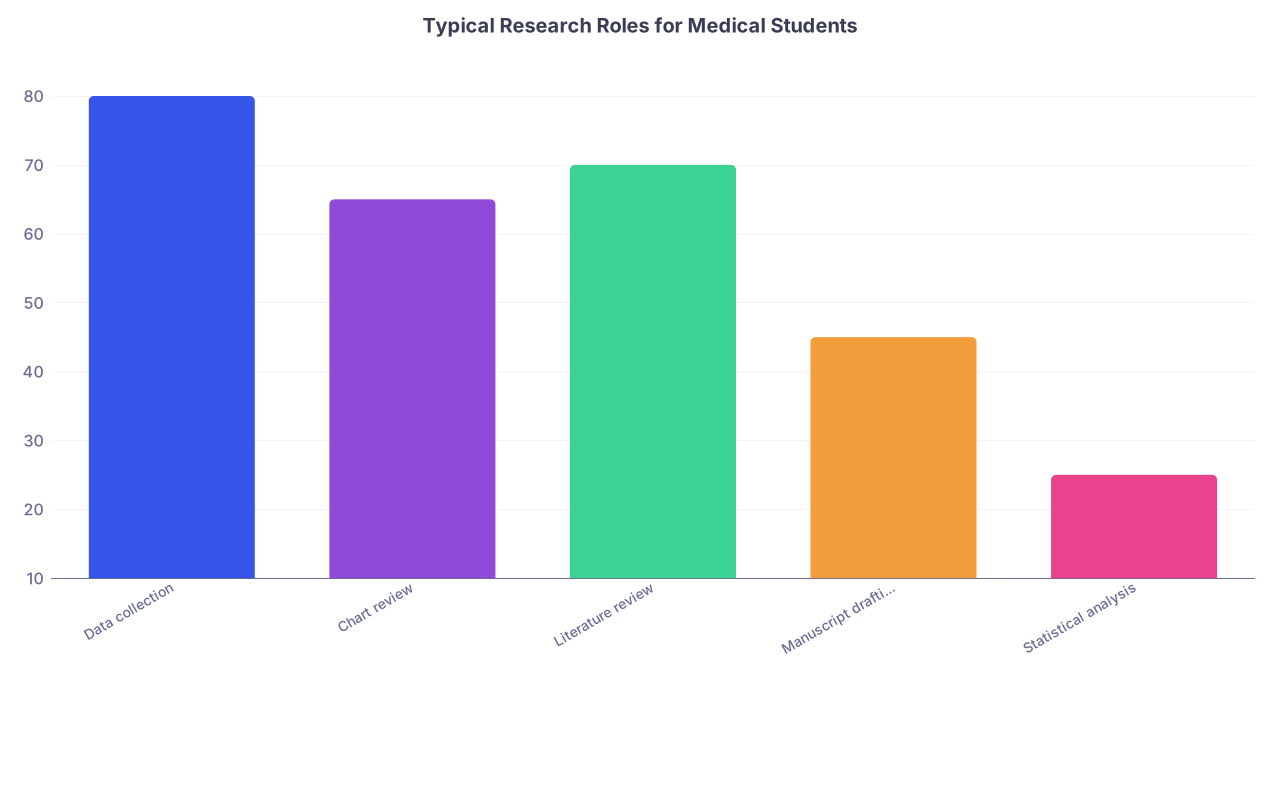
| Category | Value |
|---|---|
| Data collection | 80 |
| Chart review | 65 |
| Literature review | 70 |
| Manuscript drafting | 45 |
| Statistical analysis | 25 |
A Simple Prep Plan Before Interview Season
You don’t need a 30‑page dossier. You do need intentional prep.
For each research item you list:
- Write a 1–2 sentence summary of the question and design.
- Bullet your exact contributions (2–4 bullets).
- Note one challenge/problem the team faced.
- Note one thing you personally learned or would do differently next time.
Then practice saying it out loud like a human, not like you’re reading a methods section.
Here’s what that might look like for one project:
“Retrospective cohort of ~350 patients with ischemic stroke, looking at whether time to rehab consult predicted functional outcomes at discharge. I helped refine the inclusion/exclusion criteria, did the chart abstraction for about 120 patients, and created the initial data dictionary. Biggest challenge was dealing with incomplete documentation of NIHSS, which forced us to adjust our primary outcome. I learned how crucial variable definition is before you start pulling data.”
That’s 20–30 seconds. Clean. Honest. Shows insight.

| Step | Description |
|---|---|
| Step 1 | List all projects |
| Step 2 | Re-read papers/abstracts |
| Step 3 | Define question & design |
| Step 4 | List your concrete tasks |
| Step 5 | Identify challenge & lesson |
| Step 6 | Practice 20-30s summary aloud |
| Situation | How Candid You Should Be |
|---|---|
| You were primary driver / first author | Very direct; state you led design, major decisions, and writing |
| You were mid-level contributor | Clear about your slice of work; emphasize your piece, not the whole project |
| You had minor involvement | Honest about limits; frame as early exposure, not major achievement |
| Unpublished / stalled project | Open about status; highlight process and lessons learned |
| Oversold slightly in ERAS | Align interview story with true scope; don't repeat inflated phrasing |
How Programs Actually View Your Research
Reality check: outside very research-heavy programs, most interviewers aren’t scoring you on your h‑index. They’re looking at your research section and thinking:
- Did this person commit to something and follow through?
- Do they understand basic scientific thinking?
- Are they curious and reflective?
- Can I trust what they write on a chart if I can trust what they write on their CV?
At research‑intense places (think big academic IM, neurology, radiation oncology, or physician‑scientist tracks), they care more about productivity. But the honesty rule doesn’t change. If anything, those folks are even better at smelling inflated nonsense.
I’ve seen applicants with a single poster, discussed intelligently and honestly, leave a stronger impression than someone with 10 lines of vague “manuscript in progress” who couldn’t explain a single project clearly.
Quick Phrases You Can Steal
If you struggle with wording, use these templates and customize:
- “My primary responsibilities were…”
- “I joined the project at the [design/data collection/analysis/manuscript] stage, where I…”
- “I wasn’t involved in X, but I did Y and Z, which taught me…”
- “The PI/fellow led the analytic plan; my role was to…”
- “The project ultimately didn’t lead to a full paper, but from my perspective the key lesson was…”
They all share the same DNA: clear scope, no pretending, plus reflection.
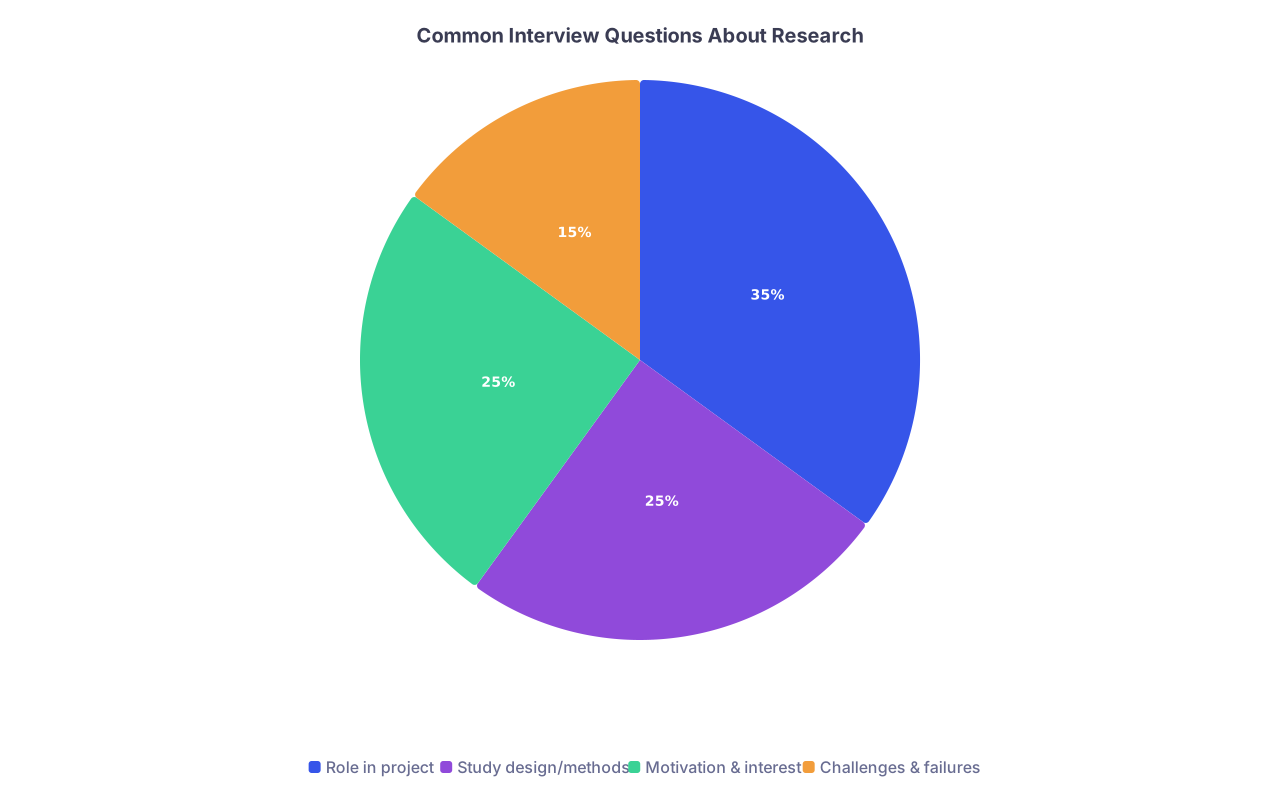
| Category | Value |
|---|---|
| Role in project | 35 |
| Study design/methods | 25 |
| Motivation & interest | 25 |
| Challenges & failures | 15 |

FAQ: Honesty About Your Research Role
Can I say “we” when describing the project, or should I always say “I”?
Use both. “We” for the overall project (“We conducted a retrospective study…”), and “I” for your specific role (“I was responsible for…”). If you only say “we,” it sounds like you’re hiding behind the group.What if the PI or fellow described me as ‘leading’ something, but I don’t feel I truly led it?
Calibrate. Instead of “I led the entire project,” say “I led the student team for data collection” or “I led the abstract writing.” Narrow the scope to what you actually owned. That’s still leadership, just accurately framed.Is it dishonest to list ‘manuscript in preparation’ when it’s moving slowly?
It depends. If there’s a real draft, clear plan, and ongoing work, it’s reasonable. If it’s a fantasy manuscript no one has touched in 9 months, don’t oversell it. In interviews, be transparent: “We have a draft in progress but it’s moving slowly because…”How should I handle a project where I disagreed with methods or quality?
Don’t trash your team. You can be tactfully honest: “I had some concerns about X; it sparked good discussions with my mentor about trade‑offs in real‑world research.” Focus on what you learned about critical appraisal and communication.What if I forget a detail (like sample size or exact p‑value) during the interview?
Say, “I don’t remember the exact number off the top of my head, but roughly…” and then give your best approximate. People respect that more than pretending. What matters is that you understand the gist and can explain the meaning, not that you can recite the abstract.Can I remove or downplay a project if I’m worried I exaggerated my role in ERAS?
You can’t change submitted ERAS, but you can absolutely downplay it in your narrative. Don’t bring it up proactively. If asked, give a precise, modest description of what you actually did. The further your interview story is from exaggeration, the better.
Two closing points:
- Be completely honest about what you did, but describe it with confidence and specificity. Specific tasks sound bigger than vague titles.
- Programs care more about your integrity and insight than your author position. If they walk away thinking, “I trust this person and they think like a scientist,” you’ve already won the research part of the interview.