
You’re staring at the ERAS “Scholarly Activities” section. You’ve got:
- One paper submitted to a mid-tier journal.
- Another in “final edits” that your PI swears will be submitted “this month.”
- A review you drafted that’s been sitting in a co-author’s inbox for six weeks.
And ERAS is asking for: Published, Accepted, Provisionally Accepted, Submitted.
No “in preparation” option.
Now you’re wondering: Should you list submitted manuscripts? What about “in preparation” stuff? How honest do you need to be? How much can you “project” without getting yourself into trouble?
Here’s the answer you’re looking for.
The Short Answer: What You Can and Cannot List
Let me be blunt:
- Submitted manuscripts: Yes, you can list them on ERAS.
- “In preparation” manuscripts: No, you should not list them as citations on ERAS.
- Anything not at least truly submitted: Don’t list as a paper. Period.
You can mention serious in-progress projects in experiences or your personal statement, but you should not create fake citations for things that don’t exist in a journal’s system yet.
Programs care much more about honesty and verifiability than they do about one extra “maybe” paper.
How ERAS Wants You to Classify Research
ERAS gives you explicit categories for publications. If you try to be creative here, you’re the one who’s wrong, not the system.
Here’s what ERAS categories actually mean and what belongs where:
| Status You Have | ERAS Category | List as Full Citation? |
|---|---|---|
| PubMed / DOI, fully accepted | Published | Yes |
| Final acceptance email, pending print/online | Accepted | Yes |
| Conditionally accepted, minor/major revisions but accepted if done | Provisionally Accepted | Yes |
| Manuscript formally submitted to a journal | Submitted | Yes |
| Draft not submitted / “in preparation” | None | No |
If you can’t log into a journal’s submission system and see your manuscript listed as “under review” or “with editor,” it doesn’t count as submitted.
Exactly How to List Submitted Manuscripts on ERAS
Let’s make this practical.
If a paper is actually submitted (i.e., uploaded to a journal and you have a manuscript ID), you can:
- List it in the Publications/Presentations section.
- Use the “Submitted” status.
- Include all co-authors and the target journal.
Example of a submitted manuscript citation on ERAS:
Smith J, Patel R, Lee A. Title of the manuscript. Journal of Internal Medicine. Submitted.
That’s it. Don’t add a fake year, volume, or DOI. Don’t say “in press” if it’s not accepted.
If the journal changes or it gets rejected and resubmitted elsewhere, that’s life. Nobody is going to crucify you because a submitted paper didn’t get accepted. They will care if you lied about its status.
How many submitted papers is “okay”?
Programs don’t get mad that you have submissions. They get suspicious when:
- You list 8+ “submitted” or “in press” items and almost nothing published.
- Your CV looks inflated and top-heavy with future promises.
A couple of submissions? Great. A wall of “Submitted, Submitted, Submitted” with nothing to show for MS1–MS3? People notice.
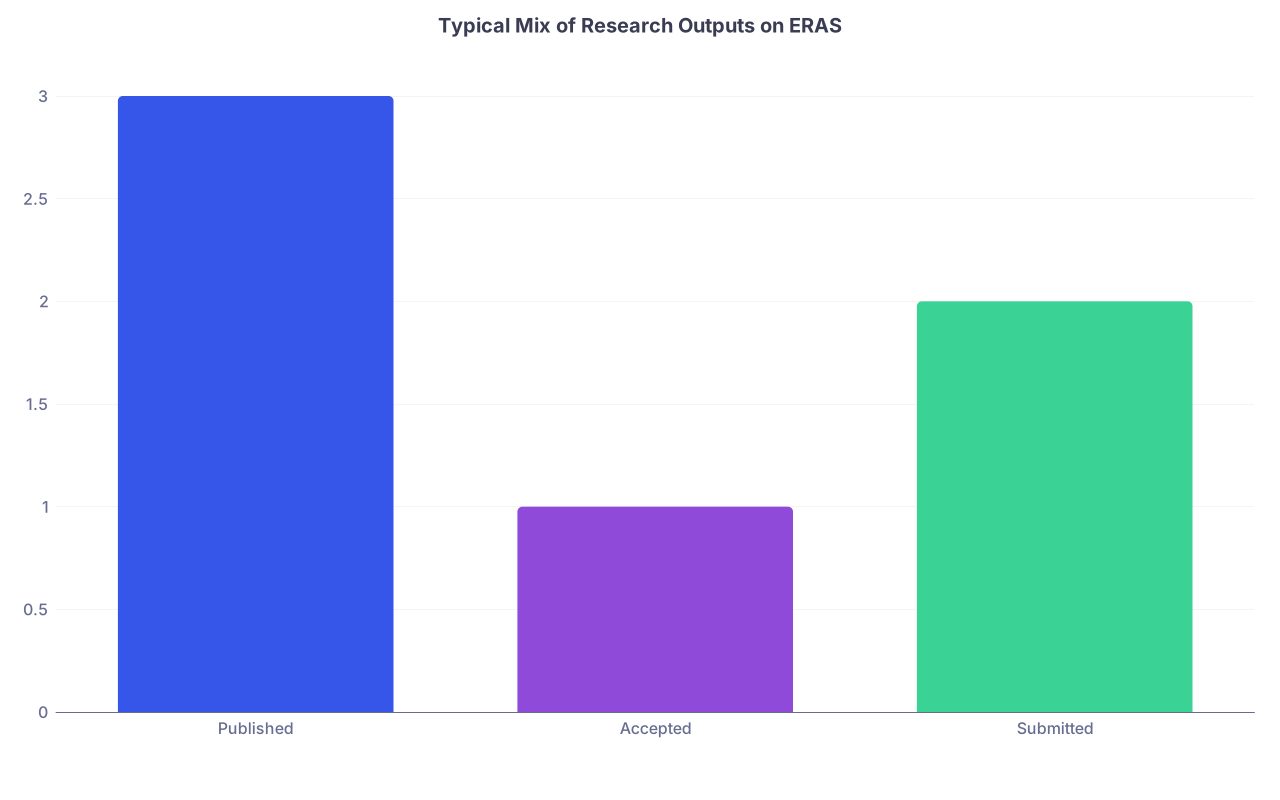
Here’s how this usually plays:
| Category | Value |
|---|---|
| Published | 3 |
| Accepted | 1 |
| Submitted | 2 |
That’s a normal, believable pattern for a research-active applicant. One or two submitted pieces is totally reasonable.
Why You Should Not List “In Preparation” Manuscripts as Publications
“I’ve written the first draft.”
“We’re doing figures now.”
“My PI said we’ll submit to NEJM.”
“Almost ready.”
Every PD has heard this a thousand times.
Here’s the reality:
- 30–50% of “in preparation” projects never get submitted.
- Another chunk gets submitted but heavily changed, or with different author order.
- PIs overpromise timelines. Chronically.
If you list “in preparation” as if it’s a real citation, you’re essentially asking a PD to grade you on a future that may never happen.
What goes wrong when you list “in preparation” as a paper
I’ve seen this play out in interviews:
- Applicant lists a beautiful-sounding “in preparation” paper in a great journal.
- PD or faculty interviewer asks: “So, what’s the status of that?”
- Applicant: “We’re still collecting data / it’s in draft / we’re revising.”
- Follow-up: “So not actually submitted yet?”
- Momentum dies. You look like you were padding your CV.
Best case, they think you’re overzealous. Worst case, they think you’re comfortable with half-truths.
Programs talk a lot about “integrity.” This is where they actually measure it.
Where to Put Legit “In Progress” Work (Without Lying)
You might be thinking: “If I can’t list in-prep as a paper, how do I get any credit for months of work?”
You absolutely can get credit. You just have to put it in the right place and describe it honestly.
You’ve got three good options:
- Research experience entries
- Personal statement mentions
- Interview talking points
1. Use the “Experiences” Section to Describe Ongoing Projects
ERAS has that big “Experiences” section for a reason. Use it.
Create a Research experience and describe:
- Project title / topic.
- Your role (data collection, analysis, first author, etc.).
- What’s actually been completed so far.
- Realistic expected outcome (e.g., “Manuscript in preparation for submission”).
Example description:
Conducted a retrospective chart review of 320 patients with HFpEF. Led data extraction and statistical analysis (logistic regression and Cox models). Drafted Introduction and Methods sections of first-author manuscript currently being prepared for submission.
That’s honest. Strong. And not overreaching.
2. Mention Big, Serious Projects in Your Personal Statement
If you have one major project that genuinely shaped your interest in a specialty, it deserves a line or two in your personal statement.
You just still don’t turn it into a fake citation.
Something like:
I’ve spent the last year working on a first-author project analyzing outcomes after TAVR in older adults. We’re finalizing the manuscript now, but the process of struggling through messy data and unexpected results has been more educational than any lecture.
Again: real, verifiable, not exaggerated.
3. Use Interviews to Update Programs on Progress
Interviewers actually like hearing: “Since my ERAS submission, X has been accepted / submitted.”
That’s one of the few times you’re supposed to give them happy updates.
You can say:
- “That project I mentioned is now submitted to [journal].”
- “We just got a revise-and-resubmit.”
- “It was accepted last month and is in press.”
Just don’t try to time travel and pretend it was at that status when you submitted ERAS.
The Ethics and Risk: How Much Can You “Spin” Without Lying?
Let me draw the line very clearly.
Okay:
- Listing a manuscript as “Submitted” when it’s actually submitted.
- Mentioning “manuscript in preparation” in the description of a research experience.
- Being optimistic about your role (e.g., “first author”) if that’s currently true and agreed upon.
- Updating programs during interviews with new acceptances.
Not okay:
- Creating a full citation for “In preparation” articles in the publications section.
- Calling something “Accepted” when it’s actually just “Submitted.”
- Dramatically inflating your author order.
- Listing a journal that your PI simply hopes to submit to.
Because yes, programs do spot-check. Especially in research-heavy fields.
Here’s how that usually happens:

| Step | Description |
|---|---|
| Step 1 | Faculty sees your ERAS |
| Step 2 | Look up papers on PubMed |
| Step 3 | Skim without checking |
| Step 4 | Trust but ask about projects |
| Step 5 | Ask pointed questions at interview |
| Step 6 | Research heavy specialty? |
| Step 7 | Find your name? |
If you’re applying to things like dermatology, radiation oncology, plastic surgery, or academic IM, they’re more likely to actually search your name.
You don’t want that to end badly.
Special Situations People Always Ask About
Let’s hit some edge cases that confuse a lot of applicants.
“The paper is accepted after ERAS submission. Now what?”
Perfect. That’s a good problem.
Here’s what you do:
- Update it in your CV for away rotations / post-interview communication.
- Mention the acceptance in interviews: “Since submitting ERAS, this was accepted in [journal].”
- If programs ask for updates explicitly, include the new status.
You don’t need to freak out that ERAS still says “Submitted.” It reflects your status at the time of submission.
“The journal changed. We got rejected and resubmitted somewhere else.”
Normal. Nobody cares.
At interviews, you say:
That manuscript I listed as ‘Submitted’ to Journal X is now under review at Journal Y after we received a rejection with constructive feedback.
That’s still honest. In fact it shows resilience and reality.
“I’m second or third author. Does it still matter?”
Yes. Not every paper has to be first-author to help you.
ERAS doesn’t punish you for not being first author on everything. They punish you for lying or stretching the truth.
If you’re deep in the work and got real experience, list it. Just don’t invent your role.
How Programs Actually Interpret Your Research Section
Here’s what PDs and interviewers are trying to figure out from your research section. It’s less about raw numbers and more about patterns.
They’re looking at:
- Trajectory: Did your research story grow over time or stall out?
- Consistency: Do your descriptions match what you can actually talk about?
- Credibility: Does the mix of “Published/Accepted/Submitted” look real or padded?
- Fit: Does your research point toward the specialty and type of career you claim you want?
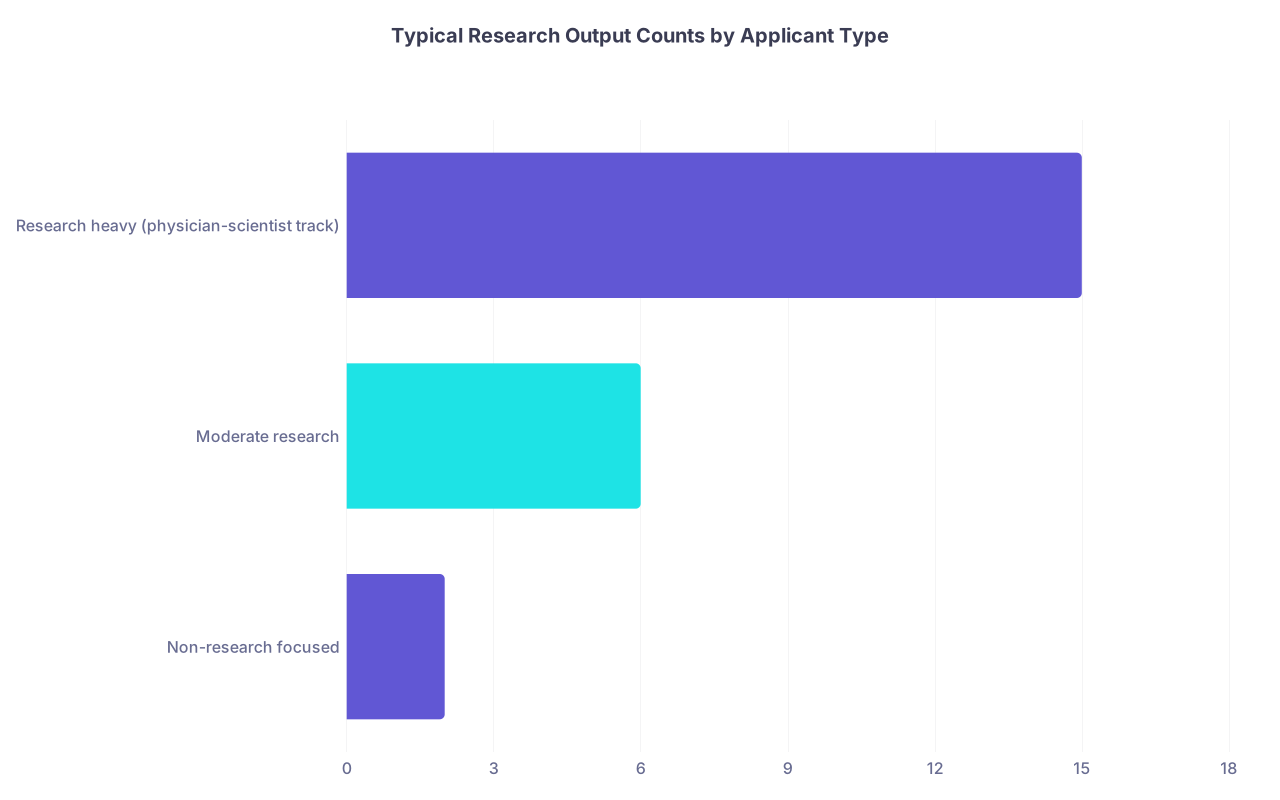
Here’s a rough sense of how many total “scholarly” items people might have by application time, not just papers:
| Category | Value |
|---|---|
| Non-research focused | 2 |
| Moderate research | 6 |
| Research heavy (physician-scientist track) | 15 |
These counts usually include:
- Posters
- Abstracts
- Presentations
- Publications
- Submissions
The point: one or two submitted manuscripts is fine. They belong. They help. Just don’t build an empire out of air.
Practical Checklist: What You Should Do Right Now
Let’s turn this into an action plan. Here’s how I’d tell a student to handle their current projects today.
Make a list of every project you’re involved in.
Column for: title, your role, status (idea / data collection / writing / submitted / accepted / published), and target journal if relevant.Circle only the ones that are actually submitted or accepted.
Those are the only ones that become formal citations in the ERAS publications section.For the remaining “in preparation / ongoing” projects:
Put them under Research Experiences and describe:- What you’ve personally done.
- Current concrete state.
- Realistic next step (e.g., “manuscript in preparation,” “data collection ongoing”).
Confirm with your PI your author order and submission status.
Don’t guess. Send a short email: “Hey Dr. X, I’m filling out ERAS — could you confirm current status and my author position on [project]?”Write down 1–2 sentences you could say in an interview about each project.
If you can’t explain the hypothesis, methods, and your role clearly, you’re not ready to list that project prominently.
One Concrete Next Step
Open a blank document right now and make a two-column list:
- Left column: “Submitted / Accepted / Published”
- Right column: “In Preparation / Ongoing”
Move each project you’ve worked on into one of those two columns.
Anything in the left column? That can become an ERAS citation, with honest status (Submitted / Accepted / Published).
Anything in the right column? That belongs in your Experiences section as research, not as a publication.
Do that, and you’ll have a clean, ethical, and strong research section that programs can trust—and that you won’t have to mentally defend in every interview.