
Your research narrative will matter more than your raw publication count.
Applicants with five scattered papers and no story routinely lose to applicants with two well‑aligned projects and a clear through‑line. I have seen it cycle after cycle.
Let me walk through how you actually build that narrative—from pre‑med all the way to residency applications—so that your CV, personal statement, and interviews read like one coherent arc instead of a random collection of “I needed something for ERAS.”
1. What Program Directors Actually Mean by “Research Narrative”
Program directors are not secretly counting PubMed links with a clicker. They are scanning for three things:
- Can you stick with something hard over time?
- Do you understand a clinical problem deeply enough to ask good questions?
- Is there a logical connection between who you say you are and what you have done?
They call this “having a research focus” or “a coherent story.” Practically, that looks like:
- A recognizable theme (topic, population, method, or question) that shows up more than once.
- Increasing responsibility and sophistication over time.
- Alignment between your stated interests, your research, and your target specialty.
Here’s the part people get wrong: the theme does not have to be narrow. You do not need “left atrial appendage occlusion device outcomes in older adults with CKD.” That is overfit.
You need something like:
- “Outcomes and quality of care in older adults,” or
- “Improving systems and efficiency in emergency care,” or
- “Digital tools and data science in clinical decision‑making.”
Those are broad enough to flex, but specific enough to be memorable.
2. The Four Axes of a Strong Research Narrative
Think on four axes. If you can show coherence along even two or three, you are ahead of most applicants.
Topic / Clinical Domain
Cardiology, psychosis, surgical outcomes, health disparities, peds ICU, whatever.Patient Population
Older adults, children, underserved communities, transplant recipients, cancer survivors.Methodology
Clinical outcomes, quality improvement (QI), basic science, imaging, machine learning, medical education.Underlying Question / “Why”
Examples:- How do we reduce preventable complications?
- How do we make care safer for vulnerable patients?
- How do we use data/technology more intelligently in medicine?
- How do training and education affect patient care?
You can build coherence by:
- Repeating the same topic with different methods.
- Repeating the same method in different clinical areas.
- Following the same patient population across settings.
- Chasing the same underlying problem (e.g., access, safety, efficiency) as you move between projects.
If your pre‑med research was in basic neuroscience and now you want ortho, your narrative is not dead. You just have to be thoughtful about which axis you lean on.
3. Stage 1 – Pre‑Med: Laying Raw Material (Even If “Off‑Topic”)
Pre‑med research is often opportunistic. Wrong lab, wrong field, wrong campus. That is fine. The key is: how can this become usable raw material for your eventual research narrative?
You want to extract three things from pre‑med research:
- Evidence of persistence and productivity.
- Techniques or skills that can transfer.
- Seeds of a theme you can plausibly carry forward.
Example 1: Classic basic science mismatch
You: pre‑med at a strong undergrad, worked 2 years in a Drosophila circadian rhythm lab, one middle‑author paper, one poster. Now you want EM or anesthesia.
Most applicants treat that as “old, irrelevant.” That is sloppy. Here is how you salvage and connect it.
Your axes:
- Method: hypothesis‑driven experimental work, data analysis, reproducible protocols.
- Underlying question: how biological systems respond to stress/cycles, which appears again later in ICU/OR/ED settings.
- Skills: quantitative analysis, statistics, troubleshooting experiments.
Your story later:
“My first exposure to research was in a basic science lab studying how disruptions in circadian rhythms affect neuronal signaling. I loved the rigor of hypothesis‑driven work, but I missed direct clinical relevance. In medical school, I carried that interest in physiological stress into the clinical space, focusing on peri‑operative hemodynamics and ICU outcomes.”
Now your fruit fly paper is not random. It is chapter 1.
Example 2: “Soft” pre‑med research (education / social science)
You: did pre‑med work on STEM education in underrepresented students. No wet lab, but multiple posters.
Axes:
- Population: underrepresented / disadvantaged students.
- Underlying question: equity and access.
- Method: survey design, mixed methods.
Later, you go into internal medicine with a focus on disparities in diabetes care in underserved communities. That is perfectly coherent.
The trick as a pre‑med is not trying to guess your final specialty. Your job is to:
- Actually commit to at least one project long enough to show results.
- Learn a real method (not just “pipetted sometimes”).
- Reflect early on what genuinely interested you—technique, topic, population, or question.
Write those reflections down now. You will not remember the details when you are polishing your ERAS personal statement at 1 a.m. four years later.
4. Stage 2 – Early Med School (M1–M2): Choosing Direction Intentionally
This is where people either tighten their story or blow it up completely.
Your goals in M1–M2:
- Get into at least one project that plausibly points toward 2–3 specialties you are considering.
- Start inching toward the methods valued in competitive programs in those fields.
- Position yourself with at least one mentor who is recognizable in that field or at your own institution.
Stop chasing random case reports in 5 different fields. It looks desperate.
Matching your research to a “cluster” of specialties
Think in clusters, not single endpoints. For example:
Cluster A: Internal Medicine, Cards, Pulm/Crit, GI
Good research anchors: outcomes, QI, health services, imaging, cardiometabolic disease.Cluster B: Surgery, Ortho, ENT, Neurosurgery
Good anchors: surgical outcomes, peri‑op care, trauma, biomechanics, oncology.Cluster C: Psych, Neurology, Neuro, PM&R
Good anchors: neuroimaging, behavioral research, neurophys, rehab outcomes, addiction.Cluster D: EM, Anesthesia, ICU
Good anchors: acute care workflows, resuscitation, hemodynamics, airway, ED operations.
If you are unsure between EM and IM, for example, research in sepsis outcomes, ICU admission criteria, or ED‑to‑floor transitions fits both.
| Cluster | Possible Specialties | Good Research Anchors |
|---|---|---|
| A | IM, Cards, Pulm/Crit | Outcomes, QI, chronic disease |
| B | Surgery, Ortho, ENT | Surgical outcomes, peri-op care |
| C | Psych, Neuro, PM&R | Neuroimaging, rehab, addiction |
| D | EM, Anesthesia, ICU | Acute care, hemodynamics, ED ops |
How to select projects that strengthen your arc
When an attending offers you a project, ask yourself three questions:
- Can I reasonably see myself caring about this topic, population, or question 3–5 years from now?
- Does this build on anything I have done before—skills, methods, or themes?
- Is the mentor productive and will they actually finish this?
If the answer to all three is no, politely decline. You do not have infinite bandwidth.
Example: You did undergrad health disparities work. As an M1, a hospitalist offers you a QI project on readmissions for heart failure in Medicaid patients. Perfect. You continue your “equity / vulnerable populations” axis and add clinically visible outcomes.
On the other hand, if a dermatologist offers you a one‑off cosmetic case report and you have zero other tie‑ins, that may be a distraction.
5. Stage 3 – Clinical Years (M3–M4): Tightening the Story for ERAS
By late M3, you need to commit to your narrative. That does not mean you cannot pivot specialties; it means you must decide which version of your past to emphasize.
Decide your “headline” in one sentence
This is non‑negotiable. You need a single, clean research identity line that you can put in your ERAS application, say on interview day, and repeat without thinking.
Examples:
- “I am interested in cardiometabolic disease and outcomes in complex medical patients.”
- “My research focuses on surgical quality and postoperative complications.”
- “My primary interest is mental health care access in vulnerable populations.”
- “I focus on acute care workflows and resuscitation in high‑acuity settings.”
Notice what these are not. They are not “I did some projects in X and also Y.” They are a clear through‑line.
Everything else in your application must be edited to support this sentence.
Curating your CV to emphasize coherence
You cannot change what you did. You can change how it is grouped and described.
Strategies:
Group related projects under a thematic heading in your experiences section.
Instead of 3 separate entries:- “Research Assistant – Sepsis QI”
- “Research Assistant – ICU Transfers”
- “Research Assistant – ED Throughput”
Use one entry:
- “Clinical Outcomes and Operations Research in Acute Care”
Then list bullets specifying each project.
Use descriptions to highlight the axis of alignment.
“Investigated the impact of ED boarding on ICU outcomes, extending my prior work on sepsis triage and hospital flow.”Downplay or compress unrelated work.
A basic science fly paper? Still list it, but one line, near the bottom, without big fanfare. It is there for productivity, not branding.
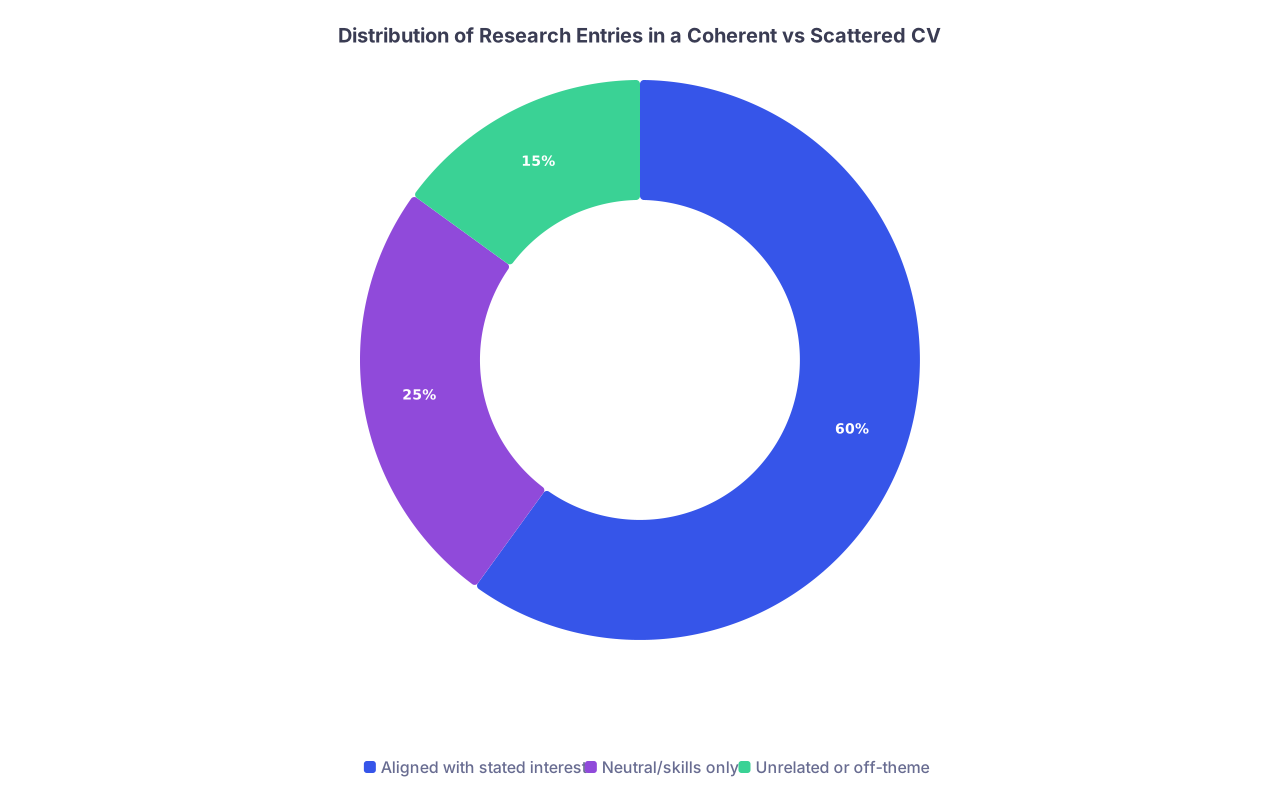
| Category | Value |
|---|---|
| Aligned with stated interest | 60 |
| Neutral/skills only | 25 |
| Unrelated or off-theme | 15 |
In a good CV, most entries clearly support the central narrative. A few are skill‑based or legacy work. Very few feel random.
6. Making Pre‑Med and Med School Research Talk to Each Other
The main technical problem you are solving is this: pre‑med research often looks disconnected from med school research. Your job is to write the connective tissue.
You do that through:
- How you write the “description” of experiences.
- How you structure the personal statement.
- How you answer “Tell me about your research” in interviews.
Step 1: Identify the strongest bridge
Look back at everything you have done and pick the most defensible bridge:
- Shared population (e.g., older adults, adolescents, underserved).
- Shared method (e.g., outcomes analysis, basic science, imaging, education).
- Shared question (e.g., improving access, understanding mechanisms, enhancing quality).
Example:
Pre‑med:
- STEM education for underrepresented minorities.
Med school:
- Diabetes management in a safety‑net clinic.
- Hospital readmission QI in predominantly low‑income patients.
Bridge: equity and access for underserved populations.
You do not need a tortured story about how education research obviously leads to diabetes QI. You need a straightforward arc:
“I have been consistently drawn to understanding and addressing barriers faced by underserved communities, first in educational contexts and later in clinical care.”
That is it. Clean.
Step 2: Rewrite your old work with the bridge in mind
On your CV, the education project becomes:
“Investigated structural barriers affecting STEM achievement in underrepresented students, initiating my interest in how systemic factors shape outcomes in vulnerable populations.”
Now the seed is clearly there.
Step 3: Use chronology as a strength, not a weakness
Chronology helps you. You are allowed to grow and shift.
The pattern you want:
- Early, “general” version of the theme (pre‑med).
- More clinically oriented and focused expression (M1–M2).
- Concrete, specialty‑relevant applications (M3–M4).
Your personal statement can literally be structured that way: early exposure → refining interest → concrete current focus.
7. Writing the Personal Statement Around a Research Narrative (Without Sounding Robotic)
Personal statements that just name‑drop projects read like expanded CVs. That is useless. You are writing a progression, not a PubMed recap.
Simple framework:
- Opening: clinical moment or insight that ties to your core theme.
- Middle: how your research and experiences have developed that theme across time.
- End: how that leads logically to this specialty and your future plans.
Example for someone applying to cardiology‑leaning IM:
- Opening: a brief story of an elderly patient with recurrent heart failure admissions whose social situation complicated care.
- Middle:
- Pre‑med: public health work on chronic disease and adherence in community clinics.
- M1–M2: outcomes project on heart failure readmissions.
- M3: QI work on discharge planning and transitions of care.
- End: interest in internal medicine with a future in cardiology focused on improving outcomes for complex, socioeconomically vulnerable patients.
The pivot line you are aiming for sounds like:
“Across these experiences, I have been drawn to the challenge of improving outcomes for complex patients, particularly where medical decisions intersect with social realities. That interest has crystallized into a focus on [your specialty].”
One clean through‑line. No whiplash.
8. Presenting Your Narrative in Interviews
This is where most applicants fumble. They either monologue about methods until faculty eyes glaze over, or they give a scattershot list of projects with no theme.
You need three canned, practiced answers:
- “Tell me about your research.”
- “How did your research interests develop?”
- “How do you see research fitting into your future career?”
All three are variations on the same story, adjusted for angle.
1. “Tell me about your research”
Do not walk through every project. Pick 1–2 that best represent your narrative and show progression.
Structure:
- One sentence: your overall research focus.
- 3–4 sentences: brief summary of a key project (question, what you did, what you found, why it matters).
- 2–3 sentences: how this connects to your clinical interests / future plans.
Example:
“My research focuses on acute care operations and resuscitation. As an M2, I worked on a project evaluating how ED boarding times affected outcomes for septic patients. I helped design the data abstraction protocol and performed part of the statistical analysis. We found that prolonged boarding was associated with higher ICU admission rates and longer lengths of stay, which underscored how system factors shape patient outcomes. More recently, I have been working on a QI project implementing a new sepsis pathway to address those delays. These projects have cemented my interest in emergency medicine and critical care, where I hope to continue improving systems of care for critically ill patients.”
Notice: everything aligns to “acute care operations and resuscitation.” The early project and the QI project are chapters, not disconnected anecdotes.
2. “How did your research interests develop?”
Chronological version. 2–3 stages:
- Pre‑med: initial exposure, what you learned / liked.
- Early med: how you refined or pivoted the focus.
- Current: your mature version of that interest.
Carry the same theme.
3. “How will research fit into your career?”
This is where programs want to see realism. You do not get bonus points for claiming you will be 80% research at a community program with no T32 slots.
Anchor your answer to:
- The type of questions you want to keep asking.
- The role you realistically see (e.g., clinician‑educator who does QI; academic subspecialist; trialist; basic scientist).
And match it to the program type.
“I expect my primary role to be as a clinician, but I want to remain involved in outcomes and QI research focused on [your theme]. I enjoy identifying system problems at the bedside and then working with a team to design and study interventions. I am looking for a program where I can have protected time for these kinds of projects and good mentorship in health services research.”
That is coherent and believable.
9. Handling Common “Broken Narrative” Scenarios
There are a few recurrent patterns I see where students panic. Here is how to clean them up.
Scenario A: Early Basic Science, Later Clinical, Different Specialty
Pre‑med: bench immunology.
Med school: clinical renal outcomes.
Applying: anesthesia.
Bridge on methods and underlying question:
- Bench: mechanisms of inflammation and organ injury.
- Clinical: kidney injury and outcomes.
- Anesthesia: peri‑operative organ protection and hemodynamics.
Your line:
“I have been interested in how physiologic stress leads to organ injury—from mechanistic work in immunology as an undergraduate, to studying renal outcomes in clinical populations in medical school. In anesthesia, I hope to apply that interest to peri‑operative organ protection and hemodynamics in high‑risk patients.”
No one reasonable will fault that.
Scenario B: “I Did Everything” Syndrome
You: one derm case report, one GI retrospective, one psych survey, two QI things, one global health project. Looks like a yard sale.
You cannot sell yourself as “I love everything.” That sounds unfocused.
Pick the strongest cluster by:
- Which projects have real substance (not just name on a case report)?
- Which have the best mentorship / letters attached?
- Which align with your actual specialty choice?
Then:
- Promote 2–3 aligned projects heavily.
- Compress the rest under a single heading like “Additional Scholarly Activity” or treat them as “opportunities to explore different fields” in one line.
- Craft your one‑sentence headline around the cluster, not the outliers.
The mistake is trying to give each random project equal airtime. Do not.
Scenario C: Late Pivot in Specialty
You thought you were going into surgery. All your work is on surgical outcomes. Late M3, you fall in love with anesthesia.
This happens. Programs see it all the time.
You have two ways out:
Recast your theme around peri‑operative care.
Surgery outcomes → complications, peri‑op risk stratification, post‑op pain → perfect for anesthesia.Your story:
“Through work on surgical outcomes, I became more interested in the peri‑operative period as a whole—how intra‑operative management affects complications and recovery. That led me to anesthesia, where I can focus on physiologic management and risk reduction throughout the operative course.”
Or, emphasize method over domain.
“I have focused on outcomes research and prediction modeling,” which you now apply in anesthesia contexts.
Do not pretend you “always loved anesthesia.” Instead, show a plausible evolution.
10. Putting It All Together: Concrete Checklist
If you want a brutally simple sanity check for your research narrative before submitting ERAS, use this.
By the time you hit submit, you should be able to:
Write one clear sentence that describes your research focus that:
- Fits your target specialty.
- Can plausibly include at least half your significant projects.
Identify at least one axis of coherence (topic, population, method, or question) that shows up:
- In at least one pre‑med project.
- In at least one med school project.
- In how you talk about your future.
Point to progression:
- Early: assistant/data collector.
- Later: designing elements, leading pieces of a project, presenting, maybe first‑author.
See that your ERAS descriptions and personal statement:
- Use consistent language around your theme.
- Do not over‑emphasize off‑theme one‑offs.
- Make your chronology look like growth, not whiplash.
Answer, out loud, without rambling:
- “Tell me about your research.”
- “How did your research interests develop?”
- “How will research fit into your career?”
If you cannot hit those, you do not need more projects. You need to rewrite how you are presenting what you already have.

| Step | Description |
|---|---|
| Step 1 | Pre-med Research |
| Step 2 | Identify Theme Axis |
| Step 3 | M1-M2 Project Selection |
| Step 4 | Focused M3-M4 Projects |
| Step 5 | Craft One-Sentence Headline |
| Step 6 | Align CV & Personal Statement |
| Step 7 | Consistent Interview Story |
Key Takeaways
- Coherence beats volume. A few well‑aligned projects with a clear through‑line look better than a noisy pile of disconnected work.
- You build your narrative on axes—topic, population, method, or underlying question—and connect pre‑med, med school, and future plans along at least one of them.
- The real skill is not doing more research; it is editing and presenting what you have so that your CV, personal statement, and interviews all tell the same focused story.