
Only 27% of applicants with “small” research projects ever mention them in detail during residency interviews—yet those who do are rated higher on “scholarly potential” almost every time.
You built a database for a QI project. Or for a retrospective chart review. Or to help your attending stop tracking patients in a 400-column Excel nightmare. Now you are staring down residency interviews wondering: is this actually worth talking about?
Yes. If you frame it correctly, a modest database project can beat out a flashy basic-science poster in how program directors remember you.
Let me break this down specifically.
1. Why a Database Project Actually Matters More Than You Think
Most applicants underestimate “infrastructure” work. They think if it is not a randomized trial or an R01-level project, it is filler. Programs do not see it that way.
Here is what a good database project quietly signals to interviewers:
- You understand clinical workflows.
- You can bring order to chaos.
- You think longitudinally—beyond one abstract.
- You make other people’s work easier and more reproducible.
That is residency gold.
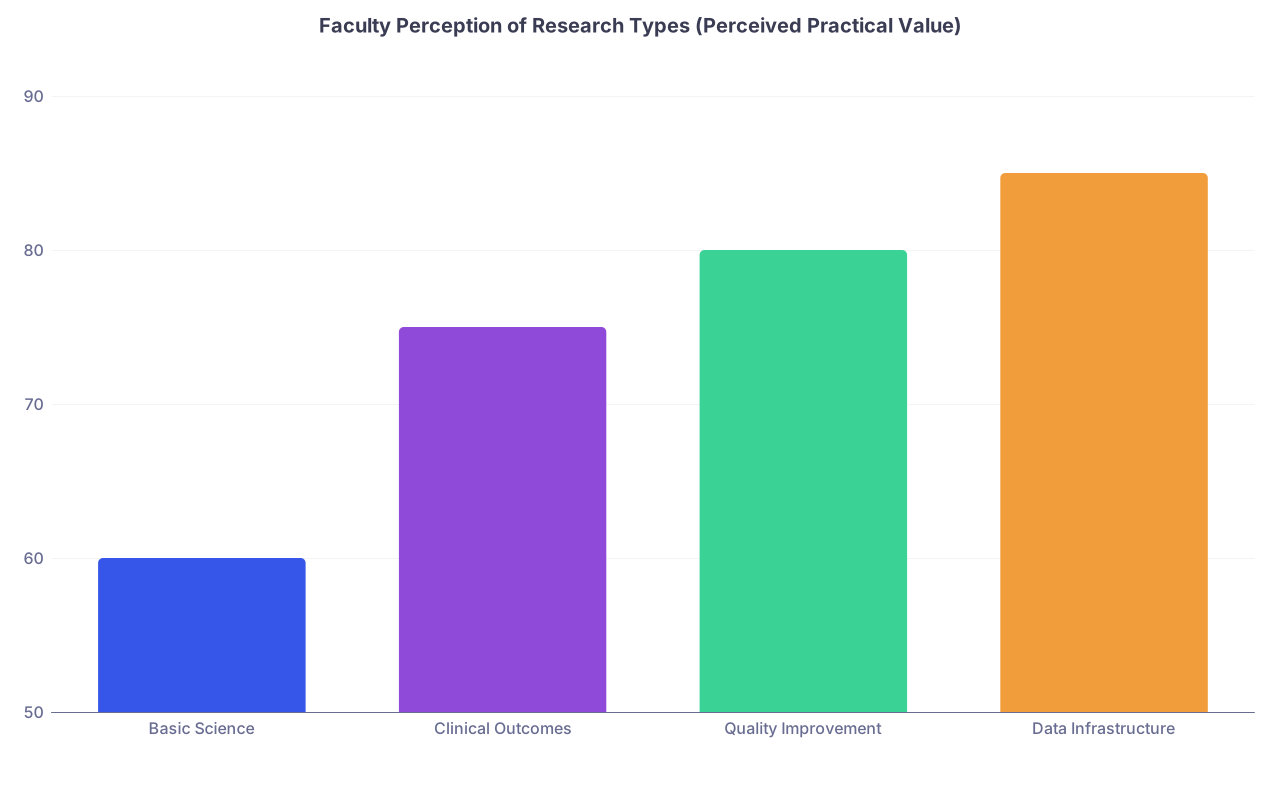
| Category | Value |
|---|---|
| Basic Science | 60 |
| Clinical Outcomes | 75 |
| Quality Improvement | 80 |
| Data Infrastructure | 85 |
You are competing in a field where everyone says “I did a retrospective study on X outcomes in Y population.” Most of those “studies” are actually painful: 3 students manually abstracting data into a barely functioning spreadsheet.
You, on the other hand, can say:
“I built the database that now underlies three separate projects and is being used by other residents.”
That is an identity. Not just a line on ERAS.
2. First Step: Translate Your Tech Work Into “Clinician Language”
The worst way to talk about your project: “I built a MySQL database with X tables and Y relationships and used Python for ETL.”
Faculty will tune out after “MySQL.”
Your job is translation. Turn a technical project into a clinical story.
Think in this order:
- Clinical problem
- Process pain
- Your solution (the database)
- Measurable or at least credible impact
Strip out jargon unless they ask.
Convert this…
“I designed a REDCap database with branching logic, data dictionaries, and complex queries for longitudinal data capture in a multi-center cohort.”
Into this…
“Our group had 800+ patients scattered across multiple spreadsheets that were constantly out of sync. I built a single REDCap database so every team member entered data in a standardized way, which reduced errors and made future analyses much faster.”
Same project. Very different level of comprehension.
3. Dissecting the Database Project: What Interviewers Actually Care About
You need a structure to talk about this in 2–3 minutes without rambling. Use four buckets:
- Problem
- Design
- Execution
- Impact and durability
Let’s walk through each, with the nuance that interviewers care about.
3.1 Problem: Frame It Like a Clinician, Not a Coder
Start with the pain point, not the tool.
Bad:
“We wanted to build a database to store ICU data.”
Better:
“Our ICU had several ongoing QI and research projects, but every student was maintaining their own spreadsheet. Variables were named differently, there were duplicate patients, and we kept finding inconsistencies when we tried to merge files.”
Name the pain in a way clinicians recognize:
- “No one trusted the numbers.”
- “We were double-charting the same patients.”
- “It took weeks just to clean the data enough to run simple stats.”
- “We could not easily pull out which patients met specific inclusion criteria.”
This gets nods in a conference room. I have seen attendings start venting about their own Excel disasters mid-interview when a student phrases it this way. That is rapport you want.
3.2 Design: Show That You Thought, Not Just Clicked
You are not giving a lecture on relational database theory. But you do want to show judgment.
Hit 3 things:
- What you decided to capture
- How you standardized it
- How you made it usable for others
Example:
“We sat down with the PI and mapped out which variables had been used across previous projects and which were likely to be reused. I then proposed a core data dictionary—definitions, formats, and allowable values—for things like comorbidities, interventions, and outcomes. That allowed us to avoid the ‘free-text everywhere’ problem.”
If it was a relational database:
“I separated the data into related tables—patients, encounters, medications, outcomes—so that we did not duplicate information and could add new encounters without breaking the structure.”
If it was REDCap/Qualtrics/Excel but thoughtfully organized:
“I used REDCap’s branching logic to limit fields based on previous answers, and I locked down variable names so that new team members could not arbitrarily change them project to project.”
3.3 Execution: Where You Quietly Prove You Can Lead
This is not just “I clicked buttons.” Focus on:
- Stakeholder herding: residents, fellows, PI, IT, IRB
- Constraints you had to work around (HIPAA, time, approvals)
- How you trained or supported others
Example narrative:
“Once the structure was approved, I built the database in REDCap and tested it with 20 sample patients from our old spreadsheets. We found several discrepancies that forced us to refine definitions—for example, how to handle multiple admissions in the same year. After that, I wrote a short user guide, did a 30-minute training for the research team, and stayed on as the point person for any issues in the first month.”
That is leadership. Not “I am a leader” on a slide. Actual behaviors.
3.4 Impact and Durability: The Piece Almost Everyone Forget to Sell
You do not stop at “the database worked.” You push it into:
- What changed for the team or department
- What became possible that was not before
- How long the system kept being used after you left
Strong examples:
- “Before the database, it took 2–3 weeks to get a clean data set for analysis. After, we could pull an analysis-ready export in under an hour.”
- “Since then, the database has supported three abstracts at regional meetings and a manuscript that is in submission.”
- “Two other fellows adapted the structure for related projects, so we now have a shared platform instead of everyone starting from scratch.”
If the project is early and you lack hard outcomes, focus on credible future use:
“Our primary goal was to build a stable platform for prospective data capture over the next 3–5 years, and the incoming resident research lead has already started using it for a new cohort.”
4. The 90-Second “Database Story” You Need Ready
You will not get 10 minutes. You will often get a vague opening like:
“Tell me about one of your research projects.”
You need a tight 60–90 second story, with enough hooks that they can dig deeper if interested.
Use this skeleton verbatim and adapt:
- One-liner: what it is
- The mess you inherited
- What you actually built
- The effect
Example:
“I worked on a project that started as a simple retrospective review and ended up with me building our division’s main outcomes database.
When I joined, they had three different Excel files tracking overlapping patient cohorts, each with different variable names and formats. Any time someone wanted to run an analysis, it took weeks just to figure out which file was ‘correct’.
I proposed building a single REDCap database with a standardized data dictionary. I sat with the PI and fellows to define core variables, built the structure, and then migrated and cleaned the existing data. I also created user instructions and trained the team so that new patients were entered prospectively.
Now, instead of rebuilding the data set for each project, residents and fellows just query the database. It has already supported a QI project on readmission rates and a resident’s abstract at our regional meeting.”
That is tight. Clear. Clinically framed. And it makes you look like someone who fixes systems, not just runs t‑tests.
5. Handling Common Interview Questions About Your Project
You should anticipate the predictable angles faculty will use to press you.
“What was the hardest part?”
Do not say “learning SQL” or “figuring out REDCap.” That centers you, not the work.
Better answers:
- “Getting everyone to agree on definitions. For example, different clinicians counted ‘complication’ differently. I had to facilitate those conversations and lock in operational definitions so the data would be trustworthy.”
- “Balancing flexibility with standardization. If the database is too rigid, no one wants to use it. If it is too open, you lose consistency. I had to find a middle ground.”
“What would you do differently if you started today?”
This is a test of reflection, not regret.
Sample angles:
- “I would involve our statisticians earlier. Some of the variables I initially included were redundant and others were missing detail they later wanted.”
- “I would pilot the data entry with more users before finalizing. A lot of my assumptions about what was intuitive were wrong until interns actually tried using it.”
“What was your specific role versus others?”
They are sniffing for “passenger versus driver.”
Be concrete:
“I led the database design and build, did the initial data migration and cleaning, and created the user guide. The PI defined the overarching research questions and supervised the project, and two residents helped with manual chart review for missing data.”
You will get respect for being explicit.
“How did you ensure data quality?”
Great chance to show you understand rigor:
- Double entry for a subset of charts
- Logic checks in REDCap (e.g., age ranges, date sequences)
- Periodic spot audits
- Version control for variable definitions
Example:
“We did inter-rater reliability on 50 charts between me and another reviewer. Any discrepancies triggered a discussion and, sometimes, a revision of the data dictionary.”
That sounds like someone who will not garbage-in-garbage-out your ICU QI project as an intern.
6. Adapting the Story to Different Specialties
Different programs care about different things. The same project can be framed several ways.
| Specialty | What To Emphasize |
|---|---|
| Internal Med | Outcomes, longitudinal data |
| Surgery | Perioperative metrics, QI |
| EM | Throughput, real-time data |
| Pediatrics | Safety, follow-up tracking |
| Neurology | Phenotyping, detailed data |
Internal Medicine / Hospitalist Tracks
Highlight:
- Readmission, LOS, mortality, process metrics
- Ability to integrate multiple encounters per patient
- Risk adjustment fields (Charlson, etc.)
Example emphasis:
“We deliberately structured the database to track readmissions and multiple hospitalizations so we could examine longer-term outcomes rather than just index admission.”
Surgery
Focus on:
- Operative details, complications, follow-up
- Standardized definitions (Clavien–Dindo, etc.)
- Support for morbidity and mortality (M&M) reviews
Example emphasis:
“The database captured structured operative variables and postoperative complications defined by Clavien–Dindo, which made it easier for our department to review trends in M&M instead of just anecdotal cases.”
EM
They love throughput, resource use, and systems.
Emphasize:
- Timestamps (door-to-doc, door-to-CT, etc.)
- ED revisits, bounce-backs
- Integration with ED workflow
Example:
“We focused heavily on time stamps and visit-level variables so we could study throughput and identify patterns in 72-hour return visits.”
7. If Your Project Is “Incomplete” or Not Yet Published
Most applicants get sheepish here. Do not. Programs care more about your process than whether the paper is on PubMed yet.
If:
- The database is built, but analysis is pending
- Manuscript is in draft
- IRB approval slowed you down
You still present the work confidently.
Key moves:
- Describe what is done as complete work (design, build, migration).
- Describe the planned or ongoing analyses in present or near-future tense.
- Be honest about your current role (“I will likely not be first author, but…”).
Example framing:
“The database is fully built and has been populated with about 700 patients. I am currently meeting with our statistician to finalize the analysis plan, and a resident is taking the lead on the first manuscript using the data. I will be a co-author and remain the point person for any structural changes to the database.”
That sounds mature. No one expects every project to be finished neatly by interview season.
8. Subtle Ways to Signal Transferable Skills
You are not trying to sell yourself as a database engineer. You are selling yourself as a resident who:
- Can structure messy clinical information
- Makes everyone else’s job easier
- Thinks ahead to future projects, not just their own CV
Weave phrases like:
- “standardized workflow”
- “data dictionary and operational definitions”
- “reducing duplication of effort across projects”
- “making the data accessible to future residents”
Into your answers. Programs hear “this person will quietly fix things on our service.”

| Step | Description |
|---|---|
| Step 1 | Messy Clinical Spreadsheets |
| Step 2 | Design Structured Database |
| Step 3 | Train Team & Implement |
| Step 4 | Multiple Projects Use Same Data |
| Step 5 | You Present This as Systems Thinking |
9. Common Mistakes Applicants Make Talking About These Projects
I have watched this play out in actual interviews. There are consistent unforced errors.
Over-jargoning
“I normalized the schema to third normal form and wrote complex SQL joins…”
Faculty glaze over. Unless you are applying to informatics, simplify.Underplaying impact
“It was just a database; we have not published yet.”
Lazy framing. Emphasize durability and scalability.Making it sound solitary and antisocial
“I mostly just did it on my own in my room.”
Translate that into “self-directed” plus any remote collaboration, meetings, or iterative feedback.Apologizing for the project
“It is not as impressive as some other people’s research but…”
That telegraphs insecurity. Present it cleanly and confidently or skip it.No numbers, anywhere
“We had a lot of patients and many fields.”
Say “about 500 patients and roughly 60 variables per encounter.” Even rough estimates sound sharper.
10. Quick Rehearsal Blueprint Before Interview Season
If you want this project to land well, you need a few rehearsed pieces, not a script.
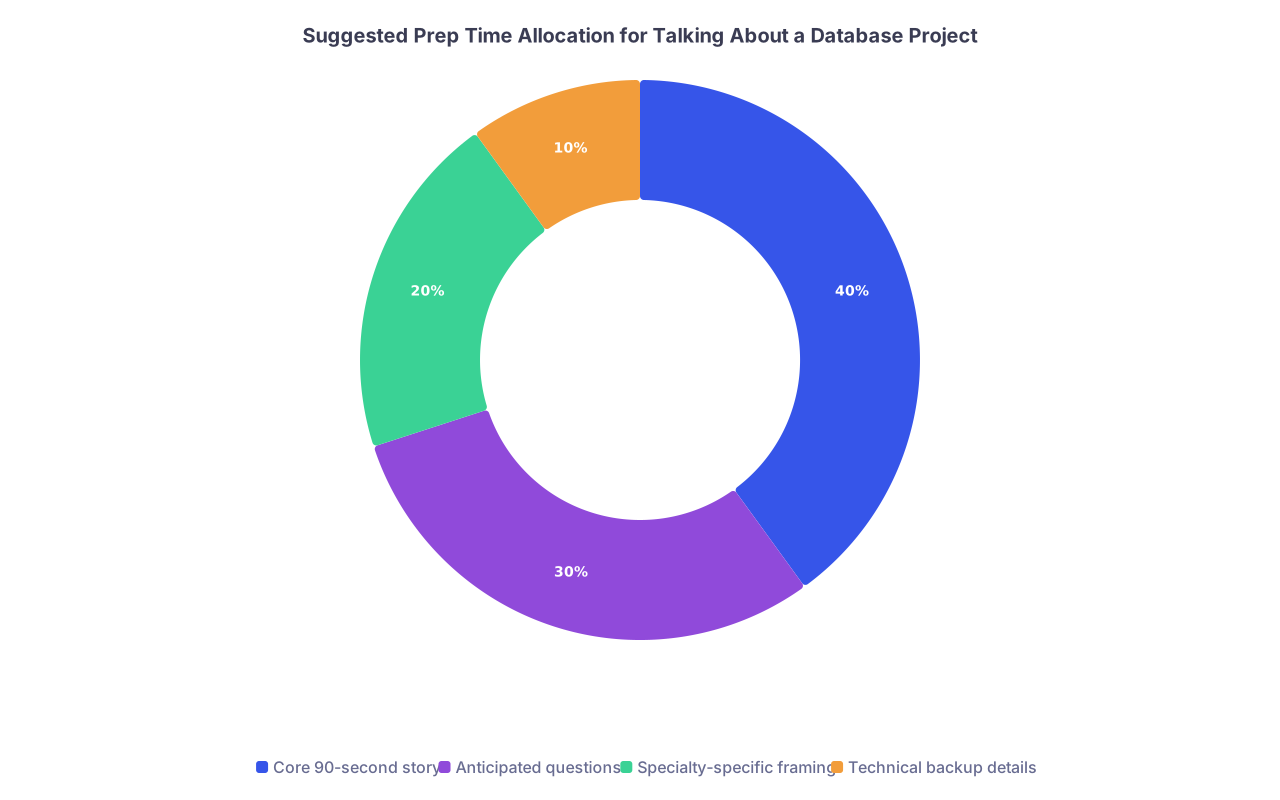
| Category | Value |
|---|---|
| Core 90-second story | 40 |
| Anticipated questions | 30 |
| Specialty-specific framing | 20 |
| Technical backup details | 10 |
Prepare:
- One 60–90 second overview story.
- 3–4 “zoom in” anecdotes:
- data quality problem you solved
- disagreement you navigated
- design choice you had to defend
- 2–3 specialty-specific sentences (for IM vs EM vs surgery, etc.).
- A one-line “update” if asked where the project stands now.
Then stop. Over-preparation turns answers wooden. You want structured but conversational.

11. Final Thought: Stop Treating This Like “Just a Tech Thing”
Programs are drowning in residents who can fill in a template and push orders. They remember the ones who redesign how information flows.
A well-told database project says:
- You noticed a systems problem.
- You convinced busy people to change how they work.
- You left something behind that others are still using.
That is exactly what good residents do, just with pages instead of tables.
If you frame it that way, your “little database project” stops being filler and becomes one of the strongest teaching points in your entire application.