
Most QI on ERAS looks weak not because the work is bad, but because the documentation is lazy.
You can run a genuinely impactful project, then bury it under vague bullets like “Led QI initiative to improve patient care.” That is how good work dies on an application.
Let me be blunt: program directors are jaded about “QI projects.” They have seen a decade of superficial “PDSA cycles” that were basically one student sending a reminder email and calling it quality improvement. Your job is to signal, in a few lines, that your project was not that.
This is about two things:
- Doing the PDSA work in a way that actually produces data.
- Translating it into ERAS language that screams: real method, real outcomes, real systems thinking.
We are going to walk through both.
What Program Directors Actually Look For In QI
Forget what your school’s QI workshop told you. On ERAS, QI is judged fast and ruthlessly.
In 15–20 seconds, a reviewer is scanning for:
- Was this a real system-level problem, not just “I cared more about my own patients”?
- Did you use an actual QI framework (PDSA, run charts, process mapping), or just label something as “QI”?
- Do you have before-and-after numbers? Clear direction of change? Over a meaningful time frame?
- Did you complete more than one PDSA cycle?
- What was your personal role: architect or helper?
- Did it live beyond you (sustainability/spread)?
If you cannot answer those quickly through how you write your experience, it reads as fluff.
So the strategy is straightforward: design and document your PDSA cycles so you can hit those points in 700 characters or less.
Step One: Structure Your QI Like Someone Who Knows What They’re Doing
You cannot fix bad design with good writing. If your project was “I made a poster about CLABSI and hung it in the workroom,” I cannot magically turn that into a robust PDSA series.
So let us tighten what “real” PDSA work looks like.
Choose the right project scope
The best ERAS QI projects are:
- Narrow in scope (one process, one unit, one metric)
- Measurable weekly or monthly
- Clearly linked to patient outcomes, safety, efficiency, or guideline adherence
Examples that work well on ERAS:
- “Reduce unnecessary telemetry orders on a general medicine floor by 20% in 6 months.”
- “Increase completion of 48-hour post-discharge follow-up calls from 35% to 70%.”
- “Decrease average door-to-antibiotic time for febrile neutropenia patients from 120 to 60 minutes.”
Vague: “Improve communication on rounds.”
Better: “Increase documentation of daily goals in progress notes from 40% to 85% on the MICU team.”
Make the PDSA cycles real, not theoretical
Too many “PDSA cycles” are actually just one intervention with minor tweaks. That is not the point.
Think of cycles as:
- Different changes you test (not just different dates)
- With measured impact each time
- That you build on or abandon, not just run forever
A typical three-cycle structure that reads very cleanly on ERAS:
- PDSA 1 – Baseline + simple change (education, reminder, small process tweak)
- PDSA 2 – Workflow integration (EMR order set changes, checklist, standardized note template, visual cue)
- PDSA 3 – Reliability + sustainability (audit/feedback, automatic prompts, policy or orientation integration)
If you can honestly say you completed at least two cycles with data between them, your QI already looks more credible than most of your peers.
Step Two: Document Each PDSA Cycle While You Work
If you do this only at the end, you will forget the details that make your ERAS entry sharp.
I tell students to keep a simple QI log in a OneNote/Google Doc. Six lines per cycle:
- Date range
- Prediction (what you thought would happen)
- Intervention (the “Do”)
- Data collected (what, how often, sample size)
- Result (numbers, direction, % change)
- Decision (adapt, adopt, abandon)
Example of a real PDSA log entry:
- Date: Feb 1–28
- Prediction: Daily huddles plus a reminder sticker will increase med rec completion from 60% to 80%.
- Intervention: Added “Complete med rec” to morning nurse-physician huddle sheet; placed red “Med Rec?” sticker on WOWs.
- Data: Random sample of 10 discharges per week; % with completed reconciliation documented.
- Result: 62%, 68%, 71%, 70% by week.
- Decision: Trend improving but below goal and dependent on human memory. Need EMR-based prompt.
Notice: succinct, concrete, and it sets you up later to say “med rec completion improved from 60% to 70% over 1 month; then to 88% after EMR prompts.”
That is exactly what ERAS wants: trend plus intervention linkage.
Step Three: Quantify Outcomes Clearly And Honestly
You want at least one of the following outcome types:
- Process measures: what people did (adherence to a checklist, order set use, documentation rates)
- Outcome measures: what happened to patients (readmissions, infection rates, time to antibiotics)
- Balancing measures: unintended consequences (increased LOS, delays elsewhere)
Multiple measures are ideal, but even one good process measure with clear improvement is stronger than a vague claim about “improved care.”
How to express QI data in ERAS language
You have limited characters. You cannot run through full statistics. You do not need to.
Use a simple, consistent format: baseline → post-intervention (% change, if impressive, but not mandatory).
For example:
- “Telemetry days per 100 patient-days decreased from 32 to 19 (41% reduction) over 6 months.”
- “48-hour post-discharge call completion increased from 38% to 82% across 3 PDSA cycles.”
- “Median door-to-antibiotic time decreased from 124 to 58 minutes after standardized order set and triage script.”
And if it did not work? You still get QI credit:
- “Early intervention (email reminders) did not improve rate (46% to 48%); subsequent EMR hard stop increased completion to 79%.”
Bad projects hide flat data. Serious QI people show what failed, then what worked. On ERAS, that reads as maturity, not weakness.
Step Four: Build a Clean PDSA Narrative
Now the key question: how do you describe PDSA cycles and outcomes without wasting characters on textbook definitions?
You do not write: “Used PDSA cycles to improve X.” That is empty.
You show the cycles compressed into one or two lines:
- “Led 3-cycle PDSA project to reduce unnecessary telemetry: resident education → standardized criteria checklist → EMR order panel revision.”
- “Progressive PDSA: initial email reminders ineffective; huddle script and nurse-driven checklist increased VTE prophylaxis orders from 68% to 90%.”
You hint at method (3 cycles, progressive), context (education → workflow → system/EMR), and outcome (68% → 90%).
That is a complete story.
Step Five: Translate the Project into a High-Yield ERAS Entry
ERAS has a stupid constraint: you did serious systems work, and they give you a glorified tweet.
So you have to be ruthless. Most QI experiences should be:
- “Research Experience” if you have IRB, formal methods, a poster, or presentation.
- “Work / Volunteer Experience” if it was more operational, even if systematic.
The label matters less than the content. Let me show you how to write the content.
The 4-part QI ERAS structure
Think of your 700 characters as four pieces:
- Problem & setting (1 sentence)
- Your role & team (1 sentence)
- PDSA & interventions (1–2 sentences)
- Outcomes & sustainability (1–2 sentences)
Bad example (what I actually see on ERAS):
“Worked on a QI project to improve discharge efficiency on the medicine wards. Attended weekly meetings and helped the team implement changes. Learned about PDSA cycles and interdisciplinary teamwork.”
Nothing here:
- No setting clarity
- No numbers
- No actual interventions
- No sense of your role beyond “attended”
Strong example (same project done right):
“Internal Medicine ward QI project targeting delayed discharges due to incomplete med rec. As student lead, coordinated team of residents, nurses, and pharmacists under hospitalist mentor. Ran 3 PDSA cycles: education and visual cues; standardized discharge checklist; EMR discharge order set with required med rec field. Med rec completion increased from 54% to 86% over 4 months; average discharge time improved from 3:10 pm to 1:45 pm. Process adopted as unit standard and incorporated into resident orientation.”
Same project. Completely different signal.
Notice several things:
- Two clear metrics (completion rate, discharge time)
- Time frame
- PDSA logic (education → checklist → EMR change)
- Your role (“student lead, coordinated team”)
- Sustainability (“adopted as unit standard”)
That is how you make QI look like “real” scholarly work, not a checkbox.
A Concrete Template You Can Steal
Use this fill-in structure and refine from there:
“[Unit/Population] QI project to [reduce/increase] [metric] related to [clinical problem]. As [role], worked with [team types] under [faculty/mentor]. Conducted [number] PDSA cycles: [cycle 1 main change]; [cycle 2 main change]; [cycle 3 main change, if any]. [Primary metric] improved from [baseline] to [post], [time frame]. [Optional: secondary metric/effect]. Intervention [sustained/spread] by [process change, EMR update, orientation content].”
Plug in your details, then cut the least essential words until you fit.
If you have multiple QI projects, this template keeps them stylistically consistent across entries, which quietly signals that you actually understand QI as a discipline.
Presentations, Posters, and QI – How They Interlock
One of the easiest ways to amplify a QI project is to turn it into a poster or presentation. This is also where your PDSA documentation pays off.
For a resident or faculty reviewer, a QI poster with no run chart or pre-post data is a joke. They may not say it out loud, but they think it.
You want at minimum:
- A simple timeline figure: PDSA cycles along the x-axis, metric percentages over time
- Each PDSA cycle annotated when interventions changed
- Clear baseline, intervention, and sustain phases
Here is roughly how data across cycles might look:
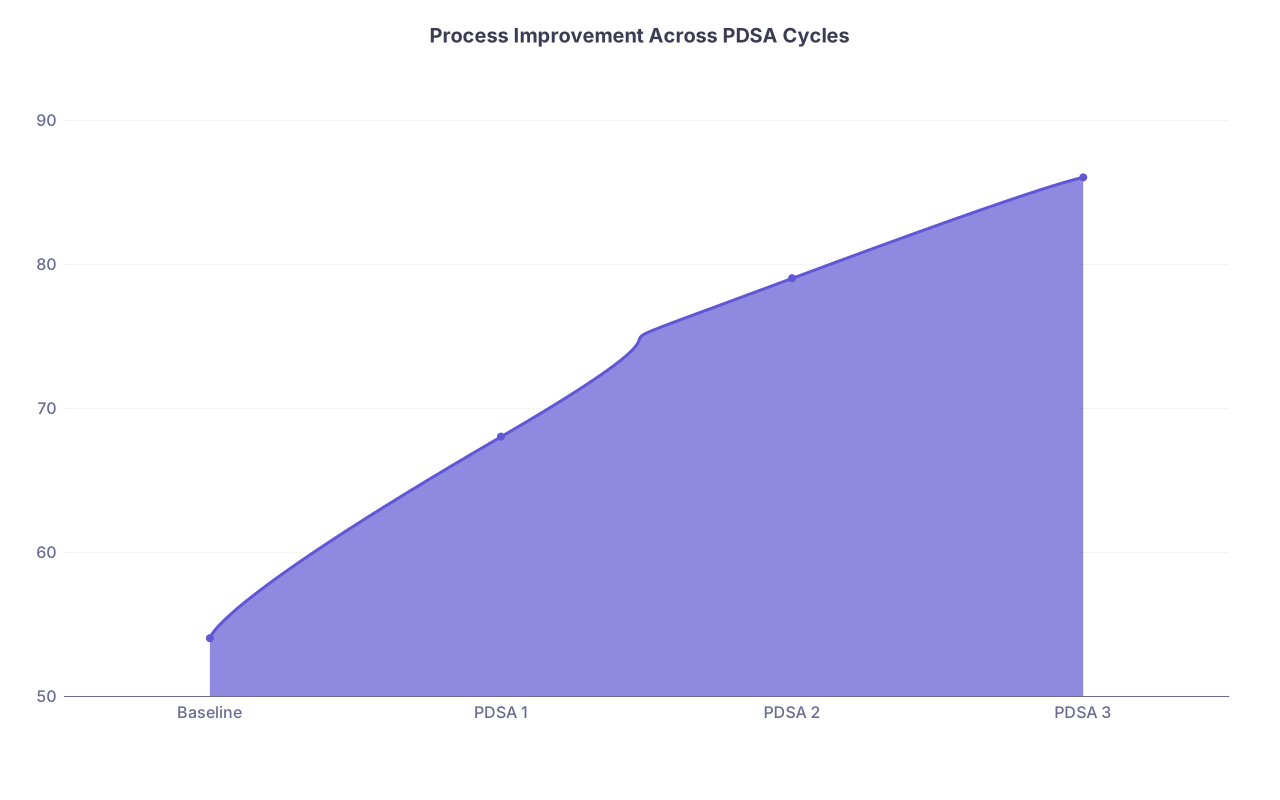
| Category | Value |
|---|---|
| Baseline | 54 |
| PDSA 1 | 68 |
| PDSA 2 | 79 |
| PDSA 3 | 86 |
Then, on ERAS, you can reference both:
- “Presented QI project as poster at [Institution/Regional QI Day]: ‘Improving Medication Reconciliation Completion Through EMR-Integrated PDSA Cycles.’”
and
- The original QI experience entry.
Now your QI lives in two places on ERAS: as scholarly work and as practical systems improvement.
Use the Right Jargon – Sparingly, but Correctly
There is a sweet spot. If you avoid all QI language, you sound naive. If you vomit acronyms, you sound like you took a two-hour workshop and memorized buzzwords.
Words that help, when used precisely:
- “Process mapping” – if you actually mapped the current workflow.
- “Key driver diagram” – if you really built one.
- “Run chart / control chart” – only if you plotted data over time and interpreted it.
- “Root cause analysis / fishbone” – if you systematically identified contributors.
- “Balancing measure” – if you tracked impact elsewhere (e.g., time, LOS).
Example:
“Used process mapping and root cause analysis to identify documentation bottlenecks; tracked both primary outcome (appropriate prophylaxis orders) and balancing measure (time to admission orders).”
This reads as: they actually did QI, not just wrote “PDSA” twelve times.
Common Mistakes That Make QI Look Weak on ERAS
Let me save you from the usual traps.
1. Calling everything “QI”
Shadowing a resident who was doing QI is not “conducting a QI project.” Editing a patient education brochure is not automatically QI.
If you cannot say:
- What the baseline metric was
- What you changed
- What the metric was after change
You probably should not label it QI. Call it education, clinical support, or service instead.
2. No numbers anywhere
“I improved handoff quality” is fluff.
Even crude measures are better:
- “Percentage of handoffs including anticipatory guidance increased from 35% to 78% by end of ICU month.”
- “Defect rate in discharge summaries regarding follow-up provider decreased from 40% to 15%.”
You can measure things with tally marks and a spreadsheet if you have to. Do not hide behind “data was not available” unless it genuinely was impossible.
3. Inflating your role
Faculty who read your ERAS may know the attending who actually ran that hospital-wide initiative.
If you were one of ten students doing chart audits, do not say you “led a multi-site QI initiative.” Call yourself “student member” or “data abstractor” and then highlight what you specifically owned (data dictionary, analysis, poster, etc.).
Integrity in how you describe your role is non-negotiable. People notice.
4. Over-explaining basic QI concepts
Do not waste characters defining PDSA, run charts, or QI in general.
They know what PDSA is. They want to know what you did with it.
Example: Before and After QI ERAS Entries
Let me give you two full rewrites.
Example 1 – Sepsis bundle QI
Weak version:
“Participated in a quality improvement project to improve early sepsis recognition and management in the ED. Helped with protocol implementation and staff education. Learned about multidisciplinary collaboration and the importance of timely care.”
Stronger version:
“Emergency Department QI project to improve compliance with early sepsis bundle. As medical student member, helped map current workflow, develop triage sepsis screen, and create standardized order set. Across 3 PDSA cycles (education, triage screening tool, EMR order set), bundle compliance within 1 hour increased from 42% to 76%, and median time to first antibiotic decreased from 110 to 61 minutes over 6 months. Presented findings at institutional QI forum.”
Example 2 – Clinic no-show reduction
Weak version:
“Worked on a project to reduce clinic no-show rates. Called patients and reminded them about appointments and helped with scheduling changes.”
Stronger version:
“Ambulatory internal medicine clinic QI project targeting high no-show rate. As student lead under clinic director, performed baseline data analysis and patient phone interviews to identify barriers. Ran PDSA cycles implementing SMS reminders, same-day waitlist fills, and targeted outreach for high-risk patients. Overall no-show rate decreased from 28% to 17% over 5 months; among high-risk subgroup, from 35% to 19%. System adopted across all three resident clinics.”
Now the work looks like something a PGY-1 could build on, not just a student did some phone calls.
Capturing QI in CVs, MSPE, and LORs
You are not done once ERAS is filled.
You want your QI work triangulated in three places:
- Your CV: list as “Quality Improvement Project” under Research/Scholarly Activity.
- MSPE / Dean’s Letter: “Demonstrated strong engagement with systems improvement; led a PDSA-based project in the MICU that improved X from Y to Z.”
- Letters of recommendation: Ask your mentor directly, “Would you feel comfortable commenting on my work in the [topic] QI project and the outcomes we achieved?”
When a PD sees QI in your experiences, then sees your ICU attending independently praising your QI leadership, the credibility jumps.
Quick Reference: What Strong QI Looks Like on ERAS
Let me condense the signals that scream “this QI is real” to a jaded reviewer:
| Element | Strong Signal Example |
|---|---|
| Baseline & Follow-up | "54% to 86% over 4 months" |
| Multiple PDSA Cycles | "3 PDSA cycles: education → checklist → EMR update" |
| Clear Role | "Student lead coordinating residents and nurses" |
| Specific Setting | "MICU", "ED", "resident continuity clinic" |
| Sustainability | "Adopted as unit standard / EMR change / orientation" |
If your description hits at least four of those five, you are ahead of the average applicant.
How QI Fits Strategically Into Your Overall Application Story
One last piece. QI is not just “extra research.”
Used correctly, it tells committees three things that matter more than whether you published in NEJM:
- You understand care happens in systems, not solo heroics.
- You can identify broken processes and do something structured about them.
- You can handle the tedious work of measuring, re-measuring, and adjusting.
That matters for every specialty. Emergency medicine cares. IM and Med-Peds care a lot. Surgery and anesthesia care when it involves OR efficiency, infection rates, or enhanced recovery pathways. Pediatrics cares about asthma pathways, vaccine uptake, growth chart documentation. You get the idea.
Tie it into your personal statement or future plans:
- “I hope to continue systems-level work in residency, particularly around [X domain].”
- “My QI work on sepsis bundle compliance showed me how small changes in workflow can dramatically alter patient trajectories.”
You are no longer “student who did a project.” You are “early-career physician who already thinks like a systems-improvement person.”
That is a different tier.


| Step | Description |
|---|---|
| Step 1 | Identify Problem & Metric |
| Step 2 | Collect Baseline Data |
| Step 3 | Design PDSA 1 |
| Step 4 | Implement Change |
| Step 5 | Measure & Analyze |
| Step 6 | Adapt / Design Next PDSA |
| Step 7 | Standardize & Sustain |
| Step 8 | Disseminate: Poster / ERAS Entry |
| Step 9 | Goal Met? |
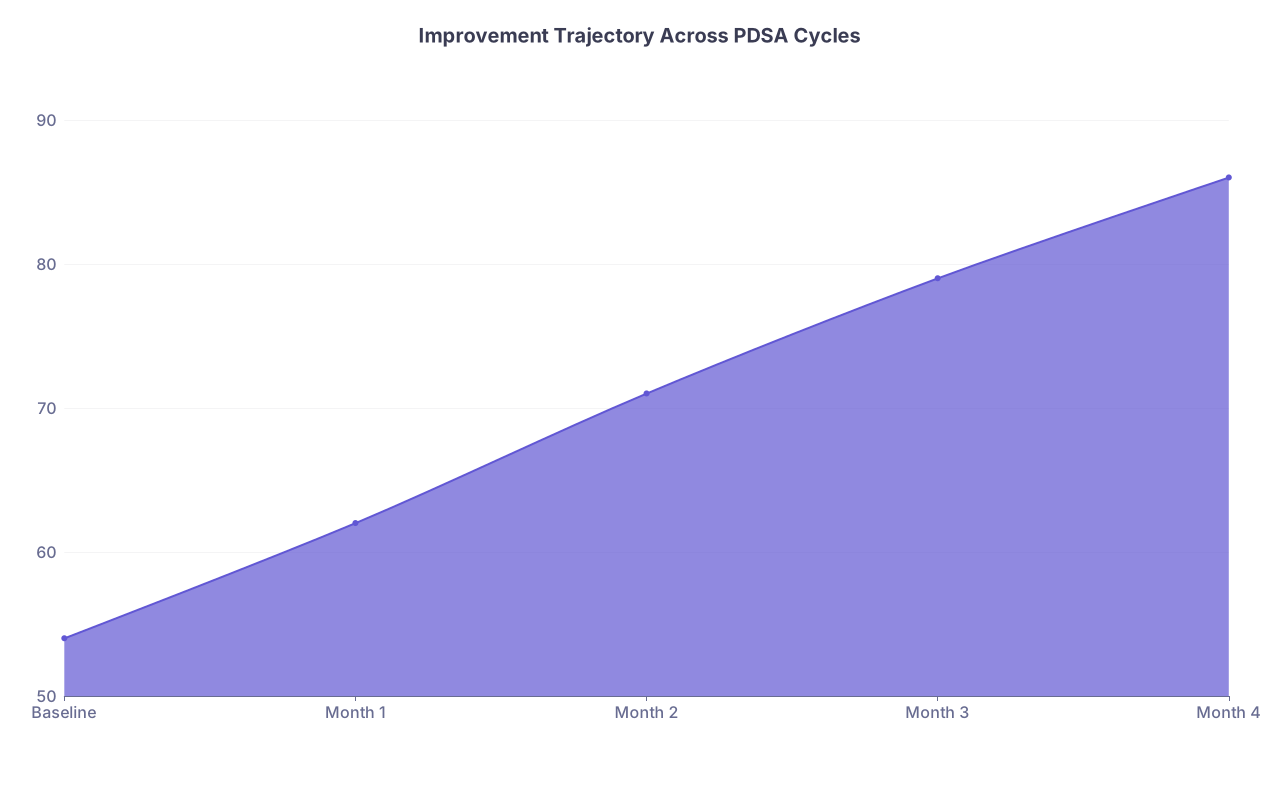
| Category | Value |
|---|---|
| Baseline | 54 |
| Month 1 | 62 |
| Month 2 | 71 |
| Month 3 | 79 |
| Month 4 | 86 |

FAQ (Exactly 6 Questions)
1. Where should I list QI on ERAS – Research or Work Experience?
If your project had clear methods, data collection, analysis, and especially if it led to a poster, abstract, or manuscript, list it under “Research Experience.” If it was primarily operational (e.g., working with a unit-based team, implementing changes) without formal study design, list it under “Work Experience” or “Volunteer.” Functionally, PDs just read the description. The category label matters less than whether the entry clearly describes a structured QI effort with outcomes.
2. What if my QI project did not show improvement or even got worse?
You can still present it as strong QI if you are transparent and show what you learned and changed. For example: “Initial education-focused PDSA did not improve rate (46% to 48%); root cause analysis led to EMR hard stop, increasing completion to 79%.” If it truly never improved despite multiple thoughtful cycles, frame it as identifying system constraints: “Despite 2 cycles, rate remained flat due to factors beyond team control (system X); project informed redesign at leadership level.” Avoid pretending failure was success. That is what looks bad.
3. How many QI projects do I need for my application to look strong?
You do not need a dozen shallow projects. One or two well-run QI projects with clear PDSA structure, measurable outcomes, and some form of dissemination (internal or external) is enough to demonstrate serious engagement. Depth beats breadth. Five one-week “mini-QI projects” with no data are not impressive. One year-long clinic or unit project you owned is.
4. Do I need IRB approval for my QI project to count as ‘research’ on ERAS?
Not necessarily. Many QI activities fall under “operations improvement” and are exempt from full IRB review. For ERAS, the key is structured inquiry, data collection, and analysis, not the IRB label. If your institution required QI review or IRB exemption and you obtained it, you can mention “IRB-exempt QI project” in a poster or CV, but it is not mandatory to call it research on ERAS. Just do not misrepresent an operational project as a randomized trial.
5. How detailed should I be about statistics and methods in the ERAS description?
You have limited space, so you should not cram in p-values and confidence intervals. Emphasize simple, readable metrics: before/after percentages, medians, or rates over time. You can briefly mention the type of analysis if meaningful (“used run charts and Chi-square testing for pre-/post-comparison”), but most of your characters should go to what changed and by how much. Detailed methods belong in your poster, manuscript, or when you discuss the project in interviews.
6. How do I talk about my QI project during interviews without sounding rehearsed?
Structure your answer like a short case presentation: problem, your role, what you tried (PDSA cycles), what happened (data), and what you learned. For example: “We noticed X problem, baseline was Y. I helped lead a team that tried A, which did not move the needle, then B, which did. Our main metric improved from Y to Z over N months. The biggest lesson was Q.” Practice this once or twice, then speak naturally. Interviewers are listening for your understanding of systems and your honesty about what was hard, not for a polished TED talk.
With these pieces in place, your QI work will read like serious, outcomes-driven scholarship rather than another generic “quality project.” When you hit submit on ERAS, your PDSA cycles and run charts should already be doing quiet work in the background—arguing for you as someone who improves the system, not just survives in it. The next move is learning how to field the inevitable interview question: “Tell me about a time you improved a process.” But that is a conversation for another day.