
The way program directors rank applicants with zero, some, and heavy research is nothing like the clean, fair rubric you’ve been told about. It’s messier, more political, and far more context‑dependent than anyone admits on webinars.
Let me walk you into the room where the actual ranking happens.
The Real Question PDs Ask: “Does the Research Match the Story?”
On paper, programs love to say they value research. On Zoom info sessions, they sound like NIH study sections. In the ranking meeting, the question is much simpler:
“Does this applicant’s research story make sense for who they claim to be—and for what we need?”
Applicants get quietly sorted into three buckets before the official rank list even starts:
- No meaningful research
- Light / moderate, checkbox‑level research
- Heavy, identity‑defining research
The mistake most students make is thinking “more is always better.” That’s not how it works.
Here’s how each bucket actually lands when the door is closed and the faculty start talking.
Zero Research: When It Hurts, When It’s Fine, and When It’s Fatal
I’ve watched PDs scroll through ERAS, see “Research: none,” lean back, and say one of three things:
- “For family med? Fine.”
- “For us? That’s a problem.”
- “How did their school let them graduate without anything?”
The reaction depends on three variables: specialty, program type, and your compensating strengths.
How Zero Research Plays in Different Specialties
Here’s the unvarnished version.
| Specialty Type | Zero Research Reality |
|---|---|
| Top‑tier academic IM, Neuro, EM, Psych | Major red flag; usually screened down the list |
| Mid‑tier academic IM, EM, Psych | Possible if clinicals + letters are strong |
| Community IM, FM, Peds | Often fine if work ethic and fit are excellent |
| Competitive surgical (Derm, ENT, Ortho, PRS, NSG) | Essentially disqualifying at most places |
Now, what actually gets said.
For a strong community internal medicine program, I’ve heard:
“Yeah, no research. But look at these comments—‘hardest working student on the team,’ ‘took ownership of sick patients.’ I’d rather have that than another poster kid who can’t place an IV.”
For a university neurology program:
“US grad, okay scores, but literally zero research? We have 150 other apps with at least something. Why take the risk?”
When Zero Research Is Quietly Forgiven
Zero research doesn’t automatically kill you if you bring other things to the table. PDs will overlook the gap if:
- Your clinical performance is stellar and consistent
- Your letters scream “team player who works like a resident”
- You have a coherent story that explains why you didn’t do research
Here’s how someone salvages this in the personal statement or interview:
“During pre‑clinicals I worked 25 hours a week to support my family, so I prioritized mastering the core material and clinical skills over lab time. On rotations, I poured that bandwidth into patient care and teaching junior students.”
And then the PD flips to the MSPE comments and sees:
“Outstanding clinical reasoning, stayed late to follow up results, reliable, excellent with patients.”
That’s the only time “no research” gets a pass: when everything else is undeniably strong and your story matches the reality in your evaluations.
When Zero Research Gets You Buried
Where it’s basically fatal:
- Any research‑heavy program that advertises “research tracks”
- Competitive subspecialty‑oriented programs (even in IM)
- Competitive specialties like derm, plastics, radiation oncology, neurosurgery, ENT, ortho
In those meetings, what you’ll hear is:
“We have no idea if this person can handle a scholarly project. Why would we pick them when half this stack already has publications in our field?”
Even if you somehow get an interview without research (usually via connections), you’re fighting up a steep hill on rank day.
The Silent Penalty: Perceived “Laziness” or Lack of Initiative
The unspoken assumption some faculty make—fair or not—is:
“No research” = “did the minimum to pass.”
They’re not thinking about your family responsibilities, your job, your mental health. They’re thinking about whether you’ll be the resident who refuses QI projects, never volunteers for database work, and can’t finish the mandatory scholarly activity.
If you’re in the zero‑research camp, you must aggressively highlight initiative elsewhere: leadership projects, quality improvement, teaching, outreach—anything that shows you step up when it’s not required.
That’s how you neutralize the laziness stereotype.
“Some Research”: The Checkbox Category That Quietly Wins
Here’s the part nobody tells you: for a huge slice of programs, “some but not insane” research is actually the sweet spot.
Not the 15‑pubs gunners.
Not the nothing‑at‑all crowd.
The “I did a project or two and actually understood what I was doing” people.
On rank day, these applicants are the backbone of the list.
What “Some Research” Actually Looks Like to PDs
Typical patterns that land well:
- 1–2 posters or abstracts
- A handful of case reports or small retrospective projects
- A single middle‑authorship publication in any reasonable journal
- A mix of clinical projects and some basic exposure to statistics or chart review
None of that sounds impressive on Reddit. But the PD conversation is different:
“Okay, this person did a couple of posters, has a middle‑authorship paper, nothing fancy but they clearly engaged. Good clinical comments. Decent Step 2. They’ll finish our QI requirement without drama.”
To faculty, this means you won’t choke when they hand you a QI project as a PGY‑2.
How PDs Rank “Some Research” vs “Zero Research”
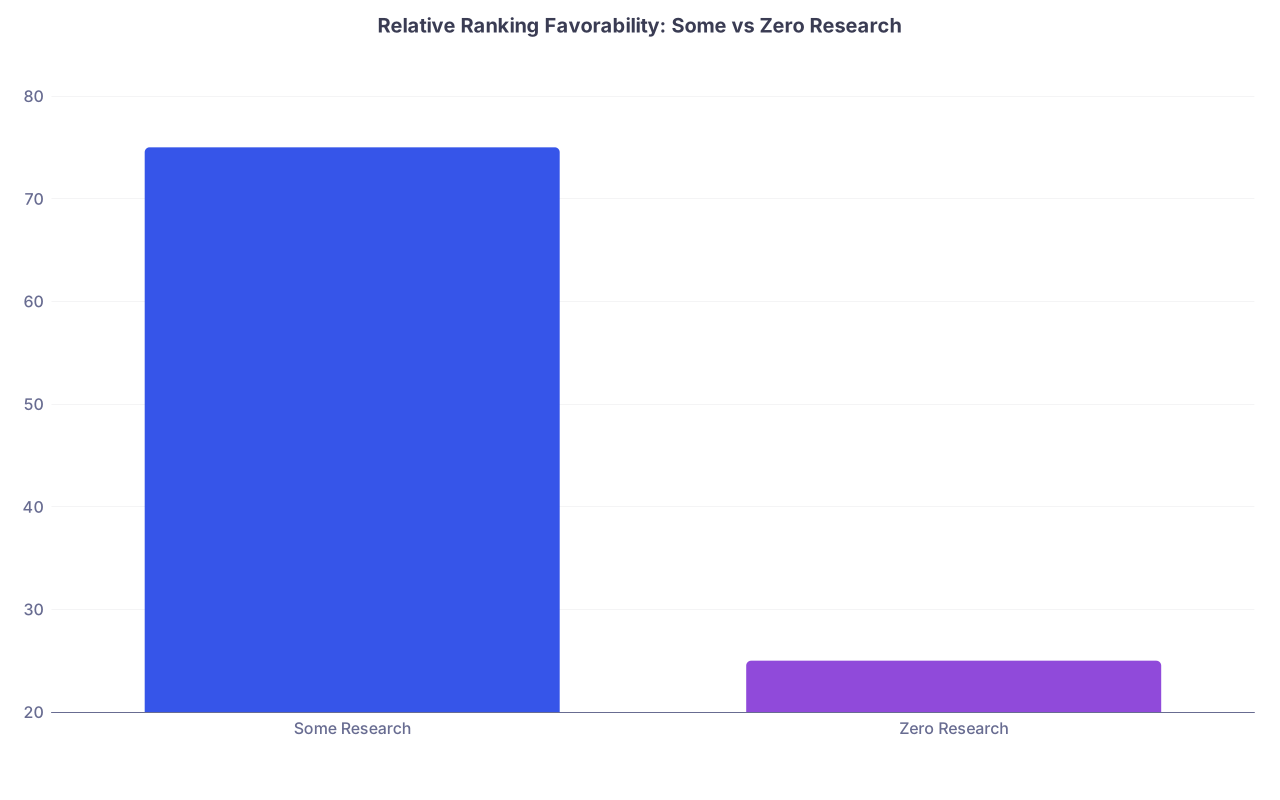
Let’s put approximate probabilities to how often I’ve seen these types outrank each other at similar score levels in academic‑leaning IM/psych/EM programs:
| Category | Value |
|---|---|
| Some Research | 75 |
| Zero Research | 25 |
Roughly three‑quarters of the time, if two applicants are otherwise comparable, the one with some research climbs above the one with none. Not because PDs are obsessed with publications, but because it’s a tie‑breaker that signals you’ll meet academic requirements.
What Makes “Some Research” Look Strong vs Flimsy
Faculty read between the lines. They know the difference between:
“Retrospective chart review on sepsis bundle compliance, presented at regional ACP, helped with data collection and abstract writing.”
versus:
“Medical student research assistant, 2019–2020.”
The first one says: “This person knows what an IRB is and probably understands a basic methods section.”
The second: “Probably checked boxes and entered data.”
In rankings, the first type is treated as research that “counts.” The second is treated as neutral—nice, but not a differentiator.
Heavy Research: When It Separates You and When It Backfires
Now the glamour category: heavy research. Multiple pubs, grants, multiple years in a lab, or a PhD.
Everyone assumes this always boosts you. That’s wrong. It can make you a superstar or a liability depending on the program.
How Heavy Research Plays in Different Program Types
| Program Type | Typical Reaction to Heavy Research |
|---|---|
| Top‑tier academic (all specialties) | Big plus, often top‑third of rank list |
| Mid‑tier academic IM/Neuro/Psych | Plus if clinically solid; neutral if weak |
| Community‑heavy programs | Mild plus or even concern re: clinical focus |
| Competitive surgical specialties | Almost mandatory, but not enough alone |
At a research‑heavy IM program (think MGH, UCSF, Penn level), the heavy research applicant gets talked about like this:
“This guy has three first‑author papers in pulmonary, plus R programming skills, and the letter from his PI calls him ‘the best student I’ve worked with in 10 years.’ If he’s even halfway functional on the wards, we want him.”
They’re thinking: future fellow, future faculty, someone who can bring in money and prestige.
At a busy community‑based program, I’ve heard the opposite:
“This is the PhD from [Big Name] lab. Do we think she’ll actually be happy with our case mix? Or will she bail to a university program as soon as she can?”
PDs remember getting burned by “too academic” residents who were miserable on night float and disappeared into “research time” whenever possible.
The Two Archetypes of Heavy Researchers
Inside ranking rooms, you see two recurring characters:
The balanced heavy researcher – Strong letters on both research and clinical sides, praised for work ethic, good interpersonal skills. These people rocket up the list.
The lab‑rat only heavy researcher – Glowing PI letter, but tepid or vague clinical comments: “quiet,” “reserved,” “limited opportunities to observe,” “good fund of knowledge.” PDs know this code. It’s a red flag.
For the second group, rank‑meeting comments sound like:
“Fantastic CV, but her sub‑I eval reads like she barely engaged with patients. I don’t want to train someone I have to push to talk to families.”
At academic programs, the balanced heavy researchers are often in the top 10–20 of the list. The lab‑rat‑only types slide down into the “if we get them, fine; if not, fine” territory.
When Heavy Research Becomes a Liability
The main ways heavy research hurts you:
You look overqualified for the program’s profile.
PDs worry you’ll be unhappy or leave for fellowship ASAP.Your story doesn’t line up.
Derm research, but now you’re applying to psych without a convincing pivot? People bring this up.Your clinical grades and comments are mediocre.
Nothing tanks you faster than “research star, mediocre on wards.” Programs do not want to babysit a brilliant but disengaged resident for three years.
At one ranking meeting I sat through, we had a candidate with multiple first‑author publications in top‑tier journals, but their medicine clerkship comments included: “Frequently late,” “needed reminders to complete notes,” “did not take primary ownership of patients.”
The PD’s conclusion was brutal and short:
“Not worth the headache. Drop them.”
How PDs Actually Compare Zero vs Some vs Heavy—Side by Side
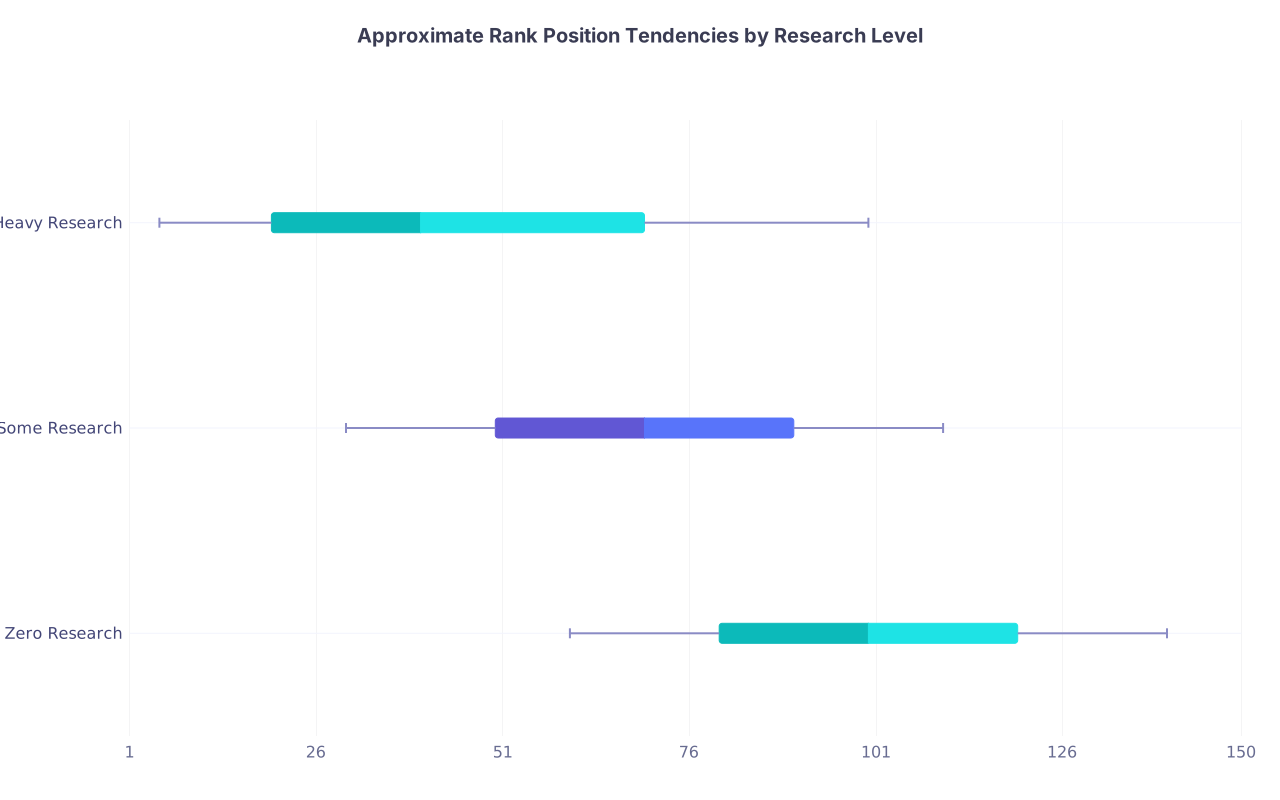
Let’s simplify what’s really happening during ranking for a typical academic‑leaning internal medicine program. Assume everyone has “good enough” scores.
| Category | Min | Q1 | Median | Q3 | Max |
|---|---|---|---|---|---|
| Zero Research | 60 | 80 | 100 | 120 | 140 |
| Some Research | 30 | 50 | 70 | 90 | 110 |
| Heavy Research | 5 | 20 | 40 | 70 | 100 |
Interpret that:
- Heavy research, when clinically solid, clusters toward the upper third of the rank list at academic places.
- Some research lands solidly in the middle—where most of the actual matched residents come from.
- Zero research, unless offset by exceptional clinical letters or a strong story, tends to sit lower or fall off the rank list entirely in academic programs.
Is it exact? Of course not. But it’s closer to reality than the fantasy that “everyone is evaluated holistically with equal weight to all factors.”
How Conversations in the Room Really Sound
You’ll hear chains like this over and over:
- “Zero research, but outstanding team player and strong Step 2? Middle third.”
- “Some research, good fit with our mission, strong narrative? Upper‑middle.”
- “Heavy research, perfect letters, wants our fellowship? Top third.”
- “Heavy research, questionable clinical comments? Slide them way down; we have safer bets.”
Nobody is pulling out a point‑by‑point rubric at that stage. It’s judgment, memory, and impressions from faculty who met you on interview day and read your file at 11 p.m. while half‑exhausted.
How To Package Whatever Research You Have So PDs Actually Respect It
You can’t change how much research you’ve done at this point, but you can control how it lands in the room.
Here’s how to spin each category so you don’t get quietly downgraded.
If You Have Zero Research
You’re not fixing this by randomly adding “in progress” trash to your ERAS. PDs know what that is.
Instead:
Lean hard into clinical strength.
Your MSPE and letters must read like: “already functions at an intern level,” “takes ownership,” “patients love her.”Make your story explicit.
Personal statement or interview: clearly explain why you didn’t do research and what you did instead (work, caregiving, leadership, teaching, etc.).Show you’re not academically fragile.
Strong Step 2, honors, teaching projects, QI or leadership roles—those tell PDs you’re not avoiding hard work.
And quietly: apply more heavily to community and mid‑tier academic programs where zero research is survivable.
If You Have “Some” Research
Your job is to show that your research wasn’t random ornamentation.
You want PDs to walk away thinking:
“This person will absolutely complete our scholarly requirements without drama.”
Do that by:
- Being specific in your ERAS entries: what methods, what your role was, what the project question actually was.
- Getting at least one letter that references your contribution to a project, even in a paragraph.
- Being able to describe your work clearly and briefly on interview day—no jargon salad, no vague “we looked at outcomes.”
If You Have Heavy Research
Your biggest risk is looking like a lab resident more than a clinical one.
Neutralize that by:
- Making sure your clinical letters are excellent, not just fine. PDs look for any sign that you’re weirdly checked out on the wards.
- Explaining why you still care about patient care, not just p‑values. Tie your research to real clinical questions or your future practice.
- Matching programs thoughtfully. A PhD with 20 papers applying only to community programs with no research infrastructure screams “flight risk” in ranking meetings.
The heavy‑research applicant who gets ranked high is the one who convinces faculty:
“This person could be our chief resident and our future junior faculty.”
FAQs
1. Can I “make up” for no research with an “in progress” project during application season?
You can list in‑progress work, but everyone in the room knows what that means. If you started it two months before ERAS and there’s no concrete output (no abstract submitted, no clear endpoint), it barely moves the needle. It’s better than nothing, but it won’t transform you from “zero research” to “research applicant.”
2. How much does authorship order really matter to PDs?
Less than students think, with one caveat. At most medicine, psych, EM programs, seeing any authorship in a real journal is enough to prove you can finish a project. First‑author gets a nod, but they’re not dissecting your CV like an R01 reviewer. Where authorship matters more is in highly competitive, research‑obsessed fields (derm, plastics, neurosurgery) and at top‑tier academic IM programs that pride themselves on NIH funding.
3. Will a gap year for research be worth it if I’m targeting a mid‑tier academic program?
If you’re applying to moderately competitive fields (IM, EM, psych, peds) and you already have solid scores and clinical performance, a pure research gap year is often overkill for mid‑tier programs. It helps a lot for top‑tier academic places and super competitive specialties—but for mid‑tier, that same year spent getting stronger clinical experiences, leadership, or teaching can be equally or more valuable on rank day.
4. Do PDs actually read the methods/results of my research, or just the titles?
Most of them read only titles and your short descriptions. But the research faculty in the room—the ones who fight for the more academic candidates—absolutely read more closely. They’ll notice if your “systematic review” is actually just a glorified literature summary or if your “prospective trial” is mischaracterized. On interview day, if you can’t coherently explain your own project in plain language, that gets reported back and can drag you down the rank list.
Two core truths to carry with you:
- Research is a signal, not a trophy. It tells PDs whether you’ll survive or thrive in their environment.
- The right amount of research is whatever cleanly fits your story and your target programs—no more, no less.
If you understand how you’ll be talked about in that ranking room, you can finally stop chasing what Reddit worships and start building an application that PDs actually trust.